


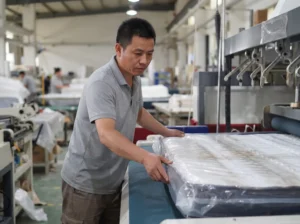


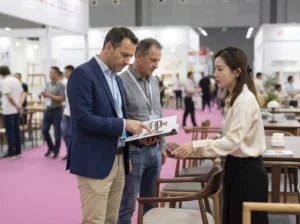
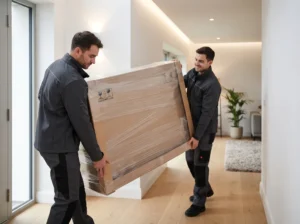

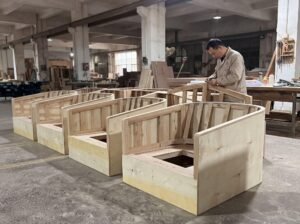
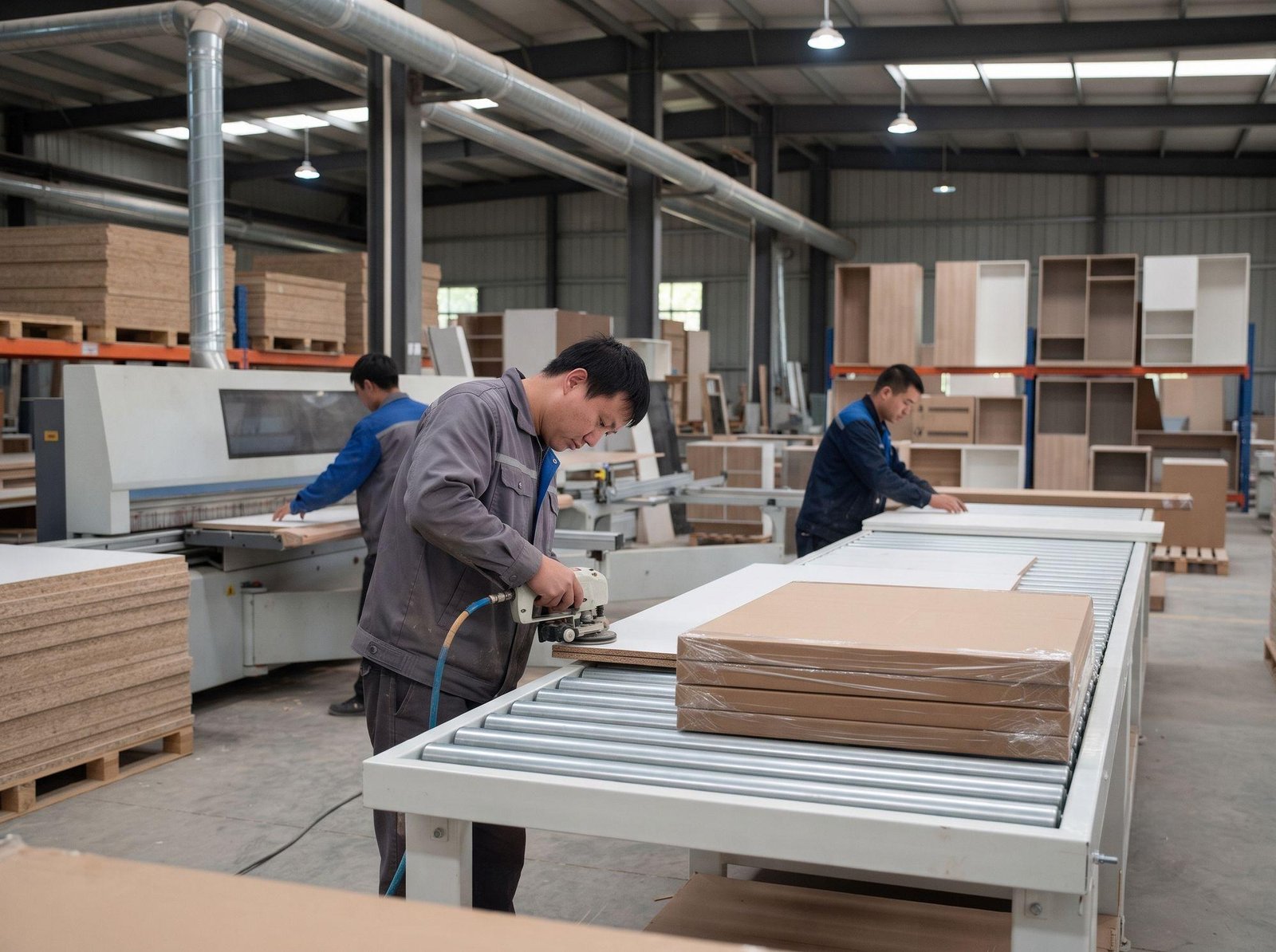
If you are sourcing cabinets, wardrobes, or modular storage, here is the straight answer: the Langfang panel furniture cluster supply chain can deliver IKEA-comparable quality at roughly half the retail price. Most overseas buyers have never heard of Langfang. They fly to Foshan, walk through sofa showrooms, and completely miss the fact that northern China’s panel furniture ecosystem quietly produces millions of flat-pack cabinets for Europe and North America every year.
Why Most Buyers Overlook Langfang (And Why That Is a Mistake)
To be honest, if you are an overseas buyer visiting China for the first time, your list probably has only one name: Foshan. That is not wrong—Longjiang’s upholstered furniture, Houjie’s office furniture, and Sanxiang’s classical pieces are all worth seeing. But here is the problem: when your procurement list includes “cabinets,” “wardrobes,” and “storage units”—all panel furniture—Foshan is not the most cost-effective choice.
We have seen this scenario too many times. An Amazon seller from California flew to Guangdong last year, spent three days looking at sofas in Foshan, and only connected with a Langfang wardrobe factory through a friend’s introduction. His exact words: “I had no idea this place existed.” Three months later, his first batch of 500 wardrobe units went live. The return rate stayed under 2%, and his landed cost was 35% lower than his previous Vietnam supplier.
You might not expect this, but the Langfang cluster—centered on Sanhe and Xianghe—churns out tens of millions of panel furniture pieces annually. The number stays invisible because these factories do not build brands. They build components and execute orders. That “hidden” identity is precisely what keeps their prices sharp.
Geography Is Half the Battle: The 50-Kilometer Advantage
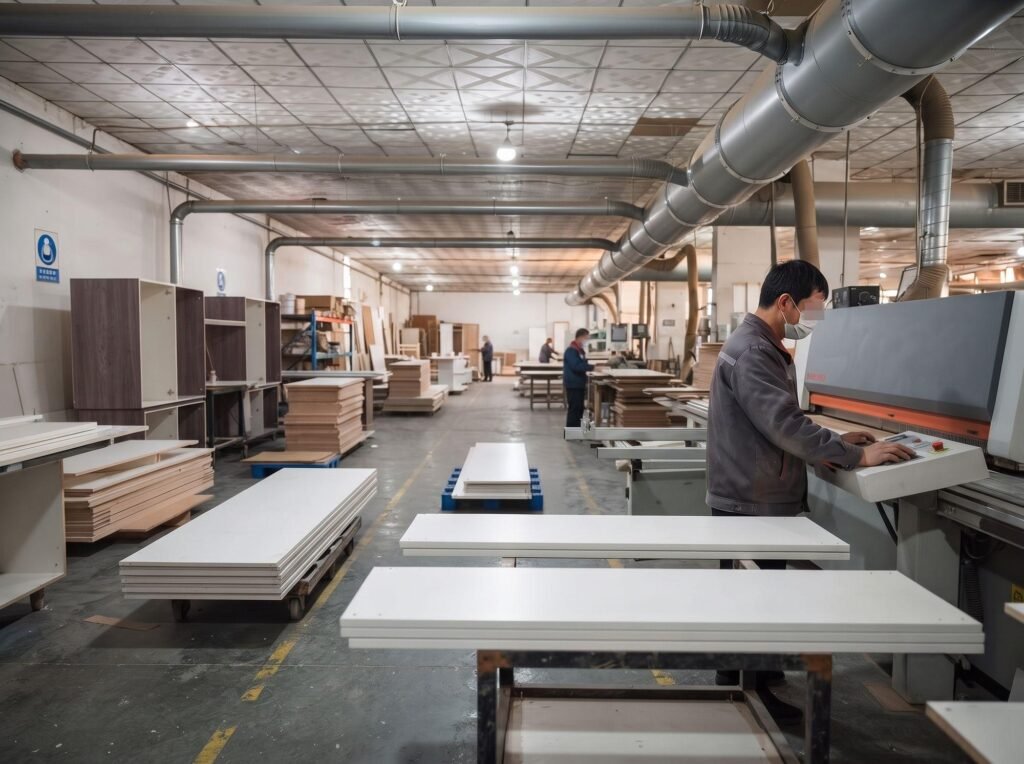
Langfang’s geographic edge is, frankly, a bit unfair. It sits right next to Beijing and Tianjin, at the heart of northern China’s largest board distribution hub. What does that mean in practice? A sheet of particle board moves from a substrate mill in Wen’an, Hebei to a cutting workshop in Sanhe in just over an hour by truck.
Compare that to Foshan. Panel factories there often source boards from Guangxi, Hunan, or even import them. Board is bulky, heavy, and sensitive to moisture. Every extra hundred kilometers on the road adds cost. In Langfang, cabinet component suppliers and cutting plants are sometimes close enough to deliver by electric tricycle.
We once visited an edge-banding workshop in Sanhe. The owner pointed across the street and said: “Down that road, left side does drilling, right side does hardware kits, and two hundred meters ahead is the packaging plant.” You will not find that density in Foshan. Foshan’s industry chain is complete, yes, but panel furniture sub-processes are scattered across Longjiang, Lecong, and sometimes Dongguan. Cross-town logistics is daily routine.
In Langfang, the Langfang panel furniture cluster supply chain responds in minutes, not days. An assembly plant orders two hundred pre-cut, pre-edged side panels in the morning. The delivery arrives that afternoon. Zero-inventory turnover is not a slogan on a PowerPoint slide. It is a Tuesday.
The IKEA Legacy: How EU Standards Became Local Muscle
Here is the counter-intuitive point most buyers miss: Langfang’s panel furniture manufacturing standards, in certain areas, actually align closer with European requirements than Foshan’s. The reason? IKEA.
For two decades, Langfang and its surrounding areas served as one of IKEA’s most important Chinese manufacturing bases. To pass IKEA’s IWAY audits, local factories invested heavily in formaldehyde control, edge-banding technology, hardware compatibility, and hole-position precision. Those EU-standard production systems did not vanish when OEM orders fluctuated. They stayed. They became the underlying muscle behind Ikea quality cabinet China.
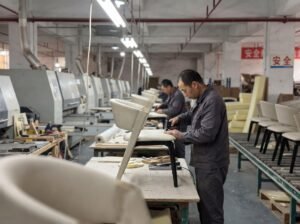
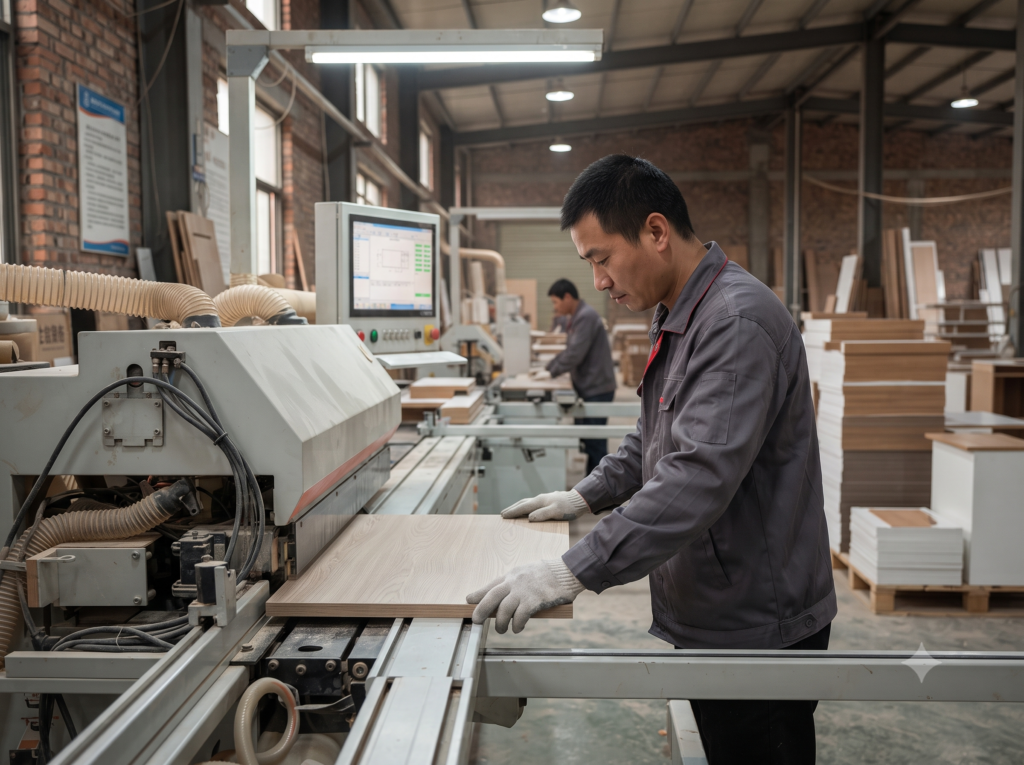
We toured a factory that had produced for IKEA for ten years. Their edge-banders were still Homag machines from Germany. The PUR edge-banding consistency and heat resistance, honestly, surpassed the hot-melt work we had seen at some Foshan counterparts. Hole precision stayed within ±0.5mm. That means a Blum hinge you bought in the US screws in flush. No on-site re-drilling.
What makes this interesting is that these factories no longer depend on IKEA orders. They have pivoted to flexible small-batch customization—the exact model cross-border e-commerce sellers and apartment developers need. You can order fifty wardrobe sets in fifty different sizes, each with a unique internal layout, and the factory will not charge you outrageous mold fees for “line changes.” That flexibility is muscle memory trained by mass OEM discipline.
Industry Truth: Langfang Is Not a Magic Bullet, and These Weaknesses Matter
Alright, we have talked up the strengths. Now let us be honest. Langfang’s panel furniture ecosystem has real ceilings, and they are not low.
First, design originality is weak. Langfang factories excel at “build-to-print.” They do not excel at “design-from-scratch.” If you need an original, designer-grade cabinet concept, or you want to launch your own designer brand, Foshan teams will serve you better. Langfang’s strength is standardization and execution, not creativity.
Second, soft furniture is basically not its game. Sofas, mattresses, upholstered beds? Skip Langfang. The local supply chain is built around boards, hardware, and edge-banding. Leather, foam, and spring networks are so thin here they might as well not exist. This is exactly why we keep saying “know when to choose Langfang, know when to choose Foshan”—product category dictates geography.
Third, export service experience trails behind Foshan. Foshan sales staff generally speak better English, understand FOB terms more deeply, and handle packing and loading with more polish. Many Langfang factories spent ten-plus years on domestic sales or OEM work. When they suddenly face direct overseas clients, communication rhythm, delivery confirmation, and export documentation can trip them up. We saw a case: a Xianghe factory produced excellent product, but their salesperson misunderstood “partial shipment.” The entire batch shipped three weeks late.
So who is Langfang right for? Buyers who already have clear design drawings, whose procurement is dominated by panel furniture, and who are willing to invest extra effort in supply-chain communication. If you expect the factory to handle full design plus export logistics turnkey, Foshan’s integrated service providers will save you headaches.
Inside the Cluster: How Components Flow from Supplier to Container
Let us break down the full chain from cabinet component suppliers to finished export. This explains how the cost lands at half of IKEA’s retail.
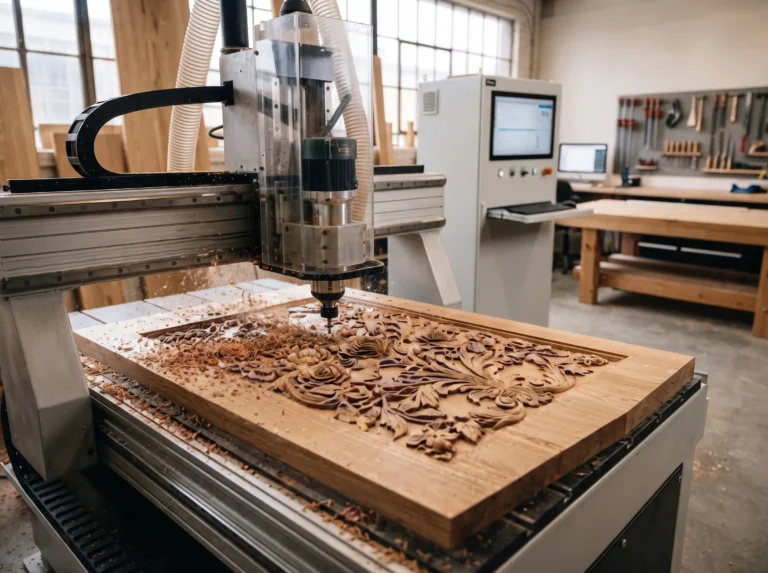
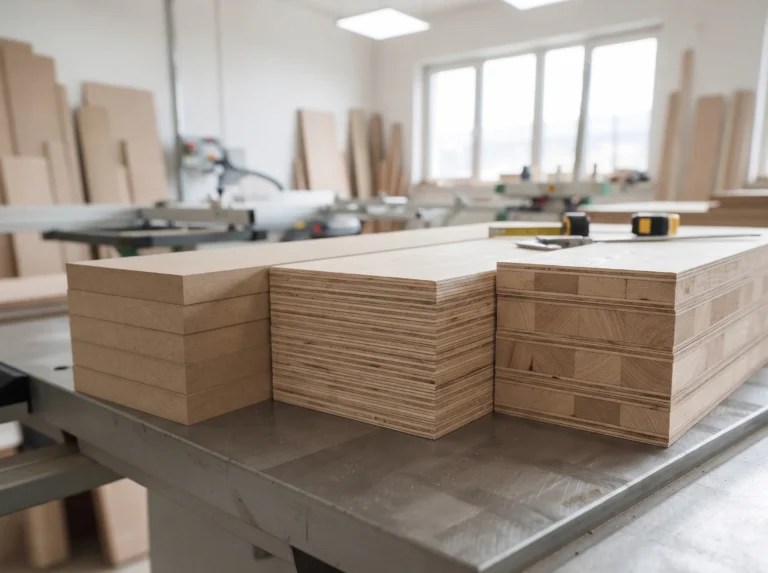
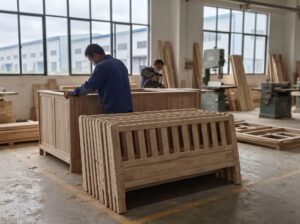
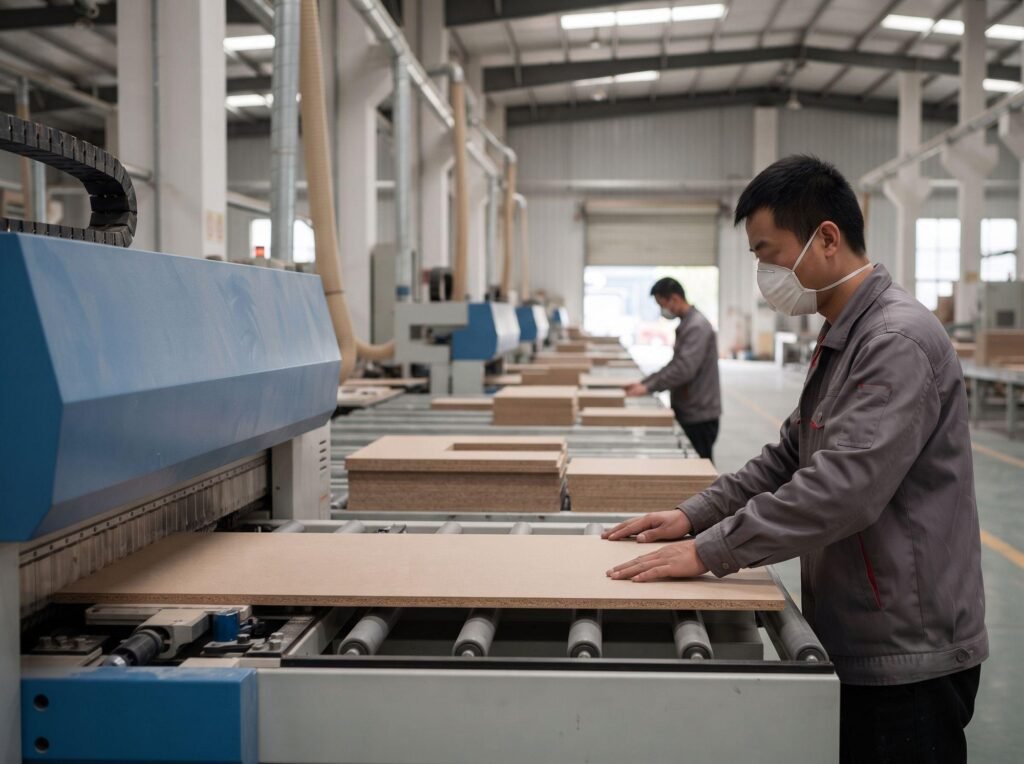
Step one: board cutting. Dozens of large cutting centers surround Sanhe and Xianghe. They source particle board or MDF from substrate mills in Wen’an and Tianjin, then cut on CNC nesting saws. Because order volume is massive, their board purchase price is already 15% to 20% below what small factories pay.
Step two: edge-banding. Cut panels move directly to an adjacent or same-park edge-banding plant. PVC, ABS, PUR, and even laser edge-banding (on a few premium lines) are all available inside the same cluster. Edge-banders do not serve one client. They serve ten to fifteen assembly plants simultaneously. That machine utilization spreads fixed costs razor-thin.
Step three: drilling and pre-assembly. Six-sided drills and line drills punch precise connector holes, hinge holes, and slide holes. Some factories pre-assemble the carcass here to check alignment, then disassemble for flat-pack. This cuts down on installation errors overseas.
Step four: hardware sourcing. Xianghe hosts dedicated hardware wholesale markets. Hettich, Blum-compatible domestic fittings, DTC, and Higold products are all available. Assembly plants do not stockpile. They buy to order and receive same-day.
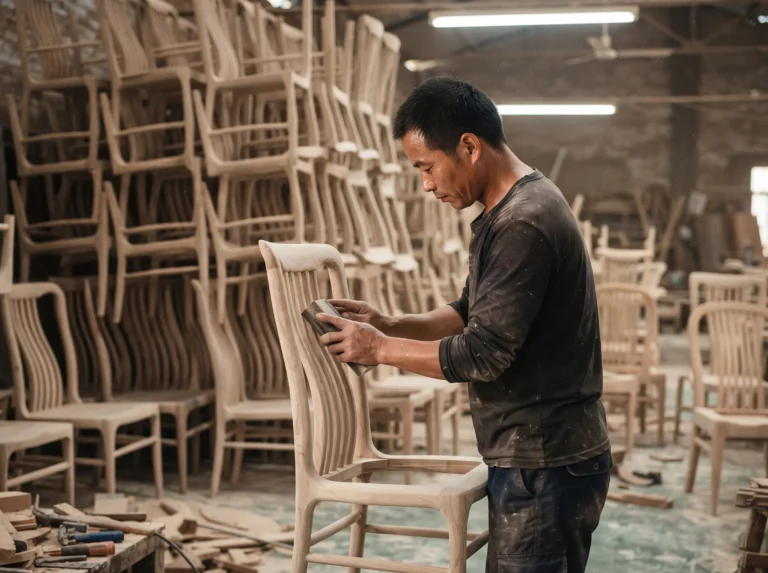
Step five: assembly, QC, and packing. The final assembly plant bundles panels, hardware, and instructions (if needed) into flat-pack cartons. A standard 40HQ container holds 800 to 1,200 wardrobe sets or 1,500 to 2,000 cabinet sets, depending on size and packing optimization.
At no point in this flow is there cross-city logistics, long waiting times, or layers of middlemen markup. That is the core secret of the Langfang panel furniture cluster supply chain: not cutting corners, but zero-inventory turnover and minute-level supply coordination inside a single industrial cluster.
Langfang vs. Foshan: A Side-by-Side Reality Check
We will put this in plain terms. This is not about praising one city or bashing another. It is about helping you decide where your project actually belongs.
| Dimension | Langfang (Sanhe / Xianghe) | Foshan (Longjiang / Lecong) |
|---|---|---|
| Core strength category | Panel furniture: cabinets, wardrobes, storage, bookcases | Soft furniture: sofas, mattresses, upholstered beds; high-end custom |
| Price level (same-spec panel cabinet) | 45%–55% below IKEA retail | 30%–40% below IKEA retail |
| Design support capability | Weak; bring your own drawings or hire a designer | Strong; full design studios and 3D rendering teams |
| Export service maturity | Medium; some factories lack experience | High; fluent English staff and mature export workflows |
| Supply chain response speed | Extremely fast; minute-level coordination inside cluster | Fast; but cross-town/cross-city logistics is common |
| Typical MOQ | Flexible; 50–100 units negotiable | Relatively high; 200 units standard for common cabinets |
| Quality stability (panel furniture) | High; IKEA OEM heritage | Medium-high; depends heavily on specific factory |
| Best fit for | B2B buyers with clear drawings, e-commerce sellers | Buyers needing design support, soft furniture, one-stop procurement |
Bottom line: if you are buying sofas, go to Foshan. If you are buying wardrobes and you already have dimensions and internal layouts, Langfang is very likely the better call.
What Buyers Actually Pay: A Realistic Cost Breakdown
Buyers often ask: half the price compared to what? Factory ex-works? Landed door-to-door? We will break down a real case.
Last year, a UK apartment developer ordered 300 two-door wardrobes. Dimensions: 800mm wide × 2,000mm high × 550mm deep. Interior included hanging rods, shelves, and drawers. Material: E1-grade particle board, PVC edge-banding, domestic soft-close hinges.
● Langfang factory ex-works price: roughly $42–$48 per unit FOB Tianjin
● Equivalent IKEA PAX retail price in the UK: approximately £95–£115 (including VAT)
● Landed cost after ocean freight, duty, and VAT: roughly $58–$65 per unit
Even after every middleman and logistics layer, the final cost stays below 50% of IKEA retail. And these 300 units were fully customized to the developer’s internal layout requirements—something IKEA simply does not offer.
Of course, this price does not include your factory audit cost, third-party inspection, or communication bedding-in costs. We have seen too many buyers calculate only product unit price and forget the “hidden cost” line entirely.
Red Flags to Watch When Vetting a Langfang Factory
Since Langfang’s export service experience lags behind Foshan, what should you look for during a factory audit?
First, inspect the edge-banding. This is where panel furniture gets cheapened most easily. Good edge-banding should fully wrap the board edge, with no gaps, no glue lines, and clean corner transitions. Dig at the edge strip with your fingernail. If it lifts easily, walk away.
Second, check hole precision. Randomly pick two side panels and mount a hinge. If hole deviation exceeds 1mm, your cabinet doors will hang crooked on site. That is a disaster.
Third, examine the packing. Some Langfang factories built their business on domestic sales, so export packing awareness can be weak. Export shipments need honeycomb corner protectors, foam inserts, and PE film wrapping. We have seen containers arrive with crushed panel corners—not because of rough seas, but because of lazy packing.
Fourth, demand formaldehyde test reports. Ask for the latest board formaldehyde emission test, at least E1 grade, preferably E0 or CARB P2. Do not accept verbal promises.
Fifth, assess the export team. If the salesperson handling you does not understand “bill of lading,” request that the factory assign an experienced export coordinator. Communication costs balloon into massive hidden risks later in the project.
Insider Tip: The Best Time to Visit Langfang
If you are planning an audit trip, the sweet spots are March through May, and September through November. Why? June to August brings rainy season and extreme heat to northern China. Board moisture content fluctuates, and quality control at smaller plants can get unstable. December through February leads up to Chinese New Year; workers head home early, and delivery timelines become unpredictable.
Also, Xianghe has a furniture mall (locals call it “Xianghe Furniture City”), but it mainly serves domestic retail. Do not expect to find export-ready factories there. Real Langfang wardrobe factory operations and cabinet component suppliers are scattered through industrial parks in Sanhe and Xianghe. You need to contact them in advance and book visits.
We recommend scheduling two to three days for your first trip, visiting four to five factories. Do not place an order after seeing just one. The quality gap between Langfang factories is wider than in Foshan. Some legacy OEM plants produce superb work. Some newer plants have tempting prices and worn-out equipment. Shopping around is not polite small talk here. It is survival.
The Bottom Line: When Langfang Wins, and When It Does Not
Let us return to the core question: should you source panel furniture from Langfang?
If your project checks these boxes, Langfang is very likely your best option:
● Your procurement is dominated by cabinets, wardrobes, storage units, and bookcases
● You have clear design drawings or dimensional requirements; you do not need the factory to invent the design
● Your order volume sits in the 50-to-500-unit range, and you need customization flexibility
● You are willing to invest time in factory audits, communication, and production follow-up
● Your target market demands IKEA-level quality, but your budget is roughly half of IKEA’s retail
On the flip side, if these describe your situation, Foshan’s integrated service providers may serve you better:
● You need soft furniture (sofas, mattresses) and panel furniture in one stop
● You have zero design capability and need the factory to provide full design-to-production service
● Your order volume is massive (thousands of units) and demands mature project management
● You need high communication efficiency and expect a fluent English salesperson to own the entire process

FAQ
Is Langfang furniture lower quality because the price is cheaper?
No. The lower price comes from the Langfang panel furniture cluster supply chain efficiency—short material transport, zero-inventory turnover, and extreme vertical division of labor—not from cutting corners. Many factories here previously produced for IKEA and retain EU-standard equipment and processes. That said, factory quality varies, so vetting is essential.
Can I buy sofas or mattresses from Langfang?
Honestly, no. Langfang’s panel furniture ecosystem specializes in cabinets, wardrobes, and storage systems. Soft furniture requires leather, foam, and spring supply chains that are concentrated in Foshan and surrounding areas. For sofas and mattresses, Foshan remains the better choice.
What is the typical MOQ for a Langfang wardrobe factory?
Most Langfang wardrobe factory operations accept 50 to 100 units for standard designs, and some will negotiate down to 30 units for repeat buyers. This flexibility is a major advantage over larger OEM factories that often require 200-plus units. Custom sizes and internal configurations are usually possible without heavy mold fees.
How do I verify if a Langfang factory actually meets EU or US standards?
Ask for three documents: current board formaldehyde test reports (E1 or E0), edge-banding adhesion test results, and hardware compatibility certificates if they claim Blum or Hettich compatibility. Visit the workshop and check the edge-banding machines—brands like Homag or Biesse are good signs. If they hesitate to show you the production floor, walk away.
Is it safe to pay a 30% deposit to a Langfang factory I have never visited?
We never recommend sending deposits before a factory audit or video verification. If travel is impossible, hire a third-party inspector in Beijing or Tianjin—both are within two hours of Langfang. A 30-minute video factory tour and sample order under $500 are minimum safeguards before committing to a full production deposit.
Recommended Resource
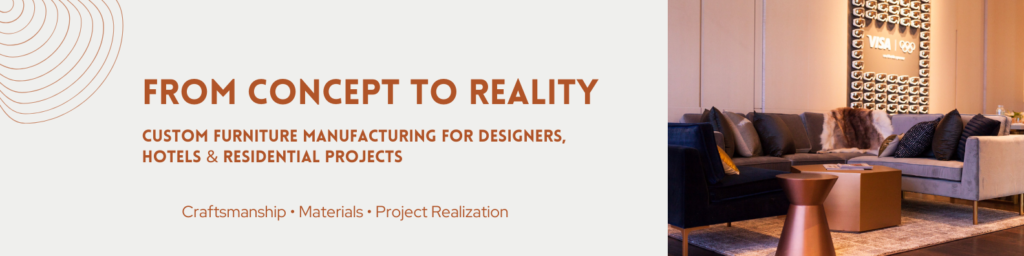
Interi Furniture specializes in custom furniture manufacturing for residential, hospitality, and commercial projects. Their experience in materials, craftsmanship, and project realization makes them a valuable resource for designers and buyers seeking tailored furniture solutions from China.