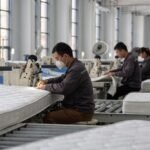



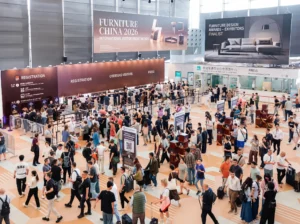






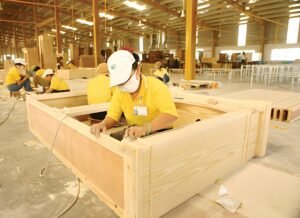


Walk onto any hall at Furniture China 2026 — September 8–11 at the Shanghai New International Expo Centre — and within minutes you will see the same setup repeated across hundreds of booths: a flawless sample sofa, a wall of framed certificates (ISO 9001, CE, FSC, CARB), and a sales rep who says “export quality” within the first thirty seconds. Here is the conclusion up front, because it will save you money: in China’s furniture industry, “export quality” is not a legal standard. It is a marketing phrase that means only one thing — the product was shipped overseas. It says nothing about construction, materials, safety, or compliance. An export quality label fake is not a rare bad apple at this fair; for a noticeable share of exhibitors, it is the operating model. This article explains how the label actually works on the ground, why your booth sample will not match your container, and how to verify compliance without trusting a framed piece of paper.
The Wall That Sells the Order
Last year we spent several days with a US Midwest wholesaler who came to Shanghai with a container-sized order for dining sets. The booth sample was genuinely impressive — solid oak, tight joints, soft-close hardware, weight where it should be. The certificate wall did its job: three ISO frames, an FSC plaque, a CARB compliance statement. He wired a 30% deposit the following week.
Eight weeks later, the container arrived. The chairs rocked on flat floors. “Oak” tops were veneered particleboard. The drawer slides had no brand name at all. His emails got slower answers each week, and the factory’s final position was essentially: goods are “export quality,” per contract. He had no golden sample clause, no material spec in the purchase order, and no inspection booked by his own side. His loss, all in, was close to $80,000 — and his story is not unusual. Every sourcing cycle, we hear versions of it from retailers, e-commerce sellers, and FF&E buyers. The Shanghai fair quality trap rarely looks like a scam while you are standing in the booth. It looks like professionalism.

What “Export Quality” Actually Means
Start with a definition, because the entire problem lives inside this one phrase.
“Export quality” has no statutory definition under Chinese law, under any destination-market regulation, or under any international trade body. On a factory’s price sheet it is a commercial description meaning “made for overseas sale” — nothing more. It implies no tested standard for materials, joinery, safety, or emissions.
That matters because buyers read it as a guarantee. In practice, factories that use the phrase fall into three categories, and only one of them deserves your deposit.
| Category | What it actually means | Booth tell | How to verify |
|---|---|---|---|
| Genuine compliance line | Products are built to destination-market regulations, tested per relevant SKU, certificates current and in scope | Sales rep can walk you through test reports by SKU; mentions TPC numbers and lab names without hesitation | Pull the FSC cert in the public database on the spot; ask which TPC certifies their composite wood |
| Bare-minimum “edge ball” line | One or two SKUs pass the lowest export bar; those reports are used to vouch for the whole catalog | Cert wall is real but generic; answers get vague when you ask about this sofa’s test report | Ask for the report matching the exact model number on your quotation |
| Pure marketing line | No meaningful testing at all; “export quality” is brochure language | Aggressive deflection, “all certificates available after order,” or a CE sticker on a wooden chair | Reverse-image search the certificate; check the certificate holder’s name against the business license name |
In our experience walking floors across multiple editions of this fair and visiting production lines in Foshan (Longjiang, Shunde) and Dongguan (Houjie), all three categories are well represented. What fraction falls into each? We will not invent a number — treat any claimed percentage from any source, including us, as for reference only, subject to official verification.
The Two-Track System: How Booth Samples Get Made
Here is the mechanic most first-time buyers never hear about. In parts of the industry, factories run parallel systems.
Two-track production: A setup in which a factory operates a dedicated sample and inspection line — senior workers, select materials, hand-finished details, generous curing time — alongside a standard mass-production line that handles actual orders. The sample line serves trade shows, buyer factory visits, and third-party inspections. The mass line is what fills your container.
On our factory visits, managers have described this openly, sometimes with a shrug: the sample line exists because “buyers touch the sample, not the machine.” The economics are simple. A booth prototype for a mid-range sofa might carry a bill of materials two to three times the cost of the production BOM — better foam density, thicker veneer, branded hardware, extra finish coats. Whether the typical gap at a given factory is 20% or 60% is something no outsider can certify: for reference only, subject to official verification. But the structural gap is real, documented across buyer complaint patterns, and entirely legal if your contract only says “as per sample.”
Booth Prototype vs. Mass Production: The BOM Downgrade Gap
The downgrade rarely happens in one dramatic swap. It drips through the BOM, line item by line item, each one deniable in isolation.
| BOM item | Booth prototype | Mass-production reality |
|---|---|---|
| Primary wood | Kiln-dried oak / beech, moisture content controlled | Rubberwood, mixed hardwood, or veneered particleboard |
| Veneer / laminate | 0.6 mm+ real wood veneer | Paper or foil print, thinner veneer, mismatched grain |
| Foam | High-resilience foam, stated density | Lower-density foam, recycled foam blend |
| Hardware | Blum, Hettich, or named Chinese tier-1 | Unbranded slides and hinges, thinner gauge |
| Frame joinery | Doweled, glued, corner-blocked | Staple-and-glue shortcuts on hidden faces |
| Finish | Multiple sanded coats, full curing | Fewer coats, faster line speed, softer cure |
| Adhesives | E0/E1 stated, with test backing | Unstated grade; formaldehyde risk on composite cores |
| Packaging | Corner protection, drop-test rated | Thin cartons, minimal cushioning |
None of this is visible in a booth, and almost none of it violates a contract that references “export quality” and a photo.

The Certificate Game: What Gets Misused and How
Certificates at the fair are real objects with real numbers. The problem is the relationship between the certificate and the goods — and sometimes between the certificate and the exhibitor.
The standard playbook runs like this. A trading company borrows a factory’s certificates (“cert borrowing”). A factory displays a certificate three years past its surveillance window (“expired certification”). A composite-board mill’s CARB paperwork gets used to cover finished furniture (“scope mismatch”). One compliant chair model is tested so the entire catalog rides on its report (“non-corresponding SKU”). And CE — the most abused frame on the wall — often should not be there at all, because plain furniture does not fall under any CE directive in the first place.
That last point deserves emphasis. CE marking attaches through specific directives — the Low Voltage Directive 2014/35/EU, EMC 2014/30/EU, RoHS — which matter when furniture has electrical parts: recliner mechanisms, LED-lit mirrors, powered lift desks. A solid wood dining chair or a fabric sofa has no CE requirement. A “CE certified” sticker on one is not evidence of compliance; it is evidence that someone in the marketing department knows what European buyers like to see.
For the certificates that do legitimately apply to furniture, here is what to verify on the spot — bring your phone, because every one of these checks takes minutes.
| Certificate | What buyers assume | What it actually certifies | Red flag |
|---|---|---|---|
| FSC (Chain-of-Custody) | The wood is from responsibly managed forests | Traceability of certified material through a specific supply chain, per site and product group, valid 5 years with annual surveillance audits | Holder name ≠ exhibitor’s business license; expired; product group on cert doesn’t cover the quoted SKU |
| CARB Phase 2 | Formaldehyde-safe composite wood | California emission limits (0.05 ppm hardwood plywood, 0.09 particleboard, 0.11 MDF, 0.13 thin MDF) | “CARB compliant” claimed with no TPC and no labels on panels |
| TSCA Title VI | Federal US composite-wood compliance | The same emission limits federalized, plus mandatory third-party certification (TPC), labeling, and record-keeping | No TPC number, no compliant label on the product or carton |
| ISO 9001 | The products are high quality | The factory runs a documented quality-management process — says nothing about the sofa | Issuing body has no IAF-recognized accreditation; address on cert doesn’t match the plant you visited |
| CE (furniture with electrics) | General EU product approval | Conformity with the specific directives listed on the Declaration of Conformity | DoC cites wrong or no directives; no technical file; model numbers blank |
The share of show-floor certificates with some form of scope, date, or holder problem is, again, something nobody can state precisely — for reference only, subject to official verification. But inspectors we talk to agree it is common enough that checking should be muscle memory, not a special project.
Third-Party Inspection: When It Works and When It Fails
Third-party inspection is the right instinct, and it genuinely helps — under the right conditions. Pre-shipment inspection (PSI) under an AQL sampling plan (ANSI/ASQ Z1.4, the US twin of ISO 2859-1) catches a meaningful share of defects and misdeclarations when it is done properly: against your sealed golden sample, with cartons selected by the inspector, with on-site tests (stability, seam strength, drop, moisture meter on wood).
It fails in predictable ways, most of which are procurement failures rather than inspector failures.
| Inspection works when | Inspection fails when |
|---|---|
| You booked it and paid for it, with reports going to you only | The supplier “kindly arranged” the inspection company |
| Inspector checks against your sealed golden sample and written BOM spec | Check is against supplier photos or the booth sample memory |
| Cartons are pulled randomly from the full lot | Staff steer the inspector to pre-staged cartons |
| Booking happens before loading, with time to rework | Inspector arrives at 9 pm while the container is half loaded |
| Scope includes material verification, not just cosmetics | $99 “inspection” that is a walk-through with a checklist of yes boxes |
One more uncomfortable note: even a clean PSI report is a snapshot of that lot, on that day, at the samples pulled. Consistency between inspection-passed lots and long-run delivery is a real but rarely measured variable — for reference only, subject to official verification. The fix is not abandoning inspection; it is combining PSI with unannounced visits, production monitoring (DUPRO) on first orders, and a contract that makes non-conformity expensive.

Red Lines You Should Not Cross
These are the mistakes that turn a bad container into a total write-off. A borrowed certificate signed off at the booth is how a routine sourcing trip quietly becomes a export quality label fake dispute you are contractually positioned to lose.
| Red line | Why it burns you | Do this instead |
|---|---|---|
| Accepting a certificate without checking holder, scope, and validity | Borrowed and expired certs are the cheapest fraud to run | Verify on the spot: FSC database, TPC registry, accreditation body |
| Contract language limited to “export quality, as per sample” | Legally meaningless; no measurable standard exists | Attach a sealed golden sample, written BOM spec, and named standards |
| Letting the supplier book and pay the inspector | You are renting an opinion the supplier shopped for | Book your own PSI; inspector reports to you alone |
| Skipping DUPRO on a first order with a new factory | Problems caught at PSI stage are already packed | Monitor during production; fix at the line, not the dock |
| No liquidated-damages or rejection clause | Non-conformance has no price, so it keeps happening | Penalty clause plus right to third-party reinspection at supplier cost |
Playbooks by Buyer Type
For High-Volume B2B Importers
You have leverage; use it on structure, not just price.
| Checkpoint | Standard to hold the factory to |
|---|---|
| Certification | FSC, TSCA Title VI, or EN test reports matched to contract SKUs by model number, with TPC/lab named in the PO |
| Quality baseline | Sealed golden sample plus written BOM spec referenced in the contract as the conformance standard |
| Production | DUPRO on first order, PSI on every order, both booked by you |
| Contract | Liquidated damages for non-conformity; reinspection at supplier’s cost; jurisdiction clause you can actually use |
For Small Retailers and E-Commerce Sellers
You will not fly to Foshan monthly, so your system must run on documents and third parties.
| Checkpoint | Standard to hold the factory to |
|---|---|
| Order size discipline | One test carton or LCL sample order before any full container |
| Verification | Video call during loading with carton IDs matching your PO; independent PSI on every order, even small ones |
| Product claims | “Export quality” and marketing adjectives stripped from your listings; claims tied only to specs you verified |
| Dispute path | Payment terms retaining balance until post-arrival inspection where your volume allows |
For Hotel and Commercial Project FF&E Buyers
Your risk is amplified: projects have opening dates, and a failed FF&E delivery is a liquidated-damages event against you.
| Checkpoint | Standard to hold the factory to |
|---|---|
| Durability standard | Commercial seating tested to ANSI/BIFMA X5.1 (US) or EN 16139 (EU non-domestic seating), not the domestic equivalent |
| Flammability | California TB 117-2013 for US projects; BS 5852 where UK rules apply — stated in the PO, not the brochure |
| Batch consistency | Production samples pulled mid-run and air-shipped to you, not just pre-production approval |
| Inspection | DUPRO plus PSI, with the project mock-up room sign-off treated as part of the conformance standard |
A contract clause that survives translation is short and physical. Ours, refined over years of disputes, reads roughly like this:
Goods shall conform to Sealed Golden Sample Ref. _ and the attached BOM Specification, which form part of this contract. Deviations in material, hardware brand, foam density, or finish constitute non-conformity. Supplier warrants compliance with TSCA Title VI and [destination flammability standard] for all composite wood and upholstered components. Buyer may conduct pre-shipment inspection with reasonable access to the production line and cartons; refusal or interference constitutes breach.

Frequently Asked Questions
Is “export quality” a real standard in China?
No. It has no legal or regulatory definition anywhere — not in Chinese export law, not in EU or US product rules. It is commercial language meaning “made for export sale.” Any specific claim (solid oak, CARB-compliant, FSC-certified) must be verified against the document for that specific claim, not the phrase.
Does a CE mark mean my wooden chair is compliant?
For furniture without electrical components, there is no CE requirement at all, so a CE mark on a plain chair or sofa proves nothing — and its presence is mildly suspicious. CE matters for powered items (recliners, LED mirrors, sit-stand desks) under directives like 2014/35/EU and 2014/30/EU, and you should demand the Declaration of Conformity citing those directives plus the model numbers covered.
How do I check if an FSC certificate is real?
Open FSC’s public certificate database (info.fsc.org), enter the certificate holder’s name — exactly as on the business license, not the brand — and check three things: the certificate is active, the validity window has not lapsed (five-year cycles with annual surveillance), and the product groups and sites on the certificate actually cover the goods you are quoting. A trading company showing a factory’s FSC cert for its own goods fails this check immediately.
What is the difference between CARB Phase 2 and TSCA Title VI?
CARB Phase 2 is California’s Airborne Toxic Control Measure, setting formaldehyde limits for composite wood (0.05 ppm hardwood plywood, 0.09 particleboard, 0.11 MDF, 0.13 thin MDF). TSCA Title VI is the federal EPA rule that adopted essentially the same limits nationwide and added mandatory third-party certification, product labeling, and record-keeping. “CARB compliant” without a TPC number and physical labels is marketing, not compliance.
Will third-party inspection guarantee my container matches the sample?
A PSI significantly improves your odds but is a sample-based snapshot, not a guarantee. It works when you book and pay the inspector, when checking runs against your sealed golden sample and written BOM spec, and when cartons are pulled randomly before loading. Combine PSI with DUPRO on first orders and a contract clause that defines non-conformity against the golden sample — that combination, not any single report, is what protects you.

Your Turn
Have you wired a deposit against a certificate wall and lived to regret it — or caught a downgrade before it shipped? Tell us what the red flag was in your case, or drop the exact certification scenario you are trying to verify, and we will walk through how we would check it.
Recommended Resource
Interi Furniture specializes in custom furniture manufacturing for residential, hospitality, and commercial projects. Their experience in materials, craftsmanship, and project realization makes them a valuable resource for designers and buyers seeking tailored furniture solutions from China.