
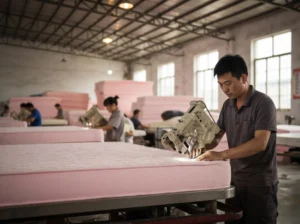






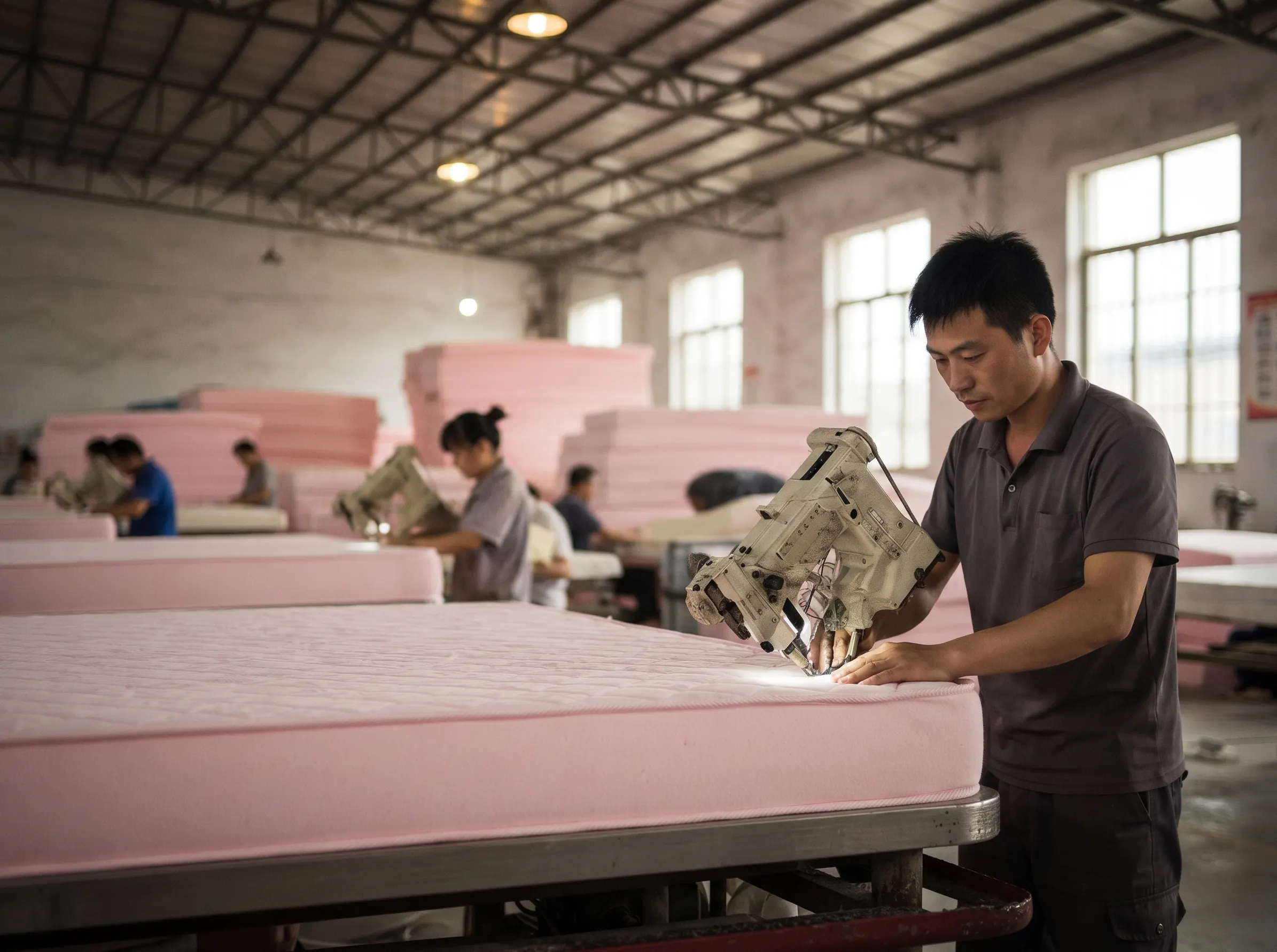
Chinese mattress export prices span a tenfold range because they describe four different products, not one product at four discounts. Under $80, you are buying a freight-friendly Bonnell spring unit wrapped in low-density foam — a product built to survive a container, not a decade. Between $150 and $300 sits the real export workhorse: pocket spring systems, honest foam densities, certifiable materials. Above $300, you are paying for material stability, tolerances, and quality control discipline, not secret technology. The tier where buyers get burned most often is the $80–$150 zone, where marketing language from the premium tiers is used to dress up hardware from the bottom one. Everything below explains how to decode any quotation you receive.
Why Every Quotation Looks Like the Same Mattress
Spend one afternoon on any B2B platform and you will see the problem. A “$50 high-quality luxury pocket spring mattress” sits next to a “$500 high-quality luxury pocket spring mattress,” and both listings use identical adjectives. This is not a translation accident. It is a structural feature of the mattress factory price China landscape.
The root cause is that “mattress” describes a construction method, not a specification. Two products can both legitimately be called “pocket spring, memory foam, knitted fabric” while differing in spring wire gauge, foam density by 40%, fabric weight, and edge reinforcement — a cost gap of $100 or more that no listing page will ever reveal. Add in compression-rolled packaging (which hides thin profiles), stock-lot liquidations sold as regular production, and certificates that were bought rather than earned, and you get the quotation chaos that defines cheap vs premium mattress confusion.
The fix is not finding a more honest supplier. The fix is learning to read the configuration behind the price. That skill starts with understanding the four tiers.
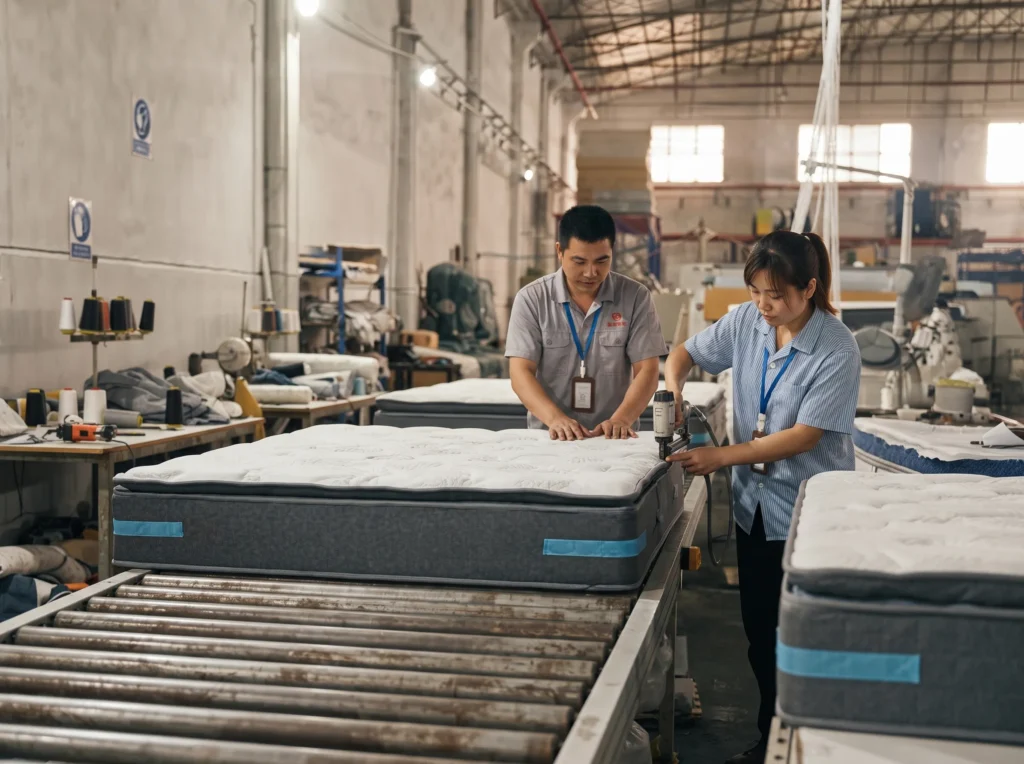
The Four Price Tiers, Defined
Before the breakdown, one working definition. A price tier here means an FOB China range for a standard queen-size (or market-equivalent) compressed mattress from a legitimate running production line — not stock lots, not showroom samples. Ranges are subject to verification and shift with raw material cycles.
| Tier | FOB Range (Queen) | What It Fundamentally Is | Honest Lifespan | Primary Channel |
|---|---|---|---|---|
| Budget | $50–$80 | Bonnell spring + low-density foam, built for container efficiency | 2–4 years | Dormitory, rental, promotional |
| Value | $80–$150 | Bonnell or entry pocket spring, mixed-density foam, first “real” mattress | 4–6 years | E-commerce volume, discount retail |
| Export Mainstay | $150–$300 | True pocket spring, consistent foam densities, certifiable materials | 6–10 years | Importers, retail chains, e-commerce premium |
| Premium | $300–$500+ | Stabilized materials, tight tolerances, disciplined QC | 8–12 years | Hotel FF&E, specialty retail, brand OEM |
Tier 1: The $50–$80 Freight Mattress
At this level the engineering goal is simple: fit as many units per container as physically possible. The spring unit is a Bonnell (interconnected) system using 2.0–2.2mm wire, heat-treated just enough to hold shape through roll-packing. Foam layers run 18–25 kg/m³ density — soft, light, and cheap. The ticking is usually 60–80 gsm knitted polyester.
Compressed and rolled, a queen in this tier packs to roughly 0.09–0.11 m³. That density is the entire business model. The mattress is not designed around sleeper comfort first; it is designed around container mathematics, and everything else follows. Comfort is acceptable for the first year, then the low-density comfort layers fatigue quickly.
Honest use case: dormitory supply, Airbnb turnover units, disaster-relief procurement, promotional retail where the selling point is the price. Dishonest use case: any channel where the customer expects durability.
Tier 2: The $80–$150 Value Zone — Where Buyers Get Hurt
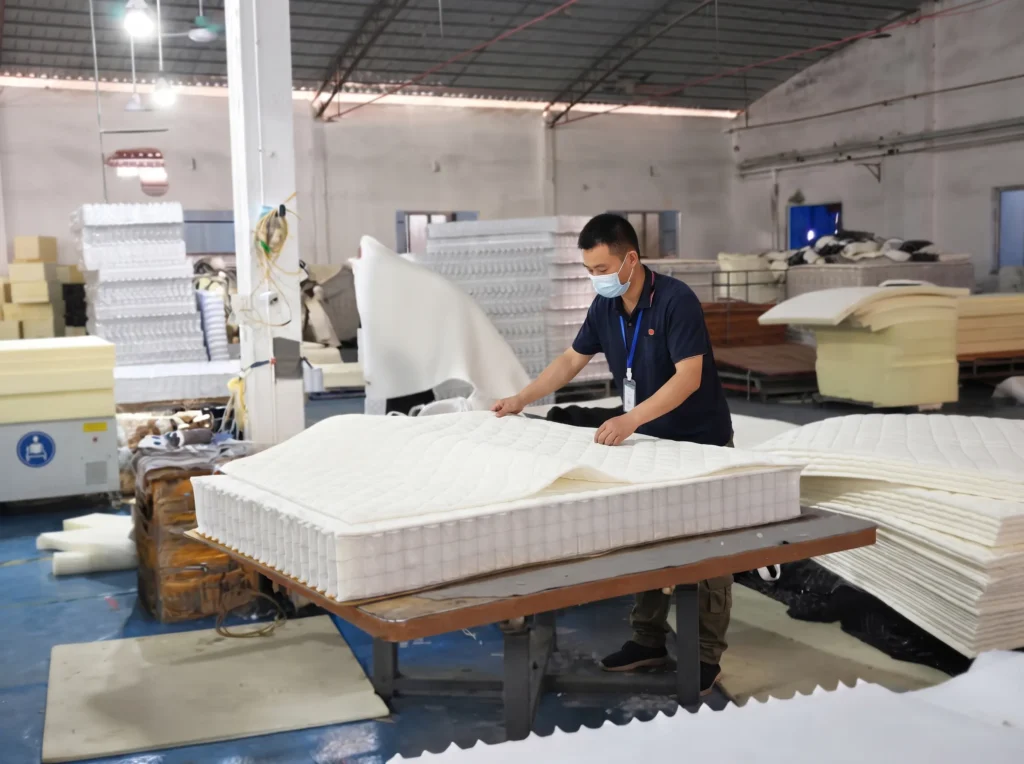
This is the most dangerous tier in the Chinese export market, and I say that having walked dozens of lines in Foshan and Nantong. The product is genuinely better than Tier 1 — pocket springs appear here, foam densities climb toward 28–32 kg/m³, fabric weight improves — but the marketing language improves far faster than the hardware.
This is the tier where “high density foam” claims proliferate. A factory may print 35 kg/m³ on the spec sheet while shipping 28 kg/m³, because the buyer has no practical way to check a rolled mattress without destroying it, and most never do. It is also where compression ratios get aggressive: mattresses rolled at higher ratios save freight but accelerate foam fatigue and edge-support collapse.
The products here are not frauds. Many Tier 2 factories run clean, honest lines. The risk is that this tier’s price point tempts suppliers to oversell, and the quotation vocabulary (“premium,” “orthopedic,” “hotel grade”) is identical to Tier 3. Verification — not trust — is the entry fee.
Tier 3: The $150–$300 Export Mainstay
This is where China’s mattress industry is genuinely world-class, and where most professional importers should be shopping. The defining feature is not luxury — it is consistency.
Pocket spring systems here use 1.8–2.0mm wire with actual zone differentiation (three-zone and five-zone configurations are real at this level, not printed on labels). Foam densities are honest and stable: 35–45 kg/m³ in comfort layers, with gel-infused or copper-infused variants available at the top of the band. Fabric moves to 280–350 gsm with options for fire barriers meeting CFR 1633 or BS 7177 at certified lines.
Quality control becomes systematic: spring unit fatigue testing, foam hardness tolerance bands, batch traceability. This is the tier where CertiPUR-US and OEKO-TEX certifications are genuinely attached to the factory’s production, not purchased as PDFs.
For a buyer building a retail program or a marketplace brand, this tier delivers the optimal ratio of landed cost to return-rate performance. Most of the volume shipped from the Nantong cluster — China’s densest mattress production region — lives in this band, which is why Nantong mattress cost benchmarks are the industry’s default reference point for Tier 3 economics.
Tier 4: The $300–$500 Premium Band
Above $300, the cost structure changes character. The materials are better — higher wire-count pocket units, latex or high-resilience foam hybrid layers, 400+ gsm fabrics — but the real money goes elsewhere: material stabilization, tolerance discipline, and process control.
Premium-tier factories hold foam density within ±1.5 kg/m³ across batches. They age-test adhesive systems. They run 100% roll-pack recovery tests instead of sampling. For OEM clients, they maintain dedicated lines with locked bills of material so unit 5,000 matches unit 1. When you pay $450 instead of $250, you are mostly paying for the probability that the container you receive in March matches the sample you approved in October.
This tier serves hotel FF&E programs, specialty retail, and brands that cannot afford a 2% defect rate becoming a social media event. The “mystery technology” premium-tier marketing loves to invoke largely does not exist. Stability is the technology.
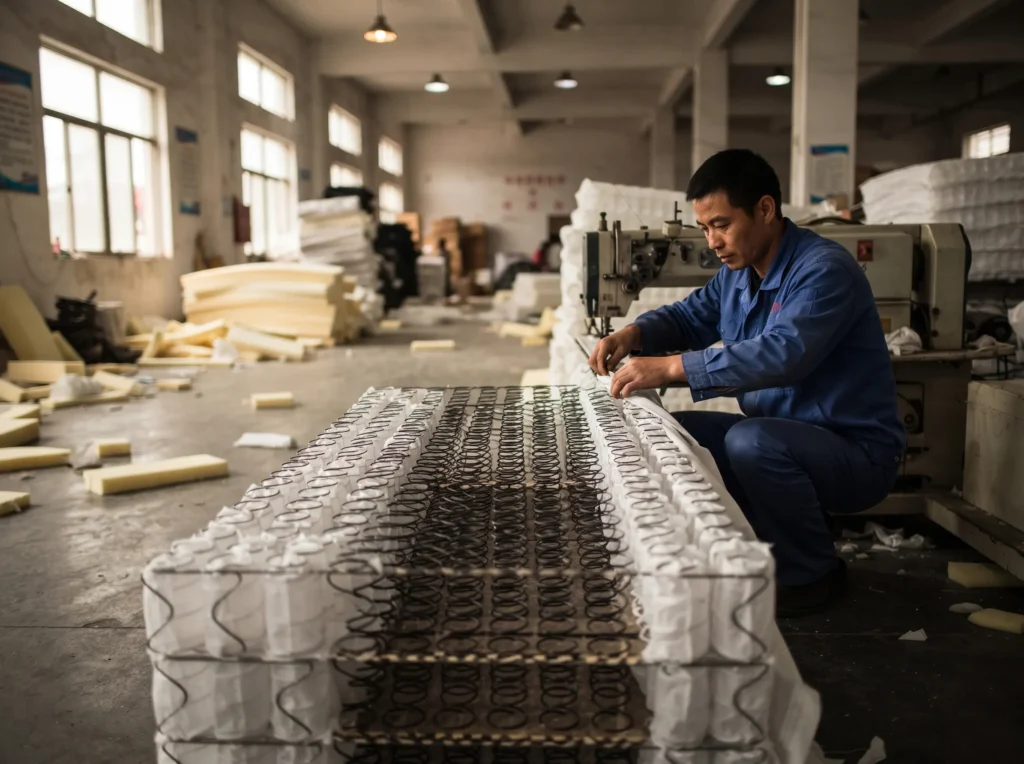
Configuration Comparison: What the Spec Sheets Actually Say
| Component | $50–$80 | $80–$150 | $150–$300 | $300–$500+ |
|---|---|---|---|---|
| Spring system | Bonnell, 2.0–2.2mm | Bonnell / basic pocket | Pocket, zoned, 1.8–2.0mm | Pocket, multi-zone, high coil count |
| Comfort foam density | 18–25 kg/m³ | 28–32 kg/m³ | 35–45 kg/m³ | 40–55 kg/m³ + latex/HR hybrid |
| Fabric weight | 60–80 gsm | 100–180 gsm | 280–350 gsm | 400+ gsm, treated |
| Edge support | Minimal | Basic foam encasement | Reinforced encasement | Full perimeter system |
| Compression ratio | Extreme | Aggressive | Moderate | Moderate / flat-pack options |
| Certifications | Rarely genuine | Mixed | Genuine, verifiable | Genuine + batch traceability |
Figures reflect common industry practice and are subject to verification per supplier and season.
The Cost Stack: From FOB to Your Port
Buyers routinely anchor on FOB price and forget that the mattress’s real cost is a stack. For a mid-tier queen example (figures are illustrative and subject to verification):
| Cost Layer | Approx. Amount | Notes |
|---|---|---|
| FOB factory price | $180 | Base quotation, compression included |
| Certification amortization | $3–$8/unit | Real CertiPUR-US / OEKO-TEX programs cost money; unverifiable “certificates” cost nothing |
| Export clearance + docs | $2–$4/unit | Varies by port and Incoterm |
| Ocean freight | $12–$35/unit | A compressed queen packs ~0.12–0.15 m³; rates swing violently with lane and season |
| Insurance | $1–$3/unit | Typically 0.3–0.5% of CIF value |
| Destination port + duty | $25–$80/unit | Duty rates vary sharply by market and trade status; check current anti-dumping measures for your destination |
| Indicative landed cost | $225–$310 | Before inland delivery, warehousing, and your margin |
The table explains two things at once. First, why compression packaging dominates Chinese exports — it can cut freight per unit by half versus flat-packed. Second, why a $50 FOB mattress can quietly become a $110 landed product, at which point its retail economics collapse in most developed markets. Mattress quality levels and landed-cost math must be evaluated together, or the tier analysis means nothing.
Certifications: The Ones That Mean Something
| Certification | What It Actually Covers | How to Verify | Red Flag |
|---|---|---|---|
| CertiPUR-US | Foam content: VOCs, heavy metals, banned substances | CertiPUR-US official database lists certified foam producers | Certificate names a “mattress brand” instead of a foam manufacturer |
| OEKO-TEX Standard 100 | Textile components, harmful-substance testing | OEKO-TEX label check with certificate number | Number belongs to a fabric trader, not the production mill |
| CFR 1633 / BS 7177 | Flammability (US federal / UK standard) | Third-party lab report tied to your exact model and batch | A single generic report covers ten unrelated models |
| ISO 9001 | Factory quality management system | Validity via certification body registry | Framed certificate, expired, factory name mismatch |
The governing rule: genuine certification attaches to a producer and a batch, never to a JPEG. Ask for the certificate number, check it on the issuer’s website yourself, and confirm the legal entity name matches the export contract. A real program adds $3–$8 per unit to cost — which is itself a filter. A supplier at $60 FOB claiming full CertiPUR-US foam is claiming something the arithmetic contradicts.
Where It’s Made: The Cluster Map
| Cluster | Core Strength | Typical Tier Position |
|---|---|---|
| Nantong (Jiangsu) | Densest mattress supply chain; springs, foam, fabric, quilting within one region | Tiers 2–4, heaviest in Tier 3 |
| Foshan (Guangdong) | Adjacent to furniture wholesale ecosystem; fast sampling | All tiers; strong OEM/ODM flexibility |
| Guangzhou / Dongguan | Export logistics maturity; trading-company density | Tiers 3–4 brand OEM |
| Nanjing–adjacent & North Jiangsu | Cost-competitive spring and foam components | Tier 1–2 supply base |
| Anji (Zhejiang) | Adjacent seating/upholstery supply chains | Mixed, growing mattress capacity |
Nantong’s dominance is a logistics fact as much as a manufacturing one: shorter sub-supplier distances mean shorter lead times and tighter batch consistency, which is why the cluster anchors Tier 3 pricing benchmarks.
The Four Traps That Eat Margins
Stock lots and tail orders. Cancelled orders and factory liquidations can be 30–50% below running-production price. Some are excellent value. Many have been warehouse-stored for 18 months, rolled at ratios that have permanently damaged the foam, or carry no valid certification chain. If the deal requires cash before inspection, the discount is not a discount.
The density number game. Claimed density routinely exceeds actual density by 10–20% in Tiers 1–2. The countermeasure is cheap and decisive: specify density in the purchase contract, then cut a sample unit from the container on arrival and weigh the foam. A 160×200×5cm foam layer at 35 kg/m³ weighs 5.6 kg. A kitchen scale outperforms any spec sheet.
Compression as false economy. Rolling saves freight and enables e-commerce shipping. But extreme compression ratios permanently stress foam cell structures and degrade edge support. If your customer keeps a mattress six years, moderate compression is worth the extra freight dollars.
Bought certificates. Covered above, but worth repeating because it remains the single most common fraud encountered in this category: if the verification link fails, the certification does not exist, whatever the PDF says.
Playbook by Buyer Type
Importers and wholesalers should live in Tier 3, dual-source within Nantong and Foshan, contract-test density, and treat certification verification as a standard onboarding step rather than a one-time favor.
Cross-border e-commerce sellers face a real fork. Tier 2 works only if you control expectations in your listing copy and accept the return-rate cost. Tier 3 with moderate compression is the sustainable play for review-driven platforms, where a 4.3-star collapse costs more than the $60/unit you saved.
Hotel FF&E buyers should go Tier 4 for flag properties and Tier 3 upper band for limited-service. Hospitality failure is measured in complaints per occupied room per month, and cheap mattresses generate complaints with a lag that outlasts the project’s installation team.
Individual and small-quantity buyers should distrust anything below roughly $150 FOB equivalent marketed as “premium,” and should treat any seller refusing batch-level certification verification as an answer in itself.

FAQ
Can a $50 Chinese mattress be legally imported and sold?
Usually yes, but legality is not the bottleneck — compliance is. Your destination market imposes flammability, labeling, and sometimes chemical standards regardless of price. Meeting CFR 1633 in the US or BS 7177 in the UK at a $50 cost basis is structurally difficult; verify the test report matches your exact model before committing, and confirm current duty and anti-dumping status for your import market, as these change.
How do I actually verify foam density without a lab?
Cut a measured block from a sacrificed sample, weigh it on any scale accurate to 50g, and divide by volume. For a 5cm-thick layer, the math is trivial and the result is definitive. Put the contracted density in writing with a tolerance, and audit one unit per container. This single habit eliminates most Tier 2 overselling.
Is pocket spring worth the price jump over Bonnell?
For any customer keeping a mattress beyond three to four years, yes. Bonnell springs transfer motion, sag progressively along the heaviest body line, and cannot be zoned. Pocket systems isolate motion and allow genuine zoning. The crossover point in cost terms sits near the Tier 2–3 boundary; below it, “pocket spring” claims deserve scrutiny.
How can I check whether a certification is real?
Obtain the certificate number and the issuing body, search the issuer’s official public database directly (never via a link the supplier sends), and confirm the certified entity’s legal name matches the factory on your contract. Certifications chain to material producers and production sites, not to trading brands. If any link in that chain fails, treat the certification as nonexistent.
What costs exist beyond FOB before the mattress reaches me?
Ocean freight on the compressed volume, marine insurance, export documentation, destination port charges, import duty and any applicable anti-dumping duties, customs brokerage, and inland delivery. Collectively these often add 40–70% to a Tier 3 FOB price. Buyers who budget from FOB alone are pricing a fiction.
Now the question back to you: which tier is your current supplier quoting you into — and does the configuration behind the price survive a density test? Tell us your FOB range and target market in the comments, and we will tell you what questions to ask next.
Recommended Resource
Interi Furniture specializes in custom furniture manufacturing for residential, hospitality, and commercial projects. Their experience in materials, craftsmanship, and project realization makes them a valuable resource for designers and buyers seeking tailored furniture solutions from China.