









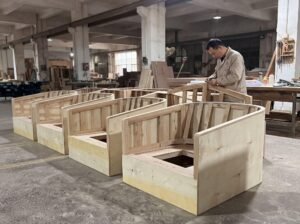
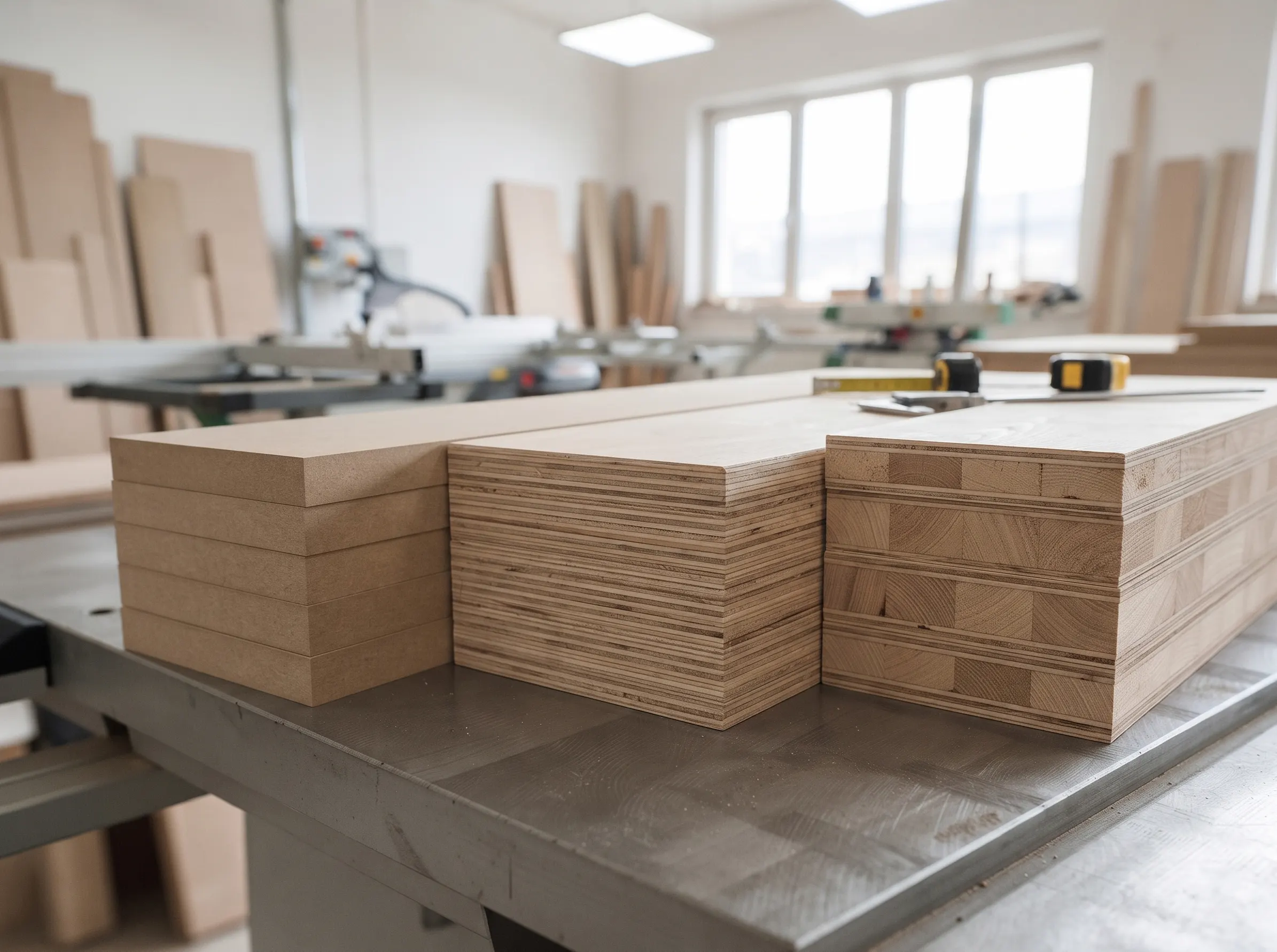
Here is the truth in plain English. MDF is not a cheap, inferior board. Plywood is not automatically premium. And blockboard, a renovation favorite at home, is a niche specialist in export furniture — not the default those guides imply. Chinese factories do not choose one board for a whole cabinet — they match the board to the part: MDF for shaped and painted doors, particleboard or plywood for cabinet boxes, thin boards for backs, and moisture-rated panels wherever water lives. What actually decides quality is density, core construction, glue class, and — more than anything — edge banding. This article explains the hierarchy part by part, and how to verify what you are really buying.
Why “Engineered Wood” Tells You Almost Nothing
Ask ten suppliers what a cabinet is made of and nine will answer “engineered wood.” That phrase covers boards whose factory-gate prices differ by a factor of three or more, with completely different lifespans and emission profiles. Among the engineered wood types in mainstream Chinese furniture production, only five matter, and each has a narrow band of jobs it does well.
This vagueness is not always deception; many sales reps genuinely do not know what the workshop used this week, because factories buy by job and cost target, not brand loyalty. The buyer’s anxiety — formaldehyde, sagging shelves, swelling cabinets — is legitimate; the fix is a better buyer question.
The Hierarchy Principle: One Board Never Fits the Whole Cabinet
The single most revealing sentence a buyer can say is: “I want the whole cabinet in one material.” Factories hear that and quietly conclude the buyer is an outsider, because their real logic is board-by-part, grade-by-cost. A routed door needs a homogeneous substrate; a cabinet box needs flatness and screw-holding at the lowest workable cost; a back panel only has to square the cabinet.
The right question is never “which board is best.” It is “which board, at which grade, for which part — and how do I prove it.”
The Five Boards That Actually Matter in Chinese Factories
MDF (Medium-Density Fibreboard)
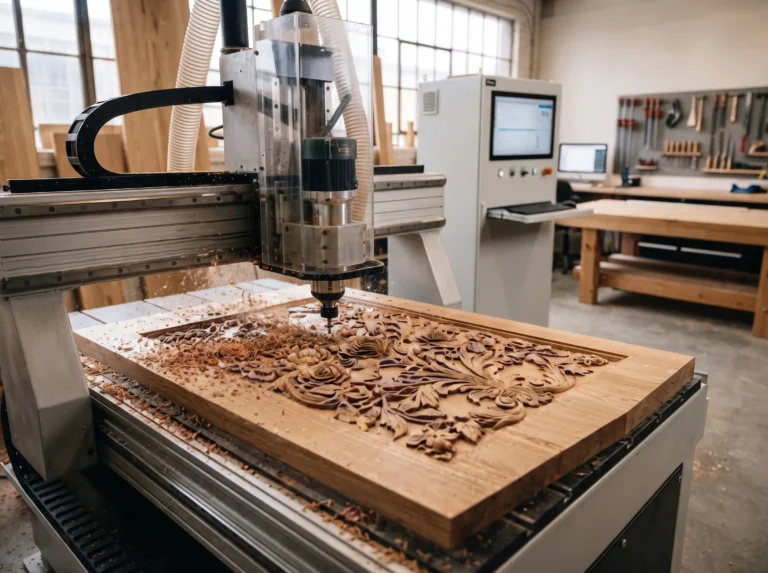
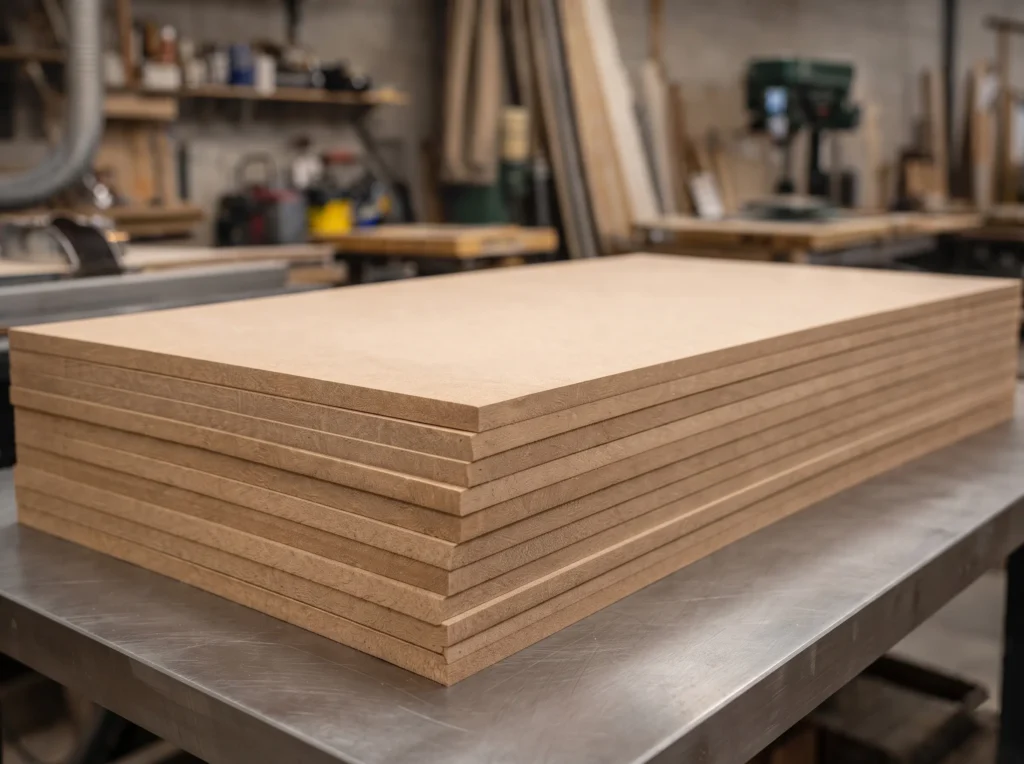
MDF is wood fibre refined to pulp, blended with resin, and hot-pressed into a uniform panel with no grain, no voids, and no directional weakness. Furniture-grade MDF commonly sits around 600–800 kg/m³, subject to verification.
Treat MDF as a specialist, not a budget option. It is the correct substrate for routed and shaped door profiles — shaker, beadboard, French-style center panels — because it mills cleanly without tearing. It is also the correct base for painted and lacquered finishes, with no grain telegraphing. Its weaknesses are equally specific: it swells badly in standing water, it is heavy, and its edge screw-holding is only fair, so quality factories use dowels, minifix fittings, or confirmat screws. None of these weaknesses matter on a dry, painted door. All of them matter on a sink cabinet.
Particleboard (Chipboard)
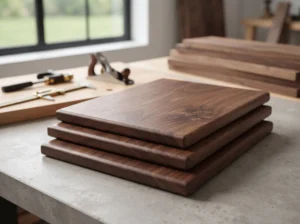
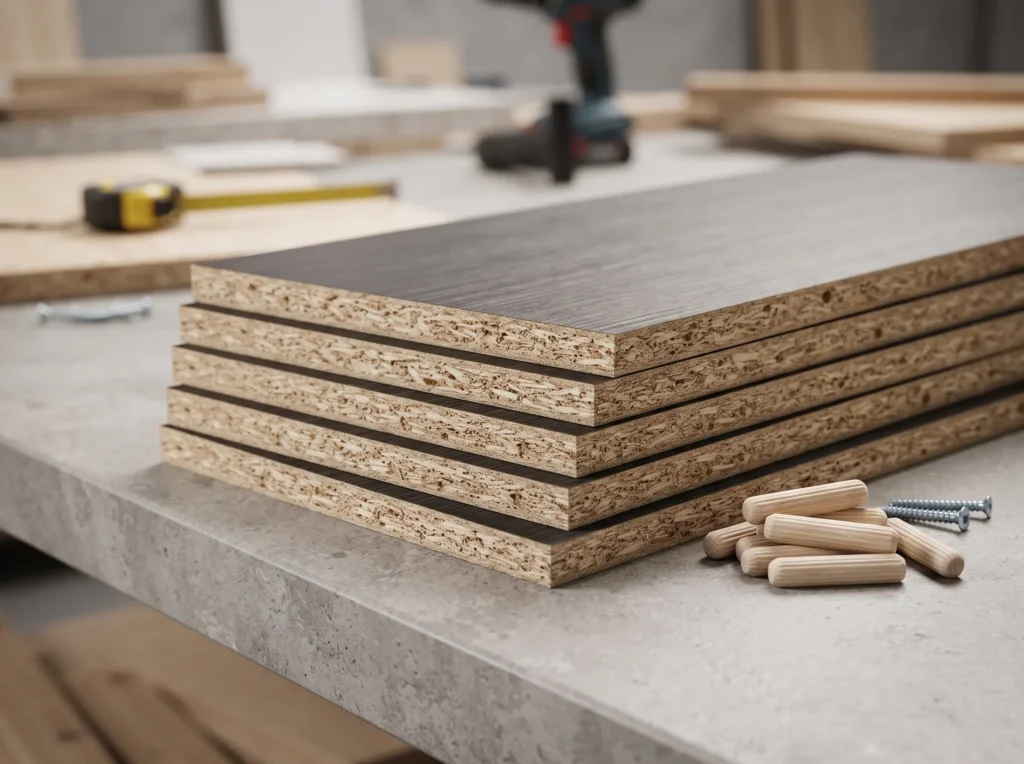
Particleboard is chipped wood and resin pressed into panels — the cheapest of the mainstream boards and, on raw material cost alone, the most rational choice for large, flat cabinet carcasses. Melamine-faced particleboard dominates wardrobe, bookcase, and kitchen-box production across China.
Its sins — edge screw-holding and moisture — are manageable with good hardware and banding. Its virtue is dimensional stability — it stays flat where cheap plywood warps.
Plywood
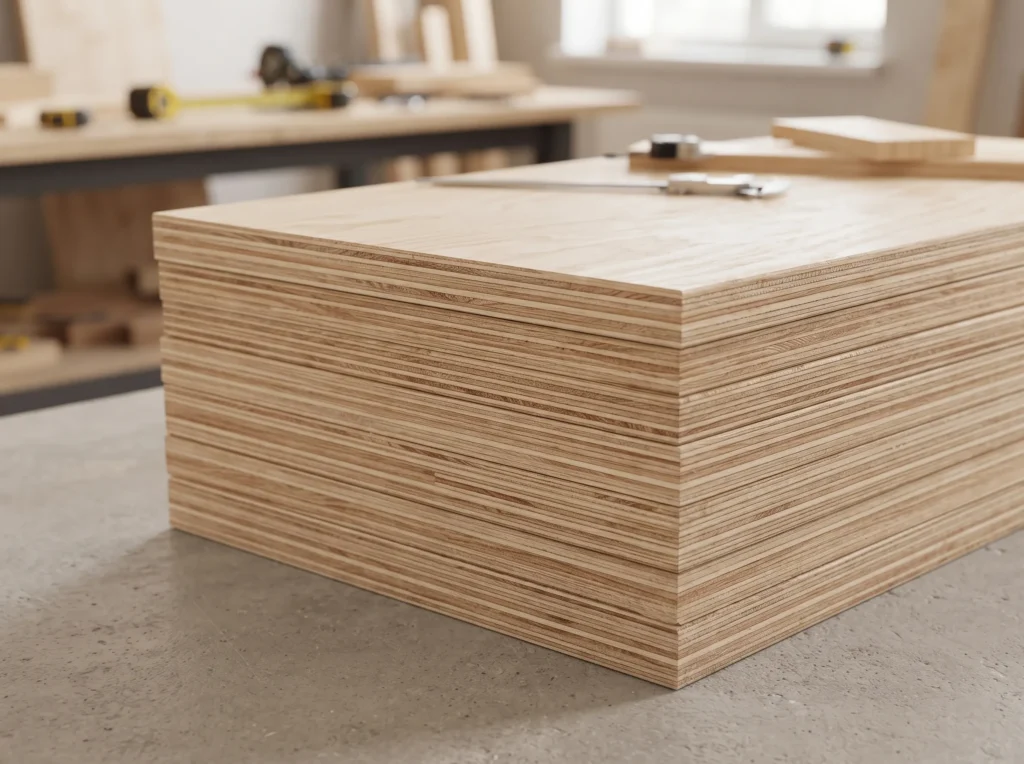
Plywood is an odd number of veneer layers, cross-laminated so the grain directions alternate. That structure gives it the best screw-holding and structural strength per kilogram of any board in this article.
The catch is that “plywood” is the least reliable noun in the Chinese board trade. Two panels both sold as 15 mm or 18 mm plywood can differ several-fold in price depending on layer count, core veneer (poplar, eucalyptus, birch, or mixed), and glue class (moisture-resistant interior, melamine-modified, or exterior phenolic). More layers is generally better; poplar core is light and cheap; birch core is dense and dear. A buyer who specifies “plywood” without layer count, core species, and glue class has specified almost nothing.
Blockboard (Lumber Core Board)
Blockboard — known in China as daxinban, “big core board” — sandwiches solid wood strips between two face veneers. It is light, holds screws well along its length, and resists the warping that plagues solid planks — a favorite for long shelves and wood doors in the Chinese renovation market.
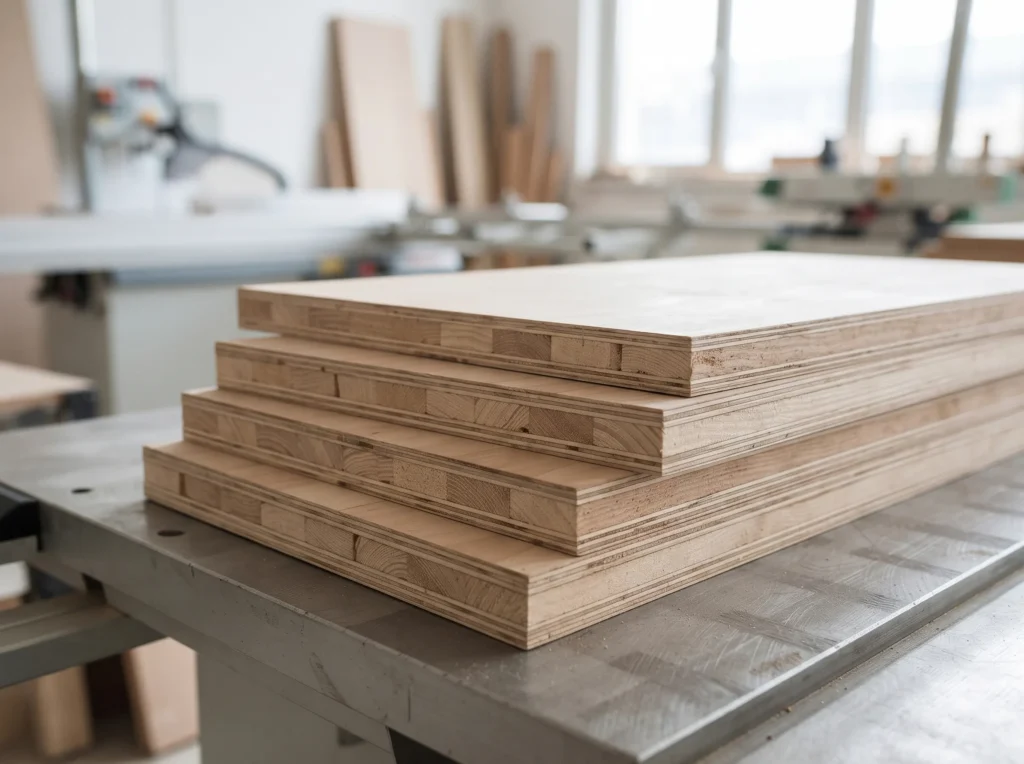
The critical variable is invisible: how the core strips are joined. Tight, machine-assembled strips with small uniform gaps behave; wide strips with sloppy joints leave voids and uneven faces that telegraph through veneer. In export furniture, blockboard is a specialist, not a default: expect it in door leaves, long light shelves, and desk tops — Middle East and Southeast Asia buyers often request it by name. The blockboard vs plywood for furniture question usually resolves to this: blockboard where you want a light, long, stable panel at moderate cost in dry interiors; plywood where strength, moisture resistance, and real structural work are required. A buyer who asks about strip width and jointing method is instantly treated as an insider.
| Board | Structure | Typical furniture use | Key strength | Key weakness | Honest verdict |
|---|---|---|---|---|---|
| MDF | Homogeneous wood-fibre panel | Shaped doors, painted/lacquered fronts | Mills cleanly, perfect paint base | Swells in water, heavy, fair edge screws | The right board for design doors — if density and grade are right |
| Particleboard | Chipped wood + resin | Cabinet carcasses, flat-pack cases | Cheap, very dimensionally stable | Weak edge screws, hates moisture | The workhorse; judged by its edge banding, not its name |
| Plywood | Cross-laminated veneer layers | Carcasses, shelves, structural parts, bent plywood | Best screw-holding and strength-to-weight | Huge quality spread by layer count, core, glue | Premium only when fully specified; a bare noun means nothing |
| Blockboard | Solid strip core between face veneers | Door leaves, long shelves, desk tops; wood doors (domestic market) | Light, screw-friendly, warp-resistant | Hidden core gaps in cheap boards | A niche specialist in export; specify strip width and jointing |
The Performance Matrix: Where Each Board Wins and Loses
The MDF vs plywood debate is really a debate about jobs. Paint finish belongs to MDF; structural honesty belongs to plywood. The matrix below is the one we use on factory floors; verify against the specific board’s test report.
| Performance dimension | MDF | Particleboard | Plywood | Blockboard |
|---|---|---|---|---|
| Screw-holding (edge) | Fair | Weak | Strong | Strong along the core, weak across it |
| Load-bearing / sag resistance | Good at proper density | Fair; long shelves need support | Strong for its weight | Very good for long spans |
| Moisture resistance | Poor unless sealed everywhere | Poor unless rated and sealed | Depends on glue class; phenolic best | Poor to fair; core strips absorb water |
| Dimensional stability | Excellent, no grain movement | Excellent | Can warp if unbalanced | Good; better than solid wood |
| Machining & paint finish | Excellent — the paint board | Good for melamine only | Poor for paint (grain telegraphing) | Fair; needs good faces |
| Typical cost position (China) | Mid | Lowest | Mid to high | Mid |
The Emission-Grade Maze: E1, ENF, E0, CARB P2
Emission grading is where honest confusion and deliberate fog meet. There are three parallel universes. China’s GB/T 39600-2021 defines E1, E0, and ENF for wood-based panels, with ENF as the strictest class (formaldehyde ≤ 0.025 mg/m³, subject to verification). China’s mandatory GB 18580-2025, in force since June 1, 2026, requires raw boards to meet E1 (≤ 0.124 mg/m³) and finished products sold domestically — faced panels, doors, custom cabinets — to meet E0 (≤ 0.050 mg/m³), subject to verification. The United States runs CARB P2 / EPA TSCA Title VI with its own limits and third-party certification. The European Union applies E1 under EN 13986.
The trap: the test methods differ — climate chamber, desiccator, perforator — so numbers from different standards are not directly comparable, and a bare “E0” on a quotation can mean Chinese GB E0, a European-style E0, or an entirely in-house label. The safe move: demand the full standard code and an accredited-lab report, then verify the report number with the lab. Any serious supplier of furniture core materials for the US or EU market has them; hesitation is your answer. Export goods are judged by destination rules, but that new domestic floor is a useful capability filter.
| Grade label | Standard / region | Indicative limit (subject to verification) | What to demand |
|---|---|---|---|
| ENF | GB/T 39600-2021 (China) | ≤ 0.025 mg/m³ | Full report citing GB/T 39600 and the chamber method |
| E0 | GB/T 39600-2021; mandatory for finished products under GB 18580-2025 (China, since June 2026) | ≤ 0.050 mg/m³ | Same — insist on the standard code |
| E1 | GB/T 39600-2021; mandatory for raw boards under GB 18580-2025 (China) / EN 13986 (EU) | ~0.124 mg/m³ (climate chamber) | Report citing the exact standard and method |
| CARB P2 / EPA TSCA Title VI | United States | Composite wood formaldehyde limits set by CARB/EPA; third-party certified | TPC certificate and panel label traceability |
How Factories Match Boards to Furniture Parts
Walk a Shunde or Fengxian workshop: same logic — board follows part, cost follows grade. This is the table that matters more than any marketing brochure.
| Furniture part | Common factory choice | Why | What to watch |
|---|---|---|---|
| Cabinet carcass (dry rooms) | Melamine-faced particleboard or plywood | Flatness + cost; plywood where screws carry load | Panel thickness; whether “plywood” is specified by layers/core |
| Cabinet carcass (kitchen/bath) | Moisture-rated plywood or particleboard | Water is the one enemy that voids warranties | Glue class, edge sealing, sink-area reinforcement |
| Shaped / painted doors | MDF | Clean routing, flawless paint base | Density grade; whether it’s moisture-proof MDF near sinks |
| Melamine flat doors | MDF or particleboard | Stable, cheap, consistent | Banding quality on all four edges |
| Door leaves | Blockboard or lumber-core composites | Light, stable, screw-friendly in dry interiors | Strip width, jointing, core gaps |
| Back panel | Thin MDF, plywood, or particleboard (3–9 mm) | Only needs to square the cabinet | Silent downgrade from 9 mm to 5 mm or 3 mm |
| Drawers | Solid wood, plywood, or particleboard with good slides | Slide quality carries the experience | Thin bottoms that sag; banded edges inside |
| Shelves | Particleboard or plywood; blockboard for long spans in dry interiors | Sag resistance per cost | Thickness and support spacing; blockboard core honesty |
| Vanity / laundry units | Moisture-rated plywood with full sealing | The wet zone punishes every shortcut | Sealed edges, sealed cut-outs, sealed hinge holes |
Edge Banding Decides Real Emissions and Real Lifespan
Here is the open secret: the board is only half the product. Every cut edge of MDF or particleboard is an open wound — raw fibres that emit disproportionately and drink moisture. Edge banding is the suture, and it matters more for emissions and service life than the panel grade itself.
Serious factories band all four edges of every panel, hidden ones included, and obsess over three things. Glue: PUR hot-melt beats standard EVA on heat and moisture; laser or hot-air banding eliminates the glue line entirely. Band material and thickness: 1–2 mm ABS or PP bands survive impacts that shred 0.4 mm paper-thin tape. Corners: radiused, seamless corners without visible glue lines. When a cabinet “bursts” at the edge or the melamine peels two summers in, the banding failed, not the board.
| Edge banding checkpoint | Good sign | Bad sign |
|---|---|---|
| Band thickness | 1–2 mm ABS/PP | Thin PVC or paper veneer tape |
| Glue system | PUR, laser, or hot-air | Barely visible EVA line, easy to lift |
| Corner treatment | Radiused, seamless, no glue line | Sharp 90° tape corners, visible seams |
| Edge coverage | All four edges, including hidden panels | Front edges only; raw backs and cut-outs |
| Cut-out sealing | Hinge holes and sink cut-outs sealed | Open raw fibre at every cut |
The Swap-Out Playbook: How Cheap Boards Get Dressed Up
Every tactic below is documented in China’s panel-furniture trade, confirmed by two or more independent sources. We describe them so you can catch them.
| Tactic | How it looks | How you catch it |
|---|---|---|
| Density-down MDF | “Furniture-grade MDF” delivered near 550 kg/m³ — honest lightweight territory — at standard-density pricing | Ask for the density range in the PO; lightweight MDF is fine when specified and priced as such |
| Mystery plywood | “18 mm plywood” with few layers, poplar core, cheap glue | Specify layer count, core species, glue class in writing |
| Hollow-core blockboard | Wide strips, big joints, gaps under the faces | Ask about strip width and jointing; demand a corner cut sample |
| Paper-grade E0 | “E0 eco board” with no standard code | Demand the standard’s full designation and an accredited lab report |
| Banding theatre | Beautiful front edges, raw unsealed backs | Specify full-edge banding in the PO; check a finished back panel |
| Back-panel diet | 9 mm approved, 5 mm or 3 mm delivered | Thickness check in the inspection checklist; caliper at loading |
| Sample-room switch | Showroom sample in good board, production in cheap board | Retain and seal a signed production sample; cut it at inspection |
These practices are real but not universal — China’s panel industry also produces world-class material. Verify; it is cheap compared to a container of swelling cabinets.
Playbooks by Buyer Type
Importers and Wholesalers
Put materials on paper, not in conversation: board type per part, MDF density range, plywood layer count and core, emission standard code, banding glue and thickness. Attach it to the purchase order, retain a signed golden sample, and book a pre-shipment inspection that includes cutting open one production unit. That single cut tells you more than ten showroom visits.
Retail Buyers and FF&E Specifiers
Your leverage is documentation. Demand test reports with verifiable numbers, insist the approved sample is locked and labelled, and write the escalation clause — production material must match the approved sample, or the goods are rejected. For hotel and commercial projects, specify moisture-rated panels for every wet-area unit.
E-commerce Sellers
Your product page may be your biggest compliance risk. Marketing copy that implies solid wood over a particleboard carcass invites returns, reviews that say “fake wood,” and in some markets, regulatory trouble. Specify boards honestly, demand sealed edges near any water, and photograph the real edge close-up for the listing.
Individual Overseas Buyers
You rarely need lab reports to start. Ask for photos of the raw board stack in the workshop, close-ups of edges and hinge holes, and the board’s printed labels. A seller who sends those within a day usually sells what they say; one who sends only glamour shots is telling you something too.

Frequently Asked Questions
Is MDF or plywood better for furniture?
Neither is “better” — they do different jobs. MDF is the right choice for shaped and painted doors and decorative panels; plywood is the right choice for cabinet carcasses, shelves, and anything structural or near moisture. A well-specified MDF door outperforms a cheap plywood one, and vice versa.
How do E1, ENF, E0, and CARB P2 correspond to each other?
Under their own test methods, from strictest to loosest: ENF, then E0, then E1; US CARB P2/EPA runs separately with its own limits. Because the test methods differ, never compare raw numbers across standards; compare within each standard and demand the full standard code on the report.
What board should a bathroom vanity or laundry cabinet use?
Moisture-rated plywood with sealed edges, sealed cut-outs, and sealed hinge holes — or a properly specified moisture-proof MDF for painted fronts, kept away from direct water. Standard particleboard or MDF in a wet zone is the most common expensive mistake we see.
How can I judge edge banding quality from a sample?
Press the band with a fingernail near a corner: lifting or a visible glue line is a fail. Check whether hidden edges and cut-outs are sealed, not just the front. Ask what glue system is used — PUR, laser, or hot-air all beat basic EVA for moisture and heat.
What exactly should I ask for to verify a board’s claims?
Three documents: the material spec sheet naming board type, density or layer count, and glue class per part; the emission report citing the exact standard code from an accredited lab, with a report number you can verify; and a retained, signed production sample your inspector may cut open.
Now it’s your turn: paste the board named in your latest quotation — “MDF,” “plywood,” or just “engineered wood” — in the comments, and tell us the product. We’ll tell you what it likely is, what questions to fire back, and where the quote is probably hiding its margin.
Recommended Resource
Interi Furniture specializes in custom furniture manufacturing for residential, hospitality, and commercial projects. Their experience in materials, craftsmanship, and project realization makes them a valuable resource for designers and buyers seeking tailored furniture solutions from China.