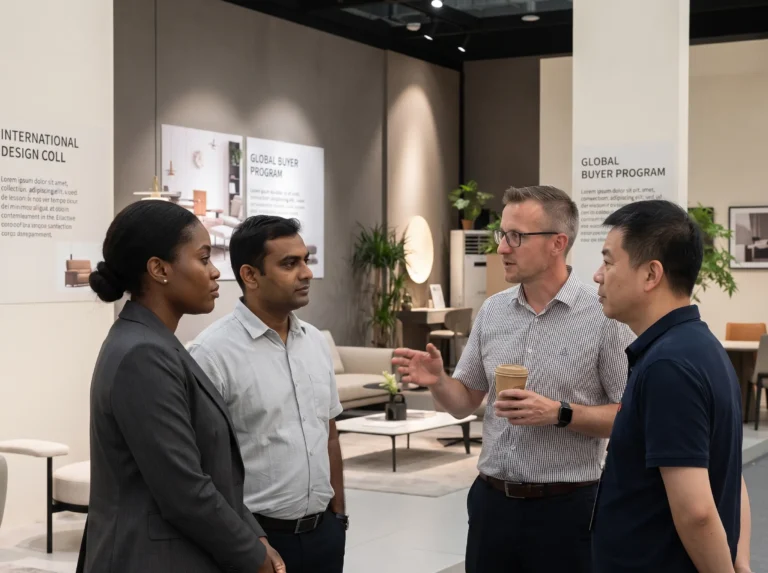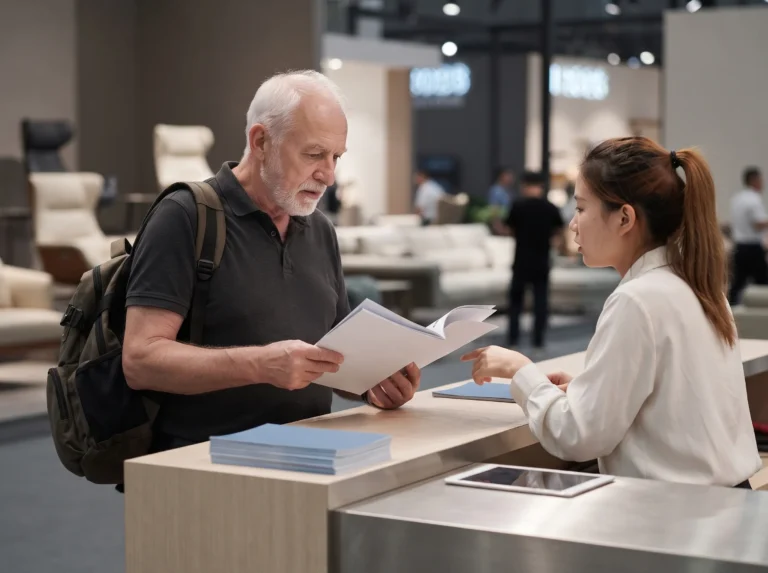





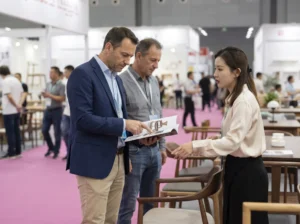

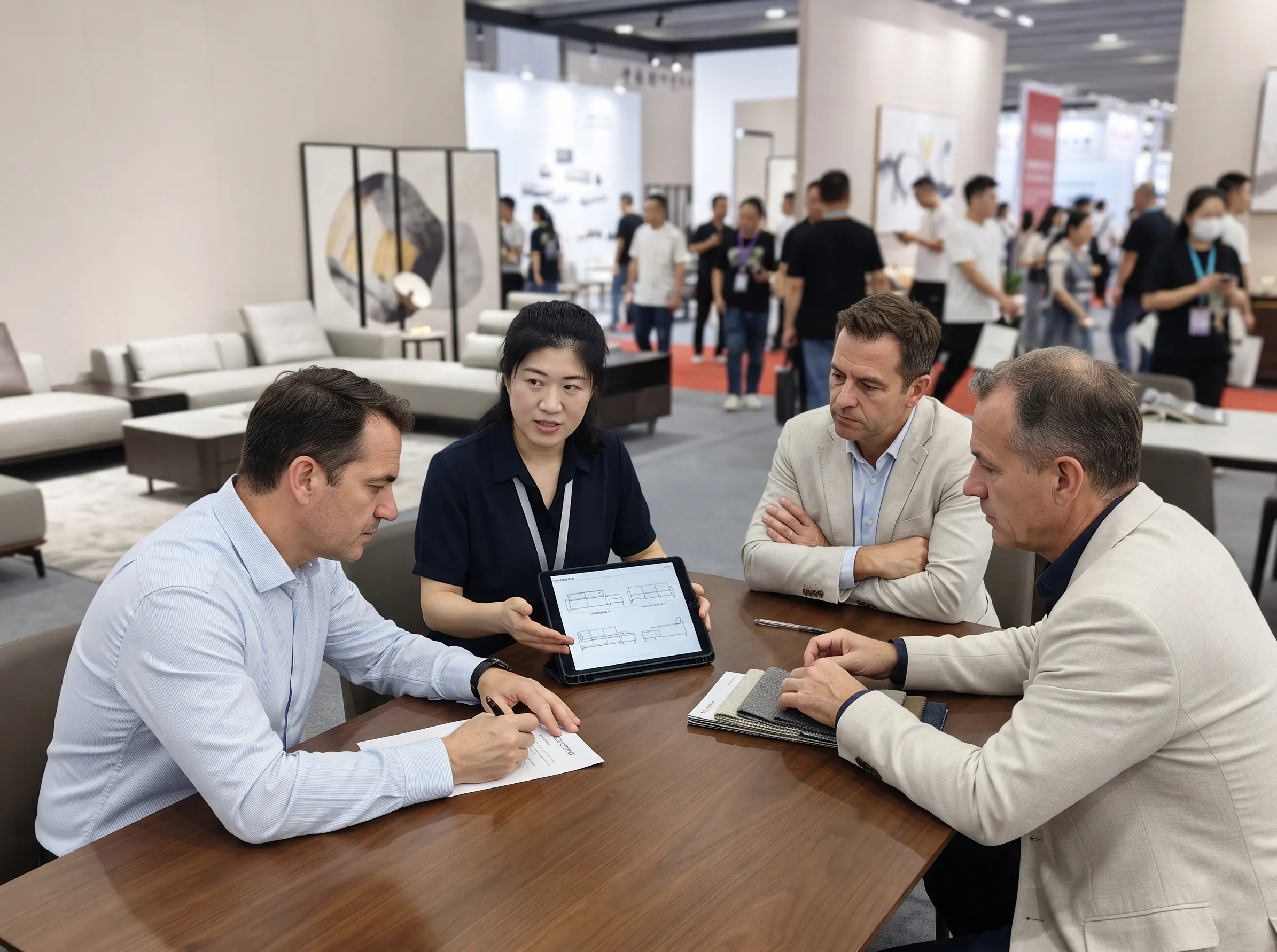
Here’s the uncomfortable truth first: you cannot tell a factory from a trading company by looking at a booth. Not in five seconds. Not in five minutes.
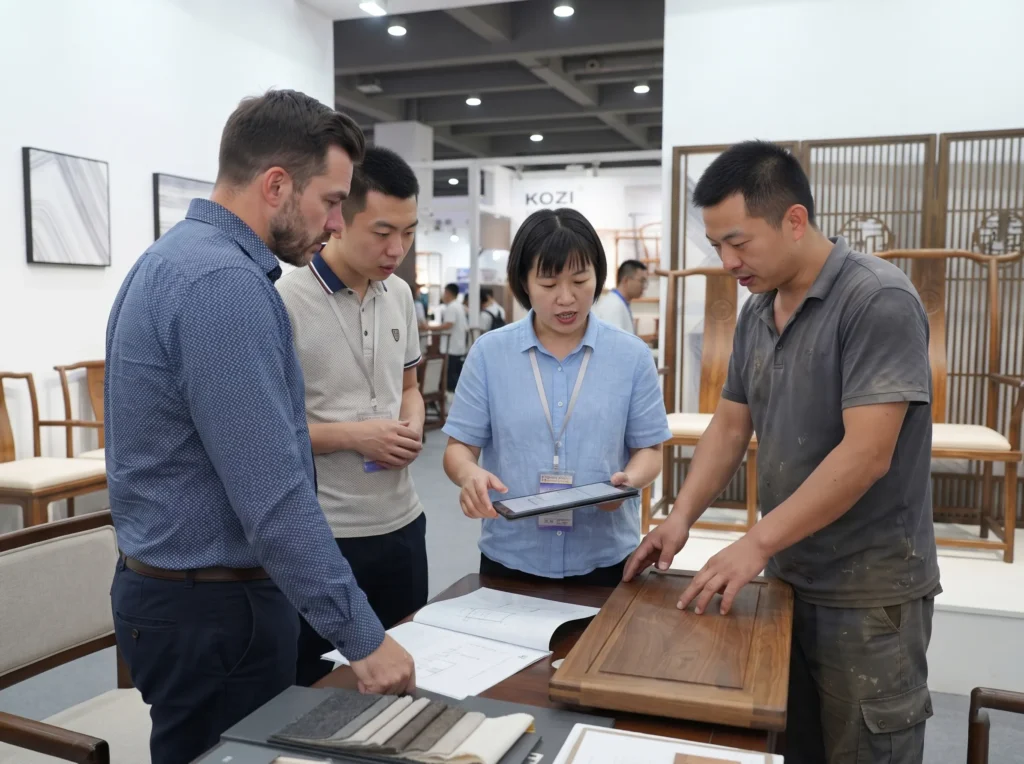
What a sharp buyer can do in those first seconds is judge how much the exhibitor knows about making the product. Material samples on the table. A cutaway frame. Spec sheets with actual tolerances. Staff who talk about stitching and joinery instead of “premium quality.” That first read decides who gets your next hour at the fair — and who doesn’t.
The follow-up that matters most is a request for a live video walkthrough of the facility that would actually produce your order. Useful evidence? Absolutely. Proof? Never. This guide covers how to identify furniture manufacturers and honest trading partners among the Canton Fair furniture exhibitors, what to do when signals contradict each other, and how to verify a Chinese furniture supplier before any money moves. Every signal here is a lead, not a verdict.
A Few Days, Thousands of Booths, Zero Time to Waste
Furniture at the 140th Canton Fair lives in Phase 2 — October 23 to 27, 2026. Five days on paper, but after badge pickup, buyer registration queues and the obligatory coffee at the Pazhou concourse, most working buyers get maybe three solid days on the floor. Covering the furniture halls properly in that window is a screening exercise, full stop.
Two things separate a productive trip from a blurry one, and neither happens at the fair.
The first is pre-show shortlisting. The Canton Fair’s own platforms let buyers search exhibitors and products by category, and — this part gets underused — filter by business type. The directory fields include Manufacturer and Foreign Trade Company, plus trade modes like OEM, ODM and OBM. A buyer who builds a target list at home, saves booth numbers to the fair app, and walks a planned route starts every conversation ahead. The second is triage discipline: spend ninety seconds deciding whether a booth deserves twenty minutes. Most buyers do the opposite.
Keep one distinction in mind through everything below. Screening decides where your time goes. Verification decides where your money goes. Confuse the two and the fair will punish you for it.
What a Booth Can — and Cannot — Tell You
A booth is a clue generator. Nothing more.
Manufacturers tend to fill their space with proof of making: construction samples, material options, the boring technical details that don’t photograph well. Trading companies tend to fill theirs with the portfolio — a coordinated spread of products chosen to match whatever buyers might ask for. Tendencies, though. Not rules. Big factories run booths that look like brand flagships. Specialist traders employ staff who know more about sofa construction than half the engineers in Foshan.
Booth design tells you about presentation budget. It tells you almost nothing about who owns a production line.
So skip the wallpaper. Look at what’s on the table, what the spec sheets say, and — most of all — what happens when you ask a technical question. A polished booth owned by a factory is common. A modest booth owned by a factory is common too. The questions sort them out; the décor never will.
The 5-Second Booth Check, Defined
The 5-Second Booth Check is a first-pass screening habit: scan a short list of observable signals in the moments before anyone greets you, and use the result to decide whether this exhibitor earns a real conversation. That’s the entire job description.
It does not confirm factory ownership. It does not measure capacity, quality systems or delivery reliability. Buyers searching for how to identify a furniture manufacturer should treat it as the opening move of a longer process — the part that happens after the check is where the actual identification lives.
The Signal Set
Scan this roughly in the seconds before the sales greeting starts.
| Signal | Reads more like a manufacturer | Reads more like a trading company | How much weight |
|---|---|---|---|
| Product range | One category explored in depth, with variations | Unrelated categories lined up side by side, breadth over depth | Moderate. Factories diversify; traders specialize. Don’t lean hard |
| Materials & construction | Swatches, cutaway frames, mechanism or joinery samples within reach | Finished pieces only, heavy on photography, thin on materials | Moderate. Real samples suggest hands-on production knowledge |
| Technical paperwork | Spec sheets naming materials, dimensions, tolerances, construction notes | Lifestyle imagery, “premium quality” language, no numbers | Moderate |
| Staff | People who explain materials and processes without excusing themselves | People who defer every technical point to “the engineer” | Moderate. Trader staff can be deeply technical; factory sales staff can be hopeless |
| Identity disclosure | Clear about what’s made in-house | Vague about who actually produces the goods | Moderate. Ambiguity is a question prompt, not a conviction |
| Quotations | Prices tied to specs, materials, quantity, packaging | Numbers offered fast, with no visible pricing basis | Low-moderate |
| Address on the card | A factory site or industrial zone | A CBD office tower | Low. Office and plant at different addresses is completely normal |
No row closes a case. The pattern earns someone twenty minutes of your afternoon. That’s all.
When the Signals Fight Each Other
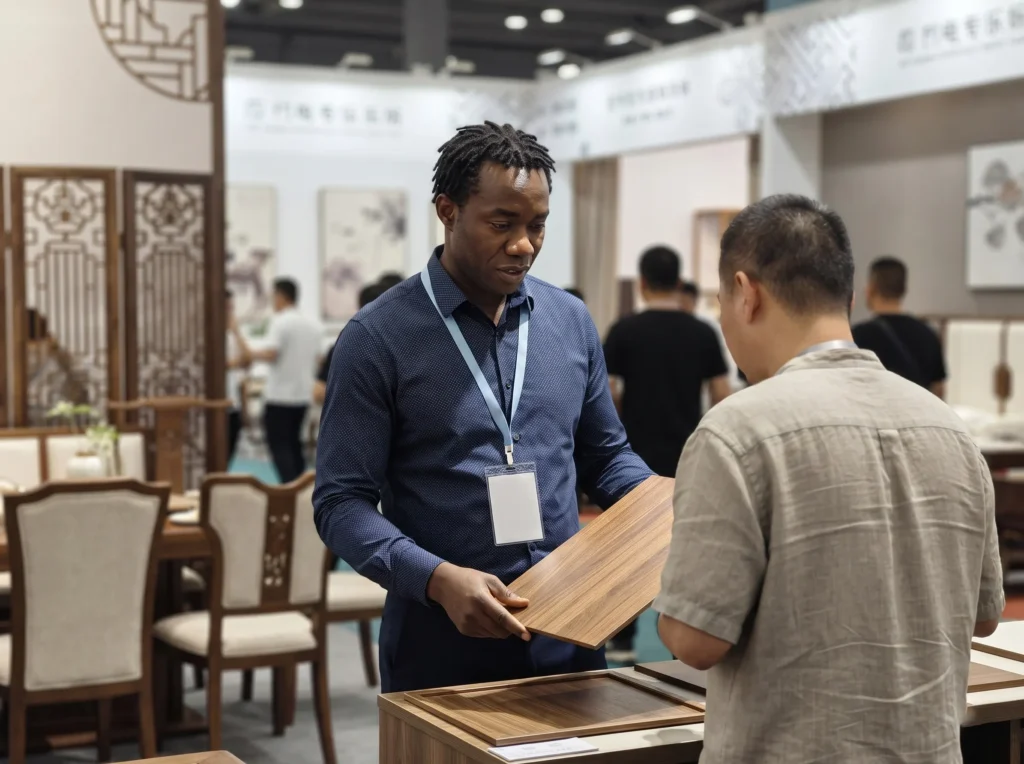
Real businesses are mixed, so real booths contradict themselves. Weighing beats guessing.
| Situation | Honest reading | Move |
|---|---|---|
| Premium booth, focused range, technical samples, staff who know their stuff | Probably a serious manufacturer — possibly a serious trader with real technical depth | Engage. Ask directly who makes each line |
| Premium booth, broad catalog, zero technical material, pure sales team | Presentation-led. Manufacturing role unknown | Ask the production-responsibility question before investing time |
| Modest booth, deep single-category display, proper spec sheets | Often a smaller factory. A specialist trader can look identical | Have the conversation — capability questions will split them |
| “Factory” banner on a spotless, photo-driven booth | Cleanliness proves nothing either way; the banner is unverified | Leave the claim open until verification |
| Exhibitor plainly states what’s in-house and what’s outsourced | Transparency — valuable from either type | Note it. Verify it later. Transparency is rarer than it should be |
One principle carries the weight: technical evidence and honesty about outsourcing outrank decoration, banners and business cards. Anyone can print a claim. Explaining a welding process or admitting which lines come from a partner factory takes actual knowledge.
The Questions That Do the Real Work
The visual pass buys you a conversation. These questions run it.
| Question | A strong answer sounds like | Dig deeper when you hear |
|---|---|---|
| Could you set up a live video walkthrough of the facility that would make this specific product? | A named contact, a time, or a clear reason it can’t happen today | “We can arrange later” with no follow-up plan, or reluctance to show the plant behind your product |
| Which processes do you run in-house, and which are outsourced? | A specific split — cutting and sewing in-house, springs bought externally, frames from a partner plant | “Everything is ours” across five unrelated categories |
| What materials and specifications define this product? | Grades, densities, thicknesses, finishes — actual numbers | Adjectives. Just adjectives |
| Which stage is your current capacity bottleneck? | Something concrete — drying time, paint line throughput, sewing capacity | Generic talk about quality control |
| Who owns quality at each stage, yours or your partners’? | Named inspection points and processes | Nobody seems to catch defects until the container arrives |
Notice something about this list. Not one question can be answered by identity alone. A trader embedded in strong factory relationships may nail most of them. An unprepared factory salesperson may fumble all five. That’s precisely why the answers feed verification instead of replacing it.
Three Mistakes That Cost Buyers Real Money
Reading a Premium Booth as a Trader Signal
The fanciest booth in the row is often the biggest factory at the fair. Established manufacturers spend serious money on presentation precisely because international buyers respond to it. Judge what’s underneath: spec sheets, samples, staff knowledge. And if a gorgeous booth does turn out to belong to a trader, the right reaction isn’t betrayal — it’s pricing. Their consolidation, QC and export services cost something. Decide whether that something is worth it.
Treating Cleanliness as Evidence
A tidy booth proves a tidy booth. Manufacturing materials and work-in-progress often stay at the factory because they belong at the factory — or because exhibition rules and sample protection demand it. Meanwhile, any trader can scatter fabric swatches on a table in five minutes. Props stage easily. Explanation doesn’t. Judge the words, not the surfaces.
Counting Categories Instead of Responsibilities
Broad range doesn’t equal trader, any more than narrow range equals factory. Some manufacturers genuinely run upholstery, wood and metal under one roof. Some traders have sold nothing but hotel chairs for twenty years. The question that matters: which of these lines do you produce yourselves, and who answers for quality on the rest? Ask it flat out. The clarity of the answer tells you more than the count.
Capability Checks by Category
Different products, different questions. These probe technical knowledge — not identity.
| Category | Ask about | Why it works |
|---|---|---|
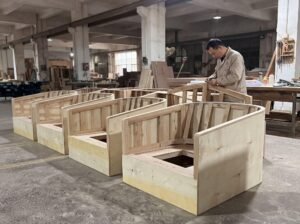
| Upholstered sofas | Frame construction, foam densities, cutting and sewing capacity, sample-to-production consistency | Surface talk stops at fabric choice; production talk gets structural |
| Solid wood dining | Wood species and sourcing, moisture control, joinery, dimensional stability | Hard to bluff |
| Office chairs | Mechanism specs, component sources, load and durability test documents | Check whether the test reports cover the actual products offered |
| Outdoor / rattan | Material and coating specs, UV-resistance test reports for outdoor materials, frame corrosion treatment | Reports have scopes — ask which products fall inside |
| Mattresses | Spring systems, foam layer structures, adhesives and fabrics, roll-pack ability where relevant | Construction questions expose genuine manufacturing involvement fast |
Where the First Pass Breaks Down
Every screening method fails somewhere. These are the known failure points.
| Scenario | Why it misleads | Workaround |
|---|---|---|
| Big manufacturers with professional fair teams | They present like brands — or like traders | Verify production responsibility, not presentation style |
| Factories exhibiting with a trading partner | Mixed signals come built into the arrangement | Ask who owns which lines and who signs contracts |
| Small factories renting minimal booths | Weak booth presence, real capability underneath | Capability questions and the video walkthrough favor them |
| Traders with deep factory partnerships | They can out-answer some factories | Judge transparency about role and pricing, not identity |
| First-time exhibitors | Nervous, thin materials, shaky English | Verify separately — registration records exist for a reason |
| A busy booth at the wrong moment | The one engineer who knows everything is at lunch | A weak conversation at peak hour proves nothing, in either direction |
Screening allocates your afternoon. Verification allocates your budget. Keep the jobs separate.

The Three-Stage Verification Framework
Three separate questions drive the whole process: who is this company, what can it actually make, and what can it reliably deliver.
| Stage | Where | Question it answers | What happens there |
|---|---|---|---|
| Initial screening | Booth approach, first minute | Worth a real conversation? | Scan range depth, technical samples, staff knowledge; work from a pre-built shortlist in the fair app |
| On-site capability check | Booth talk, follow-up meetings | What’s their real role and technical depth? | Outsourcing questions, walkthrough request, sample and spec review |
| Pre-order due diligence | After the fair, before payment | Can they deliver at the quality, volume and terms agreed? | Registration check, production address confirmation, capacity and quality review, third-party inspection where the order justifies it |
This is the honest answer to how to verify a Chinese furniture supplier: no single signal, question or video call carries the case alone. Each stage feeds the next. For orders that matter, factory verification in China means documents plus eyes on the ground — a third-party audit where the risk warrants it, not a phone camera waved around a workshop.
Playbooks by Buyer Type
| Buyer type | Prioritize in screening | Strong first move |
|---|---|---|
| Importer / wholesaler | Production responsibility, capacity evidence, transparent cost structure | Ask which lines are made in-house, then request the walkthrough |
| E-commerce / Amazon seller | Spec quality, sample consistency, compliance paperwork | Construction and test-report questions on the exact SKUs |
| Retail buyer / small business | Honest role disclosure, realistic lead times, workable MOQs | Ask who owns the factory and who answers for quality — watch how directly they respond |

Frequently Asked Questions
Can I tell a factory from a trading company just by looking at the booth?
No, and be skeptical of anyone who says otherwise. Booth appearance reflects presentation strategy and budget. A polished booth may hide a factory; a modest one may hide an excellent factory. Booth observation is triage — it tells you where to spend time. Identification happens through capability questions and verification.
Is a premium booth a warning sign?
Not by itself. Large manufacturers invest heavily in presentation. What deserves attention is beneath the finish: technical samples, spec sheets, staff who can discuss production. Premium build-out combined with zero technical depth and five unrelated categories? Worth a question. Still just a question.
Can a live video call confirm factory ownership?
It can’t confirm it alone. A trader may walk you through a partner’s plant; a manufacturer may be mid-production and unable to arrange anything today. Use the call well — facility entrance, relevant equipment, work in progress, quality checkpoints — then cross-check against registration records, the production address, and who contractually answers for your specific products.
Is a trading company a worse choice than a factory?
Often it’s the better one, depending on the order. Traders consolidate across suppliers, manage QC, handle export documentation and carry contractual delivery risk — services plenty of buyers need. The problem is never the label. It’s opacity: a trader quoting “factory prices” while claiming factory ownership transfers risk onto you. A trader who states its role and prices its services clearly is a legitimate counterpart. Evaluate transparency and terms, not the badge.
What should I do when booth signals conflict?
Accept that conflict is normal — factories outsource, traders specialize, partners exhibit together. Weight technical evidence and transparency above decoration. Mark the exhibitor unclear and spend one round of capability questions. The questions exist for exactly this case.
Which signal have you been over-weighting on the show floor — and what’s the first capability question you’ll ask at your next booth?
Recommended Resource
Interi Furniture specializes in custom furniture manufacturing for residential, hospitality, and commercial projects. Their experience in materials, craftsmanship, and project realization makes them a valuable resource for designers and buyers seeking tailored furniture solutions from China.