


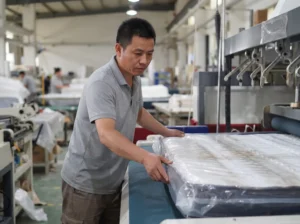




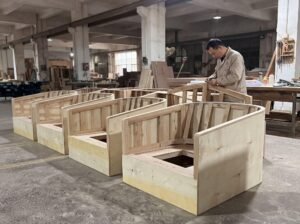

A beautiful sample proves one thing: that the factory can make a beautiful unit.
That’s it. That’s the whole list.
The quality of Canton Fair furniture samples under those showroom lights tells you what happens when materials, time, and attention all line up. Your bulk order? It runs on batch materials, production targets, and a delivery date that doesn’t move. Does a gap have to open up between the two? No — factories ship matching goods every day. But the gap never closes by itself, and wishing won’t close it either.
Furniture Discover has walked these fair halls for years and gone home with buyers to see what actually arrived. Here’s what separates the calm buyers from the furious ones: the calm ones never confused a showroom piece with a promise.
The Story You’ve Probably Lived
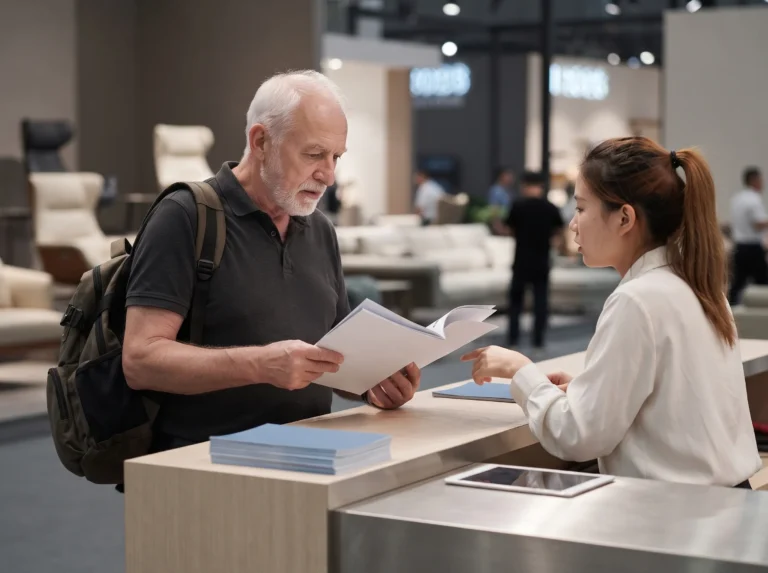
Tuesday of the fair. A sofa in a corner booth. Stitching straight, cushions firm, and when three of you pile onto it — silence. No creak.
“Your order will look exactly like this.” The rep says it warmly, and means it.
Three months later you’re cutting straps off a container, and something’s wrong before the doors are fully open. The stitching wobbles in spots. The cushions feel dead under your hands. Flip the unit over and the dust cover is thinner — cheaper — than what you remember touching in Guangzhou.
You push back. The reply lands in your inbox within a day, and it’s the same sentence buyers have been receiving for forty years: “Goods made as per approved sample.”
From there, everything depends on paperwork you may or may not have written. That sample-to-bulk quality variation doesn’t have to end in a write-off. But it usually does when the only “specification” in the file is a memory of a sofa.

So Where Does the Gap Come From?
Honest answer: usually not from bad intentions. It comes from the fact that sample-making and mass production are two different jobs.
Materials first. The sample might come from a specific batch — sometimes literally the best pieces in the warehouse. Your order draws from whatever passes incoming inspection that week. Same spec sheet, different reality, unless you wrote the grades down.
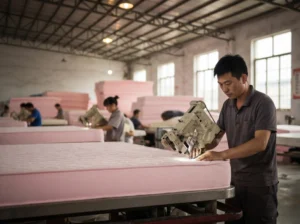
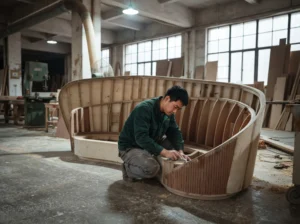
Then the people. Sample makers are a different crew from line workers. They work slower, adjust more, care about the one piece in front of them. None of that transfers automatically. If you want proof it transfers, you need a pre-production sample built the way the line will actually build it.
Then the clock. Nobody rushes a sample. Your order competes with three others for the same line time, and when the schedule tightens, inspection hours are usually what get squeezed.
And money, of course. A sample costs what it costs. Your order gets built inside a quoted budget, and if component specs aren’t locked, a purchasing manager facing a price squeeze has room to make quiet decisions.
Notice something? No villain in this story. Just pressure and missing paperwork. The fix matches the problem.
Four Samples, Not One
Buyers say “the sample” like there’s a single object in play. There isn’t. In furniture manufacturing you’re juggling at least four different things, and they don’t do the same job.
| Sample | What it actually is | What it’s worth |
|---|---|---|
| Exhibition sample | The piece on the stand, lit and staged | A first impression. Design, appearance, ambition. Nothing more |
| Pre-production sample | Built before mass production, with your specified materials and the intended methods | Your real standard. If the factory can’t hit it here, the order isn’t ready |
| Production sample | Pulled mid-run from the actual order | The truth about the line, on a specific day |
| Sealed reference sample | A labeled sample both sides identify and keep | Your tiebreaker. When memories argue, objects don’t |
The pre-production sample deserves a warning of its own, because buyers get burned here. Ask who built it. If the answer is “our sample team,” that’s fine — but now ask how production replicates it. Same foam density? Same fabric lot? Same stitch settings? Get it in writing, or the sample proves nothing about the line.
What to Do at the Booth
Nobody is hiding anything at a trade show. The lighting flatters the fabric, the front faces the aisle, and that’s just… a trade show. Your countermove is simple: go where the staging isn’t.
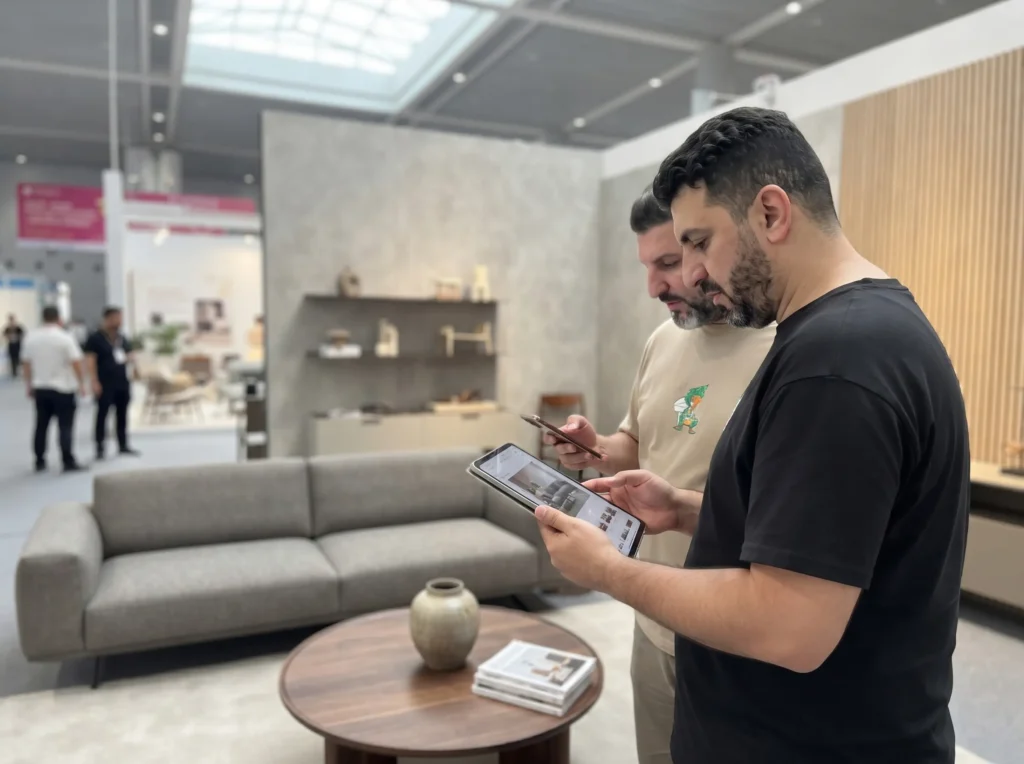
Lift the cushions. Get your hand under the frame — joints, fasteners, dust cover. Walk around the back and look at the rear panel: finished there, or does it fall apart where the cameras never go? Work every drawer, every recliner mechanism, twice. Run a finger along the piping.
None of this predicts ten thousand units. What it predicts is attitude. Factories that finish the invisible parts tend to control the visible ones. Furniture Discover has found this holds up more often than any front-of-sofa impression.
Talk while you handle. Has this unit been repaired since it was built? Which materials in this exact piece match your quotation, and which are stand-ins? Watch the pause before the answer — it’s as informative as the answer.
Ask One Question Nobody Asks
Beyond the booth, push past the product and into the process. Most buyers never do, which is why most buyers get surprised.
Can you see this category on the line, in production, not in a showroom? Does the exhibit match the quote — same fabric model, same dimensions, same configuration? Who approves a material substitution, and does anyone tell the buyer when it happens? For project orders: what’s the packaging method, what does the schedule look like, where do inspections fall?
Boring questions. They save real money.
“As Per Approved Sample” — Handle With Care
This clause shows up everywhere, and it’s not useless. Sale by sample carries genuine legal weight in some jurisdictions; in others it depends entirely on the contract and the governing law. The practical catch is simpler than the legal one: a physical object invites interpretation.
“Close to the sample” means something precise to you. To a production manager two weeks behind schedule, it can mean something else.
The way out isn’t ditching the sample. It’s giving the sample a supporting cast:
| Instead of | Write |
|---|---|
| Bare “goods as per approved sample” | A spec sheet with tolerances — dimensions, fabric GSM, foam density, wood species, hardware brand |
| A sample nobody documented | A labeled reference sample: order number, version, date, photos, both signatures |
| “Similar fabric” | Named material grades, substitution only with written approval |
| No inspection method | Sampling standard and edition, inspection level, defect categories, acceptance and rejection numbers |
| Silence on failure | Remedies and the dispute process, agreed before the deposit leaves your account |
One line that prevents more arguments than it has any right to: when sample, drawings, spec sheet, and PO disagree, the contract states which document wins.
AQL, Without the Mythology
AQL means Acceptance Quality Limit, and the first thing to know is what it isn’t. It isn’t a zero-defect promise. It isn’t a pass mark stamped on your whole future relationship with a factory.
Under ISO 2859-1 — currently ISO 2859-1:2026, which replaced the 1999 edition — AQL is a parameter for designing a sampling plan. You pull a sample, you inspect it, you compare against limits both sides agreed on. That’s the whole trick. A disciplined snapshot, not a guarantee.
| Specify | In plain terms |
|---|---|
| Standard and edition | ISO 2859-1:2026, by name |
| Inspection level | General or special — agreed before production |
| Defect categories | Critical, major, minor, defined for your product’s use and safety requirements |
| AQL values | One per defect category. Never one number for everything |
| Decision rules | Sample size, acceptance number, rejection number |
| Timing | In-process checks plus a final random inspection, agreed up front |
Where do buyers slip? They write “AQL 2.5” and move on. Then a dispute arrives and nobody agrees whether a wandering seam is major or minor. Define your defect categories first. Numbers come second.

The Expensive Mistakes
Falling in love with the booth sample is the classic. It earned your attention — let it. But sign the order because of documents and process, not because a sofa felt magical under exhibition lighting.
Trusting the clause “as per approved sample” to replace a specification is the second classic. It can’t. It never could.
Skipping the sealed reference sample is the third, and it’s the cheapest mistake on the list. An afternoon’s work. Almost nobody does it. And when disagreement starts, you’re comparing objects instead of memories — which ends conversations faster than any email chain.
Different Buyers, Different Plays
No single quality plan fits everyone. Volume, complexity, shipment value, and the cost of failure all move the math. Roughly:
Importers and Wholesalers
You have volume, which is leverage. Spend some on process. Get a pre-production sample from the real order materials. Book in-process checks plus a final random inspection, with the criteria settled before production starts — not after the first problem.
Retail Buyers and Chains
Your customers will live with these pieces for years. Foam density, fabric abrasion ratings, frame construction — these go in the contract by name, with lab reports behind them where the stakes justify the cost.
E-commerce Sellers
One bad container becomes reviews you can’t delete. Inspect representative units before listing or reordering. Keep the PO, specs, sample records, and inspection reports together; when a platform dispute opens, that file argues better than you will.
Individual and Small-volume Buyers
You probably won’t get a pre-production sample at your volume — accept that and load the front end instead. Materials confirmed in writing, with grades and densities. Production photos at each stage. And a payment method whose protections you’ve verified yourself, not assumed.

Questions Buyers Actually Ask
Does a beautiful sample mean the factory is good?
It means that unit came out well. Useful signal, incomplete picture. Better signals: documented production readiness, an approved pre-production sample, inspection criteria both sides signed.
Does “as per approved sample” protect me?
It can — it’s a real contractual reference in many setups. It stops protecting you the moment materials, tolerances, and inspection methods were never defined. Sample plus paperwork plus inspection plan. The system is the protection, not any single piece.
Pre-production sample versus production sample — what’s the difference?
Timing. A pre-production sample happens before mass production, to prove the factory can hit your standard. A production sample comes out of the actual run — evidence of what the line made on a given day, flaws included.
What do I check on a sample at Canton Fair?
The unglamorous zones. Rear panels, underside, cushion seams, corners, piping, hardware. Then ask which materials match the production quote — and listen to the pause before the answer.
What quality terms actually hold up?
Three things, together: a spec sheet with measurable tolerances, a jointly identified reference sample, and an inspection plan naming the standard, the defect categories, and the remedies. Any one of these alone? Thin. Together? Solid.
Ever Caught the Difference Too Late?
What drifted on you — materials, workmanship, something structural? How’d you spot it, and how did it end? Leave it in the comments. Somebody reading this is about to place the order you placed.
Recommended Resource
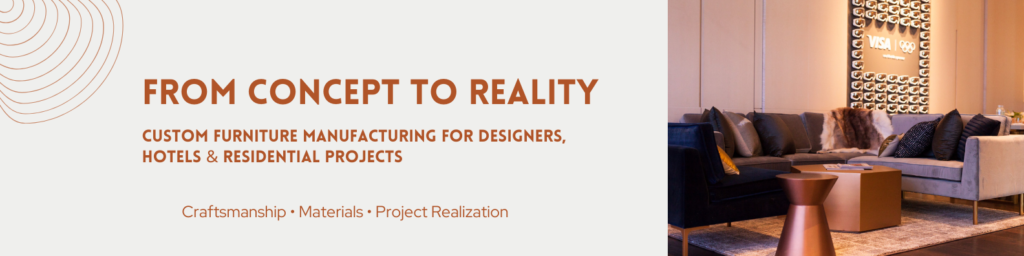
Interi Furniture specializes in custom furniture manufacturing for residential, hospitality, and commercial projects. Their experience in materials, craftsmanship, and project realization makes them a valuable resource for designers and buyers seeking tailored furniture solutions from China.