









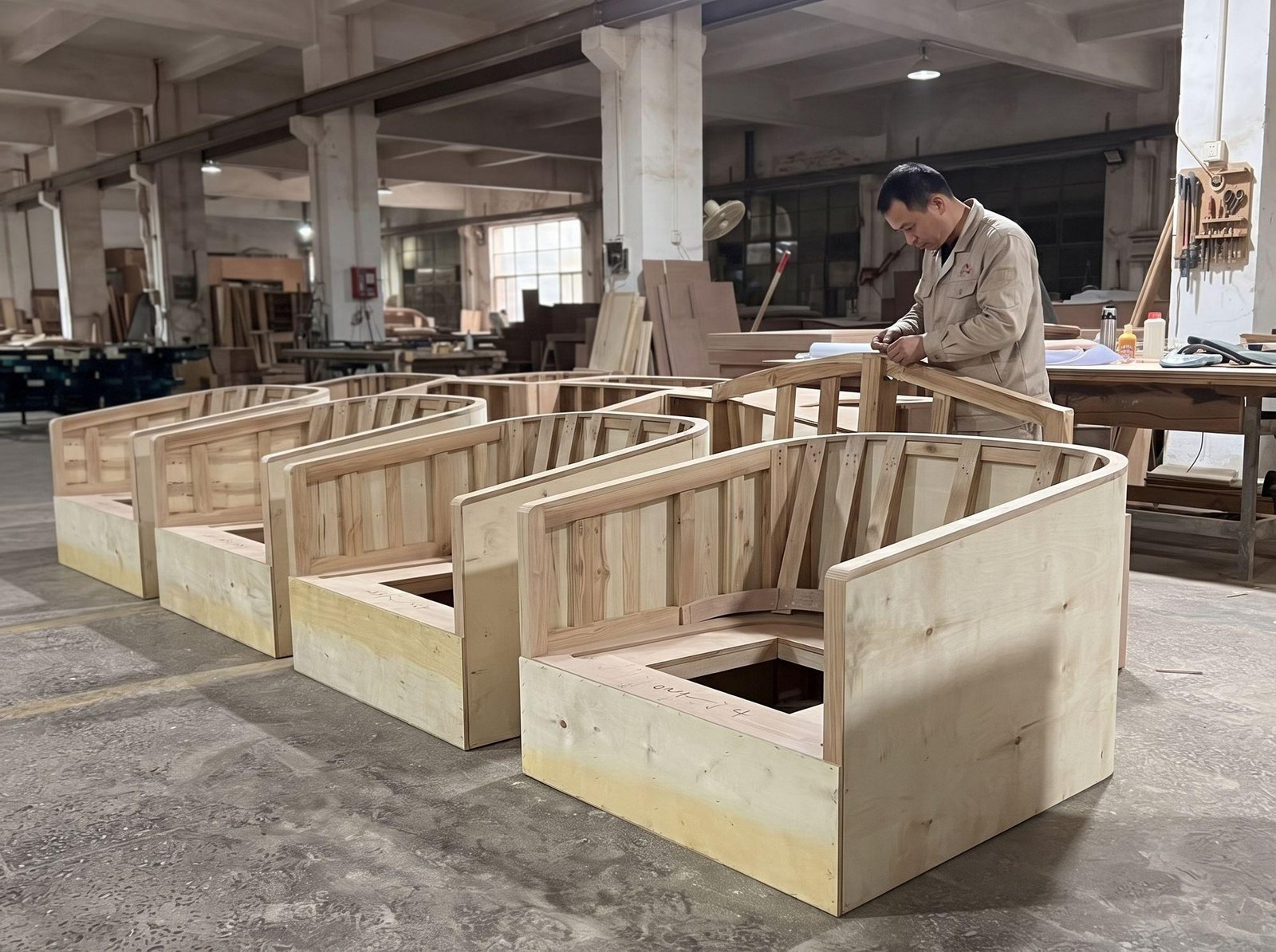
Three to five times.
That’s the number. Raw timber to finished frame. Not 1.5×. Not “a little extra.” Three to five times the wood price lands on your invoice.
I remember the first time a factory owner in Longjiang walked me through his actual numbers. We were standing in a sawdust-covered office above the kiln room. He pulled out a notebook—actual paper, not Excel—and showed me: $680 per cubic meter for rough white oak at the port. By the time it became a sofa frame? $2,400 worth of that same wood, buried inside the upholstery.
“Most buyers,” he said, “they think we’re stealing. We’re not. We’re just bad at explaining where the money goes.”
He wasn’t wrong.
Stage One: The Tree Becomes Boards (And Half Disappears)
You start with a log. Round. Heavy. Full of water.
Saw it into boards. Simple, right?
Except the bark comes off. The wane—that curved edge where the round log meets the flat board—gets trimmed. Knots get cut around. By the time you’ve got usable dimensional lumber, you’ve lost 35% to 45% of what you started with. Sometimes more.
A factory I visited in March 2025 was buying rough white oak at $620 per cubic meter, landed in Shenzhen. Their No. 1 Common grade—industry-speak for “decent but not perfect”—yielded about 58% clean stock after initial sawing. The rest? Sold to a plywood mill down the road for ¥800 per ton. Not wasted, but not frame material either.
Here’s the part that surprised me: some suppliers buy lower grade and sort aggressively. That “premium ash frame” in your showroom? Might have started as B-grade rough stock that a sharp-eyed sawyer managed to salvage. Legal. Common. Rarely disclosed.
Stage Two: The Kiln (Where Patience Costs Money)
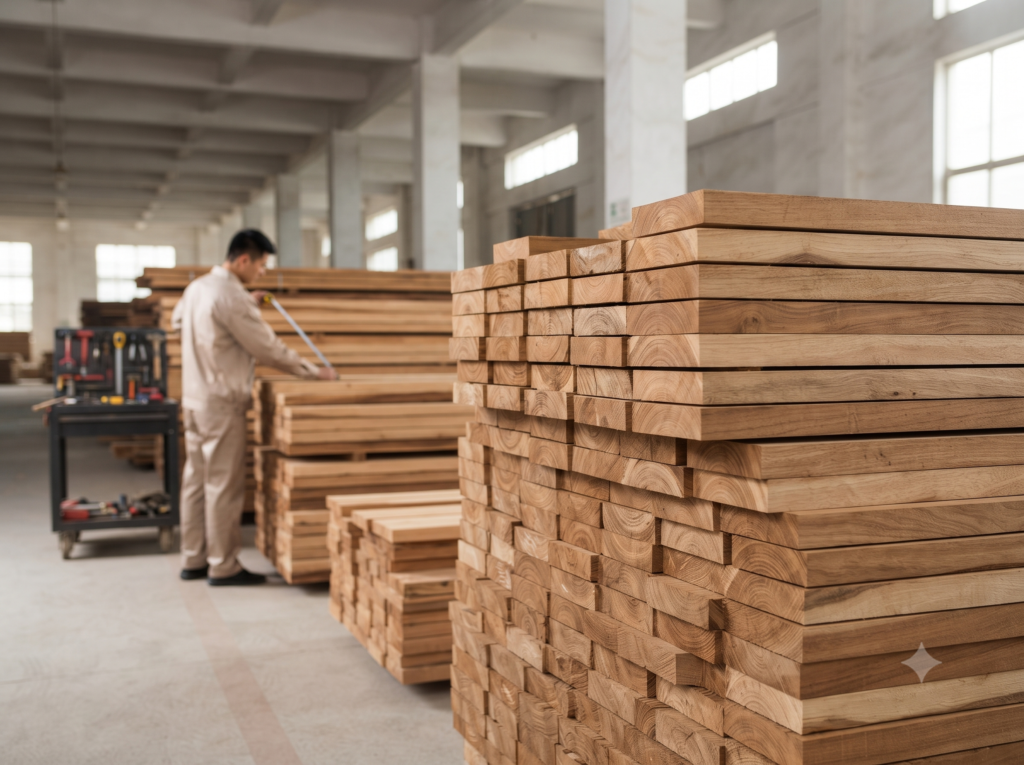
Green wood is 40% to 60% water. You can’t build furniture with that. It’ll warp, crack, grow mold inside the cushions.
So into the kiln it goes. Two to four weeks for hardwoods. Electricity bills pile up. Floor space gets tied up. And while the wood dries, it shrinks. Cracks on the ends. Surface checking. You lose another 8% to 15%.
I watched a kiln operator in Dongguan check his pin meter. “Oak’s finicky,” he told me. “Rush it, and you’ll pay later.” His cycles ran 18 days minimum. The factory next door? Twelve days. Same wood. Same price. Different warranty claim rate six months out.
The shortcut everyone’s tempted by: skip the conditioning phase. After the kiln, wood needs to sit and equalize to room humidity. Takes 3-5 days. Some factories ship immediately. Wood continues drying inside the sofa. Joints loosen. Rails bow. Customer calls angry.
That factory owner in Longjiang? He showed me a photo on his phone. A $4,200 sofa, six months old, front rail cracked clean through. “Rushed drying,” he said. “Saved $12 on the frame. Cost me $400 to fix.”
Stage Three: Milling (Where Yield Gets Brutal)
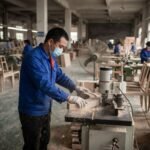
Dried boards go to the rip saw. Then the planer. Then the jointer.
Each step removes material. Knots get cut out. Wane gets trimmed. Boards get squared to consistent dimensions. By the time you’ve got clean, dimensioned frame stock, that 1.2 cubic meters of rough oak? You’re looking at 0.6, maybe 0.7 cubic meters of usable wood.
A skilled sawyer in Longjiang earns about ¥7,000 a month. His job isn’t cutting—it’s saving. A good sawyer reads the grain, plans the cuts, extracts maximum value from every board. Bad one? Turns margin into sawdust.
The yield numbers hurt: 25% to 35% total yield from rough log to finished frame parts. For complex curved designs—chesterfield arms, barrel backs—sometimes below 30%. Seventy percent of the wood you paid for never makes it into the frame.
Stage Four: Joinery (The $80 vs $180 Difference)
This is where the market splits.
Mortise-and-tenon. The gold standard. A skilled joiner manages 8 to 12 complex joints per hour. Each one interlocks, distributes load, lasts decades.
Or pocket-hole screws. Five minutes. Drill, drive, done.
Labor cost gap? Roughly 3× to 4× per joint. On a standard three-seat frame with 16 major joints, that’s the difference between $80 and $180 in labor alone.
I sat with a factory manager in Shunde last year. He showed me two frames side by side. Same oak. Same dimensions. One had mortise-and-tenon throughout. The other used screws for everything except the visible front rail. “The screw one,” he said, “sells for $40 less. Most buyers never know.”
He was right. Upholstery hides everything.
Stage Five: Assembly and QC (Where Good Factories Earn Their Money)
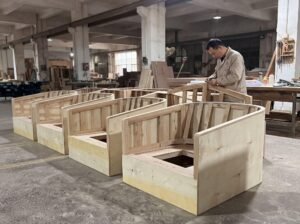
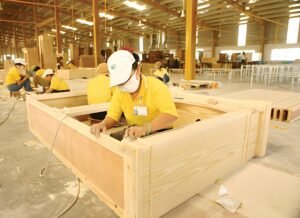
Glue. Clamps. Square it up. Check for cracks. Sand through three grits. Stain or seal.
Then QC. First-pass yield rates run 85% to 95% in well-managed factories. That 5% to 15% that fails? Gets repaired or scrapped. Cost lands on the good units.
A strict QC line checks every frame. Glue squeeze-out. Hairline cracks. Dimensional tolerance. One factory I audited in 2024 had a dedicated inspector who tapped every joint with a mallet. “Listen for the sound,” she told me. “Solid thunk means good. Hollow ring means air gap. Reject.”
The cheap way out? Spot-check 10%. Ship the rest. Hope for the best.
Wood Species: Why “Solid Wood” Doesn’t Tell You Much
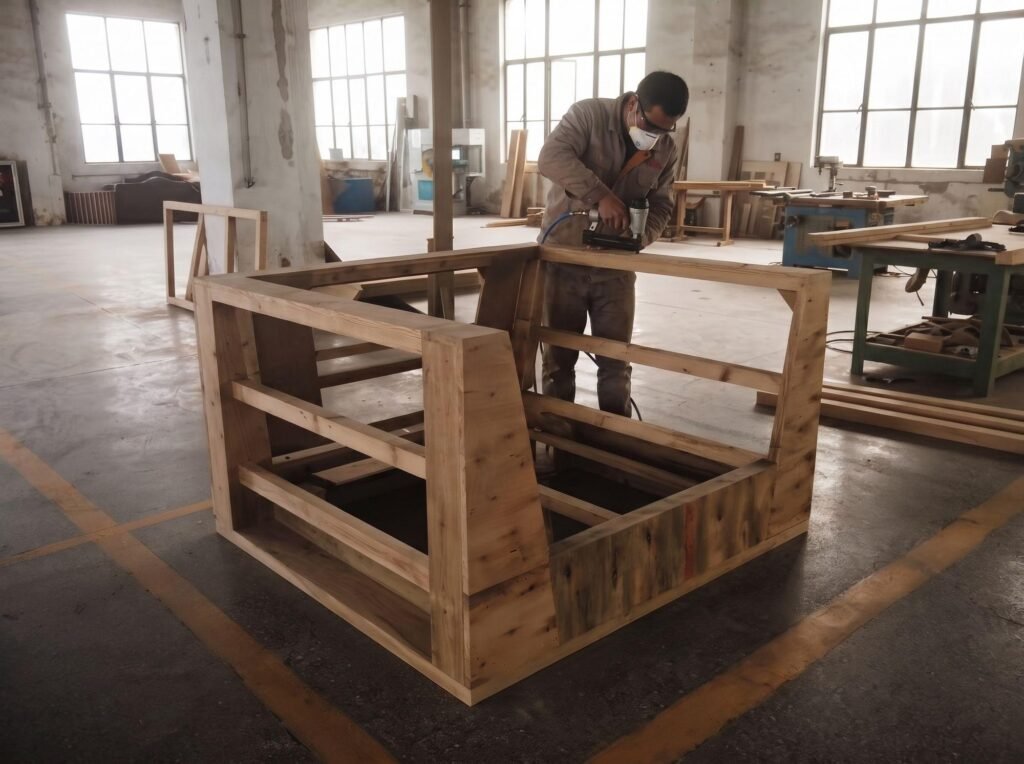
Here’s what four common species actually cost and yield:
White ash — raw timber around $500-700 per cubic meter. Machines well, takes stain beautifully. Yield to frame: 28% to 35%. Final multiplier: 3.5× to 4.5×. The workhorse of mid-range frames.
White oak — $600-900 per cubic meter. Dense. Hard. Premium positioning. But it fights the tools—more waste, slower cutting. Yield drops to 25% to 32%. Multiplier climbs to 4.0× to 5.5×. That $180 oak frame? It’s expensive for real reasons.
Southern yellow pine — $300-450 per cubic meter. Soft. Easy to work. Dents if you breathe on it. Yield’s better—35% to 42%. Multiplier: 2.5× to 3.5×. Budget frames love it. Just don’t expect it to survive a move.
Rubberwood — $350-500 per cubic meter. Plantation-grown, mostly from Malaysia and southern China. Stable, consistent, eco-friendly story. Yield: 30% to 38%. Multiplier: 3.0× to 4.0×. The sweet spot for a lot of mid-market production.
The kicker? A factory quoting “solid wood frame, $85” is almost certainly using pine with screws. Another quoting $175 is probably oak with mortise-and-tenon. Without knowing species and joint type, the price is meaningless.
Six Hidden Costs That Inflate Your Quote
Beyond the production chain, six more factors push the number up.
Wood grade. FAS grade costs 20% to 40% more than No. 1 Common. More knots to cut around. More waste. Budget factories buy Common and hope you don’t ask.
Glue quality. Industrial structural PVA runs 2× to 3× more than hardware-store stuff. Cheap glue fails when humidity cycles stress the joint. I’ve seen frames where the glue line cracked before the sofa left the warehouse. Factory owner’s response? “Customer won’t see it for six months.”
Environmental compliance. Full dust collection, VOC capture, wastewater treatment—adds 5% to 10% to overhead. The factory skipping all that? Cheaper quote. Higher risk.
Seasonal timber swings. Hardwood prices move 10% to 20% annually. U.S. housing starts, shipping rates, Chinese demand—all of it feeds into the price of your frame. A quote from March might be dead by August.
Design complexity. Straight rails? Easy. Curved back? CNC time doubles. Waste piles up. That beautiful scrolled arm costs more than the plain one next to it.
Order volume. Under 50 units, setup costs kill you. Programming the CNC. Setting up jigs. A 500-unit batch spreads that cost thin. Your 20-unit custom order? You’re eating the full setup.
The Six Shortcuts (And How to Catch Them)
Mixed species bait-and-switch. Front rail: oak. Back rail: poplar. Stretchers: rubberwood. Flip the sofa. Different color? Different grain density? You’re looking at a composite sold as “all oak.”
Rushed kiln drying. Under-dried wood feels heavy. Sometimes smells sour. Ask for moisture content records. Reputable factories test with pin meters and keep batch logs. The ones that don’t? Gambling.
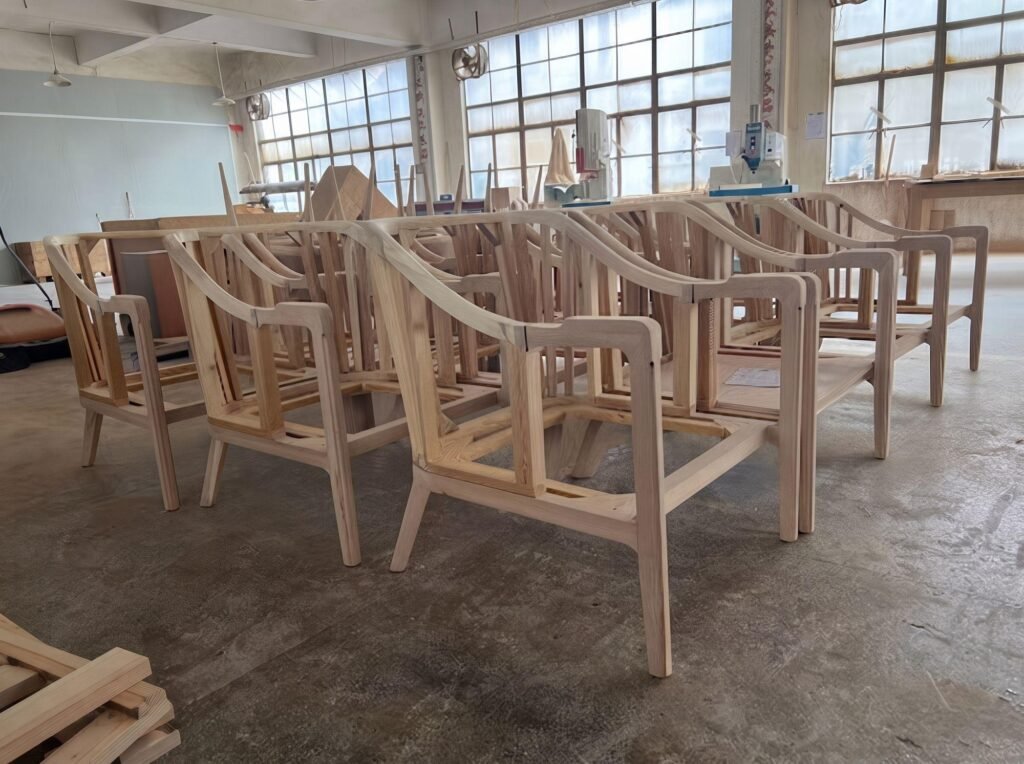
Screws instead of mortises. Lift the sofa. Check the joints. Mortise-and-tenon shows clean interlocking wood. Screw assemblies show plugged holes or metal brackets. Staples are fine for webbing attachment. Not for holding up a person.
Green wood in hidden spots. Some factories kiln-dry only the visible pieces. Internal rails get cheaper, wetter stock. Result: squeaking, loosening, distortion within a year. Warranty expires. Customer blames the brand, not the factory.
Slimmed-down rails. Standard front rails: 3 to 4 inches tall, 1 to 1.25 inches thick. Budget frames shrink to 2.5 by 0.75. Less wood. Less cost. Less durability. Measure if you can.
Fake corner blocks. Real ones are solid wood, glued and screwed. Cheap frames use plywood triangles—or skip them. I saw a “corner block” once that was literally a scrap of MDF held on with two staples. The factory called it “reinforced.”
B2B Buyers: How Pros Verify Frame Quality
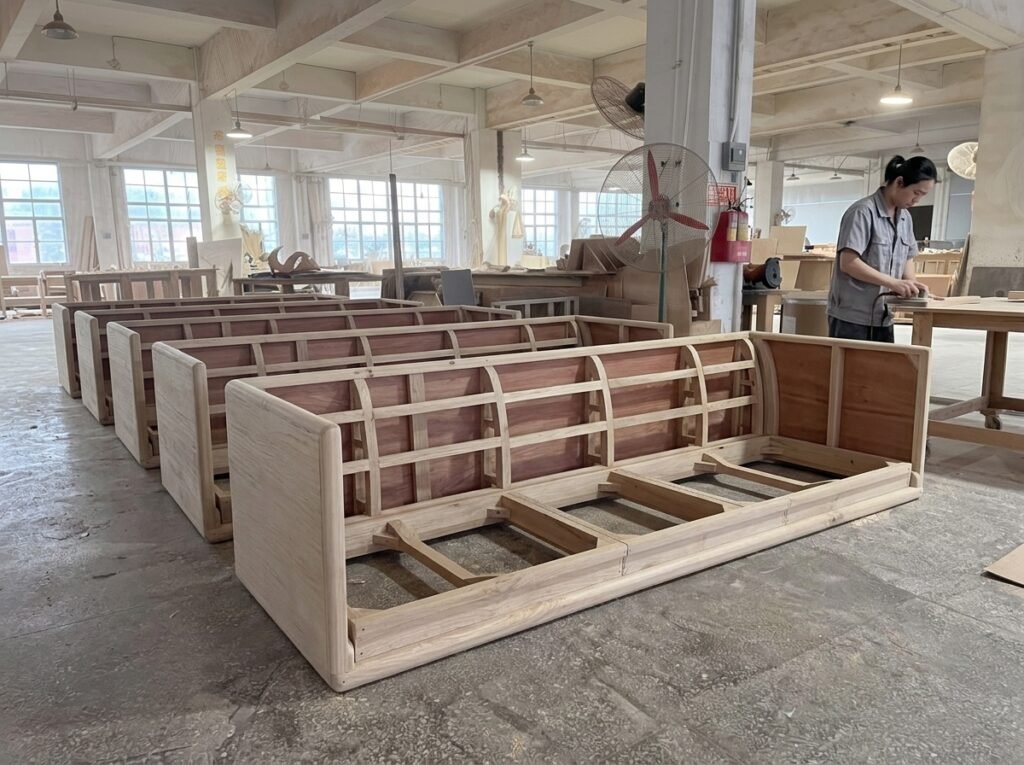
Get the BOM. Bill of materials. Wood species, dimensions, quantities per frame. Cross-check against industry yield rates. If the math doesn’t work, ask why.
Moisture test on arrival. Pin-type meter. Exposed frame members. Above 14% in a controlled warehouse? Red flag. I’ve caught “kiln-dried” oak at 18%. Factory’s excuse: “Maybe the meter’s wrong.” It wasn’t.
Disassemble a joint. First-article inspection. Mortise-and-tenon should show full glue coverage, tight shoulder contact. Screws should be structural grade, not drywall screws, penetrating 1.5 inches minimum.
Load test. 300 pounds static weight, center of seat frame, 60 minutes. No creaking. No separation. No permanent deflection. BIFMA X5.4 baseline. If the factory refuses this test, walk.
Trace the wood origin. FSC claims need chain-of-custody documentation. Illegal logging isn’t just unethical—it’s a customs seizure waiting to happen in the EU or North America.
For Home Buyers: Five Quick Checks
Read the spec sheet. “Solid hardwood frame” means nothing. Look for: “kiln-dried oak, mortise-and-tenon construction.” Specifics matter. Vague language hides vague quality.
Lift it. Solid hardwood is heavy. If a three-seater feels light enough to carry with one hand, the frame is either small softwood, engineered wood, or hollow. Weight isn’t everything, but it’s a solid first filter.
Ask about warranty. Ten years or lifetime? Good sign. One year? They know something you don’t.
Peek underneath. Mixed wood colors. Exposed staples on structural joints. Missing corner blocks. Any of these? Walk away. I’ve seen “solid oak” sofas with plywood stretchers and cardboard corner reinforcements.
Price reality. A quality kiln-dried hardwood frame with proper joinery represents 20% to 30% of total manufacturing cost. If the retail price seems impossibly low, they found the savings in the frame.

The Questions People Actually Ask
How much does a solid wood sofa frame cost at factory level?
$45 to $150 for a standard three-seater. Pine with screws at the bottom. Oak with mortise-and-tenon at the top. These are observed ranges from Longjiang and Dongguan factories—general guidance, not guaranteed quotes. Your mileage varies.
Why such a big gap between ash and oak?
Oak is denser, harder to machine, more expensive as raw material. More waste during processing. Ash cuts faster, grows quicker in plantations. The performance difference is real but narrower than the price gap suggests. A well-built ash frame outperforms a poorly built oak one.
Can I trust a “solid wood” sofa under $500 retail?
At that price, the frame is solid wood somewhere. Not everywhere. Expect mixed species, simplified joinery, minimal QC. Three to five years of normal use. For a decade-plus lifespan, budget accordingly.
Is kiln-drying really necessary?
Yes. Non-negotiable. Without it, wood keeps losing moisture unevenly after assembly. Joints loosen. Rails warp. Finishes crack. Kiln-drying is the single most critical step between forest and living room. Skip it, and you’re buying a delayed failure wrapped in fabric.
What’s the most common scam?
Selling mixed-species frames as “all oak” or “all ash.” Visible parts match the label. Structural parts don’t. Always verify the underside and internal rails. The front rail tells you what they want you to see. The back rail tells you what they’re actually using.
The Bottom Line
Solid wood sofa frame cost isn’t magic. It’s math with five stages, multiple leak points, and variables that factories manipulate every day.
The 3× to 5× markup is fair when every stage is done right. It becomes a problem only when shortcuts meet uninformed buyers.
At Furniture Discover, we believe the best negotiation tool is knowing what you’re actually paying for. Trace the chain. Spot the shortcuts. Know fair when you see it.
Recommended Resource
Interi Furniture specializes in custom furniture manufacturing for residential, hospitality, and commercial projects. Their experience in materials, craftsmanship, and project realization makes them a valuable resource for designers and buyers seeking tailored furniture solutions from China.