





That ISO Certificate on Their Wall? It Might Be Photoshopped
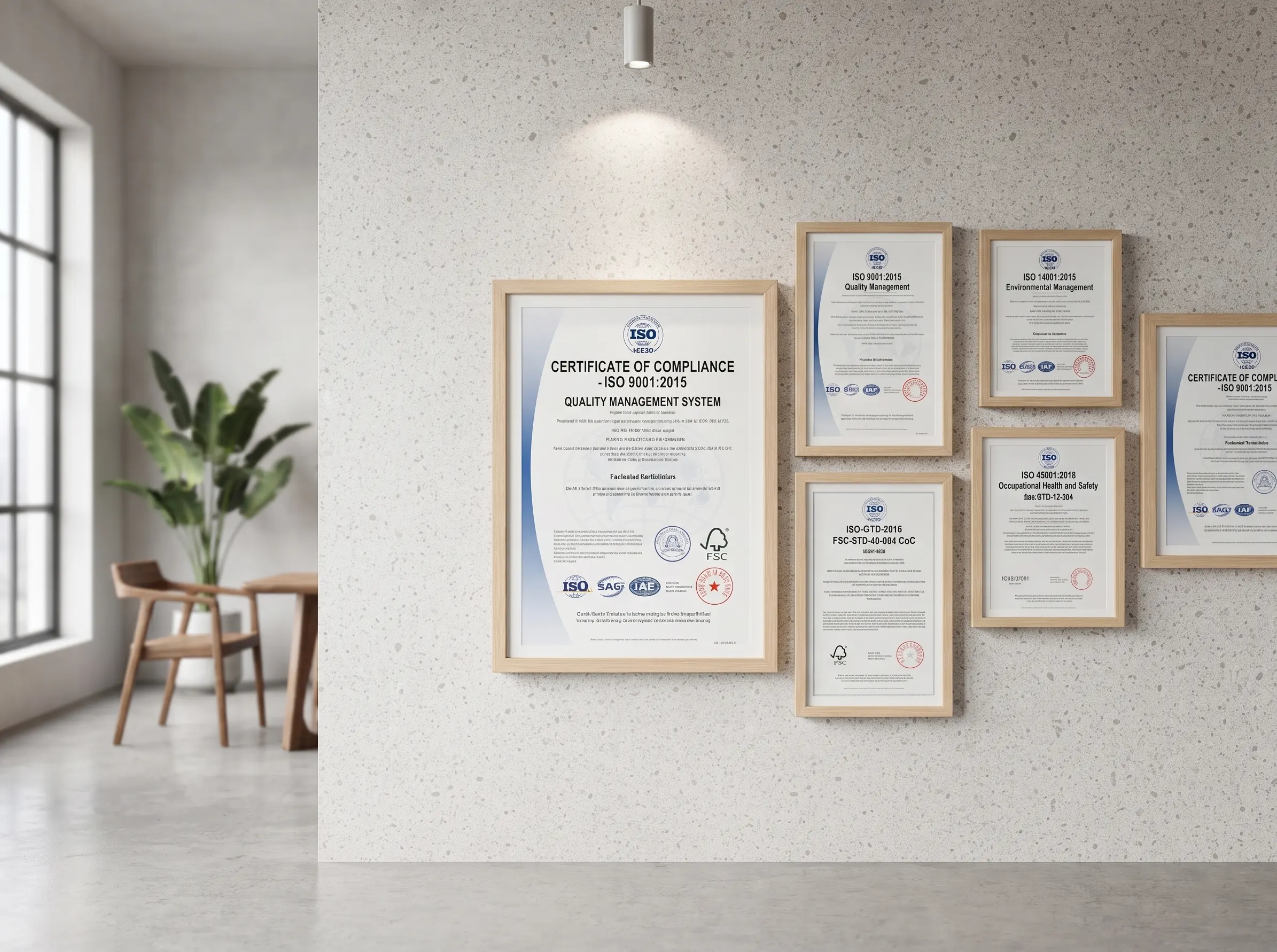
Walk into a factory showroom in Dongguan or Zhongshan and you’ll usually see a wall of certificates. ISO 9001, ISO 14001, BSCI, Sedex, FSC. Framed, laminated, hung with pride. Buyers see them and breathe a little easier: the factory is certified, so it must be legitimate.
That instinct is worth questioning. Fake ISO certificates China have become common enough in furniture sourcing that I’d never treat a framed document on a wall as proof of anything. A factory can buy a convincing-looking certificate for a few hundred dollars: a real-looking certificate number, a QR code that points to a slick verification site built last month, and a signature from an auditor who never walked through the door.
This isn’t a comment on whether Chinese factories are honest. Certification fraud has simply become its own little business, and factory certification fraud in this form is more widespread than most buyers imagine. The audit was never done; the website was made in Photoshop; the certificate was printed at a shop down the road.
Three kinds of certificate fakery
Not every fake looks the same. After auditing suppliers across Guangdong and Zhejiang, I keep running into three patterns:
| What it is | What it looks like | How often |
|---|---|---|
| Wholly forged | Made in Photoshop, fake number, fake signature | Common in small workshops |
| Real, wrong scope | They hold ISO 9001 for plastic toys but show it for furniture | Moderate |
| Real, expired | Valid three years ago, never renewed | Common |
The fully forged one is the boldest. They print something that looks like the real thing, invent a number, and hang it up, betting you won’t check. Most buyers don’t, so the bet pays off.
The “real certificate, wrong scope” trick is quieter and in some ways worse. The factory did pass a real audit and holds a real certificate, just for a different product, a different site, or a different process. They aren’t lying about owning the certificate. They’re lying about what it covers. When quality fails, they point at the frame and say “but we’re certified.”
The expired one is the laziest. They earned a real certificate five years ago, stopped paying the audit fees, and got suspended. The framed paper still looks impressive, and most buyers don’t think to check the date. In my experience this is the most common version: a genuine document that simply isn’t valid anymore.
Why this is so easy to get away with
Buyers ask me how factories get away with it. The honest answer is structural. Global certification bodies work in China through local agents who are paid per audit by the factories themselves. Their incentive isn’t to police fraud; it’s to run audits and issue certificates. A factory that pays on time and doesn’t ask questions is a good customer.
So weak audits are normal, and fake certificates rarely get challenged. Bodies keep a public registry, but it’s updated sporadically, and a small workshop with a forged cert won’t show up on anyone’s radar until a big buyer complains. By then the factory has taken deposits from a dozen buyers and moved on under a new name.
And if you don’t read Chinese, the documents themselves fight you. Audit document verification is also difficult for buyers who don’t speak the language. The verification site might be in Chinese, the phone number might be dead, and the QR code might lead to a domain registered three weeks ago. A buyer who doesn’t know the process has almost no way to catch it alone.
Red flags you can catch in five minutes
You don’t need a forensics degree to spot the obvious ones, so here is what I look for first. The accreditation mark is the easiest check: real ISO certificates carry the mark of a recognized national body, UKAS, ANAB, CNAS, or another, and a certificate with no such mark is like a driver’s license with no state seal. It might look official, but no authority recognizes it. The certificate number is the next thing to test. Every real certificate has a unique number in the issuer’s database, and if it’s missing, malformed, or untraceable on the issuer’s site, it isn’t real. Then there is the auditor’s name. Search it on LinkedIn or the body’s site; if the person doesn’t exist, or is listed in a country with no record of traveling to China, the signature is made up. The QR code tells on them too. Scan it and see whether it goes to the official body or to a generic verification portal with a domain registered three months ago, because fakes almost always point to look-alike third-party sites. Last, read the scope. A real ISO 9001 names the exact scope, say “design and manufacture of wooden furniture,” while fakes tend to say something vague like “quality management systems” or “manufacturing.” Vagueness is where they hide.
How to actually verify one
Here is the protocol I use. It takes about fifteen minutes and costs nothing, and it catches most fakes before any money moves. Start by naming the certification body. Is it SGS, TÜV, Bureau Veritas, Intertek, a name you know? Unknown isn’t automatically fraudulent, but if the body isn’t recognized by the International Accreditation Forum (IAF), the certificate carries no weight outside its own walls. Then check the accreditation mark: find the UKAS, ANAB, or CNAS mark, go to that accreditation body’s site, and confirm the certifier is listed as accredited. If it isn’t, the certificate isn’t accredited no matter how official it looks. The next move is the database. Every major body keeps a public cert database, so type in the number. No match means forged, and a match means read the scope carefully to see whether it covers the product you’re buying and the address you visited. A different address or category means the cert is real but being misapplied. After that, check the dates. Real certs show issue and expiry dates, sometimes a suspension record, and if it expired last year while they claim it’s current, they’re lying. If it was issued three weeks ago but they’ve run for ten years, ask why now, because the answer may expose a history of failed audits. Finish by cross-checking the auditor. Look the name up, then call the body on the number from their global website, not the one on the certificate, and ask them to confirm the assignment and audit date. No record of the audit means no certificate was ever issued.
Why factories do this
The economic logic is simple. In the Chinese furniture market, certifications are a ticket to the table. A factory without ISO 9001 doesn’t get the meeting. So they can either build a real quality system or buy a fake cert for a tenth of the cost.
And the fake cert does more than decorate the wall. It filters. It quietly weeds out buyers who won’t verify, who tend to be newer, less demanding, and slower to catch quality problems. The factory isn’t trying to fool everyone. It’s trying to fool the easy marks. The buyers who check the certificate are usually the same ones who inspect production, hold suppliers to spec, and enforce penalties. The factory doesn’t want those buyers. It wants the one who sees the frame and signs the deposit.
That’s why a fake certificate isn’t just a lie. It’s a tell. It says something about how the factory treats diligence and how much it’s willing to cut before the first order. That’s not who I’d want to partner with.
What to do when you find one
If due diligence turns up a fake, you’ll be tempted to confront the factory and hear them out. In my experience that’s usually a mistake. A factory showing a fake cert has already decided to deceive you; whatever they say next is rehearsed to limit the damage. They’ll blame a misunderstanding, a miscommunication, a former employee who “made a mistake.” They won’t tell you that fakery is just how they operate.
My advice is to walk. Finding a new supplier costs less than managing one that’s already proven it will lie to your face. There are thousands of factories in China. The one with the forged cert isn’t cheaper or faster. It’s just riskier, and in furniture sourcing, risk is the one thing you can’t afford.

FAQ
How common are fake ISO certificates in Chinese furniture factories?
In my experience, roughly 20 to 30 percent of small and mid-sized workshops display certificates that are forged, expired, or misapplied. The rate is lower for large exporters, but it never hits zero. Treat it as a standing risk, not a rare exception.
Can a factory with a fake cert still make good product?
Sometimes, but I wouldn’t bet on it. A factory that buys a fake instead of building a real system is telling you it values appearance over substance. Even if the first batch is fine, without process control the quality usually drifts by later batches. Quality without a system is luck.
What’s the fastest way to verify a cert on a video call?
Have them show it on camera and read the number aloud. While you’re still on the call, type it into the body’s database on your own screen. If they get evasive or need time to “find the right document,” that’s your answer. Real factories know their cert numbers by heart.
Are BSCI and Sedex audits faked too?
Yes, about as often as quality certs. The usual trick is reusing a real report from a different factory or a different year. Always verify through the official platforms, amfori BSCI and Sedex both have public verification systems, and never trust a PDF on its own.
Should I pay for my own audit instead of trusting their certificate?
For any order over fifty thousand dollars, yes. An independent audit through a recognized body runs two to four thousand dollars, under one percent of the order value, and it’s the only way to know the factory meets your standard rather than its own claim.
Recommended Resource
Interi Furniture specializes in custom furniture manufacturing for residential, hospitality, and commercial projects. Their experience in materials, craftsmanship, and project realization makes them a valuable resource for designers and buyers seeking tailored furniture solutions from China.