







Walking into CIFF unprepared is exactly like walking into a casino with your savings. The house always wins. Most first-time buyers leave Guangzhou or Shanghai with nothing but a stack of unread business cards and a lighter wallet because they triggered the factory sales rep’s “tourist” reflex within the first thirty seconds of conversation. This first time CIFF guide maps the seventeen behavioral signals that separate serious buyers from browsers, explains the real cost of each mistake, and gives you the operational playbook to move through the showroom floor like a buyer who has done this ten times before.
The Real Anxiety Behind Your First CIFF Trip
You are not alone in feeling overwhelmed. CIFF Guangzhou spans roughly 850,000 square meters across the Pazhou Complex, utilizing approximately 90 halls. CIFF Shanghai fills the National Exhibition and Convention Center in Hongqiao with over 1,500 exhibiting brands across multiple halls; exhibition area figures vary by source and statistical methodology, ranging from approximately 300,000 to 550,000 square meters. For a first-timer, the sheer scale creates cognitive overload before you even clear security. You worry about looking like a tourist. You worry that factory reps will quote you retail prices while whispering real ex-factory numbers to the serious buyer standing next to you. You worry about burning airfare and hotel costs with nothing to show for it. That anxiety is rational. The gap between a rookie and a professional at CIFF is not money or volume. It is behavioral fluency. Factories make snap judgments based on signals most rookies do not even know they are sending.

What Actually Happens on the Showroom Floor
Let us kill some myths before we get to the mistakes. The “show special” banner hanging above a sofa set is rarely the year’s lowest price. It is a traffic magnet. The real negotiation window opens on the final afternoon of the show, when factory sales teams are staring at empty trucks and calculating whether to haul unsold samples back to Dongguan or Foshan. That is when a prepared buyer who has already built rapport can lock in terms that beat the opening-day “special” by double-digit percentages.
Factories sort visitors into categories within thirty seconds. The rep is not being rude. They are managing finite time across thousands of booth visitors. If your first question is “How much for one piece?” you just triggered the retail channel. If you walk in with a camera around your neck, shorts, and running shoes, you are getting the tourist treatment. Once that label sticks, the pricing channel rarely resets. The sales rep will smile, hand you a catalog, and mentally move on to the next visitor.
Then there is the showroom company problem. CIFF is packed with trading companies operating fancy booths that look indistinguishable from genuine manufacturers. They rent space, display curated samples, and pose as factories. A rookie signs an order, pays a deposit, and only discovers weeks later that their “factory” is a middleman adding fifteen to thirty percent markup before forwarding the order to the actual production line. For reference only, subject to official verification: industry observers estimate that trading companies or speculative resellers (what Chinese insiders call “chao huo” operators) may represent a significant minority of exhibitors in certain CIFF zones, particularly in accessory and soft-goods halls.
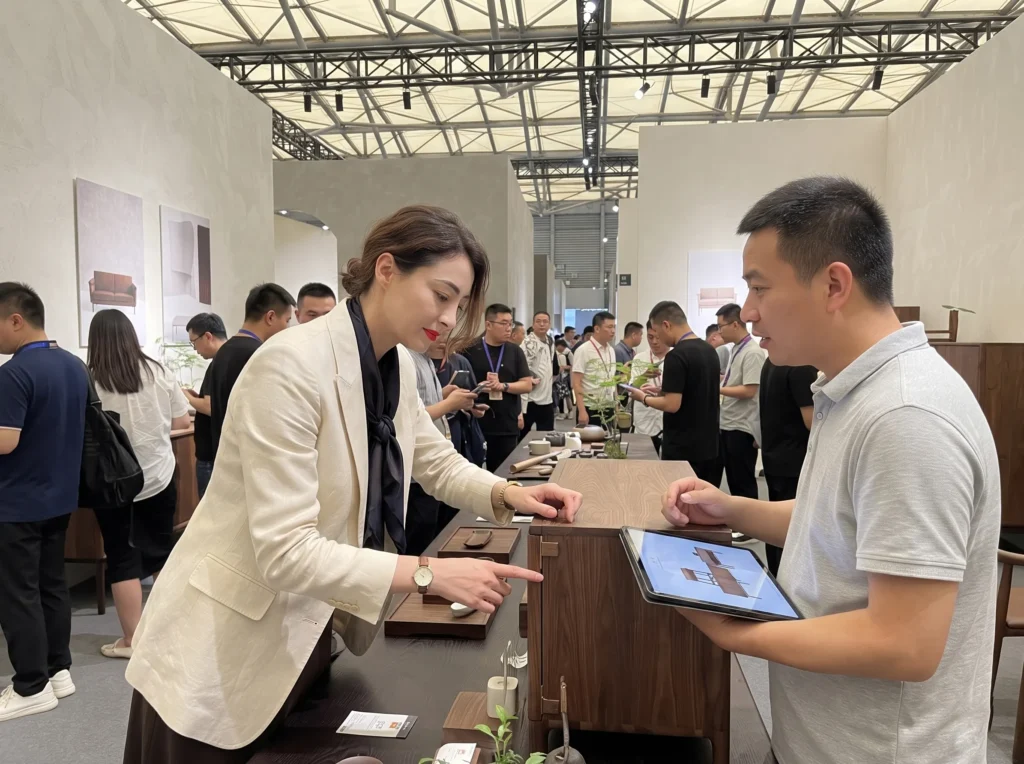
The 17 Mistakes: Behavioral Signals and Their Real Costs
The following table breaks down the exact errors we see every season on the Pazhou and Hongqiao floors, what the factory sales rep reads from each action, and the concrete financial or opportunity cost you pay.
| Mistake | What the Factory Reads | Real Cost |
|---|---|---|
| Wearing tourist gear — shorts, sneakers, camera strap visible | Leisure traveler, not here to buy | Routed to retail pricing or ignored |
| Opening with “Can I buy just one piece?” | End consumer, not B2B | Quoted retail or “market price,” not ex-factory |
| No business cards, or personal cards without company info | No procurement authority, browsing | No follow-up priority; contact info discarded |
| Snapping photos without asking permission | Competitor spy or casual tourist | Escorted out of sample viewing area; relationship damage |
| Asking “How much?” without MOQ, FOB port, or destination context | No sourcing experience | Factory tests you with an inflated anchor price |
| Arriving Day 1 morning without appointments | Unplanned browser | Missed the best slots with A-tier sales managers |
| Accepting the first quote without a counter | Unprepared or desperate | You leave 8–20% on the table |
| Believing “Show Special” signs at face value | Gullible, price-driven only | You miss the deeper negotiation window on Day 4 |
| Following off-site “pullers” (la ke zai) to distant showrooms | Easy target for markup traps | Potential overpayment; no CIFF organizer protection |
| Signing Chinese-only intent letters or contracts | Unaware of legal exposure | Dispute resolution becomes nearly impossible |
| Paying large cash deposits to unknown booths | High risk of non-delivery | Deposit loss; no recourse if booth vanishes post-show |
| Failing to verify business registration or factory certificates | Willing to trust surface appearance | High probability of trading-company markup |
| Asking “Are you a real factory?” directly | Naive; you cannot verify the answer anyway | Rep gives the rehearsed answer; you learn nothing |
| Ignoring the final afternoon of the show | Rigid schedule, not a serious negotiator | You miss the lowest willingness-to-sell prices of the week |
| Collecting every flyer instead of targeted sourcing | No procurement plan | Information overload; zero follow-through |
| Showing up without physical samples, spec sheets, or mood boards | Vague intent; hard to quote accurately | Wasted meetings; quotes that do not match your actual needs |
| Discussing proprietary designs openly without context | Design theft risk or amateur behavior | Factories may clone your concept for other clients |
Tourist vs. Professional Buyer: How Factories Read You
Factories run a silent scoring system. The table below contrasts the signals that trigger the tourist channel versus the professional buyer channel.
| Signal Category | Tourist Behavior | Professional Buyer Behavior |
|---|---|---|
| Attire | Casual vacation wear, backpack, camera | Business casual, comfortable walking shoes, small roller bag or tote |
| First Question | “How much is this sofa?” | “What is your FOB Shenzhen MOQ and lead time for a 40HQ container to Los Angeles?” |
| Card Exchange | No card, or personal mobile number only | Bilingual company card with email, WhatsApp/WeChat, and approximate volume range |
| Note-Taking | Phone photos only | Physical notebook with SKU codes, dimensions, and margin calculations |
| Sample Handling | Touches everything, asks to sit on every piece | Targets specific SKUs, checks construction details, asks about customization |
| Timing | Random booth hopping | Scheduled appointments plus strategic hall routing by product category |
| Follow-Up Language | “I will think about it” | “I will send you our spec sheet by Tuesday; please confirm if your lacquer line can match this Pantone by Thursday” |
CIFF Pavilion Navigation by Product Category
Getting lost in the wrong hall burns half a day. Use the routing logic below to plan your attack. For reference only, subject to official verification: hall assignments shift between phases and seasons, so confirm against the official CIFF exhibitor map before your trip.
| Product Category | CIFF Guangzhou (Pazhou) | CIFF Shanghai (Hongqiao) |
|---|---|---|
| Upholstery & sofas | Area A, Hall 1.2–2.2, 3.2 | Hall 1.1–2.1 |
| Bedroom & mattress | Area B, Hall 12.2–13.2 | Hall 3–4.1 |
| Dining & occasional tables | Area A, Hall 3.1–4.1 | Hall 5.1–6.1 |
| Office & commercial furniture | Area B, Hall 10.3–12.3 | Hall 7.1–8.1 |
| Outdoor & leisure furniture | Area C (Poly World Trade Center) | Outdoor garden zone, seasonal |
| Home décor, lighting, accessories | Area B, lower halls | Hall 5.2–6.2 |
| High-end design / original brands | Area A, premium pavilion | Design-focused zone, upper floors |
Pre-Show, During-Show, Post-Show Action Matrix
Professional buyers treat CIFF as a four-week campaign, not a four-day event. The matrix below shows the split of work.
| Phase | Actions | Tools |
|---|---|---|
| Pre-Show (3–4 weeks out) | Build target list from exhibitor directory; request catalog PDFs; book Day 1 and Day 4 appointments with top 15 targets; print bilingual cards; prepare sample swatches and spec sheets | CIFF official app, Google Sheets, Pantone swatch book, fabric samples |
| During-Show (Days 1–4) | Execute hall routing; take structured notes per booth; photograph booth numbers and sample cards (with permission); negotiate final afternoon; collect factory registration scans | Notebook, booth map, QR code scanner, portable battery |
| Post-Show (Week 1) | Send follow-up within 72 hours; request revised quotes based on confirmed quantities; verify factory registration via SAIC or third-party audit; cross-reference booth samples against Alibaba/Globalsources listings to catch trading companies | Email templates, SAIC lookup, audit platform subscription |
High-Risk Red Flags: Protect Your Money and Your Design
CIFF is generally safe, but the showroom floor has edges that can cut rookies who do not know where to look. Do not pay large cash deposits to a booth you just met. The exhibitor may be legitimate, but if they are a trading company posing as a factory, your deposit becomes a loan to a middleman with no asset base. Get a copy of their business license. Check the registered capital and business scope. If the license says “Trading Co., Ltd.” and the rep insists they own the factory, that is a disconnect worth investigating.
Never follow the “pullers” — the aggressive touts who linger outside the main halls offering “better prices at our other showroom.” They operate on commission. Their target showroom is often a rented space with inflated prices and no CIFF organizer oversight. You lose the dispute-resolution protection that comes with being an on-site registered buyer.
If you are asked to sign an intent letter or any document, demand an English version alongside the Chinese original. Signing a Chinese-only contract when you do not read Mandarin is not a gesture of trust. It is a unilateral surrender of legal clarity. For reference only, subject to official verification: we have observed cases where buyers signed what they believed was a simple “letter of intent” that contained binding exclusivity clauses or non-refundable deposit language buried in the Chinese text.

Audience-Specific Playbooks
Not every buyer at CIFF needs the same strategy. Your profile determines your priority halls, your negotiation leverage, and your sample follow-up rhythm.
Personal Buyers (Self-Build or Renovation)
You are buying for one home, maybe two. Your volume is low, so factories will not prioritize you. Your move is to target exhibitors who already export to retailers in your country and ask if they have stock lots or canceled-order inventory. Visit on the final afternoon when factories would rather clear samples than ship them back. Do not expect ex-factory pricing. Expect a fair “small order” surcharge, and negotiate that surcharge down rather than the base price.
Small Retailers (One to Three Stores)
You need consistent replenishment and reliable quality. Your priority is finding factories with low MOQ flexibility or mixed-container policies. Focus on halls where mid-tier manufacturers cluster. Ask about their existing distributor network. If they already have a distributor in your country, you may be locked out of direct purchasing. If they do not, you have leverage to propose a trial order. Bring your current best-selling SKU dimensions so the factory can quote accurate replacements.
Interior Designers and Project Buyers (Hospitality, Multi-Unit Residential)
You are sourcing for custom projects, not catalog picks. Your risk is design leakage. Do not show full renderings or technical drawings in the first meeting. Use mood boards and finish samples to gauge capability. Ask about their OEM experience with hotel chains or overseas project work. Verify they have a dedicated project sales team, not just a catalog sales rep. Your follow-up timeline should include a factory audit visit within sixty days of the show.

Frequently Asked Questions
Do I need a translator at CIFF?
Most A-tier factory sales reps at CIFF speak functional English. The problem is not language. It is commercial vocabulary. A rep who knows the word “sofa” may not fluently negotiate Incoterms, container loading logic, or defect-rate clauses. If your order involves complex customization or contract terms, hire a sourcing agent or interpreter who knows furniture trade terminology, not just conversational Mandarin. Do not rely on the booth’s “English speaker” to explain your liability exposure.
Is the “show special price” really a special price?
Usually not. It is a marketing hook. The real special price emerges on the final afternoon when the sales team calculates return-shipping costs for unsold samples. A professional buyer uses the first three days to build rapport and gather baseline quotes, then pushes for closure on Day 4 when the factory’s cost of not selling rises sharply.
How do I tell a real factory from a trading company with a fancy booth?
You cannot reliably tell from the booth alone. Trading companies rent impressive spaces and display polished samples. Ask for their factory address and business license registration number. Cross-check the company name on the booth against the SAIC registration. If the registered address is a commercial office in Guangzhou while they claim a 50,000-square-meter plant in Foshan, ask for a video factory tour within one week of the show. A real factory will agree immediately. A trading company will stall or deflect.
Should I bring cash to pay deposits on the showroom floor?
No. Use wire transfer or secure escrow arrangements after due diligence. Cash deposits at a trade show booth offer you zero paper trail and zero recourse if the exhibitor disappears. If a factory insists on cash to “lock in the show price,” that insistence is itself a red flag.
What is the best day to attend CIFF?
Day 1 is for reconnaissance and locked-in appointments with top-priority factories. Day 4 afternoon is for negotiation and closing. Days 2 and 3 are for filling gaps, discovering secondary suppliers, and comparing samples. If you can only attend one day, make it Day 4 — but arrive with prior research so you do not waste precious hours on orientation.
Can I just walk in, or do I need pre-registration?
CIFF requires registration, and the process varies by phase and city. Pre-register online to avoid long on-site lines. Bring your passport and business documentation. Some phases are trade-only and may deny entry to consumers. Check the official CIFF website for the specific phase you are attending.
What Is Your CIFF Story?
We have walked these halls for over a decade, and every season brings new variations of the same rookie errors. If you are preparing for your first CIFF, what is your biggest concern — pricing transparency, finding real factories, or simply navigating the physical scale of the event? If you have already attended, what mistake cost you the most time or money? Drop your experience or question below. We read every response, and the best questions get expanded into future deep dives.
Recommended Resource
Interi Furniture specializes in custom furniture manufacturing for residential, hospitality, and commercial projects. Their experience in materials, craftsmanship, and project realization makes them a valuable resource for designers and buyers seeking tailored furniture solutions from China.