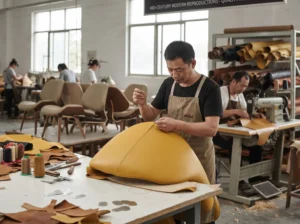


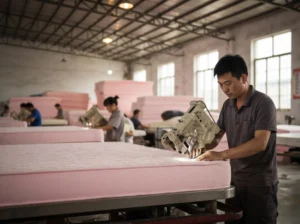

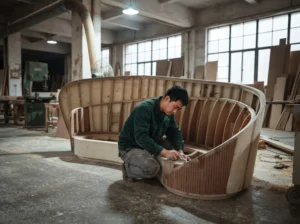
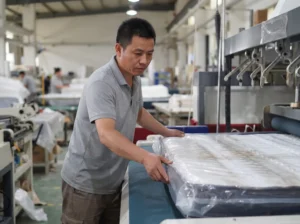





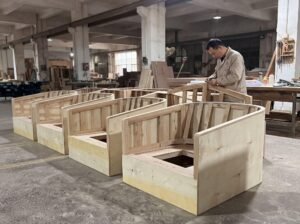
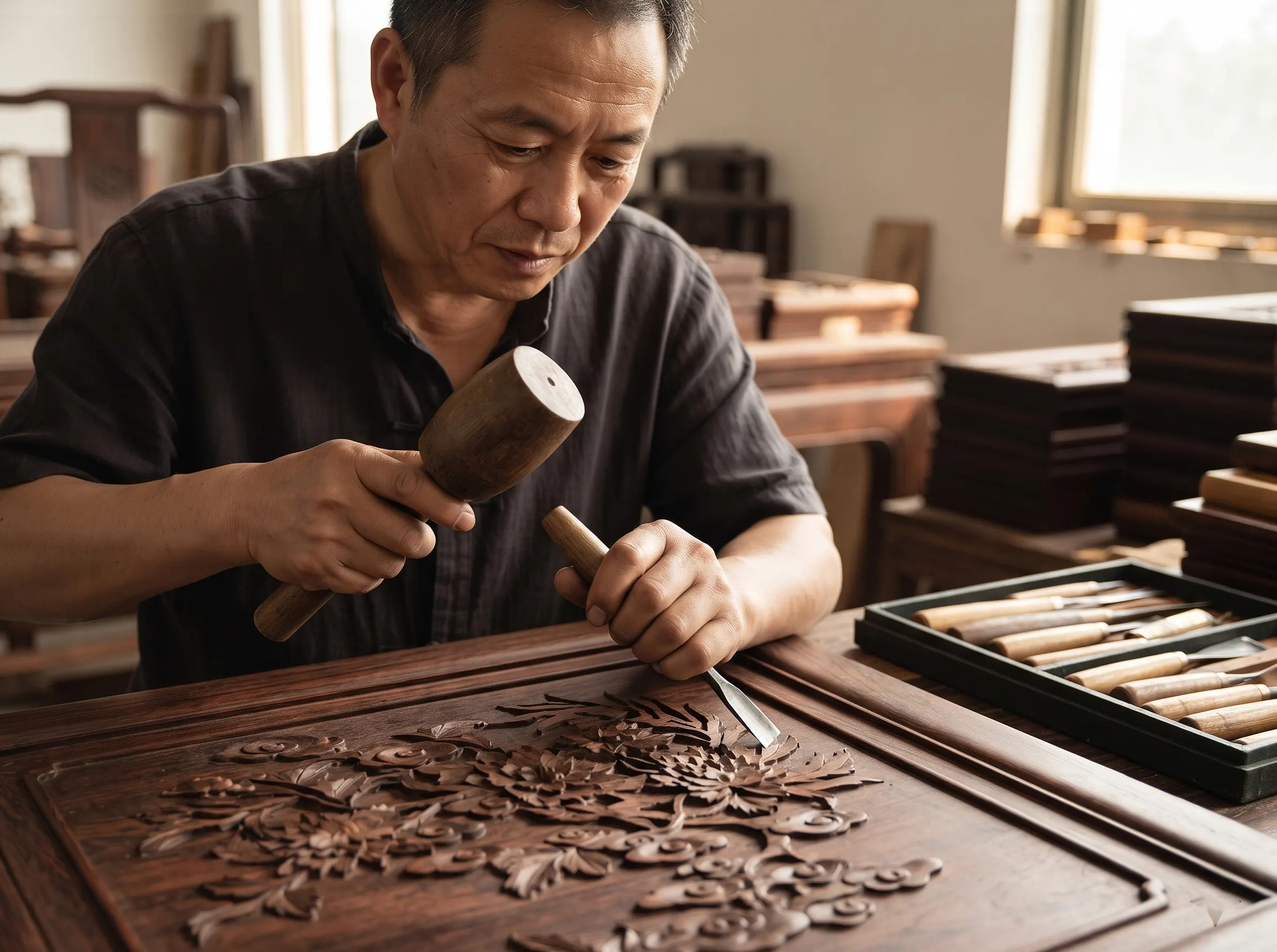
The “craftsmanship spirit” narrative in China’s furniture industry is neither a complete myth nor a universal truth. After walking factory floors in Foshan, Dongyang, and Xianyou, we have seen the full spectrum: genuine artisan workshops where hand-cut mortise-and-tenon joints still outnumber CNC outputs, and marketing theaters where “handcrafted” labels disguise assembly-line production. The reality is sharply stratified. True craftsmanship survives in pockets—high-end custom ateliers, specific rosewood and solid-wood antique reproduction lines, and certain European luxury OEM workshops. For the bulk of export orders, however, “artisan” is mostly a storytelling device. This article maps where real craft lives, where it dies, and how buyers can tell the difference before paying a premium.
The Buyer’s Dilemma: When Showroom Theater Overrides Factory Truth
Every month, we hear variations of the same story from importers and interior designers. A factory tour in Foshan’s Lecong district features a “master craftsman” hand-planing a rosewood surface in a climate-controlled showroom corner. The buyer is impressed, signs a purchase order for fifty units, and six weeks later receives crates of furniture where every joint was cut by a CNC router, every surface sanded by an oscillating machine, and the “hand-applied lacquer” was sprayed through an automated reciprocating system. The gap between performance and product is not accidental. It is a calibrated sales ritual designed to trigger exactly the romantic association Western buyers have with Eastern craft.
This disconnect creates a specific anxiety among overseas buyers. They want to believe in furniture artisan China capabilities. They have seen the Instagram reels of Dongyang carvers working on Buddhist motifs, read the “centuries of tradition” copy on Alibaba storefronts, and been courted by factory owners who claim their workers “inherit the spirit of Lu Ban.” Yet when the container arrives, the dovetails are too uniform, the patina too consistent, and the “hand-rubbed oil finish” feels suspiciously identical to catalyzed lacquer from a spray booth. The result is a trust crisis that hurts both buyers and the small number of factories that actually maintain genuine craft standards. Buyers begin to assume all Chinese craft claims are fraudulent, which pushes authentic workshops further into obscurity while marketing theaters continue to dominate export channels.
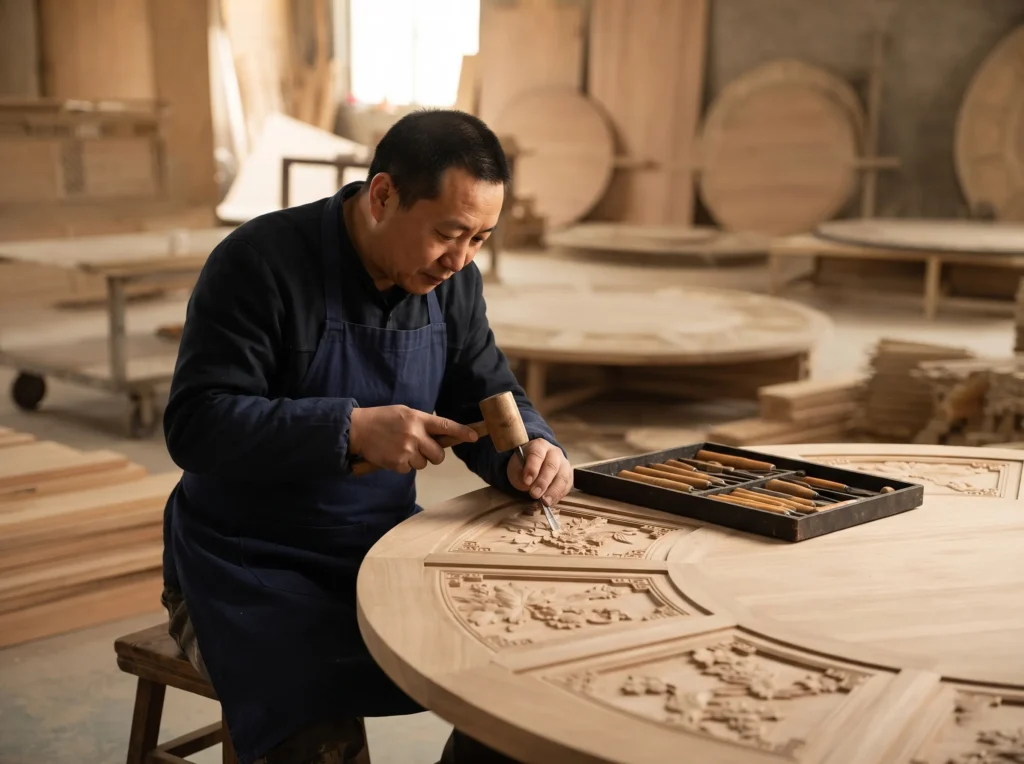
Dismantling the Binary: Where Craftsmanship Actually Lives
The Western media tends to frame Chinese furniture through two lazy narratives. The first is the “sweatshop assembly line” stereotype—cheap, disposable, machine-only, ethically suspect. The second is the orientalist fantasy of thousand-year-old workshops where sage-like masters pass secrets to silent apprentices beneath red lanterns. Neither survives a day on the ground in China’s actual production zones. The reality is far more fragmented and economically rational.
We estimate that workshops maintaining genuine high-ratio handcraft—defined as more than sixty percent of structural and surface work done by hand rather than automated equipment—represent less than eight percent of export-capable factories. For reference only, subject to official verification. Another fifteen to twenty percent blend significant handwork with machine assistance, particularly in carving, assembly, and final finishing. The remaining seventy-plus percent rely on CNC nesting, automatic edge banding, five-axis machining centers, and UV coating lines for nearly every operation. This is not a moral failure. It is a market response to global retail pricing pressure. Handwork cannot meet the price points, tolerances, and delivery schedules that mass retail demands. A hand-cut mortise-and-tenon joint takes twenty to forty minutes. A CNC machine with a dedicated fixture produces the same geometry in ninety seconds. When a buyer demands a forty-dollar FOB side table, hand joinery is mathematically impossible.
What separates the real from the theatrical is not the presence of machines—every workshop uses some—but the intention behind the process. A genuine craft workshop uses a CNC machine to rough-cut a complex cabriole leg, then spends three hours hand-shaping the transitions and grain alignment. A marketing theater uses the same machine to finish the leg, then has a worker spend ninety seconds scuffing it with sandpaper to create “authentic tool marks” before photography. The difference is not in the equipment list. It is in the time allocation and the skill level of the human hand that touches the piece after the machine stops.
Craftsmanship Spectrum: From Artisan Studio to Marketing Theater
| Category | Production Reality | Typical Price Tier | Red Flags for Buyers |
|---|---|---|---|
| True Artisan Studio | Hand-cut mortise-and-tenon, hand-planed surfaces, natural lacquer with 30+ day drying cycles, hand-carved details | $800–$3,000+ per piece | Extremely limited capacity; 8–16 week lead times; no two pieces identical; often refuses large orders |
| Hybrid Craft Workshop | CNC rough-cutting and dimensioning; hand-assembly with traditional joinery; hand-finishing (wax, oil, or hand-rubbed lacquer) | $400–$1,200 per piece | Will show both machine shop and hand-work areas; tolerances tighter than pure handwork; accepts mid-volume orders |
| Machine-First with Craft Accents | Full machine joinery; machine sanding to 320 grit; hand-applied final color layer or selective hand-carving on premium SKUs only | $150–$500 per piece | “Handcrafted” claims apply only to specific SKUs or details, not entire line; high volume capability |
| Marketing Theater | Fully automated production; artificial “hand distressing” added post-production; showroom demo areas that do not connect to assembly line | $80–$300 per piece | Inability to photograph actual production line; identical “hand variation” on every unit; master craftsman appears only in showroom |
Traditional Techniques vs. Modern Manufacturing: Where Each Lives
| Technique | What It Actually Means on the Factory Floor | Where It Survives | Where It Has Disappeared |
|---|---|---|---|
| Hand-Cut Mortise-and-Tenon | Chisels and saws cut joints without metal fasteners; allows wood movement; slower but structurally superior for solid wood | High-end custom solid wood; antique reproduction; some European OEM; select Xianyou master studios | Mass-market “solid wood” lines using screw-and-dowel or biscuit joinery with decorative tenon plugs |
| Hand Carving | Knives and chisels remove material, leaving slightly irregular tool marks and undercut details that catch light differently | Dongyang Buddhist motif specialists; Xianyou rosewood master studios; European luxury carving subcontractors; architectural millwork | Mid-market “carved” furniture using CNC relief routing with shallow, uniform passes; rotary-carved spindles |
| Natural Lacquer (Raw Urushi) | Multiple layers of filtered Toxicodendron vernicifluum sap, each requiring specific humidity and 48–72 hours drying time; allergic reaction risk for workers | Museum-grade reproductions; Japanese market specialists; some high-end domestic brands; art furniture | Nearly all export furniture using catalyzed polyurethane, nitrocellulose, or “waist lacquer” (cashew-based) with 4–6 hour bake cycles |
| Hot Wax / Beeswax Finish | Heated wax applied and buffed by hand; penetrates grain; repairable; low sheen; requires reapplication | Custom furniture workshops serving European vintage markets; some mid-century reproduction specialists; restoration workshops | Standard “wax finish” furniture using wax-infused spray lacquer or one-step wipe-on products that mimic the look without the maintenance |
| Hand Planing | Hand plane creates a slightly undulating surface that reflects light organically; superior glue adhesion for veneer; visible facets under raking light | Small-batch architectural millwork; custom table specialists; Japanese tool-influenced workshops | All standard production using wide-belt sanders and stroke sanders to uniform flatness; surfaces often too smooth for traditional oil finishes |
| Hand Woven Cane / Rush | Natural material woven by hand into seat or back panels; tension varies organically; repairable by local craftspeople | Small workshops in Guangdong and Zhejiang serving European brands; domestic retro specialists | Mass production using paper-wrapped wire or plastic extrusion molded to resemble cane; impossible to repair |
Regional Clusters: Where Real Craftsmanship Survives in China
| Region | Specialization | Craft Authenticity Assessment | Buyer Notes |
|---|---|---|---|
| Foshan, Guangdong | Comprehensive furniture manufacturing; strongest in upholstery, metal, and mid-range solid wood | Mixed. Lecong showroom district is heavy on marketing theater. Shunde and Nanhai have small custom workshops with genuine handwork, but they do not advertise on export platforms | Best for buyers who can visit in person and distinguish demo floors from production facilities; avoid sourcing “craft” from pure showroom operations |
| Dongyang, Zhejiang | Wood carving; Buddhist and traditional Chinese motifs; relief and openwork | High. Carving skill density is real and historically grounded. However, much “Dongyang carving” on export furniture is now CNC-roughed with hand-cleanup | Ask to see the rough blank before carving. True hand carving starts from an unmarked block. If the blank already shows router marks, the handwork is secondary |
| Xianyou, Fujian | Rosewood and hardwood furniture; Ming and Qing style reproductions; mortise-and-tenon tradition | Highest concentration of genuine traditional joinery in China. Master studios exist, but are increasingly outnumbered by CNC-equipped factories using “master studio” branding | Verify if the factory owns the master or rents the name. True master workshops rarely handle volumes above twenty containers annually; they also tend to specialize in specific wood species |
| Zhongshan, Guangdong | American classical and European reproduction furniture; high-end hotel and villa custom work | Moderate to high. Several factories maintain European-standard craft rooms for hand-finishing and hand-carving, but these are separate from their volume lines | Clarify which production line your order enters. The craft room and the volume line are different buildings with different teams and different cost structures |
| Ningbo / Cixi, Zhejiang | Mid-range solid wood; Scandinavian and Japanese style OEM | Low to moderate. Strong in precision machining and consistent finishing; handwork limited to final assembly and touch-up | Good for buyers wanting machine precision with craft aesthetics, not genuine handcraft; excellent for hygge and Japandi-style exports |
| Zhangzhou, Fujian | Antique reproduction and export curios; distressed finishes; “colonial” style | Low. Heavy on artificial aging and surface distressing; genuine craft is rare | Avoid for authentic craft claims; acceptable for intentional “vintage aesthetic” at honest machine-made prices |
Verifying Craft Claims: A Buyer’s Field Checklist
| Verification Point | What to Ask | What to Look For | What to Distrust |
|---|---|---|---|
| Joinery | “Show me how the leg connects to the apron without metal fasteners” | Interlocking wood joints; slight irregularity in hand-cut sockets; wood dust from chisel work, not router chips; facets visible under close inspection | Decorative “fake tenons” glued over screw joints; perfectly identical joint geometry across samples; metal brackets hidden inside corners |
| Carving | “Can I see a piece in intermediate carving stage?” | Tool marks undercutting details; slight asymmetry between left and right elements; wood grain continuity through carved areas; different depth of cut in soft vs. hard grain | CNC tool path marks (uniform step-over ridges); perfectly mirrored pairs; sanding marks inside “hand-carved” crevices; no rough blanks in workshop |
| Surface Finish | “What is the drying cycle between coats?” | For natural lacquer: humidity-controlled rooms, 30+ day total cycle, oxidation-darkening over time. For wax: heated application, manual buffing variation, soft sheen | Instant-cure spray booths for “lacquer”; perfectly uniform sheen suggesting automated application; chemical smell indicating solvent-based fast cure rather than oxidizing natural resin |
| Production Flow | “Walk me from raw lumber to packed crate without skipping rooms” | Logical progression; handwork stations with actual dust and tools in use; difference between showroom samples and line output; workers who do not pause when visitors enter | “This area is being renovated”; showroom samples that differ materially from warehouse stock; workers performing only for the camera; refusal to show kiln or rough-milling areas |
| Capacity vs. Claims | “What is your monthly output of purely hand-joined pieces?” | Artisan studios: 15–50 pieces monthly. Hybrid workshops: 100–300 pieces. Anything higher claiming “handcrafted” is suspect | Factories claiming 500+ “handcrafted” units monthly while showing only three hand workers; inability to reconcile volume claims with visible labor |
| Tool Inventory | “Can I see the hand tools used for my order?” | Well-maintained chisels, planes, and carving knives with sharpening stones; tools matched to the claimed techniques; wear patterns indicating actual use | Pristine “display tools” that never leave a glass case; only power tools visible despite handwork claims; workers who cannot quickly locate specific hand tools |
High-Risk Warnings: Where Buyers Lose Money
The most expensive mistake is not buying bad furniture. It is buying ordinary furniture at craft prices because the marketing was persuasive. We have seen buyers pay a forty-percent premium for “hand-rubbed oil finish” that was actually a single-pass spray of tinted catalyzed lacquer. The surface looked rich in the showroom under 3000K lighting and showed lap marks six months later in a dry climate. The factory did not technically lie—they may have rubbed the spray gun by hand—but the buyer’s mental model and the physical reality diverged catastrophically.
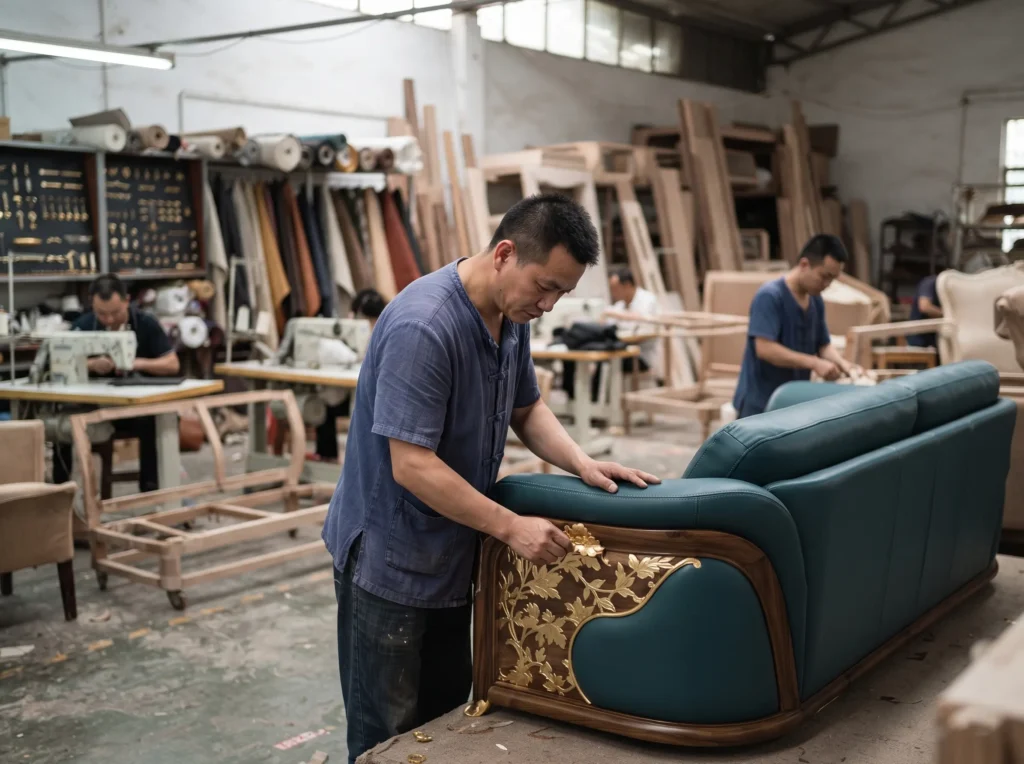
Another trap is the showroom demo zone. In Foshan, several large export factories maintain “heritage workshops” within their display centers. These are essentially stage sets. A single senior worker planes a board while buyers sip Tieguanyin tea. The actual factory, two kilometers away in an industrial park, runs Kuka robotic arms and Biesse CNC centers around the clock. The demo is not fraud in a strict legal sense—it is atmospheric marketing. But buyers who conflate the performance with their order’s production origin are setting themselves up for disappointment. If you cannot walk from the demo area to the active line in under two minutes, you are watching theater.
Buyers also confuse artificial aging with craft authenticity. “Distressing”—deliberate denting, sanding through edges, chemical patination, and fly-specking—is a legitimate industrial technique. But it is not craftsmanship. It is surface theater. A hand-hammered distress mark from a factory worker following a template is no more artisanal than a stamped pattern. True craft wear comes from use and time, not from a production-line aging chamber. When a factory sells “antique craftsmanship” based on distressing alone, they are selling an aesthetic, not a technique.
Perhaps the most subtle risk is rejecting modern quality control in pursuit of romantic handwork. We have visited workshops in Xianyou where every joint was hand-cut and every surface hand-planed, yet the wood moisture content was never properly checked, resulting in catastrophic seasonal cracking in heated Western homes. Modern manufacturing craft standards—kiln-drying to six-to-eight percent moisture, standardized glue curing schedules, and dimensional tolerance controls—are not enemies of tradition. They are prerequisites for furniture that survives international shipping and climate shifts. The best workshops combine hand skill with modern material science. The worst ignore science in favor of narrative.
Procurement Strategy by Buyer Type
High-end custom project buyers—luxury hotels, bespoke residential, museum reproduction—should bypass standard export platforms entirely. The workshops capable of genuine craftsmanship tradition do not list on Alibaba or Global Sources. They operate through word-of-mouth, regional agent networks, or direct relationships with European design houses. Budget for extended timelines. A proper natural lacquer table requires twelve to sixteen weeks of drying time alone. Hand-carved canopy beds can run twenty weeks. Rush orders force corners to be cut, and the first corner is always the handwork. Visit twice: once to verify capability, once before shipment to confirm your specific pieces received the claimed attention.
Bulk retail buyers operating at container-scale need to recalibrate expectations honestly. You are not buying craft. You are buying efficient manufacturing with craft aesthetics. The honest play is to find factories with transparent hybrid models—CNC precision for structure, hand-finishing for surface character—and price accordingly. Demand written clarity on which operations are automated and which remain manual. If a factory claims “handmade” at two hundred dollars FOB for a dining chair, either the handwork is trivial or the statement is inflated. The sustainable model is transparent hybrid production, not disguised automation.
Individual high-end buyers purchasing one to five pieces should focus on verifiable construction details rather than narrative. Ignore the “master” pedigree and the framed certificates. Examine the underside of the table. Is the apron joint hand-cut or routed? Does the drawer bottom float in a groove or is it nailed to the frame? Is the finish repairable with local materials, or will a scratch require complete factory refinishing? These physical facts outperform any story about workshop heritage or generational skill transmission.

Frequently Asked Questions
How can I tell if a Chinese factory’s “handcrafted” claim is real?
Look for production asymmetry. Genuine handwork produces slight variations in joint fit, carving depth, and finish absorption. If every curve, every joint, and every color tone is identical across sample pieces, you are looking at machine output with hand-cleanup or artificial distressing. Ask to see work-in-progress, not finished samples. A real craft workshop has half-finished pieces in various stages, rough blanks, and sharpening stones in active use. A marketing theater has only completed showroom inventory and workers who appear on cue.
Is Chinese furniture craftsmanship comparable to Italian or French artisan work?
In specific categories, yes. Xianyou’s master workshops produce mortise-and-tenon joinery that rivals European cabinetmaking in structural integrity. Dongyang’s hand carvers execute openwork at levels comparable to Italian intaglio specialists. However, the comparison breaks down at scale. Italian artisan furniture is typically produced in volumes of tens or hundreds of units annually. Chinese craft workshops that attempt to scale beyond this either mechanize or degrade. The craft itself is comparable. The industrial context and business model usually are not.
Why do Chinese factories use “craftsmanship spirit” marketing if most production is automated?
Because Western buyers consistently pay premiums for it. The “artisan” narrative commands a twenty-to-forty percent price lift in retail positioning. For factories, maintaining a small demo workshop or hiring one master carver for photo opportunities is cheaper than retooling an entire line for genuine handwork. It is rational economic behavior, not cultural deception. The responsibility lies with buyers to verify claims rather than with factories to self-regulate their marketing language. In a competitive export market, marketing exaggeration is the default setting.
What is the most reliable indicator of genuine traditional technique in exported Chinese furniture?
The joint. Hand-cut mortise-and-tenon or dovetailing leaves specific evidence: slight facet variations in the socket walls, compression marks from hand-chisel malleting, and glue lines that follow hand-fit irregularities rather than machine-perfect geometry. Machine joints are geometrically identical and often rely on metal fasteners hidden behind decorative plugs. Turn the piece over. Look at the secondary surfaces and interior frames. Craftsmanship hides in the places photographers ignore.
Should I avoid CNC-made Chinese furniture entirely?
Absolutely not. CNC machining produces superior dimensional consistency, tighter tolerances, and often stronger structural joints when paired with modern adhesives and curing protocols. The issue is not technology. It is misrepresentation. A well-made CNC chair with honest labeling is preferable to a poorly made “handcrafted” chair that was merely machine-cut and hand-sanded for theatrical effect. Buy based on construction quality, material honesty, and production transparency, not based on romantic production mythology.
Can I source genuine artisan furniture from China without visiting in person?
It is extremely difficult. The workshops that maintain true handcraft ratios typically lack export licenses, English-speaking staff, and international logistics capability. They work through intermediaries who often blend their output with standard factory lines. Without a trusted agent or your own physical verification, the risk of receiving marketing theater instead of craft workshop output is unacceptably high. If you cannot visit, hire a third-party inspector who understands joinery and finishing techniques, not just cosmetic checks.
What Has Your Experience Been?
We have laid out the factory-floor reality as we see it. But the furniture trade runs on relationships and accumulated experience. Have you visited a Chinese workshop that genuinely surprised you with its craft standards? Or have you paid an artisan premium and discovered machine-line reality upon uncrating? What verification methods have worked in your sourcing process? Drop your perspective or your specific craft-verification question below. We read every response, and the community benefits from honest field intelligence.
Recommended Resource
Interi Furniture specializes in custom furniture manufacturing for residential, hospitality, and commercial projects. Their experience in materials, craftsmanship, and project realization makes them a valuable resource for designers and buyers seeking tailored furniture solutions from China.