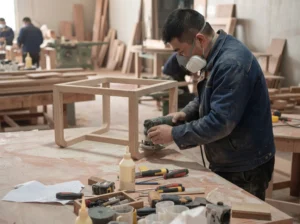


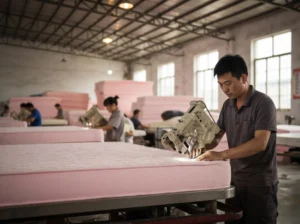

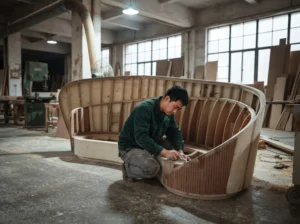
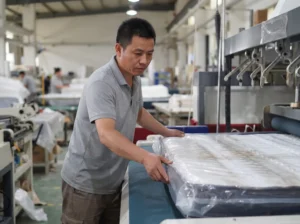





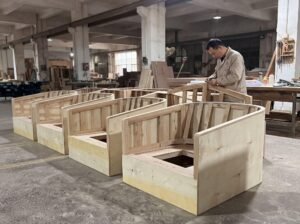
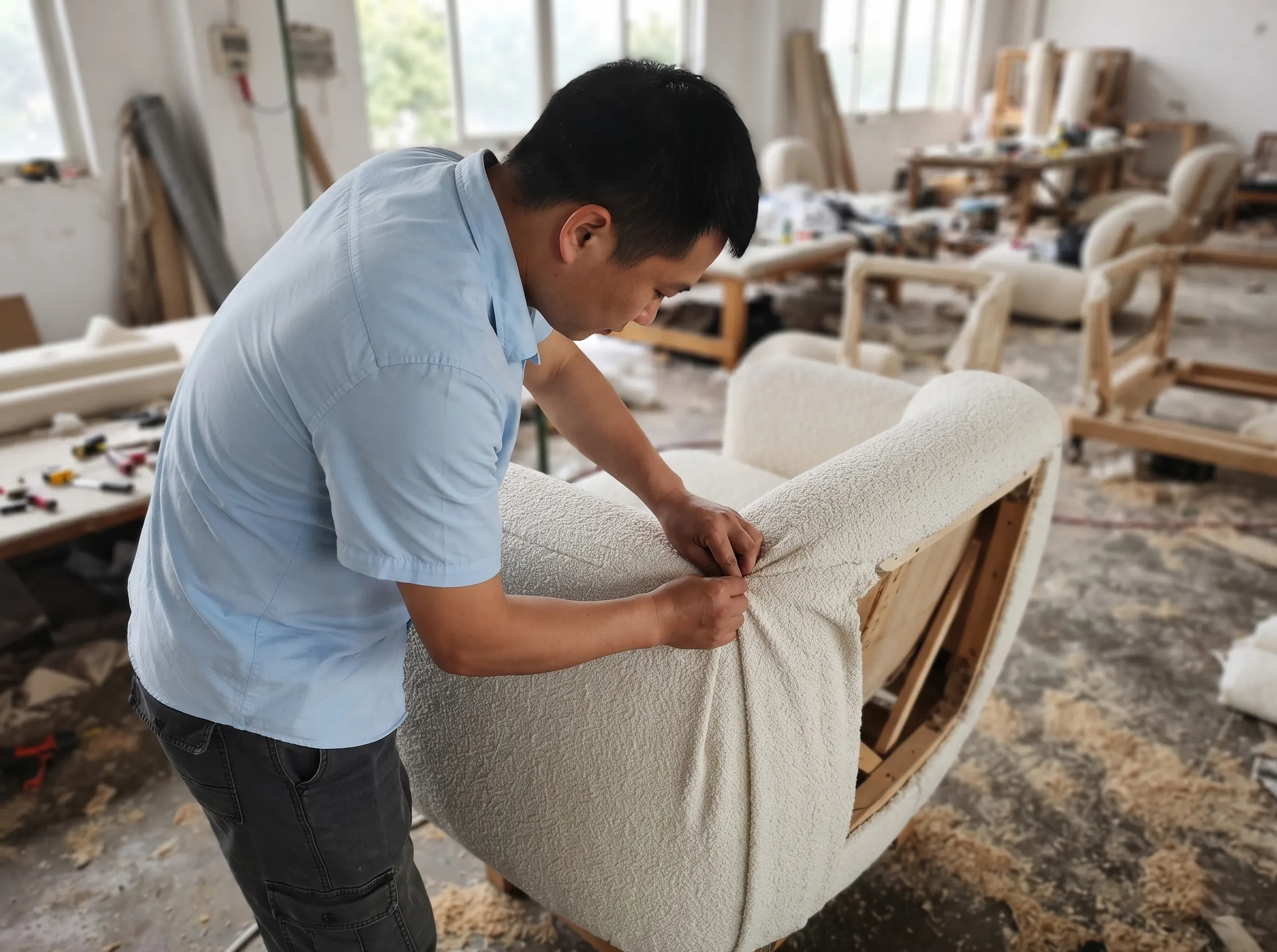
The short version is this: custom furniture manufacturing China is not a factory taking your sketch and “making it.” It is a controlled transfer of decisions from buyer to factory through drawings, samples, sealed materials, contracts, inspections, and loading records. The buyer who controls those documents controls the order; the buyer who only controls the price usually inherits the problem. The most dangerous moments are not carving or upholstery. They are the drawing freeze, the unwritten change, the skipped mid-production check, and the container that leaves without evidence. A typical custom run from confirmed drawings to delivered goods takes roughly eight to fourteen weeks: design and sampling about one to three weeks, production about four to eight weeks, and ocean freight about three to six weeks. Sampling alone in the Foshan cluster commonly takes fifteen to twenty-five days, and a fully upholstered custom sofa can run twenty-five to thirty days. All of this is subject to verification and varies by product complexity, season, and line load. Treat this as a process guide, not a promise; the signed contract always wins.
Most disputes I have seen in hotel projects, private-label programs, and special-dimension orders did not begin with a “bad factory.” They began with two different mental maps. The buyer imagined a creative workshop that interprets taste. The factory was running a production system that needs stable inputs: approved drawings, confirmed materials, locked quantities, realistic dates, and payment that follows risk. When those inputs stay vague, the factory does not stop. It guesses. A guess becomes a batch. A batch becomes a container. Then the buyer discovers that “similar wood,” “standard foam,” and “as discussed” are not quality standards. They are dispute starters.
The core concept: process is control
In custom work, the product is only half the deliverable. The other half is the decision trail. custom furniture manufacturing China rewards the buyer who can prove what was agreed before value is added. A sketch is intention. A production drawing is authority. A prototype is a physical argument. A sealed sample is evidence. An inspection report is leverage. A loading photo is the last cheap insurance you will ever buy. This is why the full phrase sketch to container matters: it describes a chain of custody for decisions, not merely a logistics route.
| Phase | Typical duration, subject to verification | What the buyer must contribute | What the factory must return | Money or risk moving |
|---|---|---|---|---|
| Brief and feasibility | Three to seven days for scope clarity | Room plans, use case, target market, budget band, compliance needs | Clarifying questions, cannot-do list, option paths | Scope risk shifts from buyer to shared table |
| Drawing development | One to three weeks across revision rounds | Sketch, references, dimensions, brand standards | Shop drawings, material callouts, tolerance notes, carton and CBM estimate | Small design or engineering fees may appear, subject to verification |
| Prototype and sample approval | Fifteen to twenty-five days in Foshan; fully upholstered sofas twenty-five to thirty days | Approval authority, test users, deadline logic | Prototype, finish sample, comments log | Sampling fee is a filter, not a nuisance |
| Sealed materials and contract | Two to five days once samples pass | Approved samples, signed specs, payment terms | Sealed samples, PI or contract, production calendar | Deposit commonly tied to material purchase and slot booking |
| Production and in-process control | Four to eight weeks for a first custom batch | Change freeze discipline, inspector access, response SLA | Cutting and CNC records, photos, rectification plan | Progress exposure rises; second payment often tied to visible progress |
| Final inspection and loading | Two to five days including loading | Inspection criteria, AQL baseline, loading witness | Inspection report, container photos, packing list | Balance before shipment only after pass and documents |
| Ocean freight and claims | Three to six weeks to major ports, subject to lane | Consignee details, insurance decision, receipt process | B/L draft, invoice, packing list, certificates | Evidence quality decides whether a claim survives |
The table looks administrative because it is. Factories in Foshan, Shunde, Dongguan, Guangzhou, Nankang, Anji, and Yunfu differ in style, but mature custom lines converge on the same control points. They ask what can be made, what must be signed, what will be sealed, who can change it, and what proves it happened. A factory that resists those questions is telling you something useful before your money is inside the building.
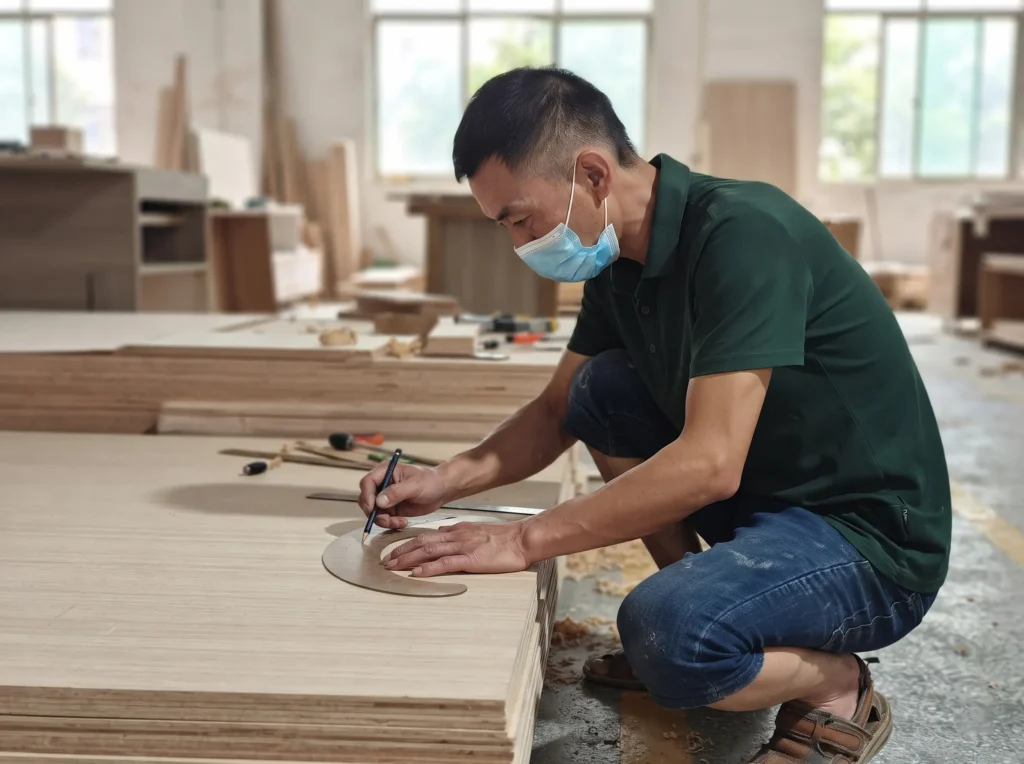
From rough brief to production-ready drawings
The first high-value work is negative. A good engineer or project manager will tell you what should not be attempted: a cantilever that cannot survive parcel shipping, a veneer pattern that will telegraph through paint, a marble top on a hotel table that becomes a maintenance claim, a chair dimension copied from a photo without seat-pitch logic. Buyers often hear “no” as friction. In custom manufacturing, “no” is cheap compared with “we will try.” The cannot-do list should be written down before pricing starts, because every impossible idea later becomes a variation order with blame attached.
Your sketch is not a production drawing. It may contain taste, but production needs authority: dimensions with tolerances, joinery assumptions, hardware brand or grade, substrate, veneer species and cut, finish system, fabric or leather grade, foam density, carton expectations, assembly method, and the market compliance frame. Compliance belongs in the brief now, not after sampling. On the China side, GB 18584-2024, the mandatory national standard for harmful substances in furniture, took effect on July 1, 2025 and caps formaldehyde release at 0.08 mg/m³, benzene at 0.06 mg/m³, toluene at 0.15 mg/m³, xylene at 0.20 mg/m³, and TVOC at 0.50 mg/m³ for indoor furniture. For upholstered and public-space products, GB 20286-2006 addresses burning behavior requirements. For exports, the destination rules bite harder: composite wood products bound for the United States must meet CARB Phase 2 and TSCA Title VI formaldehyde limits, EU-bound products face REACH restrictions on chemicals in finishes and materials, and any solid wood packaging must comply with ISPM 15 heat treatment and marking rules. Verify the current rule set for your exact product and market; standards move, and customs does not accept ignorance as an excuse.
One step buyers consistently skip is the container loading simulation at the drawing stage. Before any prototype is approved, the factory should calculate carton dimensions from the shop drawings and estimate the cubic meters of each SKU, then model how the order fits a twenty-foot or forty-foot container. This is standard practice in serious export programs: it exposes whether your elegant design wastes forty percent of container volume through air, whether disassembly is economically necessary, and whether the freight budget assumed in your costing is even physically possible. A design that cannot be packed profitably is not a design; it is a future argument about freight.
| Buyer deliverable at drawing stage | Why it matters later |
|---|---|
| Intended use, user weight and load, cleaning and climate context | Prevents correct-looking but wrong-duty products |
| Reference images plus measurements, not reference images alone | Photos hide depth, structure, and proportions |
| Target market and selling channel | Determines compliance, packaging, and finish robustness |
| Budget band with logic | Lets factory propose structure changes instead of silent downgrades |
| Approval hierarchy and response time | Stops “my partner saw it later” from becoming a factory delay |
| Carton dimensions and CBM estimate per SKU | Feeds freight costing, loading simulation, and carton drop-test design |
Expect several drawing rounds. The first round proves geometry. The second proves construction. The third proves cost engineering and packability. If a supplier returns a perfect-looking rendering before asking hard questions, be cautious. A serious factory usually surfaces conflict early: grain direction versus yield, solid wood movement versus climate, gloss level versus touch-up cost, drawer runner grade versus hotel abuse, carton size versus container utilization. Conflict handled early is design. Conflict discovered at loading is damage.
Prototyping: the argument you can touch
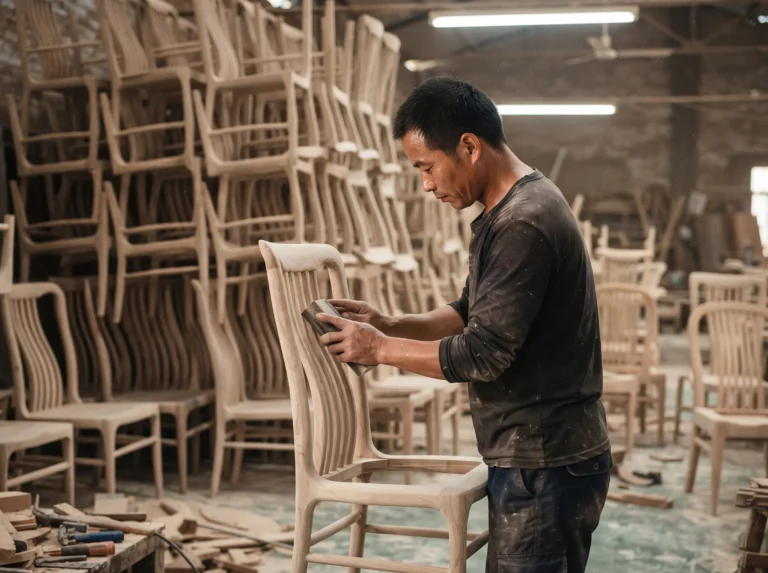
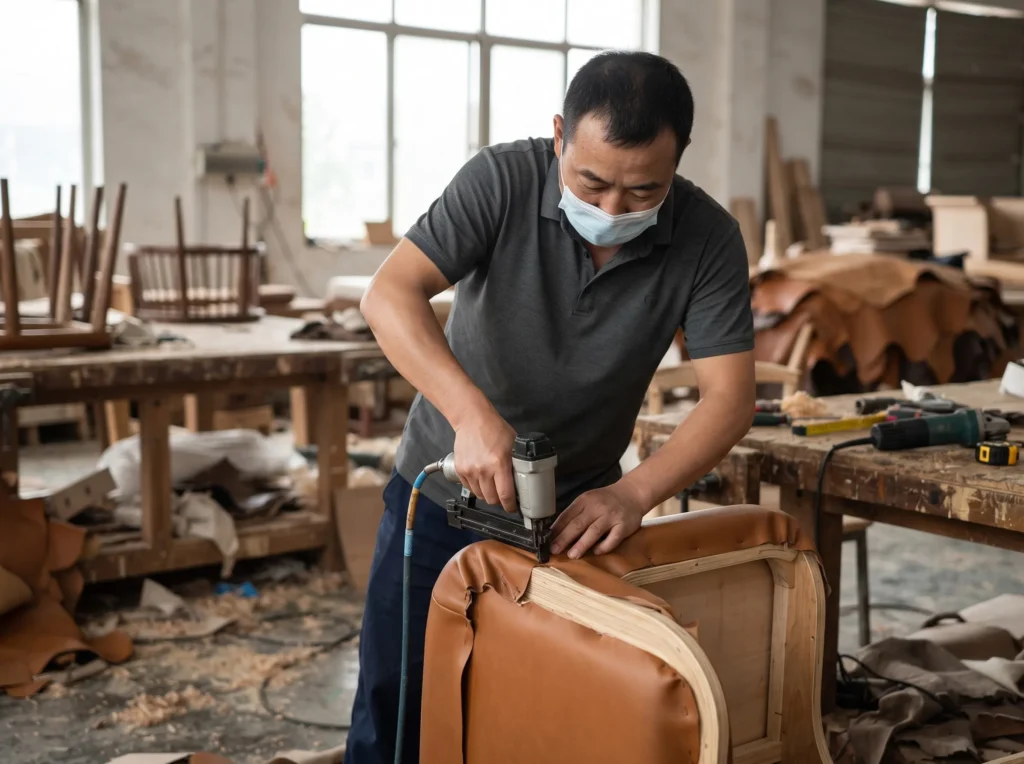
A prototype has one brutal job: to make disagreement physical before it becomes 200 units. It is not a showroom trophy. It is a test of proportion, comfort, finish, stability, packaging, and repairability. For seating, sit in it, wobble it, check seam alignment under load, inspect foam recovery, and look at the underside where buyers rarely look and inspectors always do. For casegoods, check door gaps after humidity exposure where possible, drawer alignment, edge banding, back panel rigidity, and whether the finish survives tape tests and cleaning chemicals you plan to allow.
Sampling fees are normal in serious custom furniture manufacturing China, subject to verification. A fee does not prove virtue, but refusal to charge can be a warning sign: the factory may be recycling an old sample, planning to bury cost in unit price, or not treating your item as custom at all. In the Foshan cluster, a sampling cycle of fifteen to twenty-five days is common for casegoods and mixed items, while a fully upholstered custom sofa with frame construction, multiple fabric processes, and comfort validation can legitimately take twenty-five to thirty days. Pay for the learning. Mark who owns the prototype, who may photograph it, and whether the approved sample travels with the order or remains sealed at the factory.
| Prototype checkpoint | Pass signal | Failure pattern |
|---|---|---|
| Structure | No creak, racking, loose joints, or fastener shortcuts | Hidden blocks, staples where dowels were implied |
| Finish | Uniform sheen, clean corners, repair plan visible | Orange peel accepted as “handmade character” |
| Materials | Substrate, veneer, foam, fabric match callouts | “Equivalent” appears only after approval |
| Packaging | Corner protection, moisture plan, carton drop logic | Beautiful product in a box designed to fail |
| Documentation | Photos, measurements, deviations signed | Verbal “same as sample” with no sample reference |
The costliest sentence in custom furniture is “we’ll fix it in production.” Mass production amplifies whatever the prototype tolerated. If the prototype wobbles, 300 will wobble in different ways. If the finish scratches under normal handling, the warehouse will teach you the rest.
Sealed samples and the contract that makes them real
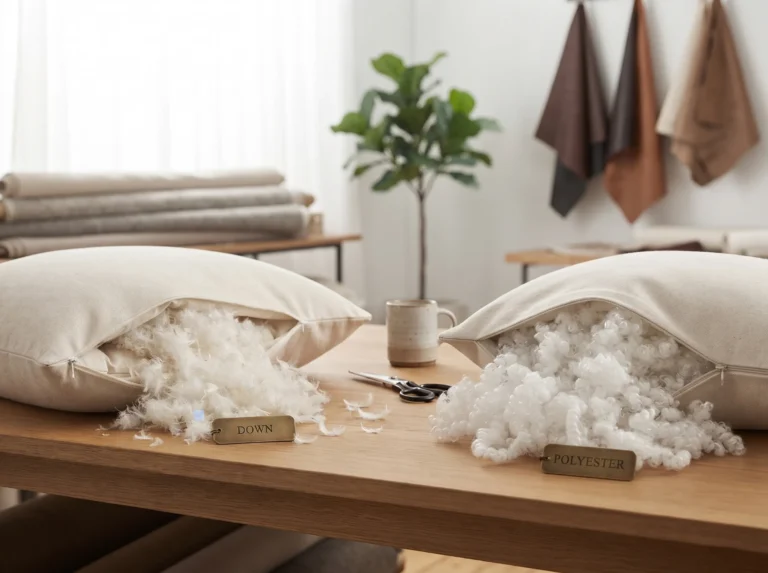
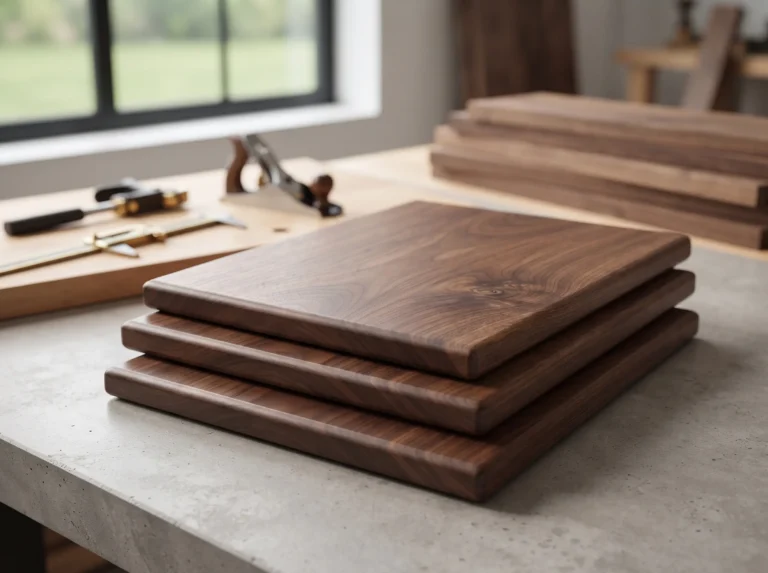
A sealed sample is not a souvenir. It is the physical definition of acceptable. For custom orders, approve at least three reference objects where practical: material sample board for substrate, veneer, finish, fabric or leather, foam, and hardware; a finished prototype for geometry and assembly; and a packed sample or packaging specification for logistics. Seal them with signatures, dates, order number, and photos from multiple angles. If color is critical, agree on light source and viewing distance. If wood is natural, define acceptable range rather than a fantasy of uniformity.
This is the point where the phrase custom furniture production process from sketch to delivery becomes operational. Production should be able to pull a sealed board and compare it against incoming veneer, dyed lot, leather batch, powder coat, or fabric roll. Without that habit, even an honest factory drifts across lots. With it, drift becomes a deviation report instead of a relationship argument.
| Contract clause that protects the buyer | Weak version to reject |
|---|---|
| Approved drawings, sealed samples, and agreed AQL criteria form part of order | “As per sample” with no sample ID and no defect classification |
| Change control requires written approval, cost, and date impact | “Minor changes acceptable in production” |
| Material substitution requires equivalent-or-better and buyer signoff | “Factory may use similar materials” |
| Inspection rights, timing, fail criteria, rectification window | “Buyer may inspect before shipment” only |
| Balance payment after pass and document set | Large balance before inspection or against copy B/L only |
| Late delivery, delay notice duty, and remedy path | Only a delivery date with no consequences |
| Packaging, labeling, pallet or carton spec, loading photos, CBM statement | “Standard export packing” as complete spec |
Deposits often fund materials and production slots. A common structure is deposit after contract and drawings, second payment tied to progress or pre-shipment stage, balance after inspection pass and before release of original documents, subject to verification and your negotiating position. The exact split matters less than whether payment follows evidence. If the factory asks for a high balance before you have seen meaningful progress, the issue is not trust. It is sequence.

Production: where silence becomes expensive
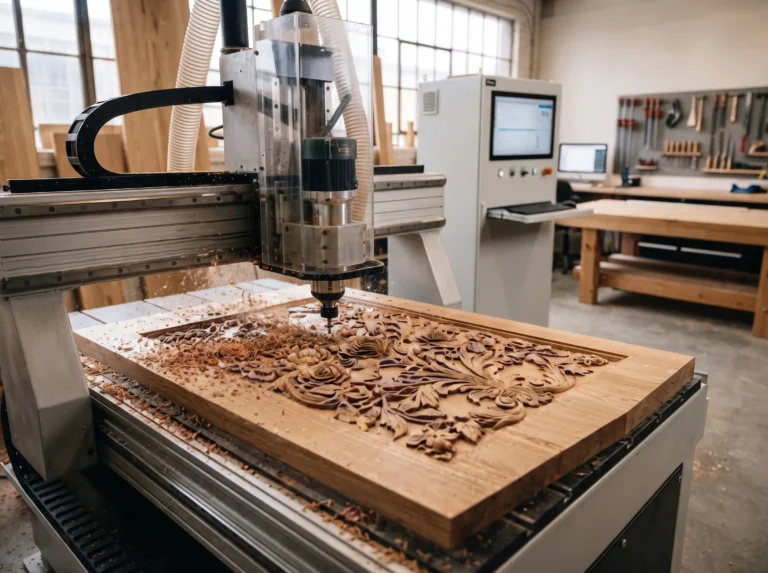
Once materials enter the line, your leverage changes. Before production, the factory needs clarity from you. During production, you need visibility from the factory. A practical cadence includes kickoff confirmation after deposit, material arrival photos, first-off sample confirmation for critical components, mid-production inspection, pre-shipment inspection, and loading supervision or documented loading. For larger programs, ask for a production calendar that shows buffer before peak season, Chinese New Year, Canton Fair weeks, and shipping congestion. Dates should be treated as commitments with escalation, not weather reports.
Mid-production inspection is worth more than final inspection because it is the last moment when structure can be corrected without dismantling. By final inspection, a wrong carcass may still be caught, but the cost of correction is brutal and the schedule is wounded. If the order has custom color, complex upholstery, hotel casegoods, or mixed SKUs, do not wait until the end to learn that fabric was cut against an old marker or veneer lots were sequenced incorrectly.
Inspection criteria should be written down before the inspector books a train ticket. The commonly used baseline, drawn from ISO 2859-1 sampling practice and widely applied in furniture trade, is AQL 0 for critical defects, AQL 2.5 for major defects, and AQL 4.0 for minor defects, subject to verification and your contract. Critical means a safety or regulatory failure: a chair that tips under rated load, a crib part that fails, formaldehyde over the applicable limit, sharp exposed edges on a public-space product. Major means functional or clearly visible damage that a reasonable end customer would reject. Minor means small cosmetic imperfections within agreed tolerance. If your contract does not define which defects sit in which class, the AQL number is decoration.
| Production node | What to request | Red flag |
|---|---|---|
| Material incoming | Lot photos, quantities, certificates where relevant | Substituted “same grade” already on line |
| First article | Component or unit matching sealed sample | Line runs ahead of approval |
| Mid-production | In-process photos, dimensional checks, issue log | No access until everything is packed |
| Rectification | Root cause, corrected sample, reinspection point | Repainting without stripping or sanding |
| Pre-shipment | Full inspection against order, not against memory | Minor defects waved because “ship is waiting” |
| Loading | Container number, seal, photos before and after, packing list, CBM reconciliation | “Driver is in a hurry” as reason to skip evidence |
The buyer’s job during production is not to become a line supervisor overseas. It is to make deviation expensive and correction fast. Define who may approve changes, how many hours or days the factory has to respond, and what happens if silence delays shipment. Many factories are responsive until a problem appears; your process should assume the problem and still leave a path out.
Container loading: the last cheap insurance
Loading day is where custom furniture stops being a project and becomes freight. A container can leave with correct goods and still create claims if the evidence is weak. Agree in advance on carton labels, SKU marks, handling icons, pallet use or floor loading, moisture protection, strapping, blocking, bracing, and photo requirements. Reconcile the actual loaded volume against the CBM estimate made at the drawing stage; if reality is twenty percent worse than the simulation, you want to know why before the doors close, not when the freight invoice arrives. If the shipment is mixed with another buyer’s cargo at a warehouse, require photos showing your cartons separated before loading and the count reconciled to the packing list.
At minimum, the document and evidence set should include commercial invoice, packing list, bill of lading instructions, certificate of origin where applicable, inspection report, product photos, loading photos, container number and seal number, and any test or compliance documents tied to the destination market. Keep the same order number across all documents. A mismatch that looks small at origin becomes a customs or insurance puzzle at destination.
| Loading file item | Why it protects you |
|---|---|
| Container and seal numbers | Links condition and count to a specific box |
| Photos of empty container, half load, full load, closed doors | Shows wet damage, odor, contamination, or short loading was not pre-existing |
| Packing list matching carton marks | Turns “we sent it” into a countable claim |
| Inspection report with dated signatures | Defines acceptance before vessel departure |
| CBM reconciliation against drawing-stage simulation | Catches carton redesigns or loading errors before departure |
| B/L draft checked early | Prevents consignee, port, and freight term errors |
| Insurance decision recorded | Clarifies whether risk transfer is acceptable |
If you receive goods with concealed damage, the loading photos and packing list are often the difference between a supplier conversation and a recoverable claim. This is not bureaucracy. It is the cheapest legal department in the supply chain.
Risk points that repeatedly burn buyers
| Risk | How it starts | Control that works |
|---|---|---|
| No sealed sample | “We know what you mean” | Signed, photographed, order-referenced samples |
| Oral drawing confirmation | Fast chat approval | Drawing revision number on every approval |
| No CBM simulation at drawing stage | Carton sizes appear after production | Carton dimensions and container fit signed with drawings |
| Change by habit | “The workshop improved it” | Written change order with cost and date effect |
| Mid-term blindness | Buyer waits for final photos | Scheduled in-process access and reports |
| Vague AQL classes | Inspector applies personal taste | Written defect classification with AQL values in contract |
| Balance before evidence | Factory cash pressure | Payment tied to inspection and documents |
| No loading record | Rush at warehouse | Mandatory photo and seal checklist |
| Compliance late | Market rules discovered after production | Destination requirements inside the first brief |
The pattern is consistent. The more custom the order, the less weight you should place on goodwill and the more on artifacts. A factory can be competent and still fail you if your controls are soft. Conversely, a mid-tier factory with clear drawings, sealed samples, CBM math, and honest escalation can outperform a famous name that relies on reputation.
Playbooks by buyer type
| Buyer type | Main constraint | Practical adjustment |
|---|---|---|
| Hotel project | Opening date, FF&E coordination, brand standards | Lock mock room earlier, inspect in phases, keep replacement path |
| Private label | Repeatability, margin, claim exposure | Control golden sample, carton drop test, spare parts logic |
| Small B and e-commerce | Cash flow, MOQ pressure, mixed SKUs | Limit customization to finish and dimensions, standardize structures |
| Designer-led order | Aesthetic precision, small quantity | Pay for engineering clarity, accept longer sampling, document color |
| First-time individual buyer | No import infrastructure | Use one accountable partner, simplify materials, avoid fragile hero pieces |
A hotel buyer should think in phases: prototype room, bulk material approval, room-by-room production lots, installation snag list, and spare unit policy. Given that production commonly runs four to eight weeks after drawing freeze and ocean legs run three to six weeks, a hotel opening date should be set backwards from drawing approval, not from the day the deposit clears. A private-label buyer should think in repeats: the first order proves the product, the second proves the system. A small buyer should not copy a hotel program; borrow the controls but reduce the ambition. A designer should remember that beauty can be manufactured only after ugliness has been engineered out.

FAQ
Can I start with only a sketch and no technical drawing?
Yes, but only if the next paid or clearly scoped step is drawing development. A sketch can open the conversation; it cannot release production. Treat the engineering round as the bridge between inspiration and liability, and use it to force the carton dimensions and CBM estimate you will need for freight costing.
How long does custom furniture production take in China?
Plan for eight to fourteen weeks from confirmed drawings to delivered goods: about one to three weeks for design and sampling, four to eight weeks for production, and three to six weeks for ocean freight, subject to verification. Sampling in Foshan commonly takes fifteen to twenty-five days, and fully upholstered custom sofas can take twenty-five to thirty days. Complex finishes, peak season, and Chinese New Year can stretch every stage.
What AQL should I use for furniture inspection?
A widely used baseline is AQL 0 for critical defects, AQL 2.5 for major defects, and AQL 4.0 for minor defects, aligned with ISO 2859-1 sampling practice and subject to your contract. The number only works if your contract defines which defects are critical, major, and minor. “Defects as per industry standard” without a classification table is not a criterion.
Can I change the design after production starts?
You can, but every change after material purchase should carry cost, time, and approval consequences. If a factory agrees casually to late changes, ask what they plan to remove quietly later. Custom discipline is not rigidity; it is priced flexibility.
Should I send someone for mid-production inspection?
For larger orders, complex finishes, hotel programs, or new suppliers, yes or use a credible third party. For small repeat orders with stable sealed samples, remote evidence may be enough. The deciding factor is not airfare; it is whether a mid-stage mistake can still be corrected cheaply.
Which documents must I have before the container leaves?
At minimum, align the commercial invoice, packing list, inspection acceptance, loading photos, container and seal numbers, bill of lading instructions, and compliance papers required by the destination market. If any document points to a different order, stop the release until it is corrected.
If you are planning a custom run, send us the one step that worries you most: drawing freeze, sampling fee, sealed materials, CBM loading simulation, mid-production check, balance payment, or loading evidence. Tell us your product type, destination market, and timeline, and we will map the control points that deserve your attention first.
Recommended Resource
Interi Furniture specializes in custom furniture manufacturing for residential, hospitality, and commercial projects. Their experience in materials, craftsmanship, and project realization makes them a valuable resource for designers and buyers seeking tailored furniture solutions from China.