











Here is the short answer most sellers won’t give you: on a finished piece of Chinese furniture, you usually can tell pure CNC from pure hand carving—but the majority of what you’ll actually be offered sits in a middle layer, and that middle layer is designed to be nearly undetectable from the front. Pure hand carved furniture at production scale is genuinely rare. CNC is not the enemy of quality; in fact, premium lines use it heavily. What you’re really paying for, when the premium is justified, is not accuracy but character—something only worth buying at the high end. And the fastest way to check any claim is to flip the piece over: the back of the carving tells you more than the front, roughly ten times more.
Why Overseas Buyers Are Addicted to the “Hand Carved” Label
Walk any showroom in Foshan or Shunde and you’ll hear the phrase within minutes: “hand carved, master craftsmanship.” For European and North American buyers, the label carries emotional weight. It signals heritage, rarity, and human touch—everything mass production is supposed to lack.
That emotional weight is exactly why the label gets stretched. In my ten years walking carving workshops from Dongguan to Dongyang, I’ve seen the same pattern repeatedly: a design that starts as genuinely hand-worked gets quoted, cost-engineered, and quietly shifted to a hybrid process—while the marketing copy never changes. The buyer pays for the story, not the process.
This article exists because that gap is closing. Understanding CNC wood carving versus hand work—and, more importantly, the hybrid in between—will save you more money per container than almost any other negotiation skill.
The Three-Layer Reality of Carving in Chinese Furniture
Definition: Pure CNC Wood Carving
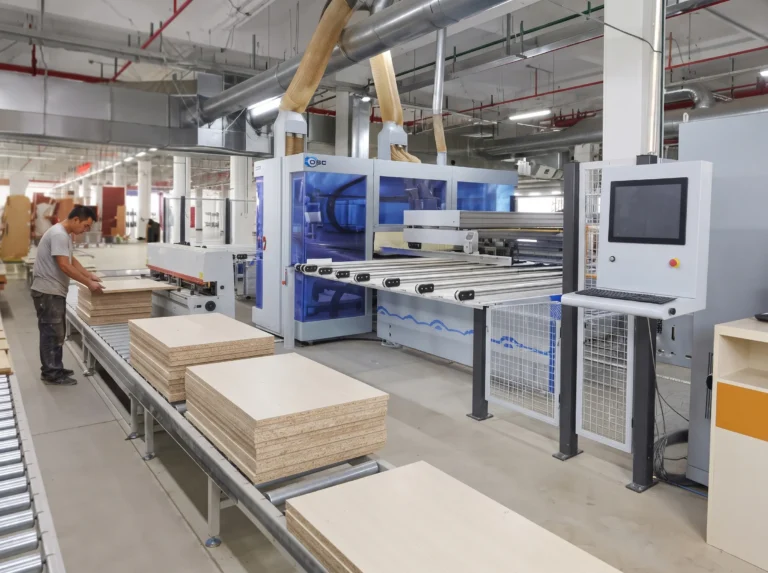
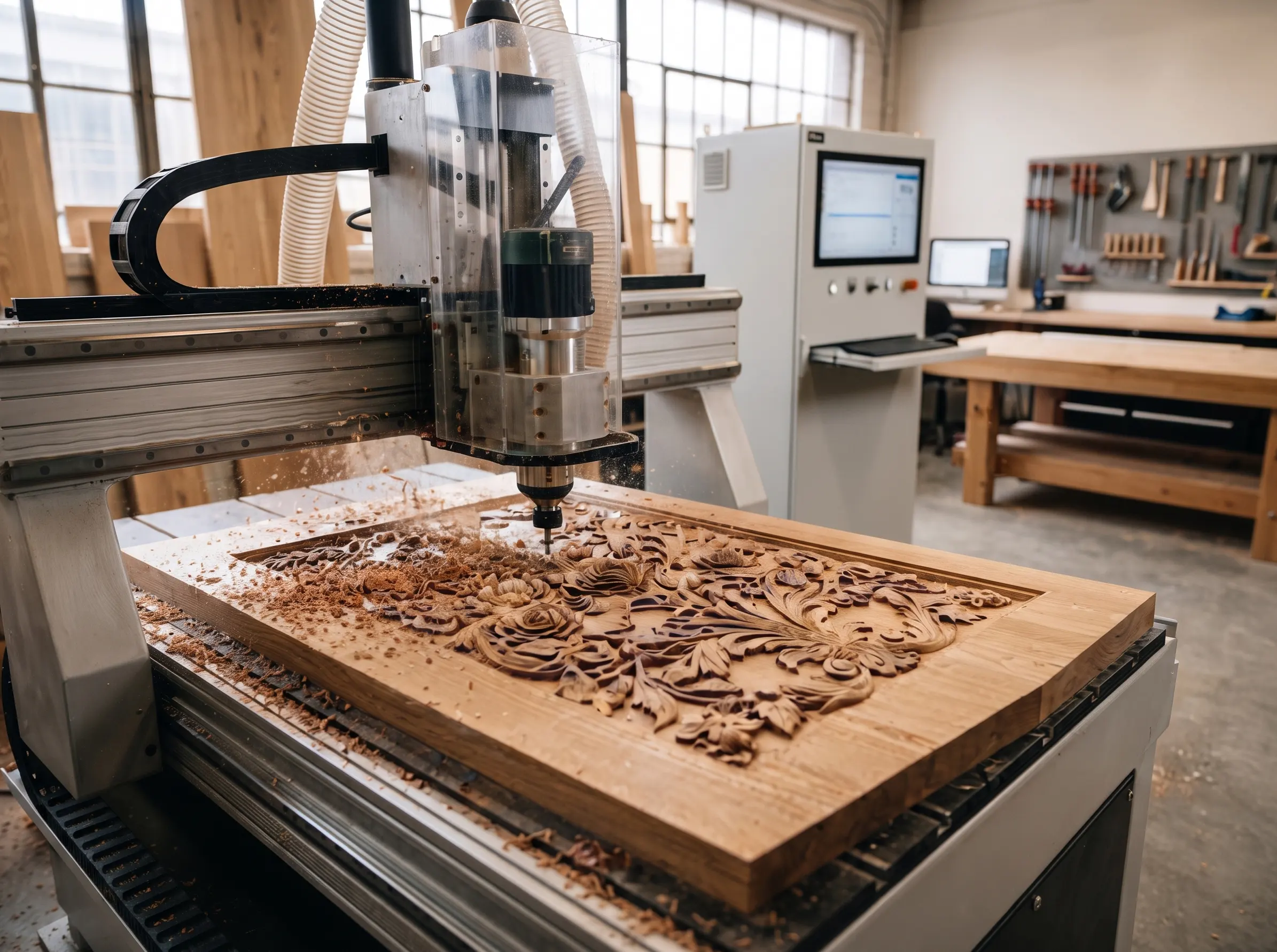
Pure CNC wood carving means the entire relief is cut by a computer-controlled router. An operator digitizes the pattern, sets toolpaths, and the machine executes every pass. No chisel touches the wood.
Definition: CNC Rough Carving + Hand Finishing
This is the industry workhorse. The CNC machine removes 80–90% of the material quickly, then a carver goes in by hand to sharpen edges, deepen key details, and soften machine-flat surfaces. From the front, it genuinely looks hand-carved.
Definition: Pure Hand Carving
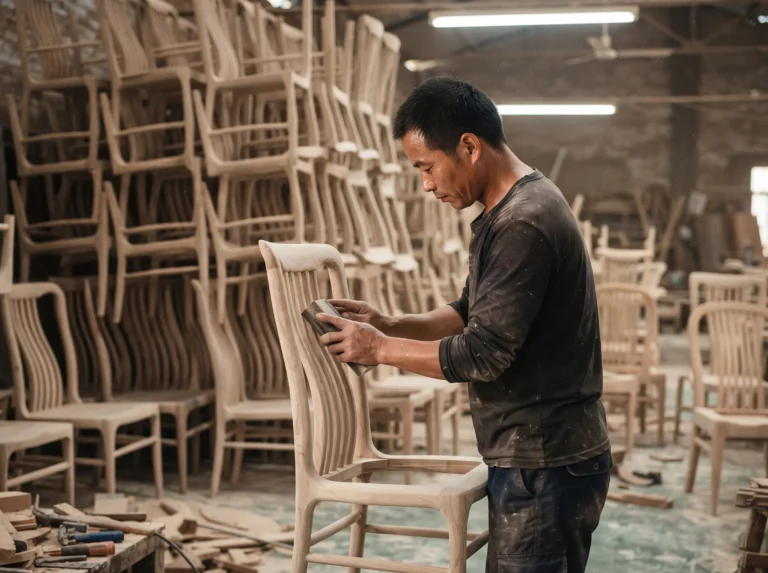
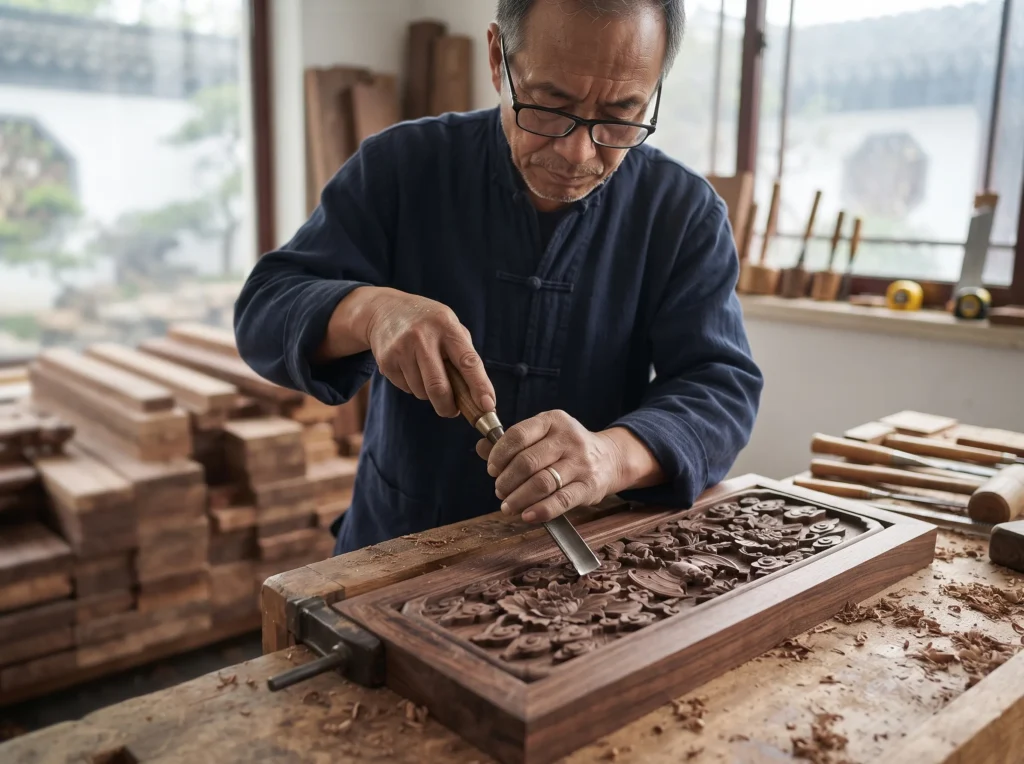
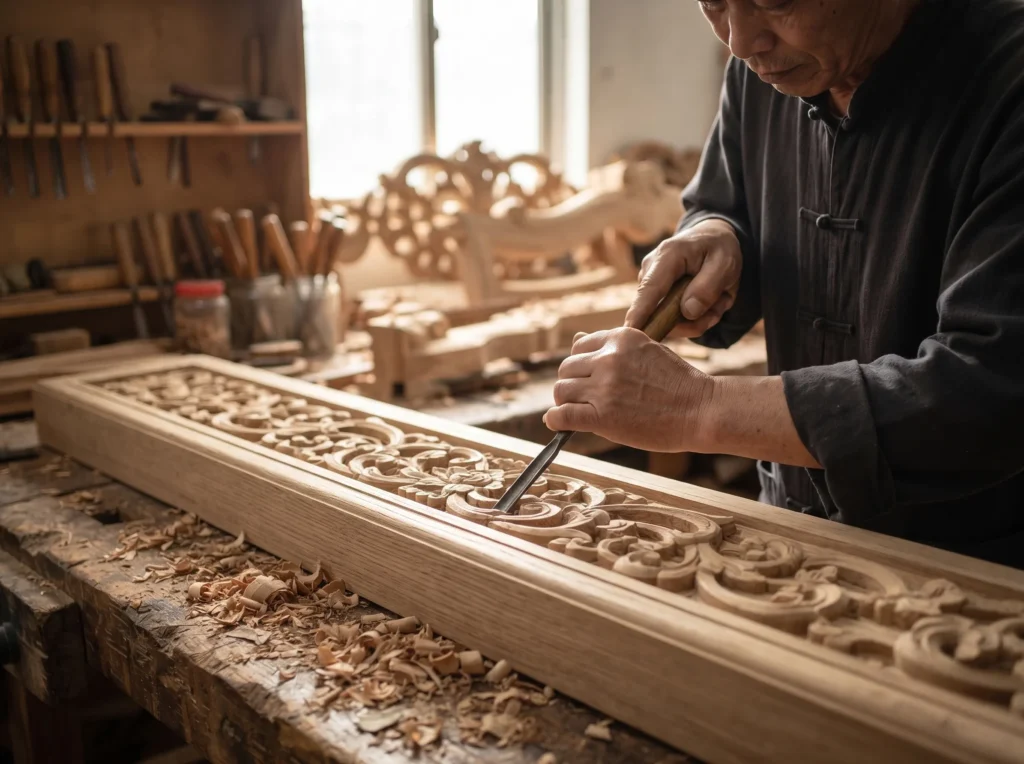
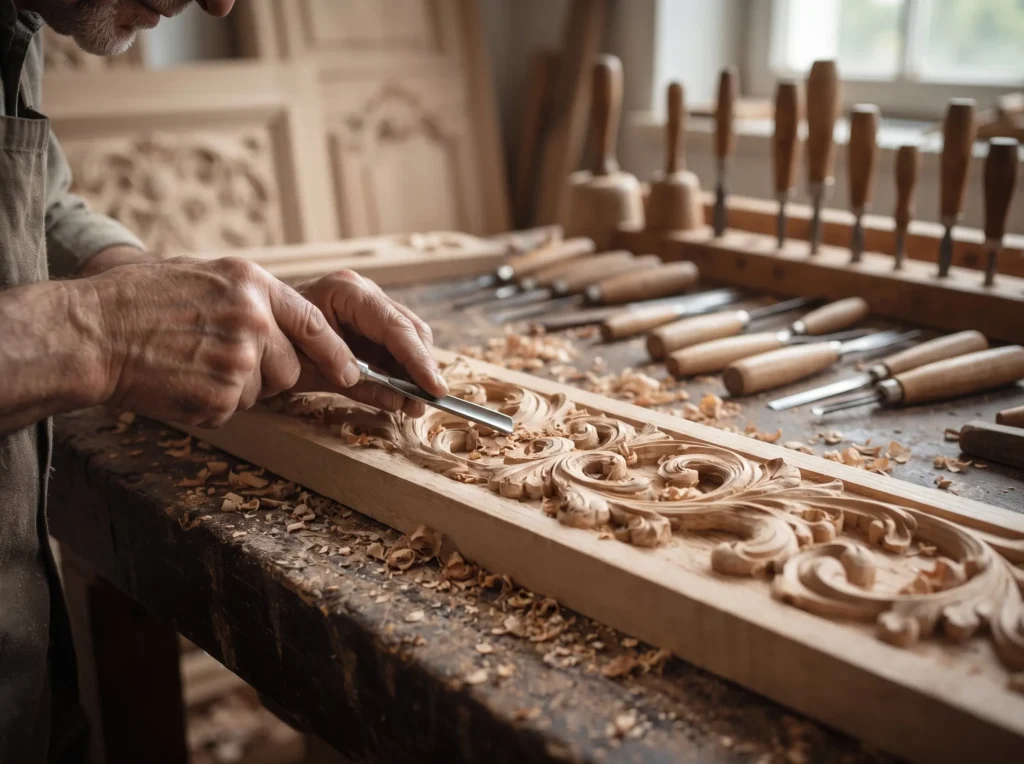
Pure hand carving means every pass comes from hand and chisel. Even here, a craftsman’s methods may vary—but the toolpath logic, the depth variation, and the surface texture all originate from human decision-making on every square centimeter.
Process Comparison: What Actually Happens on the Floor
| Dimension | Pure CNC | CNC + Hand Finishing | Pure Hand |
|---|---|---|---|
| Pattern source | Digitized file, repeatable forever | Digitized file + human judgment | Drawn/transferred by hand per piece |
| Material removal | 100% machine | 80–90% machine, 10–20% by chisel | 100% by chisel |
| Consistency across matched parts | Near-perfect | High, with slight human variation | Visible piece-to-piece variation |
| Time per typical panel | Hours | Hours plus half a day of hand work | Days to weeks depending on complexity |
| Skill floor required | CNC programming + setup | Programming plus experienced carvers | Years-trained master carvers |
The critical insight: the middle column is where 80% or more of mid-to-high-end carved export furniture lives. It is not a scam by default—it is a rational production method. It becomes a problem only when it’s sold as column three.
The Cost Structure Nobody Puts in the Quote
Costs vary by region, wood species, and pattern complexity, so treat all figures as subject to verification. But the ratios below hold remarkably steady across the Foshan, Dongyang, and Nanjing-area workshops I’ve audited.
| Cost Factor | Pure CNC | CNC + Hand Finishing | Pure Hand |
|---|---|---|---|
| Labor share of carving cost | Low (setup-dominated) | Moderate | 70–90% |
| Relative carving cost index | 1× | 2–4× | 6–15× |
| Scalability | Excellent | Good | Poor |
| Retooling cost for new pattern | Program once | Program + carver training | Full new pattern development |
This is why the math almost never supports “fully hand carved” on a volume export order. When a factory quotes you hand-carving prices at production quantities, either the quote is wrong or the carving is.
Where Each Craft Actually Lives on the Piece
Carving on a single cabinet is rarely one process. Factories allocate craft by visibility and by part economics.
| Furniture Part | Typical Process in Practice |
|---|---|
| Front door panels, headline motifs | CNC + hand finishing at mid/high end; pure hand on top-tier pieces |
| Corbels, aprons, visible edges | CNC + hand finishing is the norm even on expensive lines |
| Side panels, back panels, rear aprons | Almost always pure CNC, sometimes barely sanded |
| Mirror frames, headboard crests | Split by price tier—this is where pure hand survives |
| Repeat floral borders, geometric bands | Pure CNC even in luxury factories; consistency beats hand here |
The honest takeaway: pure hand carving survives where eyes actually rest for a long time, on pieces priced for connoisseurs. Everything else has been rationalized.
Is “Hand Carved” Worth the Premium?
Sometimes. The genuine value of hand work is not precision—CNC wins on precision every time. The value is three things: tool marks with rhythm and variation, shallow-relief layering that machines flatten, and the fact that no two panels are identical.
On a $400 distressed-finish sideboard, those qualities are invisible and irrelevant. On a $4,000 rosewood cabinet where the carving is the product, they are the product. Paying a hand-carving premium for machine-looking work is the single most common waste I see in buyers’ budgets.
Carving Detection: The Buyer’s Field Guide
If you’ve ever searched how to identify hand carved wood furniture, you’ve probably found advice like “look for imperfections.” That’s weak. Imperfections can be faked; here is what can’t, easily.
The Six Checks That Actually Work
| Check | What You Look For | What It Tells You |
|---|---|---|
| Back of the carving | Toolpaths continuing across the back; uniform depth | Pure CNC or minimal finishing—see it and the “hand carved” claim collapses |
| Symmetry on matched pairs | Machine-identical left/right panels | Strong CNC signal; genuine hand pairs always drift slightly |
| Edge sharpness | Crisp hairline edges under raking light | Hand finishing present; CNC leaves slightly radiused edges |
| Surface undulation | Gentle wave under side light | Hand work; CNC planes read flat |
| Tool mark direction | Flowing, overlapping arcs vs. uniform parallel passes | The single most reliable texture signal |
| Repeat patterns across the lot | Identical panels in every unit | CNC at some stage, guaranteed |
Carving detection skill, honestly applied, takes about thirty seconds per piece once you know the tells. Bring a small flashlight; raking light does half the work for you.
What Price Tiers Actually Buy You
| Retail Tier (illustrative, subject to verification) | Realistic Craft | What to Demand |
|---|---|---|
| Entry/mass market | Pure CNC | Honest labeling, clean toolpaths, good sanding |
| Mid-market “carved” lines | CNC + selective hand finishing | Finishing on front-facing motifs, documented in writing |
| Upper-mid / designer tier | CNC + substantial hand work | Named-carver or workshop verification, contract clauses |
| True luxury / collector tier | Pure hand on signature elements | Proof: process photos, workshop visit, artist attribution |
The Three Traps That Cost Buyers Real Money
Trap one: the hybrid sold as pure hand. The front looks hand-carved because it partly is. The back exposes the truth. This is the most common misrepresentation in carved export furniture, and it is rarely a factory lie so much as an agent’s or trader’s embellishment.
Trap two: the “hand carved” label with no definition. “Hand carved” in a marketing PDF means nothing. There is no enforced standard. We’ve verified this across multiple sources: the same words cover everything from full hand work to five minutes of chisel cleanup per panel.
Trap three: no craft clause in the purchase contract. If your PO says “carved cabinet” and nothing more, you have agreed to whatever shows up. Specify process, inspection points, and remedy for misrepresentation—subject to verification by third-party inspection before balance payment.
Practical Playbooks by Buyer Type
Import wholesalers and distributors: Audit one production panel from the actual order, not the showroom sample. Specify “hand finishing on all front-facing carved surfaces” in writing, and price the order as hybrid unless you’ve verified otherwise.
Retail buyers and purchasing agents: Train your QC to run the six-check routine on the carving back and one matched pair per SKU. Budget accordingly—honest hybrids are legitimate products at legitimate prices.
E-commerce sellers: Never write “hand carved” in your listing unless you can document it. Marketplace platforms increasingly penalize craft claims, and your supplier’s word is not documentation.
Individual and collector buyers: For genuinely hand-carved work, buy from workshops that will show you the process—photos, video, or a visit. On premium pieces, the maker’s willingness to be transparent is itself the quality signal.

Frequently Asked Questions
Does CNC carving mean cheap furniture?
No. CNC is a tool, and premium factories run the best-maintained machines. Cheapness comes from skipping hand finishing, poor wood selection, and thin finishing—any of which can happen with or without CNC.
Why does the front look hand-carved but the back doesn’t?
That’s the signature of CNC roughing plus hand finishing: a carver refined the visible face and no one touched the reverse. It’s the single most common real-world configuration in mid-to-high-end carved export furniture.
Can I require “hand carved” in a contract?
You can require it, but the words alone are unenforceable in practice. Define it instead: specify percentage of hand work, which surfaces must be hand-finished, and a third-party verification step tied to payment.
What price actually gets me real hand carving?
At production volumes, genuine pure hand carving is rarely available at any price—it doesn’t scale. True hand work appears in limited runs and collector-tier pieces, typically at multiples of mid-market pricing, and always with a named workshop behind it. Specific figures are subject to verification per order.
Is the hybrid process worth buying?
Yes—honestly priced, it delivers most of the visual value of hand carving at a fraction of the cost. The problem was never the process; it’s the labeling. A well-finished hybrid is a good product. A hybrid sold as pure hand is a markup.

Your Move
Next time a supplier shows you a “hand carved” piece, which check will you run first—the back of the panel, or the symmetry of the pair? Drop your answer in the comments; the most field-tested tip gets featured in our next sourcing guide.
Recommended Resource
Interi Furniture specializes in custom furniture manufacturing for residential, hospitality, and commercial projects. Their experience in materials, craftsmanship, and project realization makes them a valuable resource for designers and buyers seeking tailored furniture solutions from China.