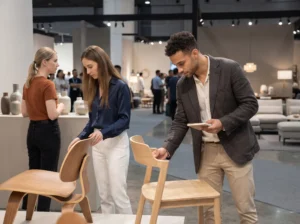



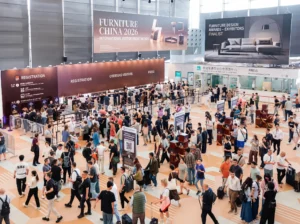





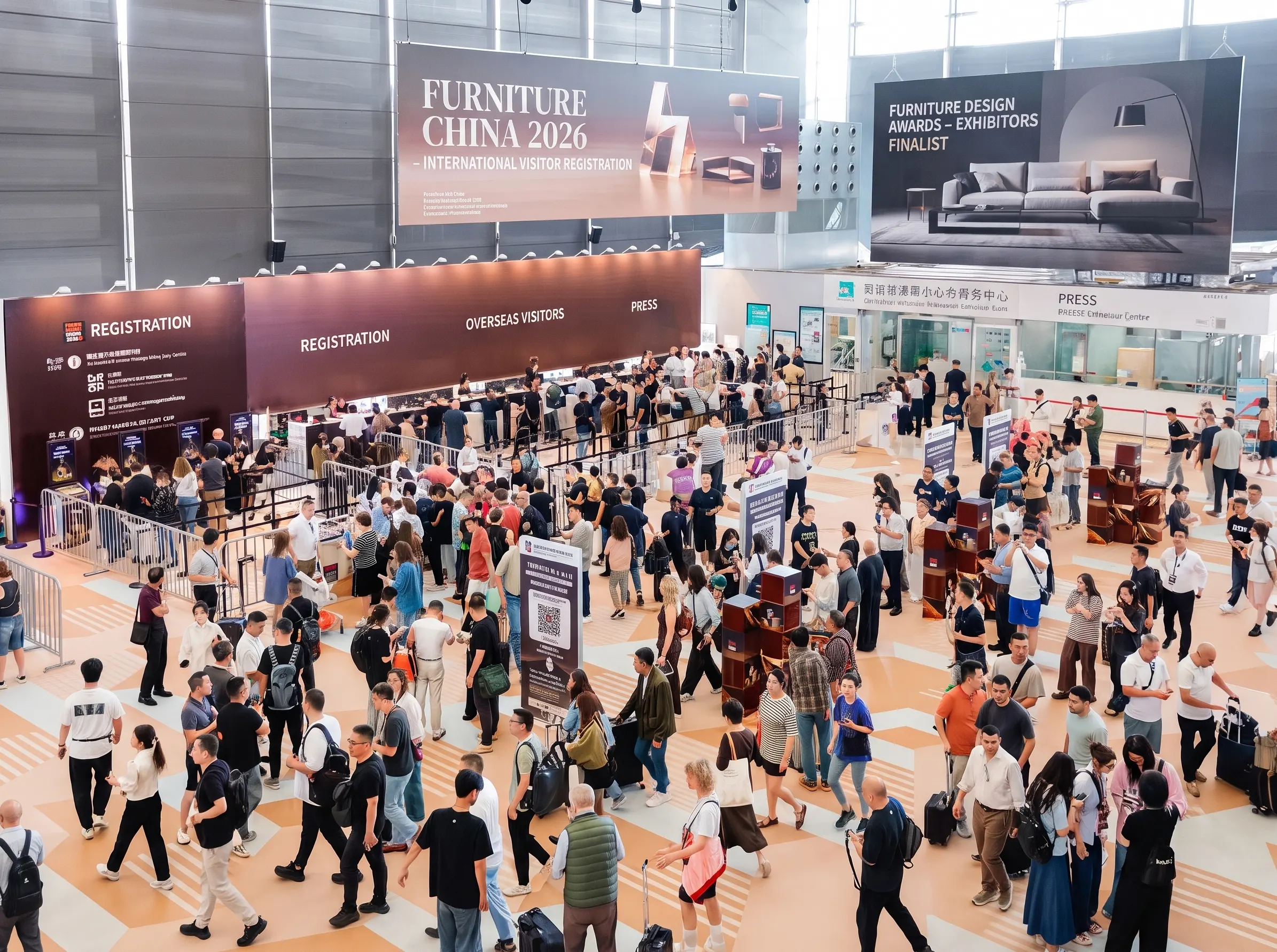
Furniture China 2026 runs September 8–11 at SNIEC, with Maison Shanghai overlapping September 7–10 at SWEECC. Together they put roughly 430,000 square metres of product and design in front of global buyers. Here is the honest read: most of what gets labeled a Shanghai furniture trend 2026 is a reaction to decisions made 6–12 months ago, not a forecast of 2027. Of the “new products” on the floor, the majority are fast-follows of Milan 2025 and High Point, or tariff-driven re-engineering wearing a lifestyle label. The genuine 2027 signals exist — sustainability, modular living, smart integration — but they are concentrated in a small minority of booths. This article tells you which is which.
Why Buyers Walk Out of SNIEC More Confused Than When They Walked In
Spend one afternoon in the halls and you will count the phrase “global debut” hundreds of times. Every aisle claims an “annual trend.” Every booth has a trend wall, a color story, a lifestyle scenario built around a sofa that looks suspiciously like last year’s sofa in new fabric.
We have walked these halls for over a decade, and the pattern repeats: buyers arrive expecting a clear signal for next year’s assortment, and they leave with a camera roll full of similar products, conflicting claims, and a nagging suspicion that the “trend premium” they just negotiated will evaporate in six months. That suspicion is usually correct. Industry estimates suggest that only a minority of products labeled “new” at the September fair are true first launches, with the balance split between refreshes of existing frames and fast-follows of Western bestsellers. For reference only, subject to official verification.
The frustration is legitimate, and it has a structural cause. Understanding that structure is worth more than any single booth visit.
The Myth: Fair Trends Predict the Future
The most damaging assumption in this industry is that what dominates a September fair predicts what will sell in 2027. It usually does not, and the reason is buried in the design cycle of Chinese manufacturing belts.
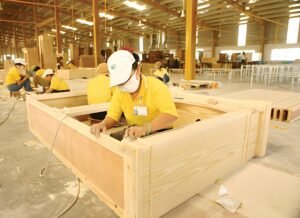
Foshan, Dongguan, and the Yangtze Delta clusters do not design on intuition. They respond to purchase orders, tariff codes, and container economics. By the time a product reaches a SNIEC booth in September, its design was frozen months earlier — often in Q1 or Q2 of the prior year for the autumn edition, because the sample-making, tooling, and photography pipeline needs that runway. What you are looking at is a delayed photograph of what factories believed the market wanted when the sketches were drawn.
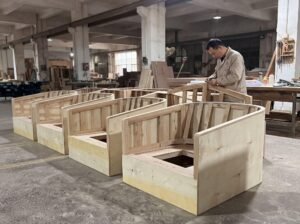
There is also a quieter problem: a meaningful share of what gets curated as “2026 lifestyle innovation” is actually cost engineering. When US tariffs pushed landed costs up, factories responded with material substitution — metal replacing solid wood in structural frames, engineered panels replacing hardwood, knock-down construction replacing fully assembled units. These are rational, sometimes excellent responses to trade reality. But repackaging them as design philosophy is curatorial packaging, scenario dressing on top of a tariff decision.
None of this makes the fair useless. It makes it a document to be read critically rather than a prophecy to be swallowed.
Furniture China 2026 New Product Matrix: True Launch vs. Refresh vs. Fast Follow
Based on our floor observations across SNIEC halls and conversations with design teams in Foshan and Dongguan, here is how the “new product” universe realistically divides. These are industry estimates from fieldwork, not official figures — for reference only, subject to official verification.
| Category | Rough Share of “New” Labels | What It Actually Is | How to Spot It on the Floor | What It Means for 2027 |
|---|---|---|---|---|
| True first launch | A small minority of total exhibits | Original design or genuinely new construction concept, often from independent designers or flagship collaborations | Seen mostly in Maison Shanghai H3 Design Highland, curated zones, and Golden Dot Award / Golden Axe Award entries | The only category worth treating as a forward signal |
| Refresh | A substantial middle share | Existing frame or platform with new fabric, new finish, new legs, new color story | Same silhouette as prior-year catalog with a fresh textile card and new scenario photography | Reliable for assortment rotation; rarely a trend in itself |
| Fast follow | The largest share of mass-market halls | Rapid replication of Milan 2025 Salone, High Point Market, or hot DTC-brand silhouettes | Products resembling designs you have already seen on Western retail sites, often at 60–70% of the original price | Confirms what already sold in the West; tells you almost nothing about 2027 |
The practical takeaway: the label “new” describes the SKU, not the design. Ask every booth one question — “When was this design frozen?” — and watch how the conversation changes.
Design-to-Showroom Timeline: What 2026 Launches Actually Reflect
| Stage | Typical Duration (Industry Estimate)* | What Happens | Why It Distorts the “Trend” Label |
|---|---|---|---|
| Market signal observed (orders, Western retail data, tariff changes) | Ongoing | Factories and design departments track what is selling in the US and EU | Signals are 3–6 months old before design work begins |
| Concept and sketch phase | 1–2 months | Designers interpret the signal; original concepts are rare outside top studios | Interpretation, not invention, dominates |
| Sampling and prototyping | 1–3 months | Mockups, material sourcing, first prototypes | Material substitution decisions (often tariff-driven) get locked in here |
| Tooling and pre-production | 1–2 months | Molds, jigs, pilot runs | Design freeze point — typically Q1–Q2 of the prior year for the September fair |
| Photography, catalog, fair preparation | 1–2 months | Scenario staging, the “trend wall” gets built | This is where cost engineering gets dressed as lifestyle |
| Booth display at SNIEC | September 2026 | Buyers see the finished theater | You are viewing a response to 2025, packaged as a prediction for 2027 |
*For reference only, subject to official verification. Actual cycles vary by factory scale and product complexity.
This is why the autumn edition lags more than the spring edition: the September product was frozen earlier and responds to an older market picture. If you want to know what factories will actually build in 2027, ask what their US and EU clients were ordering in June — not what is on the trend wall.
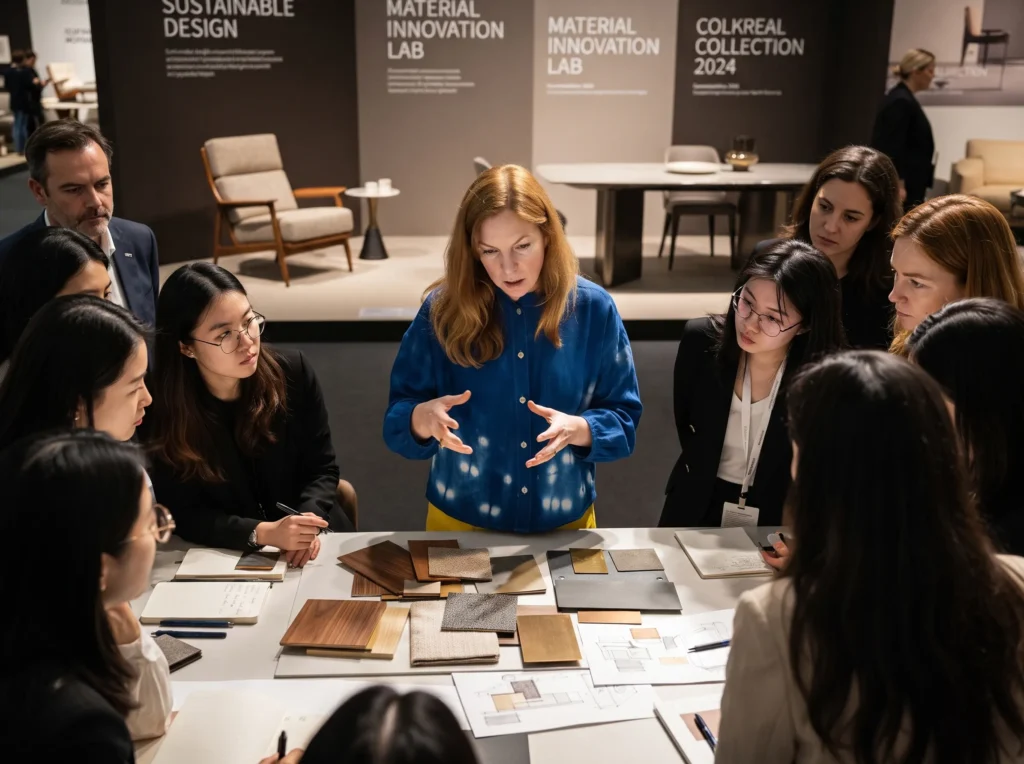
The Six Real Trends vs. The Three Fake Ones: What 2026 Reveals for 2027
Here is our working verdict as an independent observer. These are the signals we believe have genuine market value for a 2027 furniture prediction, alongside the ones we would advise buyers to discount.
| Signal | Real or Dressed-Up | Evidence on the Floor | 2027 Market Value | Buyer Action |
|---|---|---|---|---|
| Sustainable and certified materials accelerating into mainstream SKUs | Real | FSC-certified timber, recycled textiles, low-VOC finishes appearing outside premium halls; Green Booth Construction Award pushing exhibitor practice | High — ESG compliance is becoming a purchase requirement in the EU and among US retail chains | Qualify certifications per SKU, not per brand |
| Modular, flat-packed, small-parcel living furniture | Real, but driven by logistics as much as lifestyle | KD construction, tool-free assembly, modular sectionals designed for container and parcel efficiency | High for e-commerce sellers; the driver is real even if the marketing is romantic | Prioritize SKUs with low damage rates and assembly times under 15 minutes |
| Metal and hybrid structures replacing solid wood frames | Real as a cost-engineering trend, dressed as “industrial aesthetic” | Ubiquitous in mid-market seating and dining | High volume, thin margins; treat as commodity sourcing | Negotiate on engineering specs, not on the trend story |
| Curved silhouettes and “soft geometry” everywhere | Half real | Fast-followed from Milan 2025 and Western DTC catalogs | Medium — already saturating by 2027; order early or skip | If you buy it, buy it as proven demand, not as a differentiator |
| Smart home integration in furniture | Real but immature | Charging furniture, app-connected lighting, sensor-embedded pieces concentrated in Future Presence zones | Medium-high for 2027–2028; verify electronics certifications (UL, CE) before committing | Pilot small; electronics failures destroy review scores |
| “Global debut” scenario staging with identical core products | Fake as a trend signal | Same frames as 2025 with new fabric, new photography, new booth theater | None — it is assortment refresh, not innovation | Do not pay a first-launch premium for refreshed inventory |
The pattern: the trends with staying power are driven by compliance, logistics, and tariff economics. The trends with the best marketing are usually the ones closest to expiration.
Maison Shanghai H1–H4: Where Design Originality Actually Lives
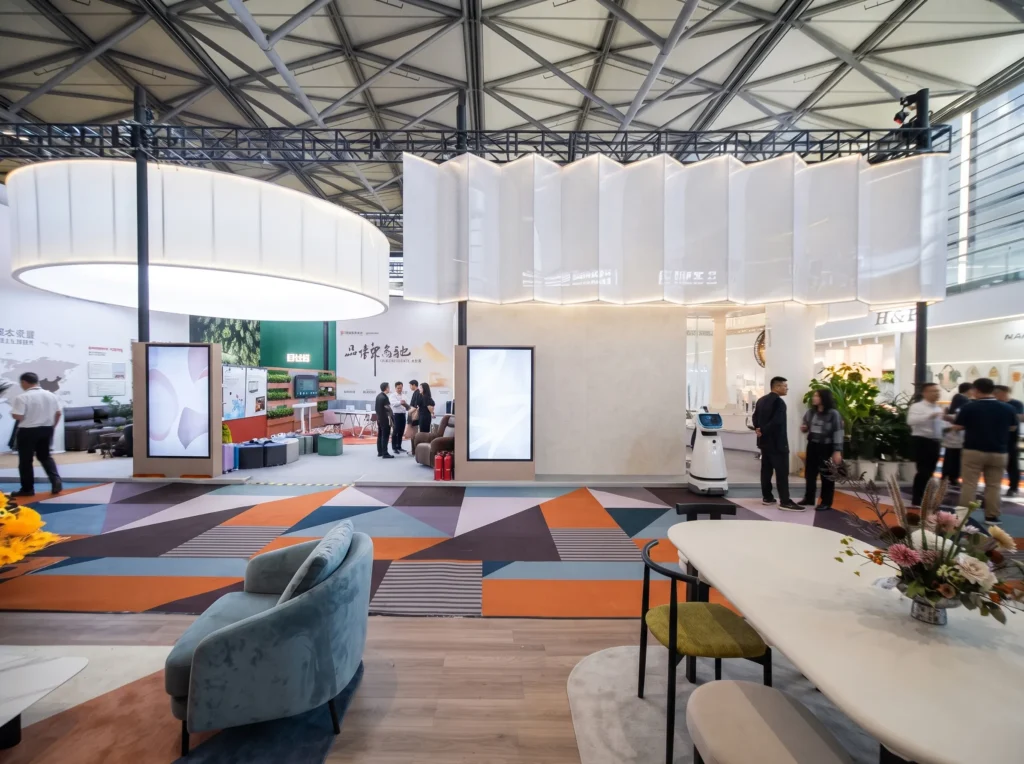
Maison Shanghai is the more interesting half of the week for anyone serious about design trend furniture China as a forward indicator. Its four themed halls map cleanly onto China’s structural shift from manufacturing followership to selective original design.
| Hall | Theme | What You Will Actually Find | Original Design Density | Who Should Spend Time There |
|---|---|---|---|---|
| H1 | Decoration Aesthetics | Decorative objects, soft furnishings, lifestyle scenography | Low-medium; heavy on styling, light on invention | Retailers sourcing accessory layers |
| H2 | New Channel Selection | Products curated for e-commerce and content-commerce channels | Medium; optimized for parcel economics and visual click-through | Amazon, Wayfair, and live-commerce sellers |
| H3 | Design Highland | Independent designers, studio brands, curated original work — including special exhibitions such as Chi Wing Lo’s “Yi Fang,” Lv Yongzhong’s “Dwelling Furniture Practice,” and Jamy Yang’s “The Evolution of Design” | Highest concentration of genuinely original Chinese design at the fair | Buyers hunting real 2027 differentiation |
| H4 | Future Presence | Tech-integrated furniture, experimental materials, concept pieces | Medium; high concept, variable manufacturability | Analysts, spec-driven project buyers, trend scouts |
The honest assessment: true original Chinese design capable of leading — rather than following — global taste in 2027 remains a small fraction of the total fair volume, concentrated in H3 and in specific flagship collaboration lines of leading factories. That fraction is growing. But if your 2027 assortment strategy depends entirely on floor discoveries at Design Highland, you are working with a thin pipeline, and you should say so to your stakeholders.
The Four Traps That Cost Buyers Real Money
First, the first-launch premium. Products badged as global debuts frequently carry pricing that corrects downward within three to six months once the initial order window closes. If a supplier will not commit launch pricing in writing with a correction clause, assume you are funding their marketing.
Second, intellectual property exposure. Fast-follow pieces that closely resemble protected Western designs can land your container in a customs dispute or your listings in a takedown. This risk is highest on items that replicate recognizable silhouettes from Salone exhibitors and DTC darlings. Verify originality against the original designs before you sign a purchase order; when in doubt, obtain a legal review in your destination market. We cross-checked this guidance against multiple trade and legal sources.
Third, unproven mass production. Concept prototypes on a trend wall have not survived a production line. Ask for pilot-run QC data, not showroom samples. Samples are hand-finished; your 500-unit order will not be.
Fourth, buying the theater instead of the product. Scenario staging — scenario-based merchandising packaging— is a legitimate merchandising craft, but it is designed to make a refresh feel like a revolution. Strip the staging mentally before you evaluate the piece.
Your Playbook, by Buyer Type
| Buyer Type | Trend Evaluation Framework | Sourcing Timing | Inventory Strategy |
|---|---|---|---|
| Large-volume B2B importer | Weight certified-material and modular SKUs highest; treat curved/fast-follow items as proven-demand commodities, not differentiators | Negotiate at the fair but lock volume pricing with correction clauses; expect better terms in the October–December window | Build 2027 core around compliance-driven trends; cap exposure to style-driven items at 20–30% of assortment |
| Mid-size retailer / e-commerce seller | Prioritize parcel-efficient modular pieces with fast assembly; validate review-damage data before scaling | Sample at the fair, commit after pilot-run data; avoid first-launch premiums on refreshed SKUs | Small-batch test orders on trend items; reorder only on sell-through evidence |
| Interior designer / project procurement | Mine H3 for genuinely original pieces; verify lead times, customization ceilings, and certification documents | Engage studios early — original design carries longer sampling cycles | Reserve original-design pieces for flagship projects where differentiation justifies the premium |
One rule applies to everyone: the fair is for calibration, not commitment. The suppliers who matter will still answer your emails in October.

Frequently Asked Questions
Is Furniture China 2026 a reliable predictor of 2027 furniture trends?
Partially. The fair reliably shows what Chinese factories will manufacture at scale in the coming year, which is a different question from what will lead global taste. For genuine forward signals, concentrate on Maison Shanghai H3 Design Highland and curated award entries such as the Golden Dot Award, and treat mass-market halls as a lagging indicator of Western demand.
How much of what is labeled “new” at the fair is actually original design?
Based on our field observations and industry estimates, true original design is a minority of total exhibits, with the majority split between refreshes of existing products and fast-follows of Western designs. Exact proportions vary by hall and category. For reference only, subject to official verification.
Should I pay a premium for “global debut” products at the fair?
Usually not without contractual protection. Launch premiums on refreshed inventory typically normalize within three to six months. If the product is genuinely original and you need early exclusivity, negotiate the premium against a written price-correction clause.
How do I check whether a “trend” product risks intellectual property problems in my market?
Compare the piece against the original Western design it resembles, request the supplier’s design documentation, and obtain a legal review in your destination market before placing volume orders. Fast-follow items with near-identical silhouettes carry the highest exposure.
Is Maison Shanghai worth attending alongside Furniture China?
If design originality matters to your positioning, yes. The H3 and H4 halls offer the highest density of original Chinese design and future-facing concepts at the fair week, and the special exhibitions are where the real 2027 conversations are happening.、
What Did You Actually Find on the Floor?
We read every fair differently, and the most useful intelligence in this industry comes from buyers comparing notes. Which “2027 trend” did you see repeated across twenty booths until you stopped believing it — and which under-the-radar piece made you stop walking? Tell us in the comments or bring us your specific category question, and we will give you the unvarnished read.
Recommended Resource
Interi Furniture specializes in custom furniture manufacturing for residential, hospitality, and commercial projects. Their experience in materials, craftsmanship, and project realization makes them a valuable resource for designers and buyers seeking tailored furniture solutions from China.