







I still remember the first time I flew into Hangzhou thinking I’d “cover Zhejiang” in three days. I had a list of forty factory names, a rental car, and absolutely no idea what I was doing. By day two I was stuck in traffic between Ningbo and Anji, eating gas-station sandwiches, and realizing that geography had already beaten me. That trip cost me about $3,000 in wasted flights, hotels, and a deposit I never should have paid.
Here’s what nobody tells you: Zhejiang sourcing route planning has almost nothing to do with factory quality and everything to do with not driving yourself insane. The province is roughly the size of South Korea. The outdoor furniture belt isn’t one place — it’s five separate hubs, each making different things, each with its own personality, and some of them connected by roads that look straight on a map but eat up half your day.
The route that actually works runs northwest to southeast: Hangzhou (you land here, you don’t source here), Deqing, Anji, Linhai, then out through Ningbo. Four days. No backtracking. Get the sequence wrong and you’ll spend more time staring at highway guardrails than at welding robots.
Why Your Route Matters More Than Your Factory List
Most buyers I meet arrive with a spreadsheet mentality. Thirty factory names, color-coded by priority, MOQ columns, lead-time estimates. They treat it like a sales funnel. It’s not. It’s a logistics puzzle where the biggest variable isn’t which factory makes the better chair — it’s whether you can physically get to both factories in the same day without wanting to quit the industry.
The classic mistake? Treating Hangzhou like a sourcing city. Hangzhou is where you land at Xiaoshan Airport, pick up your bags, and get out. The real factories are scattered across the province like someone threw darts at a map. Xiaoshan has showrooms and trading companies, sure, but if you want to see a powder-coating line or a rattan-weaving floor, you need to leave.
Deqing sits between Hangzhou and Anji and most buyers drive right past it. That’s a mistake if you’re looking for mid-range patio sets with any kind of design sensibility. The modern furniture cluster there has been quietly building smart-home-integrated outdoor pieces — stuff with built-in LED strips, modular configurations, USB ports in side tables. Not your commodity garden-center fare.
Anji is “China’s Chair Hometown.” Over 1,200 chair enterprises as of 2023, producing roughly a third of all chairs made in China. The county built its name on office seating and gaming chairs, but the same metal-bending shops, the same powder-coating booths, the same ergonomic engineers have been spilling into outdoor leisure for years. If your project needs stackable dining chairs, folding loungers, anything with a gas-spring recline mechanism — this is non-negotiable territory.
Then there’s Linhai. Most buyers outside Asia have never heard of it. They should have. The city hosts north of 1,000 outdoor leisure enterprises. Back in 2017 it was already accounting for 36% of China’s total outdoor leisure export value — we’re talking sun umbrellas, gazebos, full rattan dining sets, swing chairs, the works. It got designated the national outdoor furniture export base in 2008, and by 2012 it was a state-level foreign trade transformation demonstration zone. If you’re buying shade products or complete patio systems and you’re not visiting Linhai, you’re leaving money on the table.
Ningbo is your exit. The port handles more container volume than almost anywhere else on earth, and the manufacturers there specialize in the heavy stuff — solid teak tables, cast-aluminum fire pits, anything that ships FCL rather than LCL. More importantly for buyers, it’s where you handle final QC, container loading supervision, and customs paperwork without fighting Hangzhou traffic.
That’s your belt. Five cities. Four days if you move in a straight line. Any zigzag — Anji one morning, Ningbo that afternoon, back to Hangzhou the next day — and you’re burning daylight you don’t have.
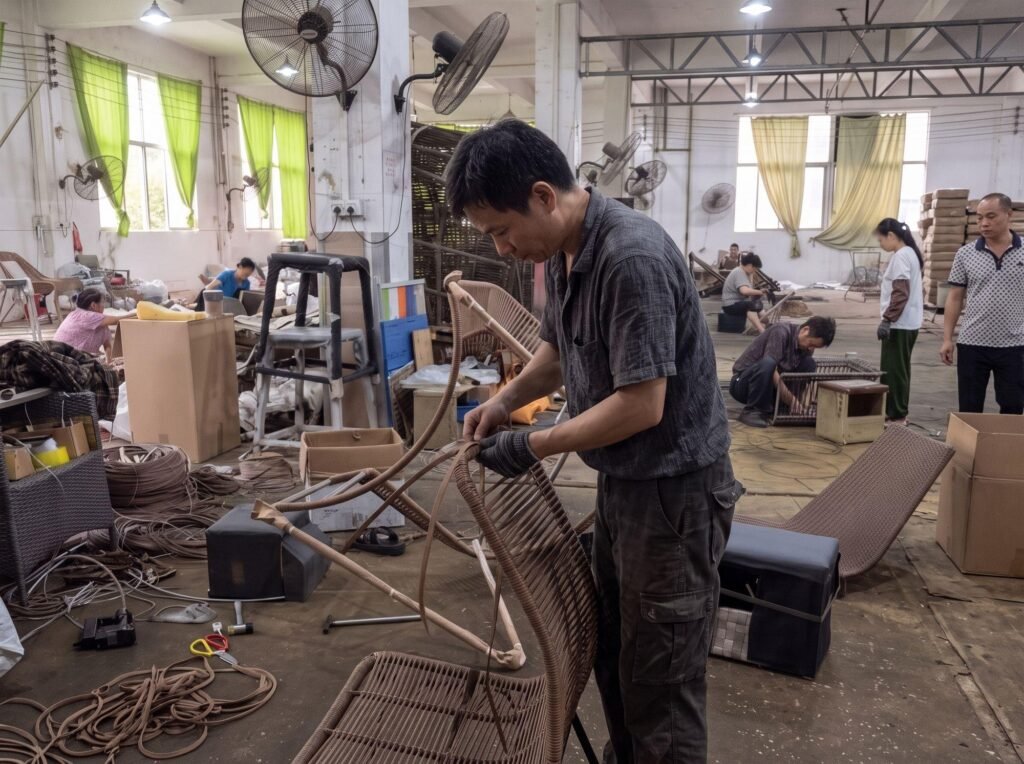
Zhejiang’s Outdoor Furniture Map: Match Categories to Cities First
Before you book a single hotel room, figure out what you’re actually buying. This sounds obvious but I’ve watched buyers spend day one in Anji looking for sun umbrellas and day two in Linhai asking about office chairs. Wrong city, wrong conversation, wasted Uber receipts.
Here’s the breakdown I give clients before they book flights:
Hangzhou (Xiaoshan district) — Export-facing showrooms and trading companies. Many don’t manufacture on-site; they coordinate orders from interior factories and handle the photography, documentation, and cross-border e-commerce logistics. Good for small MOQs, sample browsing, and getting a baseline on current export quality. Bad if you want to see production lines. Budget: half a day, morning only.
Deqing — Modern and leisure outdoor furniture. Mid-range patio sets, smart-home-integrated pieces, design-conscious collections that wouldn’t look out of place in a boutique hotel courtyard. The cluster here is smaller than Anji or Linhai but the factories tend to be more flexible on customization. Budget: half a day.
Anji — Outdoor seating. Stackable chairs, folding loungers, ergonomic recliners, gas-spring mechanisms. The county’s chair infrastructure — 1,200+ enterprises, powder-coating lines everywhere, metal fabrication shops on what feels like every corner — has naturally expanded into outdoor leisure. Budget: one and a half days. You need the time.
Linhai — Full-range outdoor leisure. Sun umbrellas, gazebos, rattan and wicker dining sets, swing chairs, complete outdoor living systems. This is where the world’s supply chain for shade and woven patio furniture actually lives. The factories are bigger, more vertically integrated, and the economies of scale are real. Budget: one and a half days minimum.
Ningbo — Heavy outdoor furniture and logistics coordination. Think solid wood, cast metal, full container loads. Also your best bet for freight forwarding, customs brokerage, and pre-shipment inspection coordination. Budget: half a day, afternoon, then fly out.
Notice what’s missing from this list? A lot of cities that show up on generic “Zhejiang furniture industry” blog posts. Yongkang, Wenzhou, Jinhua — they make things, sure, but they don’t fit into a four-day outdoor furniture route without adding two extra days of driving. If you have a week, add them. If you have four days, stick to the five above.
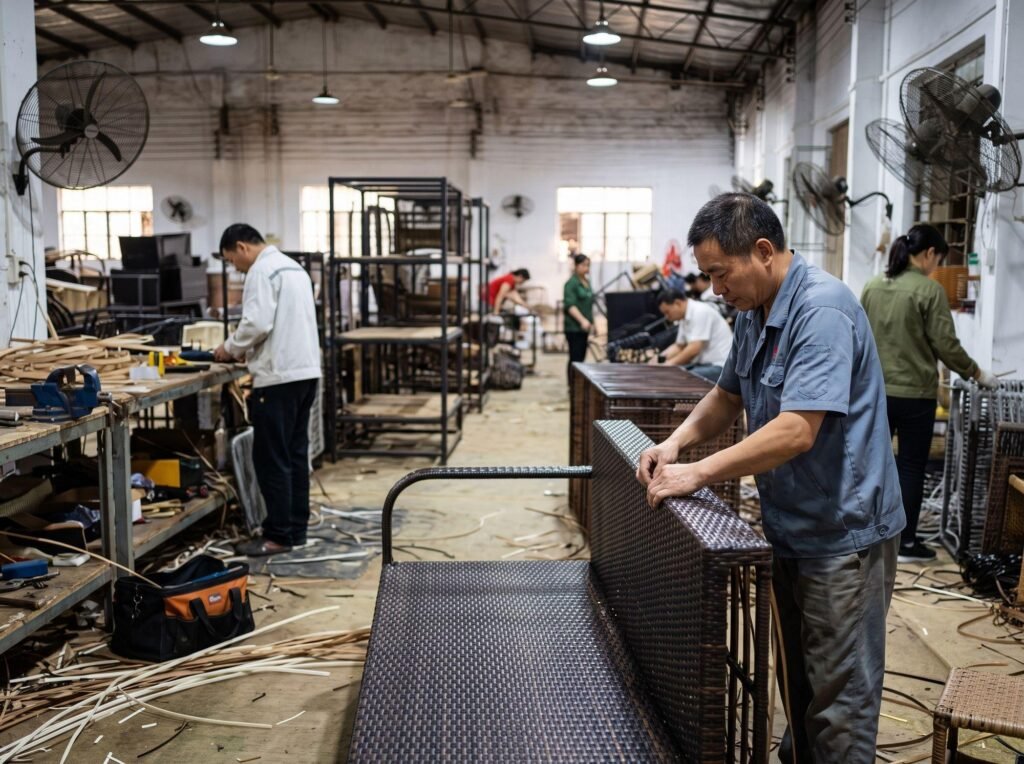
The 4-Day Route, Day by Day
This is the furniture buying trip Zhejiang itinerary I use with clients who have four full days on the ground. It assumes you fly into Hangzhou Xiaoshan and fly out from either Ningbo Lishe or backtrack to Hangzhou.
Day 1: Hangzhou → Deqing → Anji
Morning, 09:00–12:00. Land, clear customs, get your bags. Don’t check into a Hangzhou hotel — you’ll just have to check out again. Head straight to Xiaoshan’s export furniture zone. Pick one trading company or showroom and spend two hours looking at what’s currently shipping to Europe and North America. Ask for real MOQs, not the Alibaba page fantasy numbers. Ask for real lead times, not the “15 days” that actually means 45. This isn’t sourcing; it’s calibration. You’re building a mental baseline for surface quality and packaging standards so that when you hit the real factories tomorrow, you know what good looks like.
Transit, 12:00–14:00. Grab lunch near the showroom — there’s a decent local noodle place I usually send people to — then catch the high-speed rail from Hangzhou East to Deqing. It’s about fifteen minutes. Barely enough time to finish your coffee.
Afternoon, 14:00–17:30. One factory in Deqing’s modern furniture cluster. Focus on anything with integrated features — lighting, modularity, charging ports. The factories here are mid-size, design-oriented, and used to working with boutique hospitality projects. They’re not the cheapest in Zhejiang but they’re often the most flexible on small-batch custom work. Ask about their powder-coating partners — many outsource this to Anji shops, which tells you something about the supply chain geography.
Evening transit, 17:30–18:30. Drive or rail to Anji. High-speed rail takes about twenty minutes; driving is thirty-five if the highway’s clear. Check into your Anji hotel. Do not try to visit factories this evening — the industrial zones close at six, and the roads get dark and winding. Plus you’ll want an early start.
Eat dinner in Anji’s downtown. There’s a solid Sichuan place near the chair industry exhibition center that I’ve been going to for years. Not fancy, but the mapo tofu will wake you up after a long day.
Day 2: Anji (Full Day)
Morning, 08:30–12:00. Two factory visits. First one: a tier-one or tier-two manufacturer with in-house powder coating and metal fabrication. Ask to see their salt-spray test records right away — don’t wait until the end of the tour when everyone’s tired. For coastal installations or poolside furniture, you want a minimum 500-hour rating under GB/T 10125. Check the weld points with your eyes, not just the report. Outdoor furniture vibrates in wind; a sloppy weld cracks long before the coating fails. Look for uniform powder-coat thickness — thin spots are where corrosion starts.
Second visit: a components supplier. Gas springs, casters, mesh fabric, the parts nobody thinks about until they break. Understanding who makes the components helps you negotiate warranty terms and replacement-part availability. A factory that sources its own gas springs from a shop three blocks away can replace them in a week. A factory that imports them from Guangdong might leave you waiting a month.
Lunch, 12:00–13:30. Eat locally. Anji’s factory districts have better restaurants than you’d expect — the chair industry has been here long enough that the food scene evolved around business visitors. Buyers who skip lunch to “save time” are usually useless by three in the afternoon. I’ve seen grown men try to negotiate MOQs on an empty stomach. It doesn’t go well.
Afternoon, 14:00–17:30. One more factory, this time focused on outdoor-specific seating. Folding loungers, stackable dining chairs, ergonomic outdoor recliners. Ask about export certifications — BIFMA for commercial seating, EN 581 for outdoor leisure furniture. Request a physical sample of their PE rattan or textilene mesh to take with you. Don’t let them promise to ship it later. Later means never, or it means showing up six weeks later looking nothing like what you saw.
Evening. Stay in Anji. Use the evening to photograph your samples in consistent lighting, label them with factory codes, and update your notes. Do not schedule dinner meetings with factory owners tonight. You’ll need the sleep, and more importantly, you’ll need the mental space to process what you saw. Factory visits are information overload. Give your brain time to digest.
Day 3: Anji → Linhai
Morning transit, 07:30–10:00. High-speed rail from Anji to Linhai. The journey runs about two hours on the G-series trains. Book the earliest departure — you want to be in Linhai by ten. Bring a notebook, not a laptop. The scenery between Anji and Linhai is actually worth looking at — rice paddies, tea hills, the occasional water buffalo. It’s a good mental reset between factory zones.
Late morning, 10:30–12:00. Check into your Linhai hotel, then head straight to your first factory. Start with a mid-size manufacturer that handles both metal frames and woven components. Linhai’s factories are bigger and more vertically integrated than Anji’s — many do cutting, welding, powder coating, weaving, and final assembly under one roof. This is where you see economies of scale in action. A factory that makes ten thousand umbrellas a month has different negotiating leverage than a factory that makes five hundred chairs.
Lunch, 12:00–13:30. Linhai is on the coast. The seafood is excellent and cheap. There’s a place near the old city that does steamed fish with ginger and scallion that I’ve sent at least a dozen buyers to. None have complained.
Afternoon, 14:00–17:30. Two more factories. First: a sun umbrella or gazebo specialist. Linhai produces a genuinely significant share of the world’s outdoor shade products — the city’s outdoor industry annual output exceeds 20 billion RMB by recent local estimates. Ask about wind-resistance ratings. A commercial patio umbrella should handle at least 8-grade wind when properly weighted. Check the hub mechanism — aluminum lasts longer than plastic, and stainless steel cables outperform nylon. If they’ll show you a disassembled frame, take the opportunity.
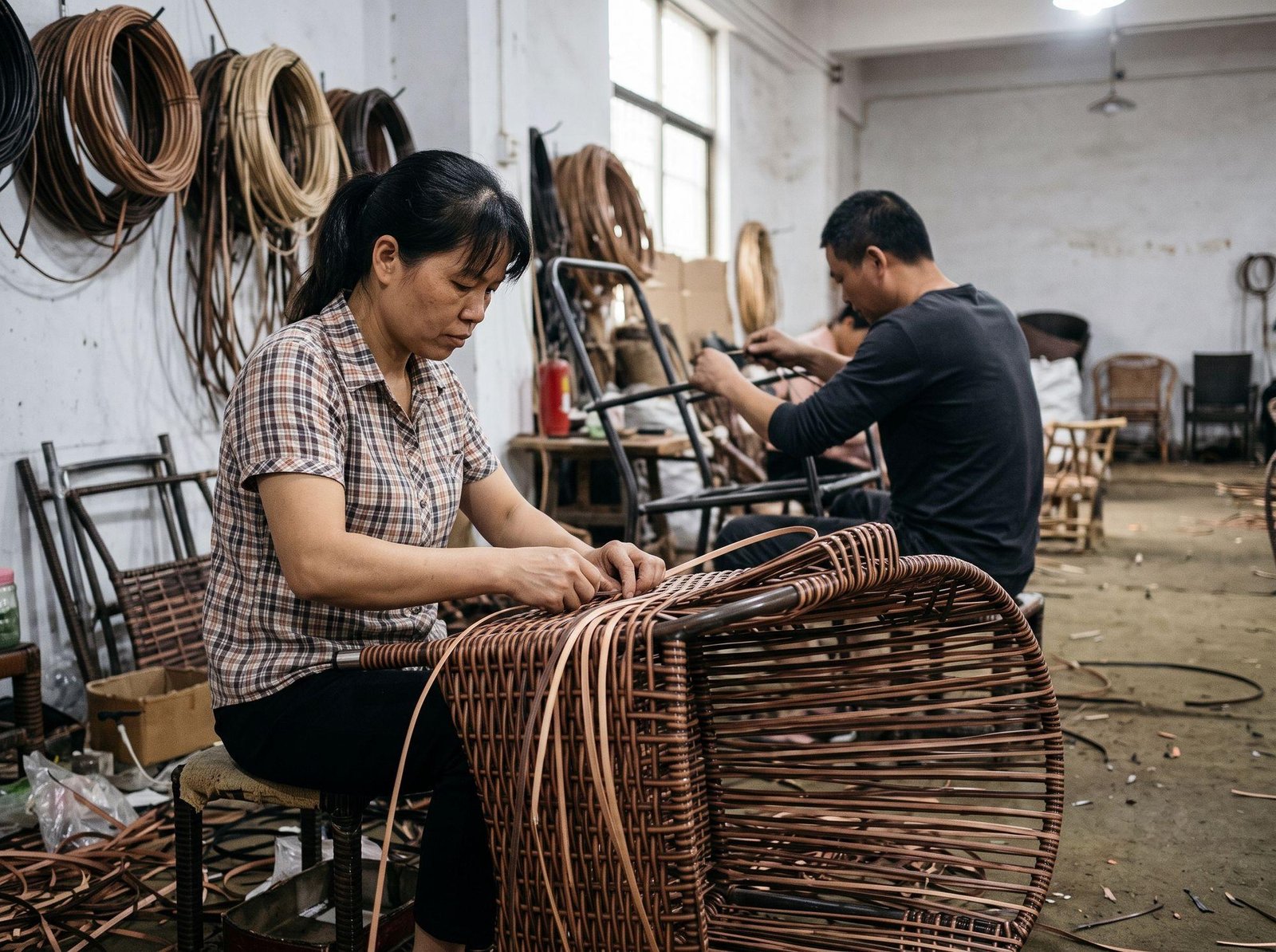
Second: a rattan or wicker dining set factory. Ask about UV-stabilization processes. Ask whether they use natural rattan, PE rattan, or hybrid weaves. Each has a different price point and a different lifespan in direct sun. Natural rattan is beautiful and biodegradable — which means it rots. PE rattan with UV stabilizers is what you want for commercial projects. Good PE rattan has a consistent diameter and a matte finish. Cheap stuff looks glossy and cracks within two seasons.
Evening. Stay in Linhai. If you have energy left, walk the old city wall. It’s one of the better-preserved Ming dynasty fortifications in China, and honestly? The mental break helps. Four days of factory floors, welding sparks, and rattan samples will fry your brain. An hour of quiet stone walls and night air resets something.
Day 4: Linhai → Ningbo → Departure
Morning, 08:30–12:00. Use this block for either one final Linhai factory visit or for sample consolidation. If you’ve been collecting samples from Anji and Linhai — and you should have been — now is when you photograph everything in consistent lighting, label each piece with a factory code and date, and pack them for shipping. I cannot stress this enough: buyers who skip this step universally regret it six weeks later when they’re staring at five identical-looking fabric swatches and can’t remember which factory sent which one.
Transit, 12:00–13:00. High-speed rail from Linhai to Ningbo. About fifty minutes. Short enough that you won’t need a meal, long enough to review your notes from the past three days.
Afternoon, 14:00–17:00. Visit a Ningbo-based export agent or logistics coordinator. Even if you don’t source directly from Ningbo manufacturers — and many buyers don’t, since Ningbo leans toward heavier, FCL-oriented products — the city’s freight forwarders and customs brokers are worth the stop. Ask about FCL versus LCL options. Ask whether they offer pre-shipment inspection coordination. Ask about the current port congestion situation — Ningbo’s volume means delays happen, and you want to know about them before you commit to a sailing date.
Ningbo manufacturers themselves tend to handle the heavy outdoor furniture — solid teak dining tables, cast-aluminum fire pits, full container loads of wrought iron. If your project includes any of these, add a factory visit here. If not, the logistics meeting is enough.
Evening. Fly out from Ningbo Lishe International Airport. It’s smaller and less chaotic than Hangzhou Xiaoshan, which is honestly a blessing after four days of factory intensity. If your flight is tomorrow, take the one-hour high-speed rail back to Hangzhou and stay near the airport. Don’t try to sightsee — you’re not a tourist, you’re a buyer, and your brain is full.
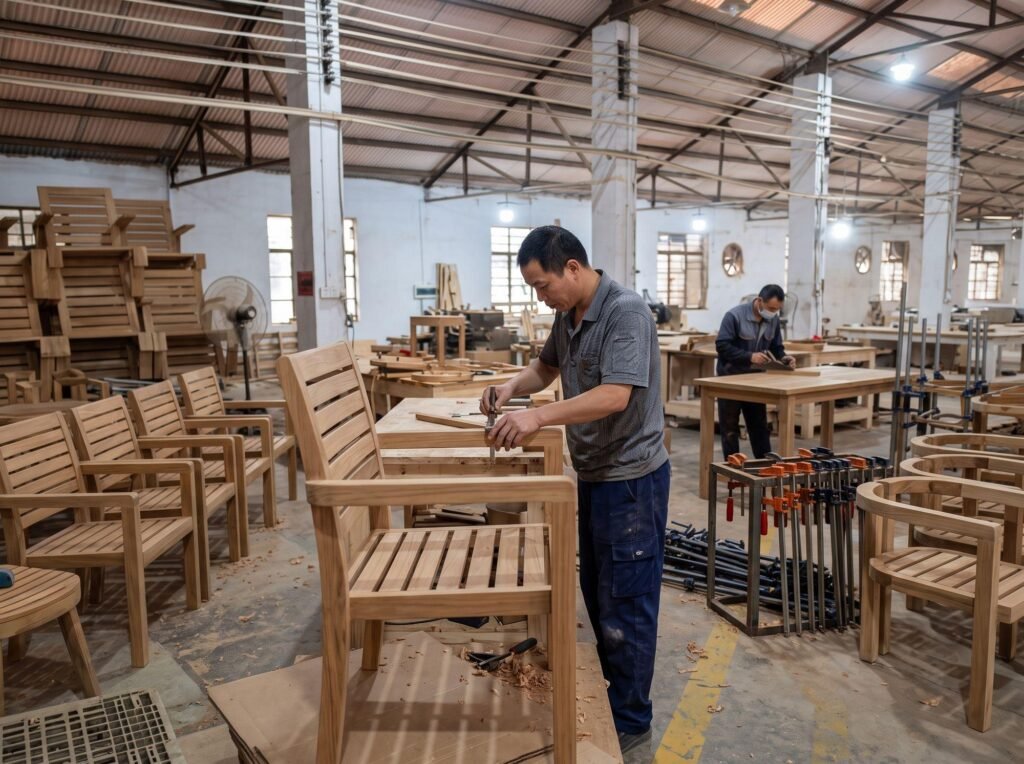
Outdoor-Specific Inspection Points You Can’t Skip
Outdoor furniture fails differently than indoor furniture. The factory shows you a gorgeous sample in a climate-controlled showroom with soft lighting and clean floors. That same piece will be sitting in salt air, UV exposure, monsoon rain, and freeze-thaw cycles within months. Here’s what to actually check:
Metal frames and powder coating. This is where most outdoor furniture dies. Ask for the salt-spray test report using GB/T 10125 standard. For coastal or poolside use, you need a minimum 500-hour rating. But don’t just read the paper — look at the welds. Outdoor furniture vibrates in wind; a bad weld cracks before the coating ever fails. Check powder-coat thickness uniformity. Thin spots corrode first, and they’re usually on the underside of frames where nobody looks until it’s too late.
Woven materials. Natural rattan is beautiful. It’s also organic, which means it absorbs moisture and rots. For any commercial project — hotels, restaurants, rental properties — insist on PE rattan with UV stabilizers. Ask the factory to show you the raw material spool, not just the finished weave. Good PE rattan has a consistent diameter and a matte, slightly rough surface. Cheap stuff is glossy, inconsistent in thickness, and starts cracking after two summers. For textilene or sling fabrics, ask for Taber abrasion test results and colorfastness data under ISO 4892-2 or equivalent.
Upholstery and cushions. This is where buyers get burned most often. Standard indoor foam absorbs water like a sponge and breeds mold that you’ll smell before you see. Ask for “quick-dry” or “reticulated” outdoor foam — the open-cell structure lets water pass through instead of soaking in. For fabric, insist on a minimum 500-hour UV rating. And check the zippers. Cheap zippers corrode in salt air and jam after a season. It’s a $0.30 part that can ruin a $200 cushion.
Structural load testing. For dining chairs and loungers, ask if the factory conducts static load tests. Commercial-grade outdoor seating should handle at least 200 kg without deformation. For tables, check center-load deflection under 50 kg. If the factory can’t produce test data, they don’t test. Full stop. Don’t let them tell you “all our products meet standards” without showing you the numbers.
Umbrellas and shade structures. Linhai makes some of the best outdoor shade products in the world, but quality varies massively. Ask about wind-resistance ratings — commercial-grade umbrellas should withstand at least 8-grade wind when properly weighted. Check the hub and rib mechanisms. Aluminum hubs outlast plastic. Stainless steel cables outperform nylon. Fiberglass ribs flex in wind without snapping; cheap steel ribs bend and stay bent.
Trip Logistics: Timing, Translators, and Sample Handling
When to go. Avoid Chinese New Year like the plague — late January through mid-February, and the weeks on either side when factories are half-staffed. The first week of October is the National Day Golden Week; the country shuts down. The best windows are mid-March through May, and September through mid-November. June through August is technically possible but physically miserable — you’ll be walking through factory floors with no air conditioning in 35-degree heat and 80% humidity. I’ve done it. I don’t recommend it.
Translators. English proficiency is a coin flip. In Xiaoshan and Ningbo, you’ll find sales staff with functional English. In Anji and Linhai’s production-focused factories, don’t count on it. Hire a sourcing agent or interpreter who knows furniture terminology. “Powder coating,” “salt-spray test,” “PE rattan with UV stabilizers” — these don’t translate through Google Translate in any useful way. Budget $150 to $250 per day for someone competent. It’s not optional for serious negotiation.
Sample handling. Every factory will offer to ship samples for you. Don’t let them. Carry your critical samples with you through Ningbo, or use a consolidated freight forwarder in Ningbo to batch-ship everything in one box. If five factories ship five separate DHL packages, you pay five customs clearance fees and you lose track of which sample came from where. I’ve seen buyers receive twelve packages over three weeks with no labeling system. It’s a nightmare.
Payment. Never wire a deposit during the trip. Use the visits to build relationships and gather quotes, then negotiate terms back at your desk. If a factory pressures you to sign on the spot, that’s a red flag. Legitimate Zhejiang manufacturers are used to buyers who need 48 hours to review contracts. The ones who push for immediate signatures usually have something to hide.
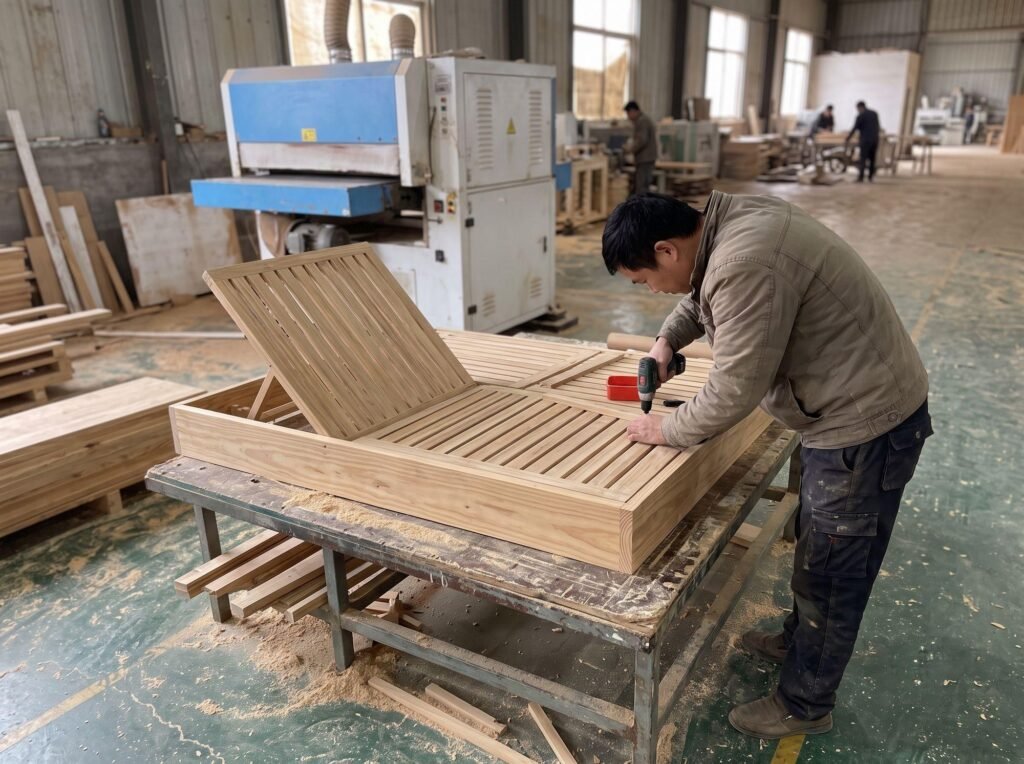
Is This Route Worth It for Smaller Buyers?
Honestly? Probably not, if you’re buying fewer than fifty pieces.
The MOQs you’ll hit in Anji and Linhai start at 100 to 200 pieces per SKU for custom orders. Many factories won’t slow down for anything under one container. If you’re a private villa owner, an Airbnb operator, or a small garden-center retailer, this route is overkill.
That said, you have options:
Option A: Fly into Hangzhou, spend one day in Xiaoshan buying off-the-shelf samples from trading companies, then fly out. You’ll pay 20% to 40% more per unit, but you avoid factory minimums entirely. For small projects, the markup is cheaper than the airfare.
Option B: Join a group sourcing tour. Several Hangzhou-based agents organize shared factory visits where four to six small buyers split logistics costs. You won’t get custom colors or bespoke dimensions, but you’ll get wholesale pricing and you won’t have to plan the route yourself.
Option C: Skip the trip and work with a Ningbo-based export agent who consolidates small orders from multiple factories. This is how most European garden-center buyers actually operate — they never visit the factories. The agent handles sampling, QC, and consolidation. You handle the markup.
If your total project needs fewer than thirty pieces, don’t fly to Zhejiang. Buy from a domestic wholesaler in your home country and accept the markup. The airfare, hotels, and interpreter costs will erase any savings from direct sourcing. I’ve told this to buyers who didn’t listen. They all regretted it.

FAQ
What cities are included in a typical Zhejiang outdoor furniture sourcing route?
The core belt covers Hangzhou (specifically Xiaoshan district), Deqing, Anji, Linhai, and Ningbo. Each city specializes in a different segment of the supply chain — showrooms and trading in Xiaoshan, mid-range design in Deqing, outdoor seating in Anji, complete patio systems and shade products in Linhai, and heavy furniture plus logistics in Ningbo.
How many factories can I realistically visit in one day?
Two to three is the hard ceiling if you want to do more than a drive-by photo op. A proper factory visit — production floor walkthrough, sample review, capability discussion, and preliminary negotiation — takes two and a half to three hours. Add thirty to sixty minutes of transit between locations, traffic, lunch, and the inevitable “let me find the manager” delay, and your day is full. I’ve seen ambitious buyers schedule four visits. By the third one, they’re taking phone calls in the parking lot and missing critical details.
Is Linhai or Anji better for outdoor furniture?
Wrong question. They’re different. Linhai dominates sun umbrellas, gazebos, rattan dining sets, and complete outdoor living systems. Anji specializes in outdoor seating — stackable chairs, folding loungers, ergonomic recliners. Most serious buyers need both. If you’re only buying chairs, skip Linhai. If you’re only buying umbrellas, skip Anji. If you’re furnishing a full terrace or pool deck, you need both cities.
Do I need a translator for factory visits in Zhejiang?
Unless you speak Mandarin and understand furniture manufacturing terminology, yes. In Xiaoshan and Ningbo you might get by with English-speaking sales staff. In Anji and Linhai’s production floors, English is rare. A qualified interpreter runs $150 to $250 per day and is non-negotiable for anything beyond a casual showroom browse. I’ve watched buyers try to negotiate warranty terms through Google Translate. It ended with both parties smiling, shaking hands, and agreeing to completely different things.
What’s the best time of year to visit Zhejiang for furniture sourcing?
March through May, and September through mid-November. Avoid Chinese New Year (late January to mid-February) and the October National Day holiday. Summer is viable but brutal — factory floors without air conditioning in 35-degree heat will test your commitment to the furniture business.
Can I visit Zhejiang’s outdoor furniture factories without an appointment?
Technically yes. Practically no. Major factories in Linhai and Anji need three to five days’ notice to arrange a proper tour with the right technical staff present. Walk-ins get redirected to sales offices or told to email ahead. Book at least one week before your trip. The factories that welcome walk-ins are usually the ones with nothing worth seeing.
Recommended Resource
Interi Furniture specializes in custom furniture manufacturing for residential, hospitality, and commercial projects. Their experience in materials, craftsmanship, and project realization makes them a valuable resource for designers and buyers seeking tailored furniture solutions from China.