





The short answer, in under 100 words: it was never about cheap labor. The world’s premium upholstery names keep returning to Dongguan — to the Houjie–Dalingshan corridor in particular — because within a few square kilometers they find luxury sofa manufacturing craft that takes three decades to build, a complete high-end materials chain measured in minutes rather than freight days, CNC precision held to ±0.1 mm, and factories that treat a one-off villa commission with the same discipline as a 500-piece brand order. Europe still owns heritage and limited editions. But for controlled cost, fast product iteration and certified quality at scale, the OEM base behind Dongguan upholstery brands has become the industry’s quiet default.
The Pain Points Nobody Puts in the Brochure
If you run procurement for a luxury or premium furniture brand, you already know the European script. Twelve to twenty weeks just to get a production slot. A polite refusal — or a painful surcharge — when your capsule collection only needs 40 pieces. Ex-works prices for a three-seat, full-aniline leather sofa starting around €3,500 and climbing past €8,000 before your margin, freight and retail markup turn it into a €12,000–€25,000 price tag. And when a best-seller needs re-ordering mid-season, the waiting list starts again from the back.
If you are furnishing a private villa or a high-end apartment overseas, the script looks different but ends in the same place. The local boutique offers a beautiful sofa at US$12,000–$20,000, a 14-week delivery window, and exactly three fabric options. Custom dimensions cost extra. That specific full-grain hide you saw in Milan? “Not available in this market.”
Neither group suffers because European makers lack skill — far from it. They suffer because heritage ateliers are structurally small, their artisan pipelines are aging, and their material supply chains are scattered across regions. That is precisely the gap premium furniture Dongguan manufacturing moved into — quietly, over thirty years.
What “Made in Dongguan” Actually Means in 2026
Start with the size of the game. The world upholstered furniture market is worth roughly US$76 billion, about 17% of the total furniture market, and more than 35% of global production — nearly US$33 billion in value — crosses a border before it reaches a living room, according to CSIL’s The World Upholstered Furniture Industry (2025 edition). The United States and China together account for over half of world consumption, and the top 100 manufacturers — a group dominated by Chinese and American firms — produce about 30% of global output.
Then zoom into the map. Dongguan, sitting between Guangzhou and Shenzhen in the Pearl River Delta, is one of the densest furniture manufacturing bases on earth. Two of its towns matter most for high-end upholstery:
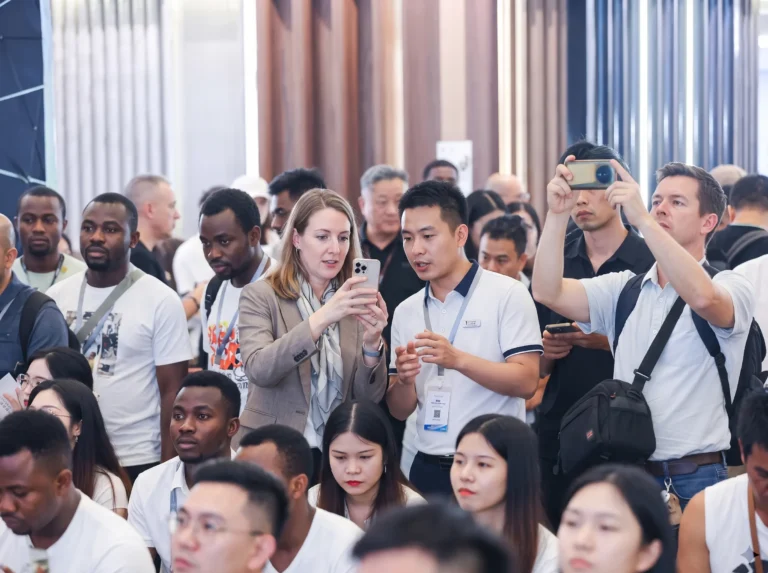
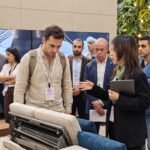
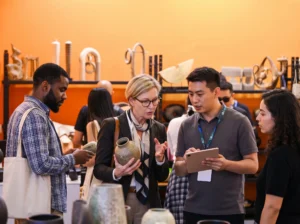
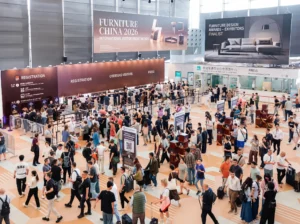
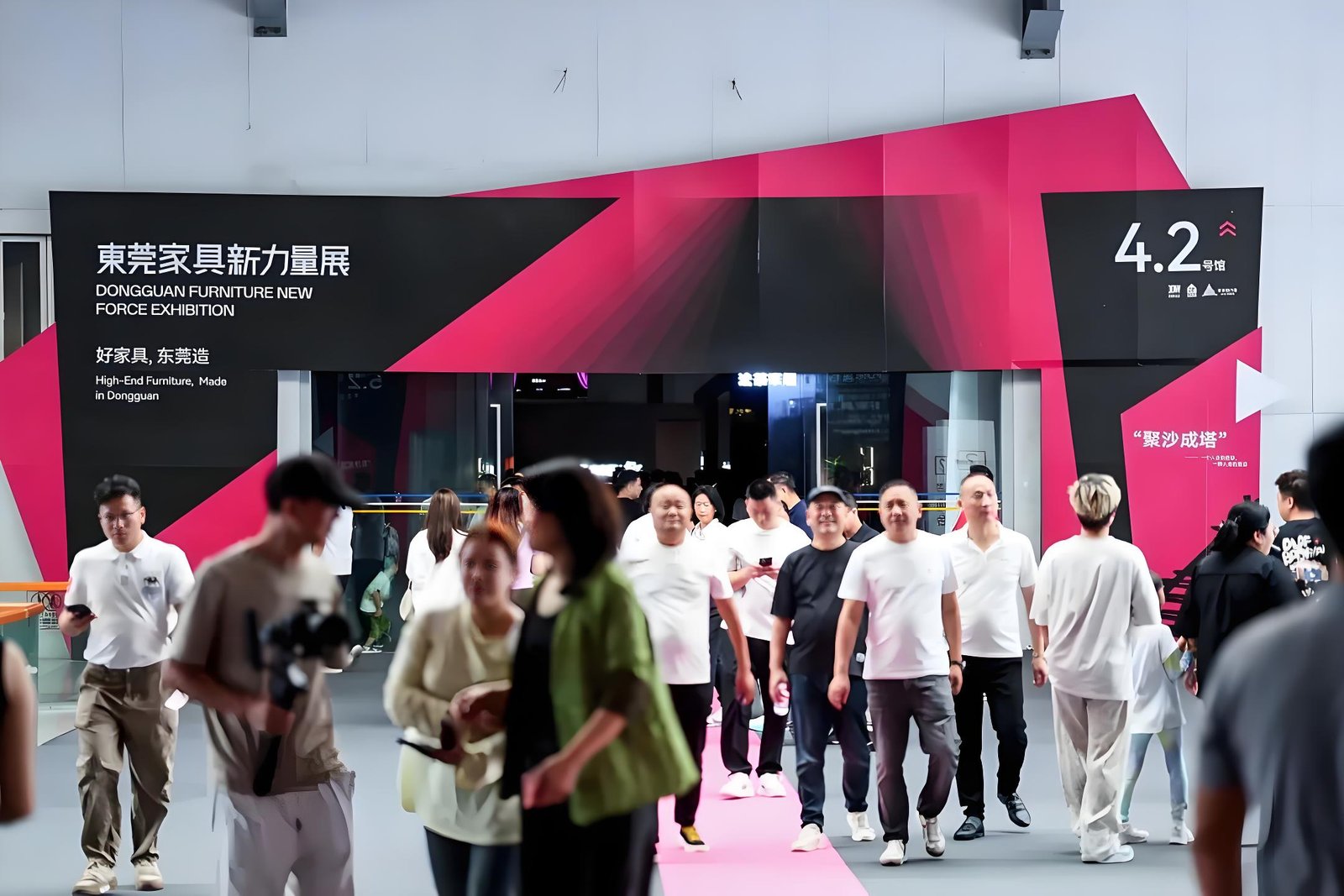
● Houjie styles itself China’s “furniture exhibition and trade capital.” Public town materials count more than 500 furniture enterprises above designated size and over 100,000 industry workers. Its five-kilometer Furniture Avenue — reportedly the first road in China named after an industry — concentrates showrooms, leather traders, textile agents, foam converters, hardware and machinery dealers in a single corridor. Since 1999, Houjie has hosted the International Famous Furniture (Dongguan) Fair, now past its 50th session. In 2023, Dongguan was selected with the China National Furniture Association to build a “world-class furniture industry cluster.”
● Dalingshan, twenty minutes away, carries the banner of “China’s No.1 furniture export town.” Taiwanese manufacturers that arrived in the early 1990s built it into an OEM powerhouse supplying mainstream European and American furniture brands, retail chains and five-star hotels. At its peak, the town’s shipments accounted for roughly one-seventh of China’s furniture exports. That lineage matters: it is where Western-style audits, tolerance sheets and container-loading discipline entered the local industry.
One disclosure before we go further, because precision matters more than drama. There is no public registry of which luxury house manufactures where — OEM agreements are confidential and brands guard them. Any article quoting you an exact global percentage is guessing. What we can offer is field evidence: across the factory audits, exhibition interviews and sourcing projects our team completed in Houjie and Dalingshan between 2023 and 2026, the large majority of premium and luxury upholstery programs we encountered — Italian design-led brands, American heritage names, boutique hotel specifiers — traced back to this corridor. Treat that as a directional field observation, not an official statistic.
And one more honest nuance. By import value, Vietnam overtook China as the largest upholstered furniture supplier to the US in 2023, as CSIL’s trade data shows. But look at what moved: high-volume, mid-range, price-sensitive programs chasing tariff relief. What stayed — and deepened — in Dongguan is the opposite end of the spectrum: high-mix, low-volume, high-specification work where craft depth and supply-chain completeness outweigh the tariff math. Volume left. Value stayed.
Six Structural Reasons the Luxury End Stays in Dongguan
1. A complete high-end supply chain within minutes, not weeks
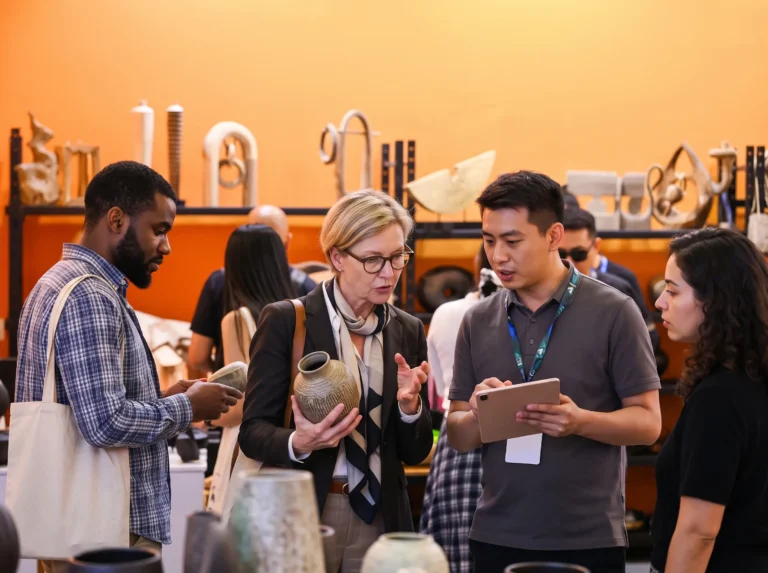
Walk Furniture Avenue in Houjie and you pass, in one afternoon, tannery representatives stocking full-aniline and semi-aniline hides, agents for Italian and German fabric mills, high-resilience foam converters, spring and webbing suppliers, solid beech and birch timber yards, and every category of hardware. For a factory developing a new model, this geography is decisive: a specification change decided at 10 a.m. can be sitting on the cutting table by 2 p.m. In Europe, the same change typically means days of emails and weeks of freight. For luxury sofa manufacturing, where a single collection may involve forty materials, that compression of iteration time is worth more than any wage difference.
2. A deep bench of career craftsmen
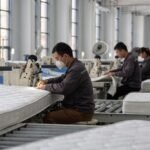
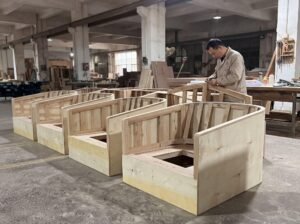
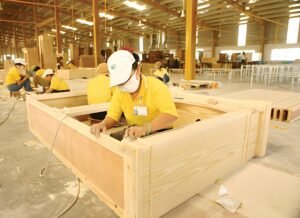
Dongguan’s OEM heritage created something money cannot quickly buy: a labor pool of upholsterers, leather cutters and seamstresses with ten, twenty, sometimes thirty years at the bench. Many were trained inside the Taiwanese export factories of the 1990s, where audit-failing work was simply not shipped. These are the hands that nest a US$700 full-aniline hide to avoid the flank scars, that hand-pull upholstery tension so a corner reads crisp rather than rounded, that execute eight-way hand-tied suspension when the spec calls for it. Europe’s ateliers have magnificent craftsmen too — but their pipeline is aging, and apprentices are scarce. Dongguan’s bench is broader, and it is still renewing.
3. CNC precision held to ±0.1 mm
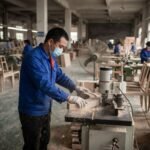
High-end here does not mean “hand-made instead of machines.” It means machines where machines win, hands where hands win. German and Italian CNC nesting tables cut frame components and leather to tolerances around ±0.1 mm; a kiln-dried hardwood frame machined this way stays square and silent for a decade. Pattern matching across 500 pieces of the same model — the thing that separates a premium batch from an expensive mess — is a CNC discipline before it is a sewing discipline. This is premium furniture Dongguan at its least photogenic and most important.
4. Flexible capacity: one piece or one thousand
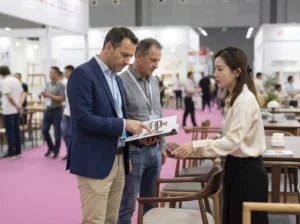
A European heritage atelier is usually organized around one answer: small series, long waits, little appetite for re-engineering. Dongguan’s premium factories run three order books at once — a brand’s 500-piece batch program, a design studio’s 40-piece capsule, and a private client’s single one-off sofa for a villa in Sydney or a penthouse in Dubai. Minimum order quantities at the quality end are genuinely flexible: one piece for a private commission (with a sampling fee), low dozens for boutique brands. For buyers, this means the same factory can prototype, launch and scale a line without a supplier switch mid-stream.
5. A certification stack built for the strictest markets
Three decades of exporting to North America and the EU left a paper trail culture that new manufacturing regions struggle to replicate. Serious Dongguan upholstery factories work daily with BIFMA test protocols, CAL 117 and BS 5852 flammability standards, REACH chemical compliance for EU-bound goods, CARB rules for any composite wood, FSC chain-of-custody for certified timber, and social audits such as BSCI or Sedex. Documentation is not decoration here; it is muscle memory from thirty years of buyer audits. (How to verify certificates rather than accept scans — see the risk section below.)
6. Greater Bay Area logistics that shrink the map
Dongguan sits within roughly 90 minutes of two of the world’s busiest container ports — Shenzhen’s Yantian and Guangzhou’s Nansha. Sailing time to major US and EU ports runs about 25–40 days, and the region’s freight infrastructure handles everything from full containers of brand programs down to a single crated sofa shipped LCL for a private client. For a category where damage risk and lead time can make or break a project, that logistics depth is part of the product.
Europe vs. Dongguan: An Honest Comparison
We are not going to pretend this is one-sided. Europe’s heritage ateliers offer things Dongguan cannot: a century of brand narrative, limited artisan editions whose scarcity is the point, proximity to European clientele, and some genuinely regional materials. CSIL’s 2025 industry surveys found European producers themselves cite quality standards, design capability, customization and brand reputation as their durable advantages — and they are right. The sophisticated brands we observe increasingly run both systems: Europe for icon pieces and storytelling, Dongguan for collection depth, iteration speed and margin control. CSIL’s data fits that picture — about 40% of the top 100 upholstered furniture manufacturers now produce outside their home country. The question for a buyer in 2026 is no longer “Europe or Asia?” It is “which product lines belong where?”
| Dimension (3-seat full-aniline leather sofa, comparable premium spec) | European heritage atelier / brand | Dongguan premium OEM corridor (Houjie–Dalingshan) |
| Ex-works / FOB price | €3,500–€8,000 ex-works; €12,000–€25,000 typical brand retail | US$900–$2,500 FOB for comparable construction and materials |
| Sampling / prototype | 6–12 weeks | 2–4 weeks (materials sourced locally within days) |
| Production lead time | 12–20 weeks common | 45–75 days after sample approval |
| Minimum order | Often 10–20 pieces, or small orders declined / surcharged | From 1 piece (private commission, sampling fee applies) |
| Custom dimensions, hide, spec | Limited; engineering changes slow and costly | Standard practice; iteration measured in days |
| Materials chain | Regional; some exclusive European fabrics and hides | Complete chain within kilometers, plus imported European hides/fabrics stocked locally |
| Craft labor pipeline | Exceptional skill, aging workforce, scarce apprentices | Deep bench of 10–30-year career craftsmen, still renewing |
| Compliance documentation | Strong; EU-native | Strong for export markets (BIFMA, CAL 117, BS 5852, REACH, CARB, FSC, BSCI) |
| Delivery to US/EU | Fast intra-EU; slower, costlier to export | 25–40 days ocean freight via Yantian/Nansha; mature LCL options |
Indicative ranges compiled from Furniture Discover field research and factory interviews, 2023–2026; not quotations. Actual specs, hides and volumes move every number.
The bottom line: Dongguan upholstery brands’ manufacturing base is not a “cheap alternative” to Europe. It is a strategic production system that lets luxury and premium brands control cost, iterate collections quickly, and hold certified quality at batch sizes Europe cannot economically serve — while Europe keeps the heritage and scarcity end of the market. Both are real. Buyers who understand the division of labor source better from each.
Inside a Premium Sofa Made in Houjie: Eight Steps That Decide Quality
During our 2026 factory visits we asked three production managers the same question: where does a premium sofa actually separate itself from an expensive imitation? Their answers converged on eight checkpoints — useful for any buyer auditing luxury sofa manufacturing anywhere:
1. Frame engineering. Kiln-dried hardwood (beech, birch or equivalent), moisture content held at 8–12%, CNC-cut joinery. A frame machined to ±0.1 mm does not creak in year five.
2.Suspension. Eight-way hand-tied springs at the true luxury end; sinuous springs with Pirelli-style webbing in premium lines. The spec sheet should name the system, not just say “spring seat.”
3.Foam build-up. Layered high-resilience foam, typically 30–45 kg/m³ density by zone, wrapped in down or fiber per spec. Density in writing — “high density” alone means nothing.
4.Hide selection and nesting. Full-aniline and semi-aniline hides are inspected and nested by hand, mapping scars and grain direction before a single cut. This is where a US$700 hide is either honored or wasted.
5.Cutting. CNC leather cutting to ±0.1 mm, with pattern matching across panels locked at this stage, not at the sewing table.
6.Sewing. Double-needle topstitching, welt-cord edges, specified stitch density. Seams are the first thing a luxury client’s hand checks.
7.Hand upholstery. Tension pulled by hand so corners read crisp, cushions crown correctly, and tailoring lines stay straight across a three-meter sectional.
8.QC and packing. Comparison against the signed golden sample, AQL-based inspection, drop-tested packaging engineering for the ocean leg.
Field Notes: Three Anonymized Cases
Case A — an Italian design-led brand’s capsule collection. A European design house (details withheld under NDA) needed a 5-piece capsule sofa line sampled and shown at a trade fair within six weeks. Its heritage atelier quoted twelve weeks for prototypes. A Houjie premium factory delivered three iteration rounds in five weeks — hides sourced from Furniture Avenue stock, CNC patterns revised overnight twice — and the line made the fair. The brand now splits production: icons in Europe, collection depth in Dongguan.
Case B — a New York design studio’s hotel project. A boutique hospitality project required 120 lounge seats in a custom COM fabric with BS 5852 documentation, on a fixed opening date. The Dongguan corridor was the only option that combined the fire-cert paperwork, the 75-day production window, and a per-unit cost that kept the project’s furniture budget intact. Third-party pre-shipment inspection at AQL 2.5 caught one batch of cushion-cover tension issues; rework took four days, not four weeks, because the materials were local.
Case C — a Sydney villa owner’s single sofa. A private client wanted one L-shaped, full-aniline leather sofa, 3.2 meters, matched to a hide sample from a Milan trip. Local boutique quote: equivalent of about US$14,000, 16-week wait. Dongguan direct: FOB US$2,200 for a comparable build, sampling fee waived against the order, 60 days production, LCL freight to Sydney. Landed cost worked out near US$4,100 including freight, GST, brokerage and last-mile delivery — roughly a third of the boutique price. (Full cost breakdown and duty caveats below.)
Where Dongguan Sourcing Goes Wrong: Risk Warnings Before You Wire Money
Our platform exists because the gap between Dongguan’s best and worst factories is enormous, and from overseas it all looks like one industrial park. The honest risks, and the controls:
● Material substitution after the golden sample. The sample arrives in full-aniline; the batch ships in corrected grain. Control: name tannery, hide grade and thickness in the contract; retain a signed, sealed sample of every material; test batch swatches at a third-party lab on arrival.
● “Leather” that isn’t. Bonded leather and split hides get sold with full-grain vocabulary. Control: require tannery certificates and, for large programs, lab verification (ISO 17131 or equivalent identification methods).
● Foam density drift. Control: density by zone written into the spec sheet, verified at pre-shipment inspection by cutting one cushion — yes, really.
● Paper factories. Trading companies posing as manufacturers rent showrooms along the furniture markets. Control: verify the business license scope, visit or commission a third-party audit, and confirm export records.
● Expired or borrowed certificates. BIFMA reports, REACH declarations and BSCI audits get recycled. Control: verify certificate numbers directly with the issuing body or testing lab; check dates, legal entity names and product scope.
● Payment structure. Control: never 100% upfront. The working standard is 30% deposit, 70% against bill-of-lading copy, with the final balance tied to a passed third-party pre-shipment inspection (AQL 2.5 is the common benchmark).
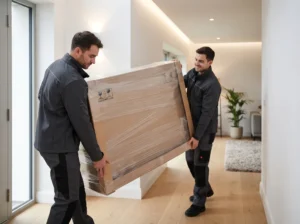
● Single-piece logistics damage. One sofa in an LCL container sees more handling than a full load. Control: require wood crating, not cartons, for private orders; insure at full replacement value; photograph packaging before container loading.
● Tariff surprises. US buyers: Section 301 duties of 25% have applied to many Chinese furniture lines since 2018–19, and US tariff policy shifted again in 2025 — treat any landed-cost number as provisional until a licensed customs broker confirms your current HTS 9401 position. EU buyers face low-single-digit MFN duties plus import VAT. Australian buyers benefit from ChAFTA zero duty on furniture, with 10% GST on import. Rules move; budgets should too.
The Personal Buyer’s Guide: Sourcing One Premium Sofa from Dongguan
This section is for villa owners and high-end residential clients buying one to five pieces — no procurement department required.
Step 1 — Write a one-page spec. Dimensions, seating depth, hide or fabric (ask for full-aniline or semi-aniline by name), foam feel, frame standard, and two or three reference photos. Factories quote faster and more accurately against a spec than against a mood board.
Step 2 — Shortlist and verify two or three factories, not twenty. Use the 15-point checklist below. Premium OEM factories that genuinely serve overseas private clients will answer technical questions directly and share real production photos.
Step 3 — Sample the materials, not the sofa. Ask for couriered hide and fabric swatches from the actual production stock; expect 2–4 weeks for a prototype if you want one. Sampling fees (typically US$150–500 for materials, more for a full prototype) are normal and usually credited against the order.
Step 4 — Contract like a professional. 30/70 payment terms, golden-sample clause, inspection clause, crating clause, and a delivery window with a remedy. One page of terms saves three months of disputes.
Step 5 — Inspect before it ships. A third-party pre-shipment inspection costs a few hundred dollars and is the single highest-value line item in the entire process.
Step 6 — Ship, clear, deliver. For one to three pieces, LCL (shared container) is the norm. Your customs broker confirms the duty position — in Australia, furniture from China currently enters duty-free under ChAFTA with 10% GST; the EU levies low-single-digit duty plus VAT; the US picture is complicated by Section 301 and 2025 tariff changes, so get a broker’s written estimate first.
Worked example — one premium sofa, Dongguan to Sydney (assumptions stated):
| Cost line | Amount (US$, indicative 2026) |
| FOB price, 3.2 m full-aniline L-shaped sofa, premium OEM | $2,200 |
| Export crating and docs | $150 |
| LCL ocean freight, Dongguan → Sydney | $600–$900 |
| Australian port, brokerage, delivery | $700–$1,000 |
| GST (10%, ChAFTA duty 0%) | ~$350 |
| Landed total | ~$4,000–$4,600 |
| Comparable local boutique price | ~$12,000–$14,000 |
A worked example, not a quotation: freight is volatile, hides and specs move the FOB price, and your broker’s numbers govern. US buyers must add the applicable tariff position before comparing.
Free Tool: The 15-Point Premium Factory Screening Checklist
Screenshot this section — it is the same screen our team applies on audits:
1.Business license scope covers manufacturing, not only trading; registered capital and founding year check out.
2.Verifiable export record to your destination market (bills of lading, references).
3.Two or three overseas client references you can actually call.
4.BSCI / Sedex social audit in date and in the factory’s own legal name.
5.Product test reports (BIFMA, CAL 117 / BS 5852 where relevant) verified with the issuing lab.
6.REACH declaration for EU-bound materials; CARB compliance where composite wood is used; FSC chain-of-custody if you claim certified timber.
7.Named tanneries and fabric mills for materials, with certificates.
8.Foam density by zone, in writing, on the quotation.
9.Frame timber species and moisture standard (8–12%) in the spec sheet.
10.Signed golden sample retained by both parties before mass production.
11.Willingness to accept third-party pre-shipment inspection at AQL 2.5 — refusal is your answer.
12.Payment terms 30/70 against B/L copy; no full prepayment.
13.Production milestone photos or video calls agreed in the contract.
14.Wood crating standard for single-piece private orders.
15.Factory visit or live video tour completed — during the March Famous Furniture Fair in Houjie is the easiest natural moment.

FAQ
Do the world’s most expensive upholstery brands really manufacture in Dongguan?
Premium and luxury programs do manufacture there, under confidential OEM agreements — there is no public registry, and brands do not advertise factory addresses. The verifiable evidence is structural: three decades of export OEM lineage in Dalingshan, the Houjie premium supply chain, and the certification stack these factories maintain exist to serve exactly that tier of client. Our own field audits between 2023 and 2026 repeatedly encountered European and American premium-brand programs in this corridor.
Is Dongguan quality genuinely comparable to Italian manufacture?
At the premium OEM end, for construction quality, materials handling and consistency across a batch — yes, and European brands voting with their purchase orders is the strongest evidence. Where Italian ateliers still lead is heritage narrative, limited artisan editions and design authorship. It is a division of labor, not a hierarchy.
What is the realistic MOQ for premium custom work?
One piece for a private commission with a sampling fee; low dozens for boutique brand capsules; batch programs from the low hundreds. MOQ flexibility is one of the corridor’s core structural advantages over European ateliers.
How much can a design studio realistically save?
In the programs we have audited, ex-works/FOB prices for comparable premium construction typically run 50–70% below European ex-works equivalents — before freight, duty and your own QC costs. The saving is real, but it is a sourcing margin, not free money: budget for inspection, sampling and logistics.
Can a private owner really buy just one sofa directly?
Yes. A growing number of premium factories accept one-to-five-piece private commissions, especially clients who arrive with a clear spec. Expect a sampling fee, 45–75 days production, and LCL shipping. The checklist and worked example above are the process.
What about shipping damage and after-sales for a single piece?
Insist on full wood crating, insure at replacement value, and photograph the crate at loading. For after-sales, agree on a spare-parts and remote-support clause before you pay the deposit; premium factories keep cushion covers, legs and hardware available for years.
How do I verify a factory’s leather and fabric claims?
Three layers: named tannery/mill certificates, retained golden samples of every material, and third-party lab testing of batch swatches for large orders. Vocabulary is free; documentation is the signal.
Which certifications actually matter, and how do I check them?
For US-bound goods, CAL 117 flammability and BIFMA test reports; for the UK, BS 5852; for the EU, REACH chemical compliance; CARB for composite wood; FSC for certified timber claims; BSCI/Sedex for social compliance. Verify every certificate number with the issuing lab or body — in date, in the factory’s own legal name, covering your product scope.
Recommended Resource
Interi Furniture specializes in custom furniture manufacturing for residential, hospitality, and commercial projects. Their experience in materials, craftsmanship, and project realization makes them a valuable resource for designers and buyers seeking tailored furniture solutions from China.