








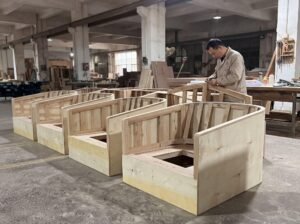
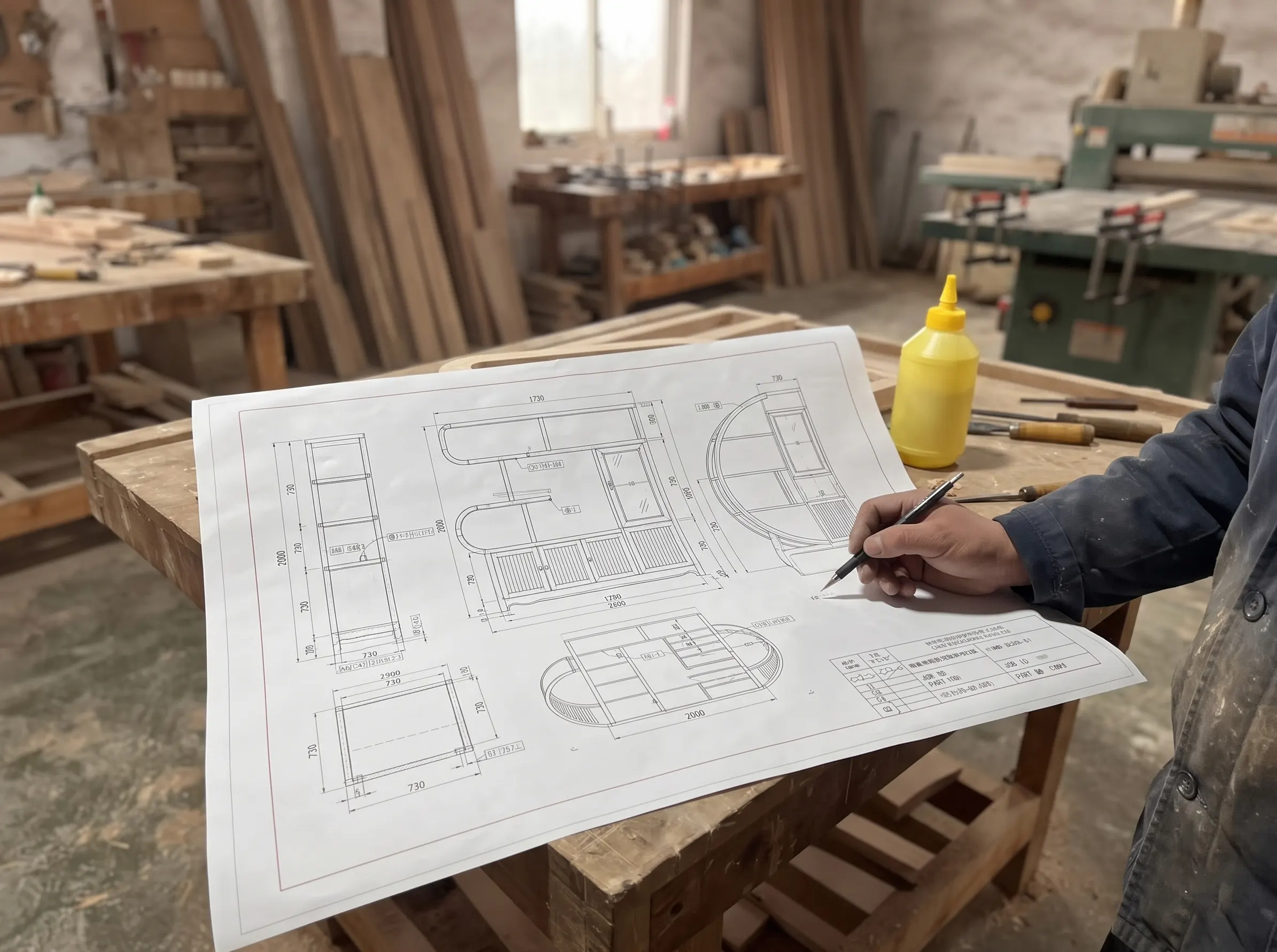
The sample arrived looking like a joke. A Los Angeles designer we work with had sent a meticulously detailed SolidWorks file for a curved walnut credenza to a factory in Foshan. Six weeks and $2,800 later, the prototype showed up with drawer fronts that didn’t align, a radius that was visibly off, and a finish that looked like it had been chosen from a completely different species. The designer was furious. The factory was confused. “We followed your drawing exactly,” the project manager insisted over WeChat.
He wasn’t lying. They had followed the drawing. They just hadn’t read it the way the designer intended. And here’s the part that stings: they never thought to ask.
We’ve spent the last twelve years walking factory floors in Longjiang, Houjie, and Guzhen. We’ve watched pattern makers huddle over drawings at 10 PM, seen project managers nod politely at Zoom calls they barely understood, and collected enough war stories to fill a warehouse. The pattern is always the same. Western designers output drawings built on architectural and industrial design standards. Chinese furniture factories receive those drawings and decode them through a completely different manufacturing logic. The gap between those two systems is where prototypes die.
This isn’t a language barrier in the traditional sense. Most mid-to-large factories in Dongguan and Foshan have English-speaking staff. The breakdown happens at a deeper level—what we call technical drawing translation. It’s the invisible layer where dimensions get reinterpreted, tolerances get silently adjusted, and material specifications dissolve into whatever the factory has in stock that week. Understanding this layer is the difference between getting a sample approved in two rounds versus six.
What the Pattern Maker Actually Sees
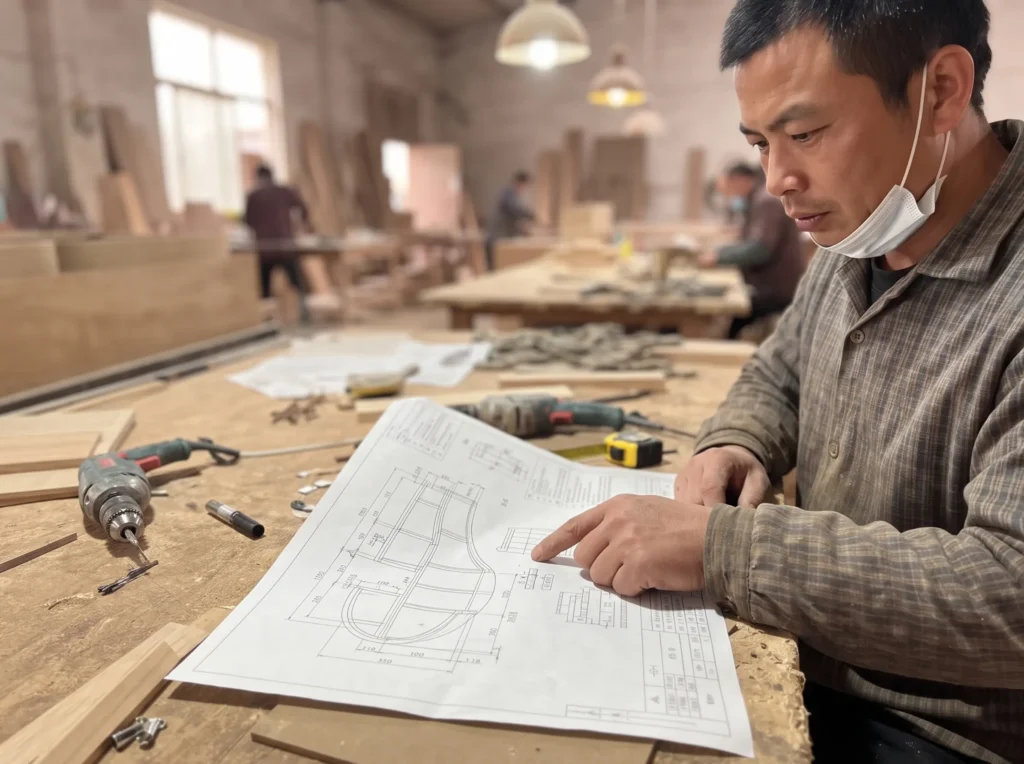
Walk into the sample workshop of a typical Foshan sofa factory at 8 AM and you’ll find a middle-aged pattern maker squinting at a PDF on an old Lenovo monitor. He’s been doing this for twenty years. He can look at a three-view drawing and tell you within thirty seconds whether the frame will hold, whether the upholstery will wrinkle at the corners, and roughly how many hours the sample will take. He’s not reading your drawing the way you think he is.
Here’s what factories actually focus on: overall dimensions, the silhouette outline, and any detail that looks like it will cause a production headache. Here’s what they routinely ignore: surface finish callouts in the title block, GD&T symbols they don’t recognize, material specifications that don’t match their supplier list, and notes written in paragraph form at the edge of the sheet.
A designer from a Brooklyn studio told us she specified “white oak veneer, book-matched, rift cut” on every page of her drawing set. The factory used red oak, plain sliced, because that’s what their veneer supplier had in rotation that month. When she confronted them, the project manager pointed to a tiny note in the corner of page seven and said, “Oh, we thought that was just a suggestion.”
This isn’t negligence. It’s a different reading protocol. In most Chinese furniture factories, the drawing is treated as a starting point for negotiation, not a binding contract. The pattern maker assumes that if something is truly critical, you’ll mention it three times, send a physical sample, or show up in person to point at it. A single line of text in a title block might as well be invisible.
The Measurement Trap Nobody Talks About
The inch-to-centimeter conversion is the obvious problem. Everyone knows about it. What fewer people understand is how the conversion error compounds through multiple stages of the supply chain.
We watched this happen in real time at a Dongguan casegoods factory in 2023. A Canadian design firm sent a dining table drawing with a top thickness of 1.75 inches. The factory’s project manager converted this to 44.45 mm in the BOM. The CNC operator, working from a different document, rounded it to 45 mm because his machine was calibrated in whole millimeters. The finishing department, seeing a 45 mm specification, assumed there was a sanding tolerance and started with a 46 mm blank. The final part measured 47.2 mm. The designer, measuring with calipers during inspection, found a table top that was nearly an eighth of an inch thicker than specified.
“That’s within tolerance,” the factory argued.
“It is not,” the designer replied.
They were both right, according to their own frameworks. The factory was working within the ±2 mm tolerance they applied to all solid wood components. The designer was working to a ±0.5 mm standard she used for her architectural millwork projects. Neither party had discussed tolerance standards before production began because both assumed the other was using the same baseline.
This is the hidden cost of designer communicate factory furniture workflows that skip the calibration conversation. You need to explicitly state not just the dimension, but the measurement system, the rounding rules, and the acceptable deviation range. And you need to do it before the first board gets cut.
When “Oak Veneer” Means Three Different Things
Material specification is where the most expensive misunderstandings hide. The same word on a drawing can point to completely different physical realities depending on which city you’re sourcing from.
Take “oak veneer.” In a drawing from a Milan-based studio, this might mean European white oak, quarter-sawn, 0.6 mm thickness, backed with fleece, ready for book-matching. Send that drawing to a factory in Foshan’s Longjiang district, and you’re likely to get Chinese red oak, plain sliced, 0.3 mm thickness, paper-backed, random-matched. The cost difference between these two options can be 40%. The visual difference is obvious the moment you open the crate.
We saw this destroy a product launch timeline in 2022. A DTC brand founder from Portland specified “walnut veneer, natural finish” for a media console. The factory in Dongguan used walnut veneer from a supplier who darkened it with a reactive stain to match what they considered “natural”—a deep chocolate brown that looked nothing like the light, honey-toned sample the designer had sent. Six weeks lost. $4,000 in sample costs down the drain. The founder told us later, “I assumed ‘natural’ meant no stain. They assumed ‘natural’ meant ‘the natural color of the walnut we have.'”
The fix isn’t to write longer specifications. It’s to send physical material samples with explicit labels, photograph those samples under standardized lighting, and require the factory to sign off on a material confirmation sheet before cutting any veneer. Words on paper are porous. Physical samples are concrete.
The Tolerance Gap That Breaks Assemblies
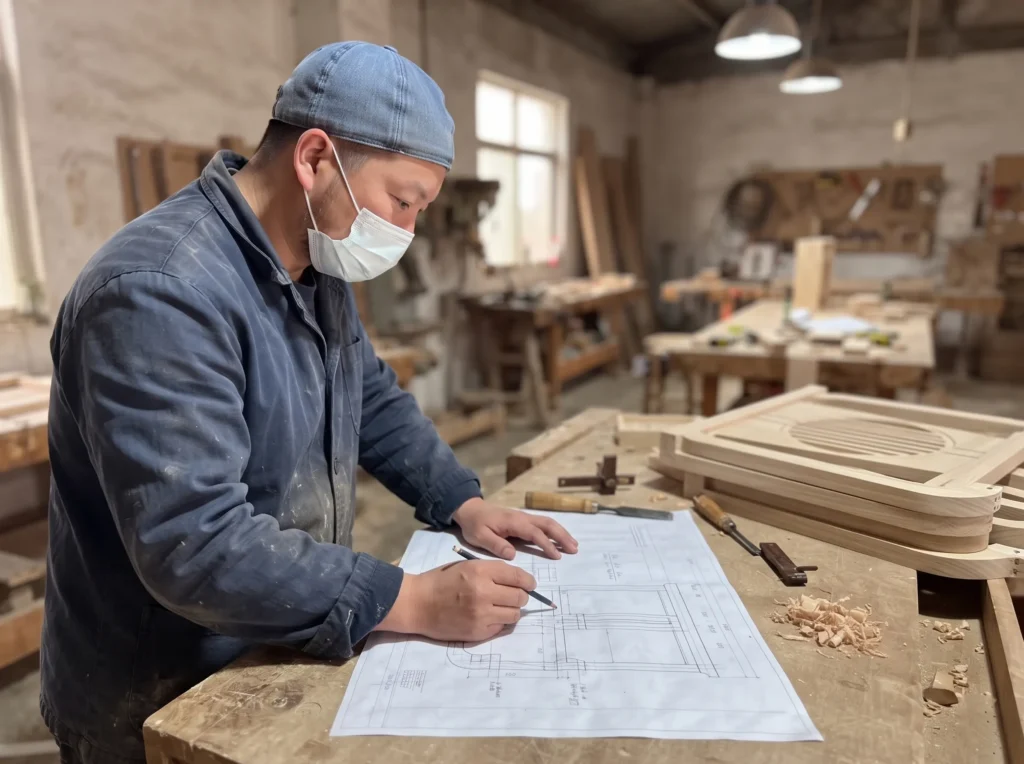
Here’s a truth that factory owners will admit over dinner but never put in an email: most soft upholstery factories in Foshan work to a ±5 mm tolerance on frame dimensions. Most metal fabrication shops in Dongguan hold ±2 mm. A Western designer working on furniture that needs to integrate with architectural millwork often specifies ±1 mm.
That four-millimeter gap is where assemblies fail.
We toured a factory in Houjie that specializes in export sofas. The owner, a pragmatic man in his fifties, explained it to us plainly: “For a sofa, if the arm is 5 mm wider than the drawing, nobody dies. The cushion still fits. The cover still sews. But if I stop the line every time a frame is 2 mm off, I’ll never hit my delivery date.” He’s not wrong for his business model. He’s wrong for your project if you need precision.
The problem isn’t that factories can’t hold tighter tolerances. Many can, especially CNC-equipped woodshops and metal factories serving the European market. The problem is that they won’t unless you explicitly negotiate it, price it in, and inspect for it. The default tolerance is whatever keeps their line moving. Your drawing’s ±1 mm note is just that—a note. It doesn’t become a requirement until someone in production planning decides it’s worth the extra cost and time.
Why Your Beautiful 3D Render Is a Liability
This one hurts because designers love their renders. The photorealistic KeyShot file, the spinning SolidWorks model, the exploded Axonometric with every screw labeled. You send it to the factory feeling confident. The factory receives it and extracts almost zero useful production information.
We’ve sat with pattern makers while they scroll through 3D PDFs on their phones. They zoom in, rotate, squint, and then switch to the 2D drawing to actually build the sample. The render is entertainment. The 2D drawing with dimensions is the work document. When designers send only renders, or when the render contradicts the 2D drawing, factories almost always default to what looks easier to build.
A particularly painful example: a San Francisco designer sent a stunning 3D model of a lounge chair with a complex compound curve. The render showed a seamless transition from seat to back. The 2D drawing, which the designer had hastily updated, showed a slightly different radius. The factory built to the 2D drawing because that’s what the CNC operator could program. The sample arrived looking like a different chair. The designer blamed the factory for “not understanding the design intent.” The factory blamed the designer for “sending two different drawings.”
The lesson is brutal but simple: if you send a render, it must be dimensionally identical to your 2D production drawing. Any discrepancy will be resolved in favor of manufacturability, not design fidelity. And if you must choose between sending a perfect render or a perfect 2D drawing, send the 2D drawing.
The “Just Make It” Culture
This is perhaps the hardest gap for Western designers to internalize. In many Chinese furniture factories, asking clarifying questions is perceived as a sign of incompetence. A project manager who emails back with three questions about your drawing is, in the internal culture of the factory, admitting he doesn’t know how to do his job. A pattern maker who stops the sample to ask about a dimension is suggesting he can’t read a drawing.
So they don’t ask. They interpret. They fill in the gaps with experience, with whatever worked last time, with the path of least resistance. And they do it with complete confidence that if they got it wrong, you’ll tell them in the next round.
This “sample first, revise later” mindset is deeply embedded. It’s not laziness. It’s a rational response to an environment where drawings are often ambiguous, designers change their minds after seeing prototypes, and the cost of asking sometimes exceeds the cost of remaking. But for a designer paying $3,000 per sample and working to a tight launch timeline, this mindset is catastrophic.
The factory won’t tell you they’re operating this way. They won’t say, “I wasn’t sure about this radius so I guessed.” They’ll present the sample, wait for your feedback, and incorporate your corrections into round two. By then you’ve lost six weeks and your confidence in the partnership is shattered.
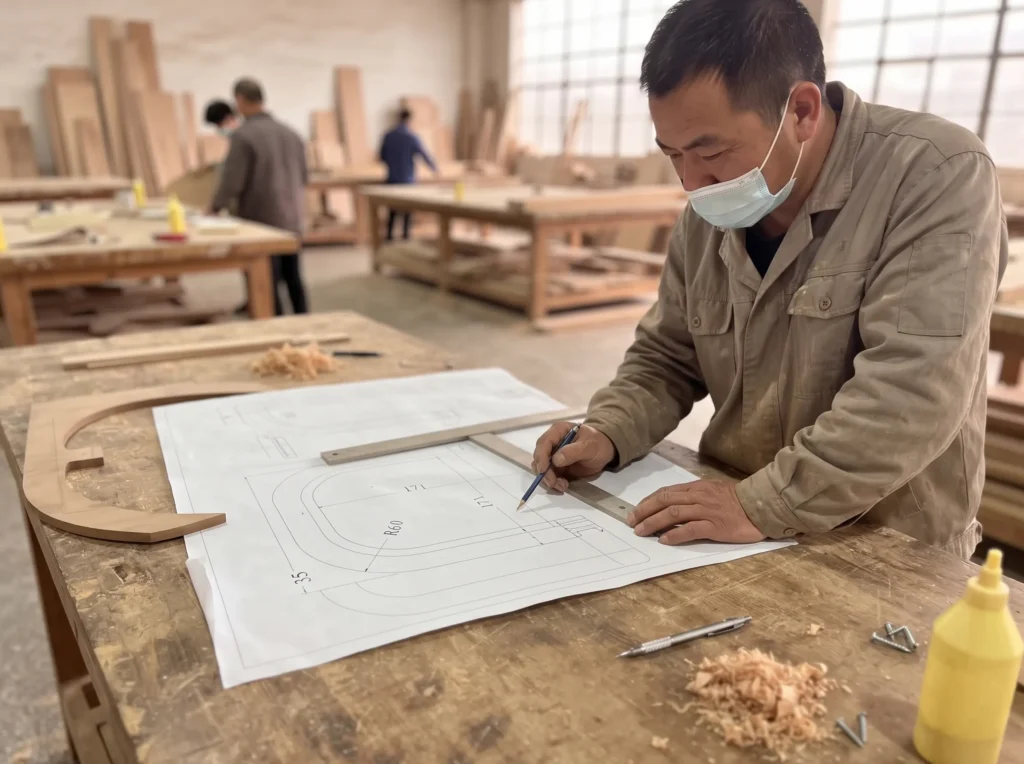
What Actually Works: A Field-Tested Protocol
After years of watching prototypes succeed and fail, we’ve distilled a communication protocol that consistently reduces sample rounds. It’s not fancy. It’s just specific.
First, send a dimensioned 2D drawing in PDF and DWG format. The PDF is for reading. The DWG is for the factory’s CAD operator to import directly. Include a 1:1 scale print that the pattern maker can lay a ruler on. Yes, some still work this way, and they trust a physical ruler more than a screen measurement.
Second, create a separate “Critical Dimensions” sheet. Don’t bury important measurements in a crowded three-view drawing. Extract the dimensions that matter most—overall width, critical clearances, interface dimensions with other components—and put them on one page with a large font. Factories will prioritize what is easy to find.
Third, send physical samples for every material, finish, and color. Not photos. Not Pantone codes. Physical samples. Label them with the exact specification name you’re using in the drawing. Require the factory to return a signed material confirmation sheet with photos of their sourced materials next to your samples.
Fourth, specify tolerances explicitly and realistically. If you need ±1 mm, say so, but understand that this may limit you to CNC woodshops and metal factories, and it will cost more. If ±3 mm is acceptable for a particular dimension, say that too. Giving a realistic range is better than an unrealistic absolute.
Fifth, include a “Build Notes” document written in short, numbered sentences. Not paragraphs. Not technical essays. Short sentences that a project manager can paste into Google Translate if needed. “Use only the specified veneer supplier.” “Do not round dimensions.” “Contact us if any dimension seems impossible to achieve.”
Sixth, and this is the one that saves the most projects: schedule a video call where you share your screen and walk through the drawing page by page. Not to explain the design—that’s already in the render—but to point at specific dimensions and ask, “Can you achieve this?” Watch their face. If they hesitate, dig deeper. The hesitation is the signal.
The Real Cost of Miscommunication
We ran an informal audit last year across thirty-two furniture projects we had visibility into. The average project that skipped a structured technical drawing translation process required 3.4 sample rounds and 14.6 weeks from first drawing to approved prototype. The average project that used a rigorous communication protocol—including the steps above—required 1.6 sample rounds and 7.2 weeks.
That’s half the time and roughly half the money. For a DTC brand founder burning through startup capital, or a design studio juggling multiple client projects, that difference is the gap between launching on schedule and missing a market window.
But the cost isn’t just financial. Every failed sample erodes trust. The designer starts to think Chinese factories are sloppy or dishonest. The factory starts to think Western designers are unrealistic and demanding. Both conclusions are wrong. The real culprit is the silent translation layer between the drawing and the shop floor.

FAQ
Why don’t factories just ask if something is unclear?
In the factory culture we observe, asking questions can signal incompetence. Project managers and pattern makers are evaluated on their ability to execute without constant clarification. Additionally, many factories operate on thin margins and tight timelines; stopping to ask feels like a delay they can’t afford. The default is to apply experience-based judgment and fix it in the next round if necessary.
Is it better to send more detailed drawings or simpler ones?
Counterintuitively, simpler is often better—but precisely simpler. A drawing with fifty dimensions, twenty material callouts, and dense notes overwhelms the reader. The critical information gets lost in the noise. We recommend a clean 2D drawing with essential dimensions, plus separate documents for materials, tolerances, and build notes. Think layered information, not information density.
Should I learn CAD standards used in Chinese factories?
Not necessarily. Most mid-sized and larger factories can work with standard DWG, PDF, or STEP files. The issue isn’t file format compatibility; it’s semantic compatibility. Focus on making your specifications unambiguous in any language rather than learning Chinese CAD conventions.
How do I handle situations where the factory says “no problem” to everything?
This is a common frustration. “No problem” often means “I understand you want this” rather than “I confirm this is achievable.” The antidote is to move from abstract discussion to concrete validation. Ask for a pre-production mock-up of the most critical detail. Request photos of similar past work. Get tolerance commitments in writing on the quotation, not just in conversation.
Are some factory types better at reading technical drawings than others?
Yes. Factories that primarily serve the European market—particularly German and Nordic brands—tend to have more experience with precise technical drawings and tighter tolerances. Factories focused on domestic Chinese market or low-cost export often prioritize speed over dimensional precision. When sourcing for detail-critical furniture, look for factories with a track record in markets that demand precision.

Recommended Resource
Interi Furniture specializes in custom furniture manufacturing for residential, hospitality, and commercial projects. Their experience in materials, craftsmanship, and project realization makes them a valuable resource for designers and buyers seeking tailored furniture solutions from China.