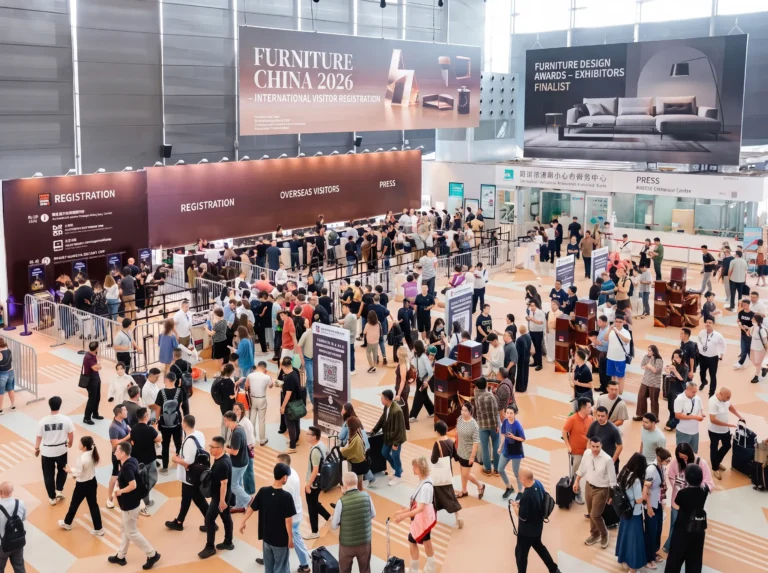









CIFF Shanghai runs September 5–8 at NECC Hongqiao. Furniture China opens the same day — September 8 — at SNIEC Pudong, a 40-kilometer cab ride away. They are not two halls of one “Shanghai Furniture Week,” and they are not interchangeable. CIFF is design-led, curated around roughly 1,200 brands in a 210,000㎡ footprint. Furniture China is export-led, hosting 3,200+ exhibitors across 350,000㎡. For most overseas buyers, going deep at one fair beats skimming two — and this CIFF vs Furniture China breakdown tells you exactly when the demanding double-header is worth the extra days.
Why Buyers Get Confused Every September Furniture Show Shanghai Season
Every September furniture show Shanghai cycle, our inbox fills with the same question: “I’m flying to Shanghai for the furniture fair — which one is the real one?”
The confusion is understandable, and it is manufactured. Marketing materials lump both events under “Shanghai September Furniture Week,” travel agencies bundle hotel packages covering both venues, and LinkedIn posts treat them as one continuous ecosystem.
They are not. CIFF Shanghai is organized by CIFF’s operating bodies (China Foreign Trade Guangzhou Exhibition General Corp. and Red Star Macalline’s exhibition arm). Furniture China is organized by CNFA together with IM Sinoexpo. Different organizers, different curation logic, different exhibitor mixes, different sales cultures.
For a buyer spending $4,000–8,000 on airfare, hotels, and a week away from the business, picking the wrong fair is not a minor inconvenience. It is a wasted sourcing quarter.
The Myth That Both Fairs Are the Same
Let us kill the biggest misconception first, because it costs buyers money every year.
CIFF Shanghai and Furniture China are not competitors fighting over the same audience. They form what Chinese industry veterans call a “relay fair” arrangement — one closes, the other opens the same day, and the exhibitor base, buyer profile, and pricing culture differ enough that choosing between them is a genuine sourcing decision, not a coin flip.
The overlap in exhibitors is modest — our field observation puts meaningful booth overlap at well under a third of either show’s total, though booth-level counts shift year to year. For reference only, subject to official verification. What that means in practice: walking both fairs does not mean seeing the same factories twice. It means burning two days on largely non-overlapping exhibitor lists you could have covered in one focused visit — unless your category demands it.

CIFF Shanghai vs. Furniture China 2026: Side-by-Side Comparison
| Dimension | CIFF Shanghai (Sept 5–8) | Furniture China (Sept 8–11) |
|---|---|---|
| Venue | NECC Hongqiao (“Four-Leaf Clover”) | SNIEC Pudong |
| Organizer | CIFF operating bodies / Red Star Macalline exhibition arm | CNFA / IM Sinoexpo |
| Scale (approx.) | ~210,000㎡ | ~350,000㎡ |
| Exhibitors | ~1,200 brands, design-forward | 3,200+ exhibitors, export-oriented |
| Positioning | Design trends, domestic retail ecosystem, curated theme clusters | Export sourcing, factory-direct, volume trade |
| Buyer type | Retail chains, designers, distributors, domestic + international | Importers, wholesalers, Amazon/Wayfair sellers, project buyers |
| Pricing culture | Design premium, MOQ varies widely | Factory-floor quotes, MOQ-driven negotiation |
| Airport friendliness | Best for Hongqiao Airport arrivals & high-speed rail arrivals | Best for Pudong Airport arrivals, Maglev-accessible via Longyang Road |
| Ticket/admission | Mixed; international buyer registration | B2B-oriented; overseas buyer registration with company credentials |
Venue Logistics: NECC Hongqiao vs. SNIEC Pudong
Geography is where planning trips go to die. The two venues sit on opposite sides of one of the world’s largest cities, and September is peak conference season — hotels near either venue book out weeks ahead.
| Logistics factor | NECC Hongqiao (CIFF) | SNIEC Pudong (Furniture China) |
|---|---|---|
| Nearest airport | Hongqiao Intl (SHA), ~15 min by cab | Pudong Intl (PVG), ~40 min by Maglev + taxi or ~60 min direct |
| High-speed rail | Hongqiao Railway Station adjacent — ideal for buyers coming from Guangzhou/Foshan/Dongguan factory tours | No direct HSR; requires cross-city metro ride |
| Metro access | Line 2 / Line 17 to Xujing East | Line 7 / Line 2 to Huamu Road / Longyang Road + short transfer |
| Cross-venue transfer on Sept 8 | — | ~70–100 min by car depending on traffic; metro ~90 min door-to-door |
| Hotel strategy | Stay near Hongqiao hub or Jing’an | Stay near Pudong expo area or Century Park |
Our honest take: if your itinerary includes visiting factories in the Pearl River Delta after the fair, CIFF’s Hongqiao location is a gift — you can be on a high-speed train to Guangzhou South within an hour of leaving the booth. If you’re flying in and out of Pudong with export orders as the only goal, Furniture China is the friction-free choice.

Buyer Profile and Density: Who Actually Shows Up
This is the section marketing brochures won’t write, so we will. Buyer density — the ratio of serious, purchase-ready buyers to total foot traffic — matters more than raw visitor counts.
| Factor | CIFF Shanghai | Furniture China |
|---|---|---|
| Crowd composition | Designers, retail buyers, domestic trade, international distributors | Exporters, importers, sourcing agents, overseas e-commerce sellers |
| Buyer density (qualitative) | High-quality conversations, lower walk-in volume | High volume; filter aggressively for qualified factories |
| Quote behavior | Showroom-style pricing, design-tier MOQs | Straight factory quotes, negotiable on volume |
| English coverage on floor | Good at design-oriented booths | Good to functional; varies by exhibitor tier |
| Best for | Trend scouting, design-led retail programs | Closing supplier shortlists, price benchmarking |
Based on our repeated attendance at Shanghai’s spring and autumn cycles, the pattern holds: CIFF booths want to talk about collections and brand stories; Furniture China booths want to talk about container counts and payment terms. Neither is better. They answer different questions.
The Double-Header Reality: Can You Actually Do Both?
September 8 is the trap day. CIFF’s final day coincides with Furniture China’s opening day, and ambitious buyers try to “seamlessly” attend both. Here’s what seamless actually looks like.
| Double-header factor | Reality check |
|---|---|
| Same-day transfer | 70–100 min minimum by road; expect luggage logistics, badge pickup lines at SNIEC, and a lost morning |
| CIFF final-day quality | Last-day foot traffic drops sharply; some exhibitors begin teardown sales or pack early |
| Furniture China opening day | Crowded registration, exhibitors still setting display stock, longest badge queues of the show |
| Information overload risk | High — after 4 days at one fair, most buyers’ note-taking discipline collapses |
| Hotel cost | Mid-tier rooms near both venues in September peak run RMB 900–1,800/night; switching hotels mid-trip adds friction and cost |
| Who it works for | Large sourcing teams with a pre-built exhibitor list, split personnel, and a dedicated logistics handler |
The double-header is not impossible. We have run it. But it only works when you arrive with a written exhibitor shortlist, split your team by category, and treat September 8 as a transfer-and-registration day, not a full working day. Without that structure, you will pay for two fairs and extract one fair’s value.

Risk Warnings: Where Buyers Lose Money
Risk one: the “Shanghai Furniture Week” framing. Treating both fairs as one ecosystem leads buyers to book a single centrally located hotel and assume the fairs are interchangeable. They are not — and a central hotel puts you 45–60 minutes from both venues. Pick your fair first, then your hotel.
Risk two: the September 8 mirage. Trying to cover both fairs on the handover day means you catch CIFF at its emptiest and Furniture China at its most chaotic. You get the worst of both.
Risk three: paying double for overlapping information. Buyers who walk both fairs expecting double coverage often find the categories they care about are concentrated in one fair. If your category is design-forward upholstered furniture, CIFF’s curation adds value. If your category is volume case goods, Furniture China’s exhibitor density wins. Overlap analysis before booking flights, not after.
Choosing by Buyer Type: Decision Matrix
| Buyer type | Recommended fair | Why | Alternative play |
|---|---|---|---|
| Large B2B importer (container-scale, multi-category) | Furniture China | Factory-direct density, MOQ-driven pricing, export-ready exhibitors | Add CIFF day 1–2 only for design-trend calibration |
| Mid-size retailer / Amazon-Wayfair seller | Furniture China | Match with OEM/ODM factories; price benchmarking across thousands of booths | Skip CIFF unless building a premium private label line |
| Interior designer / project procurement | CIFF Shanghai | Curated theme clusters, material and finish innovation, design dialogue | Add Furniture China only for volume FF&E items |
| First-time individual buyer | Neither without prep; start with Furniture China’s overseas buyer program | Structured registration and higher exhibitor tolerance for small MOQ conversations | Consider CIFF if your interest is design retail rather than sourcing |

FAQ
Is CIFF Shanghai or Furniture China better for first-time overseas buyers?
Furniture China is usually the more forgiving entry point. Its exhibitor base is built around export trade, so booths expect overseas buyers, English communication is functional at most export-oriented stands, and overseas buyer registration is a clear, documented process. CIFF rewards buyers who already know their categories and are comfortable with design-led conversations.
Can I visit both fairs on the same trip?
Yes, but only with structure. Plan CIFF days 1–3, treat September 8 as a transfer and registration day, and work Furniture China days 2–3 when booths are fully operational. Budget the hotel switch and the 40-kilometer cross-city transfer honestly — it consumes most of a working day.
Which fair has better prices?
Different pricing cultures, not different prices. Furniture China quotes closer to factory-floor levels and negotiates on volume. CIFF prices reflect design tiers and brand positioning. If your decision driver is unit cost at container scale, Furniture China is where your benchmarking should happen.
How far apart are the two venues, really?
About 40 kilometers. Road transfer runs 70–100 minutes in normal September traffic; metro takes roughly 90 minutes door-to-door. There is no practical shortcut. Anyone telling you the fairs are “a quick metro ride apart” has not carried a sample bag between them.
Do I need a business license or company documents to attend?
Overseas buyer registration for both fairs typically asks for company credentials, and Furniture China’s B2B orientation makes this more explicit. Individual buyers can usually still register but get the most value from booths willing to work smaller quantities. Check each fair’s official registration portal for current requirements before booking flights — for reference only, subject to official verification.
Your Move
Which fair are you leaning toward — and what’s your category, volume, and arrival airport? Drop your situation in the comments, and tell us whether you’ve attempted the September double-header before. If you’re still weighing CIFF, our first-time CIFF guide walks through the 17 mistakes that mark you as a tourist on the Hongqiao floor. If Furniture China looks like your fair, our Furniture China Shanghai 2026 survival guide for overseas buyers maps the export-oriented ecosystem booth by booth.
Recommended Resource
Interi Furniture specializes in custom furniture manufacturing for residential, hospitality, and commercial projects. Their experience in materials, craftsmanship, and project realization makes them a valuable resource for designers and buyers seeking tailored furniture solutions from China.