









Your first quote is a test, not an offer. The most enthusiastic supplier is often the riskiest one. Freight is priced by volume, so cheap, bulky furniture can cost more to ship than it did to buy. The sample will always look better than the container. Ordering in the factory’s slow season saves more than any negotiation. Repeat orders are where quality quietly drops. And the customs bill waiting in your own country is the budget line nobody warns you about. If you remember one thing, make it this: budget for the destination, not just the deal.
The Gap Between Tutorials and Reality
Search “how to import furniture from China” and you will find a thousand checklists. Send an inquiry, compare quotes, order a sample, pay a deposit, book a container, clear customs. Every one of those steps is real. None of them is where first-time buyers actually lose money.
After ten years of sitting on factory floors in Foshan and Shunde and standing next to nervous buyers during their first inspections, I can tell you that the failures almost never happen on the checklist. They happen in the spaces between the checklist items — in the assumptions the checklist never questions. These are the importing furniture from China secrets that veterans absorb through scar tissue and that almost never appear in content, because the people who know them have little incentive to publish them.
This article is not a process guide. Our first-time buyer field recap already walks through what happens, step by step, on a real first purchase. This piece answers a harder question: why it happens. Treat it as the companion beginner tips doc you read before you send your first inquiry, and before your second order lulls you into complacency.
Why Nobody Talks About the Unwritten Rules
Three forces keep these rules invisible.
Factories will never publish them. No supplier is going to write “our first quote includes a margin calibrated to your inexperience.” Their sales process depends on information asymmetry, and asymmetry is only valuable when it stays quiet.
Content farms cannot write them. Most importing advice online is rewritten from other importing advice online. The writers have never stood in a loading workshop watching a container being stuffed, so they recycle the same seven-step checklist and call it expertise.
And veterans forget they know them. Once you have absorbed these lessons, they feel obvious, and obvious things stop being mentioned. The result is a first timer walking into a negotiation armed with a checklist, facing a factory armed with a decade of reading buyers.
The seven truths below are drawn from industry practice and frontline observation. Every figure is a range, every pattern is a tendency, and everything here is subject to verification in your specific category and destination market. But the patterns are consistent enough that ignoring them is a choice, not bad luck.
The Seven Truths at a Glance
| What newcomers assume | What actually happens | Where the money goes |
|---|---|---|
| The first quote is close to the real price | The first quote is a test of the buyer | Overpaying 15–40% without a structured RFQ |
| A fast, friendly supplier is a good supplier | Speed and eagerness often signal a middleman | Hidden markup, no quality control leverage |
| Shipping is a small line item on top of the product | Volume-based freight can exceed product cost | Cheap bulky goods become expensive landed goods |
| A good sample means good furniture | Samples are hand-finished; mass production is not | Container arrives visibly worse than the sample |
| Negotiation skill saves the most money | Order timing saves more than negotiation | Leaving 10–15% on the table by ordering in peak season |
| A great first order means a reliable partner | Repeat orders are where downgrades happen | Quiet material substitutions on order two and three |
| The deal ends at the Chinese factory gate | Destination country costs are the surprise | Duties, VAT, port fees, and delivery wiping out the margin |
Your First Quote Is a Test, Not an Offer
Here is how pricing actually works in a Chinese furniture factory. The salesperson receives your inquiry, looks at what you asked and how you asked it, and estimates how much room for error you will tolerate. Then they add a margin of safety on top of the real cost. The quote you receive is not primarily a number about the chair. It is a number about you.
Ask for a price before sharing specifications, quantities, or destination, and you have told the factory you do not know what drives cost. Negotiate in awkward increments without data, and you have confirmed it. None of this is malicious. It is rational pricing under uncertainty, and every experienced buyer has paid the tuition to learn it.
The practical fix is boring and effective. Send a structured inquiry: materials, dimensions, quantities, target market, required certifications, packaging expectations, and trade terms. Ask for an itemized breakdown — materials, labor, packaging, overhead, margin. Request quotes from at least three suppliers using the identical template. And instead of asking “can you go lower,” ask “what specifically changes this price.” That single question flips you from tourist to buyer in the salesperson’s notebook.
What a Test Quote Actually Is
A test quote is a factory’s opening position designed to reveal information about the buyer rather than to close a sale. It is calibrated to what the supplier believes you know, what alternatives you have, and how urgently you need the goods. The correct response is not a counterattack but a demonstration of structure, which signals that the safety margin is no longer warranted.
The Enthusiastic Supplier Is Often the Riskiest One
This is the truth buyers resist most. Slow, questioning, slightly difficult suppliers are usually factories. Fast, warm, endlessly agreeable suppliers are often trading companies — or worse, factories you will never be allowed to visit.
A real factory’s salesperson spends half the day on the production floor. They reply slowly because they are checking things. They push back on your design because the pushback is real. The trading company’s agent replies in four minutes at 11 p.m. because answering messages is their entire job, and says yes to everything because they will figure out how to satisfy you later, at your expense.
The danger peaks when eagerness meets pressure: instant replies, instant agreement, instant request for a deposit. A factory with real capacity does not need your deposit this week.
How to Read a Supplier’s Behavior
| Signal | The risky pattern | The reliable pattern |
|---|---|---|
| Response speed | Replies in minutes, day and night | Replies in hours, sometimes a day |
| Answers to your requests | Says yes to everything, including the impossible | Challenges specs that will cause problems |
| Questions asked | Few or none | Asks about usage environment, tolerances, certificates |
| Factory access | Deflects or delays video calls and visits | Offers a live video walk or an open-door visit |
| Quoting style | One number, no breakdown | Itemized quote with assumptions stated |
| Deposit pressure | Pushes to close quickly | Comfortable with a slower, documented process |
None of these signals alone is proof, and any of them can be faked once. The pattern across two weeks of communication is what matters, and the pattern is subject to verification on your side with a video call or a visit before any deposit moves.
Freight Is Priced by Volume, and It Can Dwarf the Product
Furniture is a volume business. Ocean freight is charged by the cubic meter or by the container, not by the kilogram. A dining chair that weighs six kilograms and occupies 0.35 cubic meters costs roughly the same to ship as 150 kilograms of dense merchandise in the same space.
This inverts the buying logic newcomers bring from retail. A cheap, chunky sofa is not a bargain; it is an expensive way to buy empty space. Veterans have watched first-time buyers celebrate negotiating a sofa set down by eight percent, then lose the entire saving twice over because the set was upholstered, fully assembled, and loaded at sixty percent container efficiency.
Run the freight number before you negotiate the product price. Ask every shortlisted supplier for a loading plan: how many units per carton, how many cartons per container, what utilization they achieve. Compare quotes in landed cost per unit, not FOB price per unit. And design for the container — flat-pack, knock-down frames, optimized packaging — because in this trade, empty air is the most expensive material you can buy.
What Volumetric Charging Means in Furniture Shipping
Volumetric charging means the freight rate applies to the space your goods occupy, measured in cubic meters (CBM) or in container units (20GP, 40HQ), with weight mattering only as an upper limit. For furniture, which is light relative to its size, the space is almost always the binding constraint. The implication is direct: two products with identical FOB prices can have wildly different landed costs, and the difference is decided by geometry, not quality.
The Sample Is Hand-Finished; the Container Is Machine-Fed
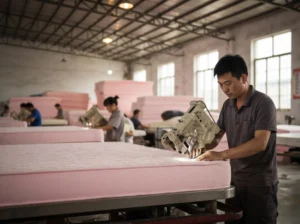
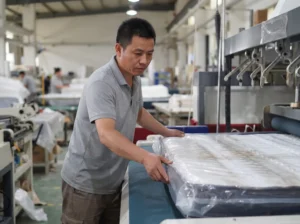
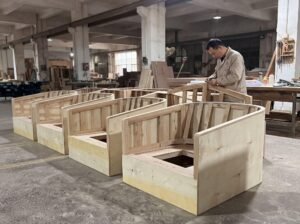
The sample you approve was probably made twice. Maybe three times. Possibly by a senior craftsman in a clean sales workshop, from the best batch of material on hand, with every joint checked twice before it was photographed for you. The container that arrives was made on a production line running at commercial speed, fed by whatever materials procurement bought that month, packed by workers paid per carton.
The gap between the two is not luck and it is not usually fraud. It is the difference between a workshop and a system. Two factories can produce identical samples and containers of very different quality, because what separates them is process control — incoming material inspection, tolerance management, in-line checks — not the sales team’s enthusiasm.
So use the sample for what it is actually for: confirming specifications, finishes, and construction methods. It is not evidence of production quality, and treating it as such is the single most common expensive mistake a first timer makes. Put tolerances and material grades in the contract. Book a during-production inspection and a pre-shipment inspection on the actual batch — not a courtesy tour of the showroom. Ask for unedited photos of your specific production run, cartons open, hardware laid out.
Timing Beats Negotiating
Factories breathe in seasons. The months before Chinese New Year and the late-summer peak shipping season are slammed: lines are booked, workers are stretched, and a small foreign order is an interruption. The weeks after Chinese New Year and the depths of mid-summer are quiet: machines idle, salespeople are hungry, and your modest order is suddenly welcome.
Place the same order in a slow window and a busy one, and the difference is routinely larger than anything a skilled negotiator extracts in a fast one — better pricing, faster slots, more management attention, sometimes priority from the best line. Subject to verification in your category, but the rhythm is industry-wide.
The actionable version of this truth: plan your purchasing calendar around the factory’s year, not around your own convenience. If you are flexible by even a few weeks, that flexibility is worth more than your best bargaining line. And if a supplier suddenly becomes generous with terms in February, that is not luck. Take the gift.
The Repeat Order Is Where Quality Quietly Changes
The first order is the courtship. The factory knows you are comparing it against competitors, that you might post a review, refer a friend, or walk away. Your goods get the good line, the owner’s attention, the batch of material that passed inspection cleanly.
The second order is where the incentives reverse. You have sunk costs now — approved samples, custom packaging, maybe molds, maybe certifications. The factory reads this as loyalty, and loyalty, in a margin business, reads as tolerance. Material costs drift; foam density drops a grade; fabric switches to a “commercially equivalent” substitute; a subcontractor you never approved takes the frames. Nothing in the carton announces the change.
The uncomfortable implication: your first order went well partly because the factory was performing for a new customer, and your repeat orders will go worse partly because you stopped behaving like one. The fix is to keep behaving like one. Reissue the full specification sheet on every order. Inspect every batch, not just the first. Keep one alternative supplier warm with a small trial order. Loyalty in this trade is built from evidence, not from silence.
The Bill Waiting in Your Country Is the One Nobody Mentions
Most newcomers obsess over the Chinese side of the transaction and meet their biggest surprise at home. Import duty, VAT or GST, customs brokerage, port and terminal handling, delivery from port to warehouse, unloading, disposal of packaging — each line looks small until they stack. Certain categories carry additional duties in certain markets; wooden furniture into the United States, for example, has a history of trade-remedy measures, and rules change. Everything here is subject to verification against your country’s current official schedule.
The classic failure case is the buyer who celebrated a landed-cost estimate that stopped at the Chinese port. Duty and VAT alone can add a third to the total on some routes; last-mile delivery of a container’s worth of furniture is its own small logistics project. Also beware the supplier who offers a suspiciously cheap “DDP, all duties paid” service: some do it by under-declaring value, and the legal exposure is yours, not theirs.
Calculate the full landed cost before you place the order, using the current duty rate from your customs authority, a broker’s quote, and realistic delivery costs to your door. Send your supplier’s spec sheet to a customs broker before you commit, not after the vessel sails.
The High-Risk Moments and the Corrections
| Risk | The early signal | The correction |
|---|---|---|
| Paying the inexperience premium | Vague inquiry, fast quote | Structured RFQ, itemized breakdown, three comparable quotes |
| Signing with a middleman at factory prices | Instant replies, instant yes, deposit pressure | Video audit, open-door visit, behavioral checklist over two weeks |
| Freight eating the margin | Quoting FOB only, no loading plan | Landed-cost comparison, loading-plan requirement, container-aware design |
| Container worse than sample | Sample treated as quality proof | Contracted tolerances, two-stage inspection, batch photos |
| Buying at peak prices | Calendar driven by your convenience | Order in post-holiday or mid-summer windows |
| Repeat-order downgrade | Complacency after a smooth first order | Full spec reissue, every-batch inspection, second supplier kept warm |
| Destination cost shock | Budget that ends at the Chinese port | Broker quote and duty check before ordering |
What This Means for Your Situation
If you are buying for yourself, one container or less: your leverage is not volume but preparation. Send a structured inquiry, demand the loading plan, get a broker quote before you fall in love with a sofa, and never skip the pre-shipment inspection because the sample was beautiful. These beginner tips matter more at small scale, because you have no margin to absorb a mistake.
If you are building a small furniture brand, your repeat-order discipline is your business model. The downgraded second order does not just cost you money; it costs you customers who trusted your first batch. Treat every purchase order like a first purchase order, and keep your alternative supplier honest with a standing trial order.
If you are becoming a professional importer, timing is your edge. Build your annual calendar around the factory year, quote freight before you quote product, and make landed cost — not FOB — the number your decisions hang on.

Frequently Asked Questions
Can I just counter the first quote with a hard discount?
You can, and it usually fails. A blunt discount request tells the factory you have no basis for your number, so they concede a little and keep the margin. Ask for a breakdown and ask what changes the price instead; the concession that follows is real.
How do I know whether my supplier is actually a factory?
You verify, because behavior is only a hint. Demand a live video call where they walk from the showroom to the line to the warehouse in one unedited take, ask questions only the floor can answer, and visit before any deposit if the order matters. Trading companies fold quickly under specific technical questioning.
How do I estimate shipping cost before I order?
Get the loading plan from the supplier — units per carton, cartons per container — then ask a freight forwarder for a current rate on that container volume on your route, and add destination charges from a customs broker. If a supplier refuses to provide loading data, that refusal is itself information.
If the sample passed, do I still need an inspection?
Yes. The sample confirms specifications; it says almost nothing about production quality. Book a during-production check and a pre-shipment inspection on the actual batch, with tolerances and material grades from your contract as the reference.
How much should a first order be?
Enough to test the full chain — production, packing, freight, customs, delivery — and small enough that a failure is tuition, not a crisis. For most individuals that means a portion of a container shared with other goods; for new brands, a volume you can sell even if quality is merely acceptable.

One Last Thing
Which of these seven truths would have saved you the most money — or which one are you about to test on your first order? Tell us your situation in the comments, and if this was useful, share it with the next first timer in your orbit before they send their first inquiry.
Recommended Resource
Interi Furniture specializes in custom furniture manufacturing for residential, hospitality, and commercial projects. Their experience in materials, craftsmanship, and project realization makes them a valuable resource for designers and buyers seeking tailored furniture solutions from China.