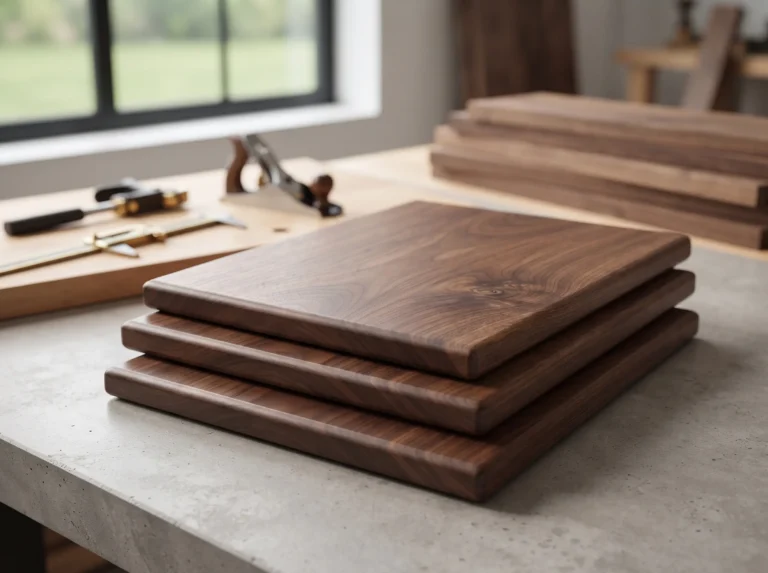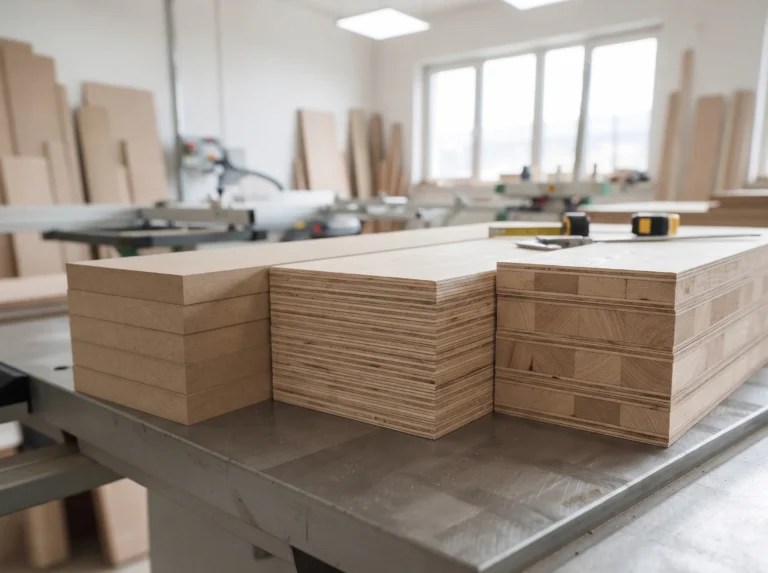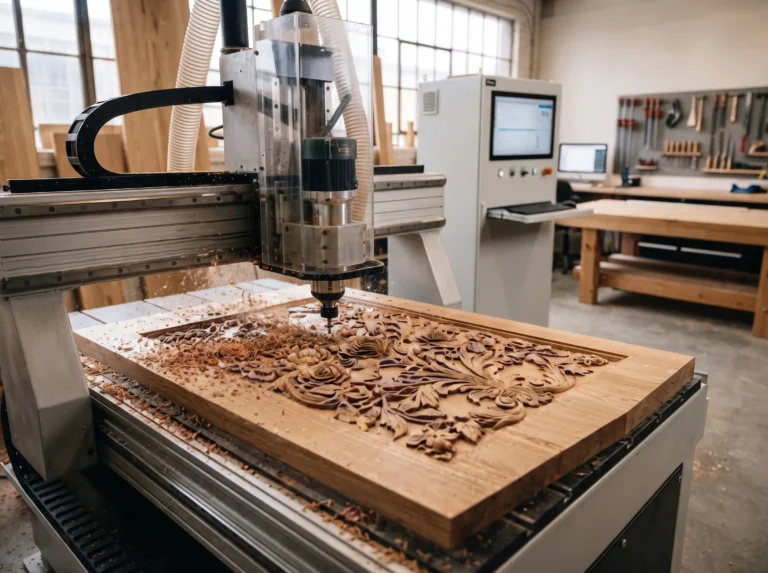










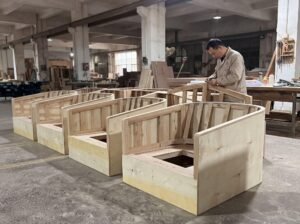

The most common question in furniture sourcing—plywood vs. solid wood—is also the most misunderstood. This is not a contest between “good material” and “bad material.” It is a choice between two structural logics: solid wood wins on repairability and tactile character; plywood wins on dimensional stability and structural consistency. The single biggest tax buyers pay is the “all solid wood” premium—money spent on marketing comfort, not durability. The truth is simple: solid wood belongs where it matters, plywood belongs where it works, and choosing the wrong structure matters far more than choosing the wrong material.
The Question Buyers Ask Most — and Answer Most Wrongly
Walk into any furniture factory showroom in Foshan or Shunde, and you’ll hear the same negotiation script. The buyer taps a cabinet side and asks, “Is this solid wood?” The salesperson nods, the price doubles, and everyone feels like they’ve won.
Twelve months later, a solid wood cabinet shipped to Arizona or Dubai has cracked at the corners, and the buyer concludes the factory cheated. Usually, nobody cheated. The buyer simply asked the wrong question.
The right question is never “what material is this?” It is “where is each material used, and why?” That single shift in framing changes everything about how you evaluate furniture—and how much you should actually pay for it.
Two Structural Logics, Not Two Quality Tiers
Solid wood and plywood fail differently, and that difference defines everything.
Solid wood is anisotropic. It moves—expanding and contracting across the grain with every shift in humidity. A wide solid panel is essentially a live element under constant internal stress. This is not a manufacturing defect; it is wood physics, and no kiln schedule eliminates it entirely.
Plywood is engineered to cancel that movement. Cross-laminated veneer layers stabilize each other—industry data indicates this construction resists warping roughly 40% better than a same-size solid panel (subject to verification against specific products and test conditions). What plywood sacrifices in repairability and edge character, it buys back in structural reliability.
Neither logic is superior. They are tools, and professional furniture design treats them that way. Solid wood vs plywood furniture is a false binary; mature construction uses both, deliberately, by location.

The Performance Matrix
The table below summarizes how the two materials behave in real furniture construction. Comparisons reflect established material science, USDA-published data, and industry practice, and are subject to verification against specific product specifications and test reports.
| Performance Dimension | Solid Wood | Plywood | Winner & Why |
|---|---|---|---|
| Dimensional stability | Low—moves with humidity | High—cross-lamination resists warping ~40% better than solid panels of the same size (industry data, subject to verification) | Plywood, for any wide panel |
| Cracking / warping risk | Inherent, physics-driven | Minimal under normal indoor conditions | Plywood |
| Screw withdrawal (face grain) | Strong—highest peak values | ~85% of same-density solid wood per USDA data; consistent across the whole panel | Solid wood on peak, plywood on consistency |
| Screw holding (end grain / edges) | Weak—end grain splits easily | Reliable and consistent when fastened into panel faces; no end-grain splitting | Plywood |
| Load-bearing (frames, legs) | Excellent in correct grain orientation | Good, depends on core quality | Solid wood |
| Moisture resistance | Swells and moves with humidity cycles | Resists delamination if properly glued | Plywood, with quality glue lines |
| Repairability | Excellent—can be sanded, re-finished, re-jointed for decades | Limited—delamination and exposed edges are hard to fix | Solid wood |
| Surface character / premium feel | Authentic grain, ages beautifully | Requires veneer to match solid aesthetics | Solid wood |
| Environmental path | Depends on finish/sealing system | Depends on adhesive grade and emissions class | Tie—compare actual test grades, not material labels |
One point deserves precision. Plywood’s advantage in hardware installation is not raw strength—it is reliability. USDA data shows screw withdrawal in plywood runs around 85% of same-density solid wood, so solid wood can post higher peak numbers. But solid wood peak values only appear along the grain; end grain splits, values scatter wildly by orientation, and one bad screw angle ruins a hinge mounting. Plywood delivers consistent holding power across the entire panel face and never splits like end grain. For hinges, drawer slides, and connecting fittings, consistency is what survives ten years of use. If a factory specs solid wood for a drawer side just to say “solid,” they may actually be engineering a weaker joint.
Where Each Material Belongs
This is the section that saves buyers money. The following table reflects mainstream practice among quality manufacturers in China’s furniture belts, and is subject to verification per individual factory construction.
| Furniture Component | Best-Practice Material | Why |
|---|---|---|
| Frame / legs / structural posts | Solid wood (hardwood preferred) | Carries load, resists impact, repairable |
| Cabinet box / carcass sides, tops, bottoms | Quality plywood (typically 15–18mm) | Stability, screw holding for hardware, resists racking |
| Back panel | Thin plywood (5–9mm) in a rabbeted groove | Stable, lightweight; fiberboard backs are the cost-cut tell |
| Drawer sides | Solid wood or quality plywood | Solid wood for repairability; plywood for stability in humid markets |
| Drawer bottom | Plywood in groove | Solid wood bottoms split across grain as drawers shrink |
| Door and drawer fronts | Solid wood frame + plywood/MDF center panel, or quality veneer plywood | Solid center panels crack; engineered cores stay flat |
| Tabletop / work surface | Solid wood (properly constructed) or quality plywood with veneer | Depends on design intent and climate |
| Shelving, wide spans | Plywood | Solid wood shelves sag and cup over time |
The pattern is not subtle. Solid wood earns its cost where structure, repairability, and touch matter. Plywood earns its place everywhere stability under hardware and humidity matters—which, in a cabinet, is most of the box.
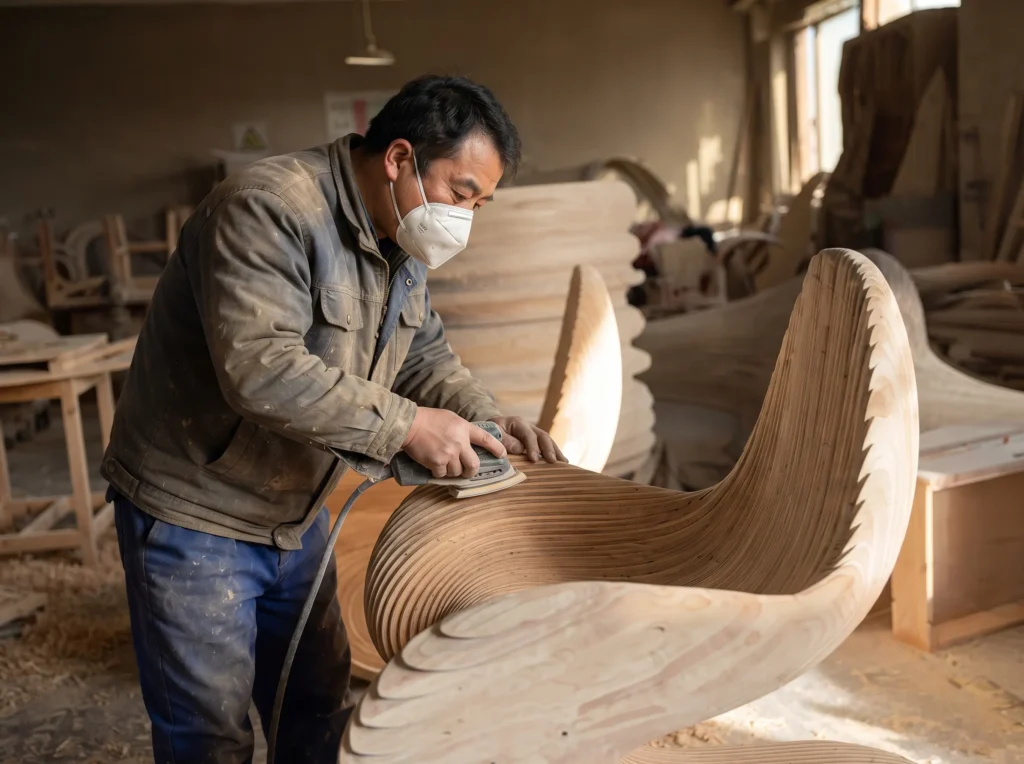
Solid Wood’s Physical Destiny: Cracking, and What Actually Mitigates It
Here is the industry’s least-discussed truth: solid wood’s greatest enemy is not insects, not formaldehyde, not factory shortcuts. It is humidity change. Wood is hygroscopic—it perpetually exchanges moisture with the air. Industry guidance puts the safe operating range for wooden furniture at 45–55% relative humidity: above 65% the fibers swell, below 35% they shrink and crack (subject to verification per species, thickness, and construction). Every solid wood panel is a restrained negotiation between two directions of movement, and somewhere in the furniture’s life, the restraint loses.
What factories can do is manage the risk, not eliminate it. The honest mitigation menu looks like this:
| Mitigation Technique | What It Does | What It Cannot Do |
|---|---|---|
| Proper kiln drying to target moisture content (matched to destination climate) | Brings wood close to the destination’s equilibrium | Prevent movement when ambient humidity swings anyway |
| Maintain 45–55% RH in use | Keeps wood within its stable moisture band | Help if the space itself swings below 35% or above 65% |
| Narrow, joined boards instead of wide slabs | Converts one big stress into many small, managed ones | Stop a poorly glued panel from failing |
| Floating panel construction in frames | Lets the center panel expand freely within the frame | Work if panels are glued rigidly (the classic cracking cause) |
| Breadboard ends on tabletops | Allows across-grain movement at the ends | Survive being screwed down flat |
| Correct finish sealing all faces | Slows moisture exchange dramatically | Seal wood permanently against climate |
| Slotted / floating fixings for tops | Mechanically accommodates movement | Compensate for wrong initial moisture content |
The reason a solid cabinet cracks in Phoenix or Riyadh is rarely “bad wood.” It is usually correct wood meeting an ambient humidity far outside the 45–55% band it was conditioned for. Buyers in dry or high-variance climates should treat wide solid panels as a climate-risk decision, not a luxury decision—and ask factories to match kiln targets to the destination.
Plywood Quality: The Grade Determines Everything
Plywood is not one material—it is a quality spectrum, and the spectrum is enormous. In my years walking board warehouses from Guangdong to Jiangxi, the single most common sourcing failure I see is buyers paying for “plywood” while mentally picturing one product. They are actually choosing among at least six.
| Plywood Grade Signal | What It Means | Furniture Suitability |
|---|---|---|
| Baltic Birch (5×5 ft format, uniform core layers) | Dense, void-minimized birch core with consistent thickness; the recognized premium cabinetry grade in North American high-end cabinet shops | Cabinet boxes, drawer systems, premium furniture |
| Full birch or hardwood core, E0/E1 adhesive | Dense, uniform core; low formaldehyde class | Cabinet boxes, premium furniture |
| Eucalyptus / poplar mixed core | Moderate density, some voids possible | Mid-range furniture, drawer components |
| Full poplar core | Soft, light, prone to dents and screw tear-out | Low-stress parts only; budget furniture |
| Veneer core with visible voids / overlaps | Weak points under load and at screw lines | Unsuitable for load-bearing or hardware zones |
| Recycled / unknown core with heavy glue | Unpredictable; emissions unverifiable | Reject for export furniture |
A note on Baltic Birch, since it confuses many buyers: it is not merely “birch plywood.” The 5×5-foot format and the uniform, void-minimized core construction are the point—they deliver consistent screw holding and machining that general-purpose birch plywood does not guarantee. When a spec sheet says “Baltic Birch,” you are buying a defined product; when it says “birch plywood,” you are buying a hope.
Two purchasing rules follow. First, specify core species or grade, thickness, and adhesive class in writing—”plywood” alone means nothing. Second, ask for the emissions test report tied to the actual batch, because plywood’s environmental story is entirely an adhesive story. A Baltic Birch E0 panel and a recycled-core panel share a category name and almost nothing else.
The “All Solid Wood” Premium: Three Kinds of Water in the Claim
When a listing says “100% solid wood,” the claim almost always contains water. After a decade of reading export spec sheets, I’ve found the phrase reliably hides three different products.
| Claim on Paper | What’s Often Inside | What You’re Actually Paying For |
|---|---|---|
| “All solid wood” | Solid frame + plywood box + plywood back | Marketing comfort; the plywood box is actually correct construction |
| “All solid wood” | Solid wood everywhere, poorly engineered (rigid glued panels) | Genuine solid material, plus an elevated cracking risk nobody priced in |
| “All solid wood” | Solid wood + MDF/particleboard hidden in backs and drawer bottoms | The hidden parts are where the failure and the smell come from |
The buyer’s premium in the first case buys nothing structural. In the second, it buys authenticity plus risk. Only the third is a genuine integrity problem—but it is common enough that “all solid wood” as a phrase should trigger documentation demands, not applause.
Ask for a construction breakdown instead: which parts are solid, which are plywood, what grade, what thickness. A factory with nothing to hide answers quickly.
Choosing by Climate and Use Case
Material selection without climate context is guesswork. The same chest of drawers behaves differently in Miami, Munich, and Melbourne.
| Scenario / Climate | RH Reality | Recommended Construction Logic |
|---|---|---|
| Humid or coastal markets (SE Asia, Gulf coast, tropics) | Often above 65% | Plywood carcass strongly preferred; solid wood limited to frames and fronts with floating panels |
| Dry or high-swing climates (US Southwest, Middle East interiors) | Often below 35% | Narrow joined solid components, sealed on all faces, kiln-matched to destination; plywood still safer for wide panels |
| High-traffic commercial / hospitality | Variable | Plywood boxes for hardware durability; solid hardwood frames for impact resistance |
| Family homes with children | Controllable (aim for 45–55%) | Repairability matters—solid wood frames and fronts worth the premium; plywood carcass |
| Budget-driven programs | Any | Quality plywood construction beats cheap “solid wood” every time; cheap solid is the worst of both |
| Premium heirloom positioning | Controllable | Full solid where touch-visible, engineered cores where stability-critical, honest labeling throughout |
Notice the pattern: climate and use case decide structure before species. Selecting oak versus rubberwood matters less than deciding whether that wide panel should exist in solid form at all.
Buyer Playbooks by Role
Importers and wholesalers should build construction specifications, not material slogans, into purchase contracts. “Cabinet sides 18mm Baltic Birch or full-birch plywood, frames rubberwood, fronts solid frame with floating panel” is enforceable. “All solid wood” is a dispute waiting to happen.
Retail buyers and purchasing managers can reframe sales-floor language immediately. Educating end customers that a plywood-box cabinet is professional construction—not a compromise—converts skepticism into margin and slashes after-sales cracking claims.
E-commerce sellers face the highest return-driven risk, because photos and listings travel farther than explanations. List the construction honestly; customers who understand they bought engineering, not marketing, leave five-star reviews instead of damage claims.
Individual buyers should apply one test: ask the seller which parts are solid, which are plywood, and why. Any seller who can answer fluently is probably building honestly. Any seller who repeats “100% solid” three times is selling the phrase.

FAQ
Is plywood furniture cheap or low quality?
No. This is the single most damaging misconception in the category. Plywood construction in cabinet boxes has been standard practice among premium European and American furniture brands for decades, because it outperforms solid wood where stability and hardware mounting matter. Quality—core species or grade, thickness, adhesive class—is a separate axis from material category, and cheap solid wood is objectively worse furniture than quality plywood.
Is it normal for solid wood furniture to crack?
Some movement is normal and is physics, not fraud. Wood continuously exchanges moisture with the air, and restrained solid panels accumulate stress until something yields. Industry guidance puts the safe band at 45–55% relative humidity; sustained conditions below 35% or above 65% will move even well-made furniture. Well-engineered construction—floating panels, joined narrow boards, all-face sealing—keeps this within acceptable limits. Structural cracking within the first months in a stable indoor climate, however, points to poor moisture control or bad construction, and deserves a warranty claim.
What material should a cabinet body be?
For most cabinets, quality plywood is the professional choice for sides, top, and bottom: it stays square, holds screws reliably for hinges and drawer slides, and resists the humidity cycles that distort solid panels. Solid wood earns its place in the frame, legs, and door fronts. Anyone insisting on solid board carcass sides is optimizing for a sales pitch, not the product.
Is “all solid wood” worth paying extra for?
Usually not, and sometimes the opposite. If the premium buys solid wood where plywood performs better—wide carcass panels, drawer bottoms, backs—you are paying more to get less durability. The premium is justified mainly for touch-critical, repair-critical components in heirloom-positioned pieces. In every other case, honest mixed construction is the better product.
How should I choose materials for a humid region?
Favor plywood for every wide, hardware-mounted panel, because its cross-laminated structure barely reacts to humidity cycles. Keep solid wood in frames and use floating-panel construction for any solid door or front. Verify adhesive class with a batch test report, because humidity accelerates any glue-line weakness. Seal all faces of every solid component, not just the visible ones—and plan for active humidity control if the space regularly exceeds 65% RH.
What Would You Like Decoded Next?
Send us the construction description from any furniture quote you’re evaluating—the material list, the thicknesses, the “solid wood” claims—and tell us which part you’re unsure about. We’ll break down what it actually means, where the risk sits, and whether the price matches the structure. The best questions get turned into the next deep dive in this series.
Recommended Resource
Interi Furniture specializes in custom furniture manufacturing for residential, hospitality, and commercial projects. Their experience in materials, craftsmanship, and project realization makes them a valuable resource for designers and buyers seeking tailored furniture solutions from China.