






In Chinese furniture manufacturing, “custom” usually hides three tiers: customizable means an existing frame with new fabric, color, hardware or legs; semi-custom means two different things—modular configuration inside an existing platform, or size and structure modification that requires engineering validation; fully custom means development from your drawing or brief. The real difference is not craftsmanship but scope, MOQ, lead time, cost structure and evidence. Before signing, ask: “Which tier is this quotation based on—model modification, module configuration, size or structure modification, or new development from drawing?”
Why “Custom” Breaks Down at the First Email
Most disputes do not start with bad factories. They start with a word that travels well and lands badly. A buyer hears “we can customize” and pictures a workshop opening a blank file. A sales manager in Foshan or Shunde often means the upholstery team can change fabric and the finishing line can match a color chip.
This is not always dishonesty. It is compressed language inside a furniture manufacturing terms culture where speed matters. Factories sell capability in short sentences because buyers ask short questions. The cost appears later, when the PO assumes third-tier freedom and the quotation was priced for first-tier work.
The expensive version is semi-custom. Buyers often merge two different jobs under one label. Module combination may sit around twenty pieces in MOQ, fifteen days for sampling, and a mid-single-digit cost premium in favorable factories. Size and structure modification may move toward fifty pieces, twenty-five days, and a double-digit premium. Those figures are directional and subject to verification, but the direction matters: planning both as “semi-custom” can understate the real budget for size changes.
Core Definitions
What factories mean by “customizable”
In standard written usage, customizable refers to modification of an existing approved model: fabric, color, leg finish, handle, cushion fill, dimensions within tolerances, packaging, and sometimes minor functional options already engineered by the factory. The product architecture stays the factory’s.
What “semi-custom” actually is
Semi-custom is not one tier. It has an inner split. The lighter version is module configuration: approved sofa frames, cabinet carcasses, table bases, bed mechanisms or chair shells recombined inside a platform. The heavier version is size and structure modification: changing dimensions beyond validated range, moving a joint, altering seat depth logic, changing internal layout or adapting a frame family to a new loading constraint. The first is closer to merchandising; the second is engineering.
What “fully custom” really demands
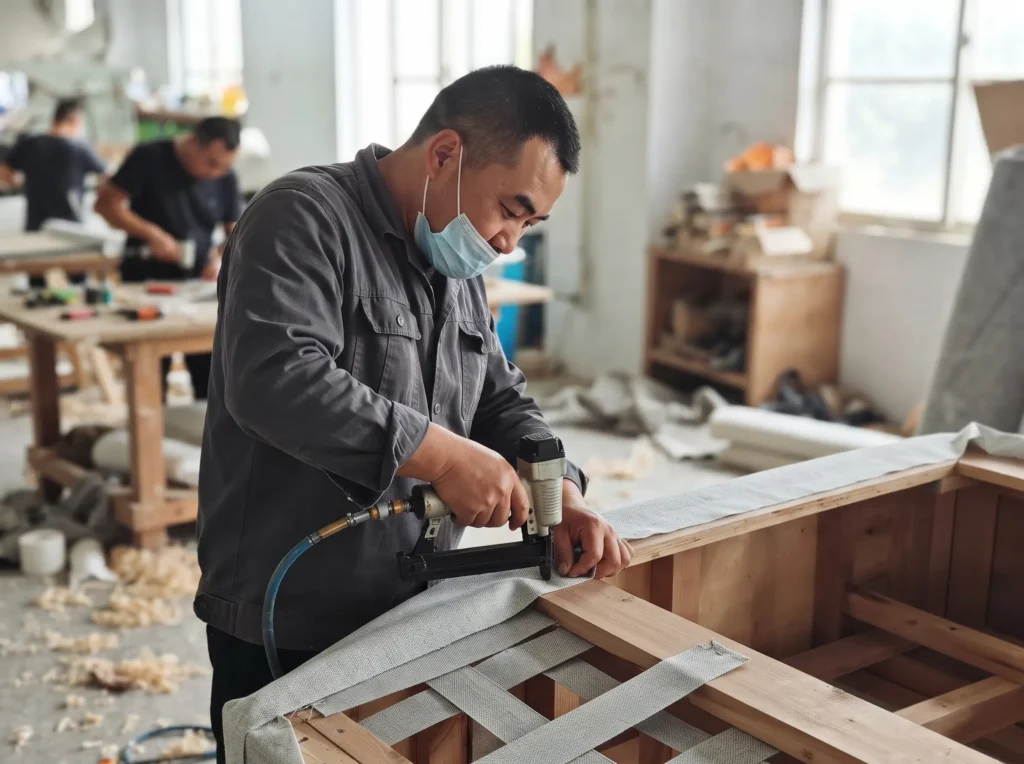
Fully custom means the factory develops from your drawing, 3D file, physical sample, or detailed brief. It can involve new frame geometry, new mechanisms, new molds, new hardware, new compliance testing, and new production documentation. After the approval sample is sealed, the project still needs technical solidification: the agreed sample must be converted into BOM, CAD production drawings, process standard cards, inspection criteria and revision control. A beautiful sample is not yet a manufacturable product. That file pack is the bridge between sealing and mass production.
The Three Hidden Tiers, Defined on the Factory Floor
| Tier | Factory language you may hear | What changes | What usually does not change | Typical buyer assumption | Actual factory meaning |
|---|---|---|---|---|---|
| Customizable | “We can customize color and fabric.” | Fabric, color, legs, handles, fill, packaging, small tolerated dimensions | Frame, mechanism, carcass logic, tooling, engineering files | “I can adapt the model to my brand.” | “Send the model code and your option list.” |
| Semi-custom, module configuration | “We can adjust the combination.” | Module mix, arm from the same family, door configuration, finish pairing, standard internal layout | Platform structure, core materials, test basis, validated dimension range | “I can create a differentiated range.” | “Stay inside approved combinations and we can move fast.” |
| Semi-custom, size and structure modification | “We can change the size.” | Dimensions beyond standard range, seat depth, joint position, internal structure, adaptation to freight or installation | Still uses a factory platform as the parent system | “A small size change should be cheap.” | “Engineering must check whether the platform still behaves.” |
| Fully custom | “We develop from drawing.” | Geometry, structure, mechanism, material system, compliance, packaging, documentation | Almost nothing except general factory capability | “The factory will build my idea.” | “Development first, production second; paperwork is the product.” |
A cleaner way to remember the customizable vs custom gap is this: customizable edits an existing answer, module configuration recombinates approved answers, size and structure modification stresses the parent platform, and fully custom asks a new question.
The Five-Dimension Capability Boundary
The boundaries below reflect common industry practice across major furniture belts; exact limits are subject to verification and must be confirmed in writing for each project.
| Dimension | Customizable | Semi-custom, module configuration | Semi-custom, size and structure modification | Fully custom |
|---|---|---|---|---|
| Design freedom | Low to moderate; options inside an existing model | Moderate; controlled variation inside a platform | Moderate but risky; boundaries look flexible until engineering objects | High in theory, constrained by engineering, compliance and cost |
| Engineering required | Little; sample room updates options | Low to moderate; combination must be checked against production history | Moderate; dimensions, joints and structure must be validated | Heavy; drawings, BOM, prototypes, testing and revisions |
| MOQ signal | Often around one to ten pieces for a simple modified model, subject to factory policy and category | Often around twenty pieces in favorable cases, subject to platform and finish run | Often around fifty pieces or more once size and structure move, subject to validation | Often fifty to two hundred plus pieces once development, tooling or testing must be absorbed |
| Lead time signal | Often shortest after materials are confirmed; still subject to fabric availability and peak season | Often around two weeks in favorable cases after options are fixed | Often around three to four weeks because geometry must be checked before sample confidence | Longest because approval samples, revisions and technical solidification precede production |
| Cost premium signal | Commonly modest, often inside a low double-digit band driven by fabric, finish and packaging | Commonly low to mid single digits in favorable platform cases | Commonly low to mid teens where structure or freight constraints change engineering | Commonly mid teens to thirty percent or more before volume offsets development |
| Main risk for buyer | Assuming visual change equals structural change | Over-configuring until the platform is no longer efficient | Treating size change as free and discovering engineering cost late | Paying development energy but communicating like a catalog order |
The practical reading is that semi-custom is powerful but not uniform. Module configuration can give a buyer much of the perceived differentiation with limited risk. Size and structure modification still sits on a platform, yet it can behave like a mini development project. That distinction is the part most buyers miss when they budget only one “semi-custom” number.
Cost, MOQ, Lead Time and Where the Risk Sits
| Item | Customizable | Semi-custom, module configuration | Semi-custom, size and structure modification | Fully custom |
|---|---|---|---|---|
| Price behavior | Usually closest to catalog pricing; fabric and finish drive movement | Usually modest uplift where combinations are proven | Higher than module work because validation and possible jig changes enter | Highest uncertainty; unit price is only part of the real cost |
| MOQ signal | Often lowest; one modified model with mixed SKUs may be possible depending on factory | Often moderate; mixed modules may be accepted under one finish or one production slot | Often higher because the line must prove the altered geometry | Frequently project-based; development fee, sampling fee, deposit structure or tooling contribution may apply |
| Lead time signal | Often shortest after materials are confirmed; still subject to fabric and peak season | Often faster than structural work because option paths are known | Often slower because dimensions must be converted into stable production references | Often the longest because prototype rounds and technical files precede mass production |
| Buyer-side risk | Thinking a color change also changes comfort, durability or compliance | Creating so many variants that QC, spare parts and after-sales become fragile | Assuming “same design, smaller size” has no engineering consequence | Treating development as procurement and discovering too late that approval discipline is the real schedule |
| Factory-side concern | Easy order, low margin, many small changes can still disrupt the line | Good balance if options are standardized; risky if every order becomes a new puzzle | Risk rises when one dimension change pulls joint, tolerance and packaging changes | High attention demand; many capable factories avoid it unless communication is disciplined |
A low quotation for “custom” work is not automatically a bargain. It is often a signal that the factory priced one tier while the buyer expects another.
How Factories Decide Which Tier You Belong To
The decision is rarely announced. It is inferred from your behavior.
A buyer who sends a reference photo and asks for a quotation usually enters the customizable conversation. A buyer who sends a mood board, dimensions and a target configuration enters semi-custom territory, but the factory will still ask whether this is combination work or structural adjustment. A buyer who sends drawings, BOM logic, target standards and approval milestones enters fully custom territory, whether or not the buyer knows it.
The silent rule matters: if a buyer demands fully custom freedom but resists sampling fees, confirmation times, engineering questions and written sign-offs, many factories quietly downgrade the order. The drawing may still be used as inspiration, but the quotation, timeline and responsibility boundary slide back to what the buyer’s process can support. This is the industry’s quiet risk filter, and it is one reason capable factories sometimes seem to “lose interest.” They are not losing interest. They are pricing communication cost.
The Questions That Lock the Tier Before You Sign
| Question to ask | What a first-tier answer sounds like | What module-configuration sounds like | What size or structure modification sounds like | What fully custom sounds like | Red flag |
|---|---|---|---|---|---|
| “Which tier is this quotation based on?” | Model code, options, fabric book, color reference | Platform code, allowed modules, finish run | Parent platform plus revised dimensions and engineering note | Drawing number, revision date, BOM, prototype plan | “Don’t worry, we can do everything.” |
| “What exactly can change without new engineering?” | Fabric, color, legs, packaging, tolerated size | Approved modules and finishes | Usually little; expect validation of joints, tolerances and packaging | Geometry, structure, mechanism, internal layout, new hardware | The answer changes after the deposit |
| “What is the approval sequence?” | Color lab dip, fabric approval, pre-production sample | Option sheet approval, finish control sample, pre-production sample | Dimensional drawing approval, prototype, revision note, pre-production sample | Concept sample, prototype, revision rounds, pre-production sample, sealed sample, technical file release | No written approval gates |
| “What happens if I change after sampling?” | Option swap may be possible within tolerance | Configuration changes may be possible if platform rules remain | Size changes after approval can reopen engineering and tooling questions | Change triggers re-quotation and new timeline | “Small changes are free.” |
| “How is color approved?” | Physical lab dip or sealed material swatch | Physical swatch tied to model and finish code | Physical swatch plus revised part list where finish area changes | Physical standard tied to drawing revision and inspection card | Approval only by screen, photo or voice note |
| “Who owns the drawings, molds and technical files if paid for?” | Usually factory platform remains factory property | Platform remains factory property unless otherwise agreed | Must be written; altered files may be project-specific | Must be written; otherwise ambiguity remains | Evasive answer or silence |
The phrase semi custom vs fully custom furniture China matters because many buyers believe they are choosing between price levels. They are actually choosing between bounded variation, platform stress, and development management.
Mismatch Scenarios That Turn into Disputes
| Mismatch | How it starts | What the buyer believes | What the factory delivers | Where it breaks |
|---|---|---|---|---|
| Color change assumed to be structure change | Buyer approves a beautiful swatch and expects comfort changes too | New fabric creates new seating feel | Same foam, same frame, same spring unit | First container complaints about firmness |
| Semi-custom budget used for size modification | Buyer plans “modules” but asks for deeper seat and revised frame | One semi-custom price should cover both | Quotation quietly excludes validation, jig or packaging changes | Production sample differs from expectation |
| Catalog price assumed for new geometry | Buyer negotiates like a repeat model | Discount pressure signals mature product | Factory accepts order but simplifies silently | No stable reference for which revision was approved |
| Spoken freedom assumed written | Sales says “any size” on WeChat or in a call | The sentence is the contract | Quotation notes reference standard model | Buyer learns that a vague chat line is weak evidence when a dispute begins |
| Screen color assumed evidence | Buyer approves color from a monitor photo | The image is enough for arbitration | Factory produces to physical standard or different dye lot | Claim fails because there is no sealed physical reference tied to the PO |
| Technical solidification skipped | Approval sample is signed, but no BOM or process card is released | The sample alone will guide mass production | Line workers interpret from experience, not controlled files | Drift appears after the first acceptable batch |
On evidence, be precise. A screen image, a phone photo, or an oral “looks fine” is usually weak in a dispute. Color and finish approval should be tied to a physical sealed sample or controlled swatch referenced in the PO and inspection standard. Even where chat records may have evidentiary value, vague wording such as “any size” is normally difficult to enforce as a clear contractual commitment. Written scope, revision numbers and acceptance criteria are safer than confidence.
Practical Playbook by Buyer Type
Private label importers should usually begin with module configuration unless they already own engineering documentation. Treat size and structure modification as a separate budget line with its own sampling plan. Ask for the platform boundary in writing and treat every change outside that boundary as development.
Wholesalers and distributors often fit customizable work better than they expect. If the commercial win is fabric, color, packaging and regional compliance, do not buy structural freedom you cannot sell. A clean first-tier program can be more profitable than a fragile third-tier launch.
Small B buyers and e-commerce sellers should resist the temptation to “customize everything.” One strong platform, controlled options, stable photography and predictable replenishment usually beat a wide custom range with unstable lead times. If you need a new size, price it as structural work even if the factory calls it semi-custom.
Design-driven project buyers should separate inspiration from specification. A rendering can guide the conversation, but a drawing package controls it. If the project cannot fund prototype rounds, revision control and technical solidification, the project is not fully custom yet; it is an ambition.
Individual overseas buyers should be direct about quantity and expectations. Many factories can serve one-piece or small-batch requests through existing models and local modification partners, but that is not the same as being a fully custom client. Honesty at intake protects both sides.

FAQ
If a factory says “customizable,” how far can I actually push it?
Usually to fabric, color, legs, handles, cushion fill, packaging and small dimensional tolerances on an existing model. Anything touching the frame logic, mechanism, carcass system or safety structure should be treated as a higher tier and confirmed in writing.
Is semi-custom one thing or two?
Operationally it is two. Module configuration is closer to approved-option recombination. Size and structure modification still uses a parent platform, but it can require engineering validation, longer sampling and a higher premium. Plan them with different MOQ, sample time and contingency.
What MOQ and cost premium should I expect across the tiers?
Directional industry ranges are often around one to ten pieces for simple customization, twenty to fifty pieces for many semi-custom paths, and fifty to two hundred plus pieces once development must be absorbed, with premiums roughly from low single digits to low teens for lighter work and mid teens to thirty percent or more for heavier work. Treat all numbers as subject to verification and category-specific.
What is technical solidification after the approval sample?
It is the conversion of the agreed sample into controlled production files: BOM, CAD drawings, process standard cards, inspection criteria, revision numbers and packaging references. Without this bridge, the sealed sample may be right while mass production still drifts.
How do I know if my order has been quietly downgraded?
Watch for sudden simplification after deposit, reluctance to reference your drawing revision, avoidance of approval gates, or a production sample that looks like a modified catalog model rather than your geometry. If the quotation becomes vague after payment, ask for the tier again in writing.
Does changing fabric or color count as custom?
Commercially, yes; technically, usually only at the first tier. It is customization for sales and merchandising, but it is not engineering. That distinction is the heart of the difference buyers feel in price, MOQ and risk.
Before Your Next Quotation
Send one short message to your current supplier: “Please confirm whether this project is existing-model customization, platform module configuration, size or structure modification, or new development from drawing; list what is excluded; and tell me which physical sealed samples and technical files will govern mass production.” Then share the answer—or the silence—with us. Which tier do you think most buyers believe they are buying when they say custom?
Recommended Resource
Interi Furniture specializes in custom furniture manufacturing for residential, hospitality, and commercial projects. Their experience in materials, craftsmanship, and project realization makes them a valuable resource for designers and buyers seeking tailored furniture solutions from China.