







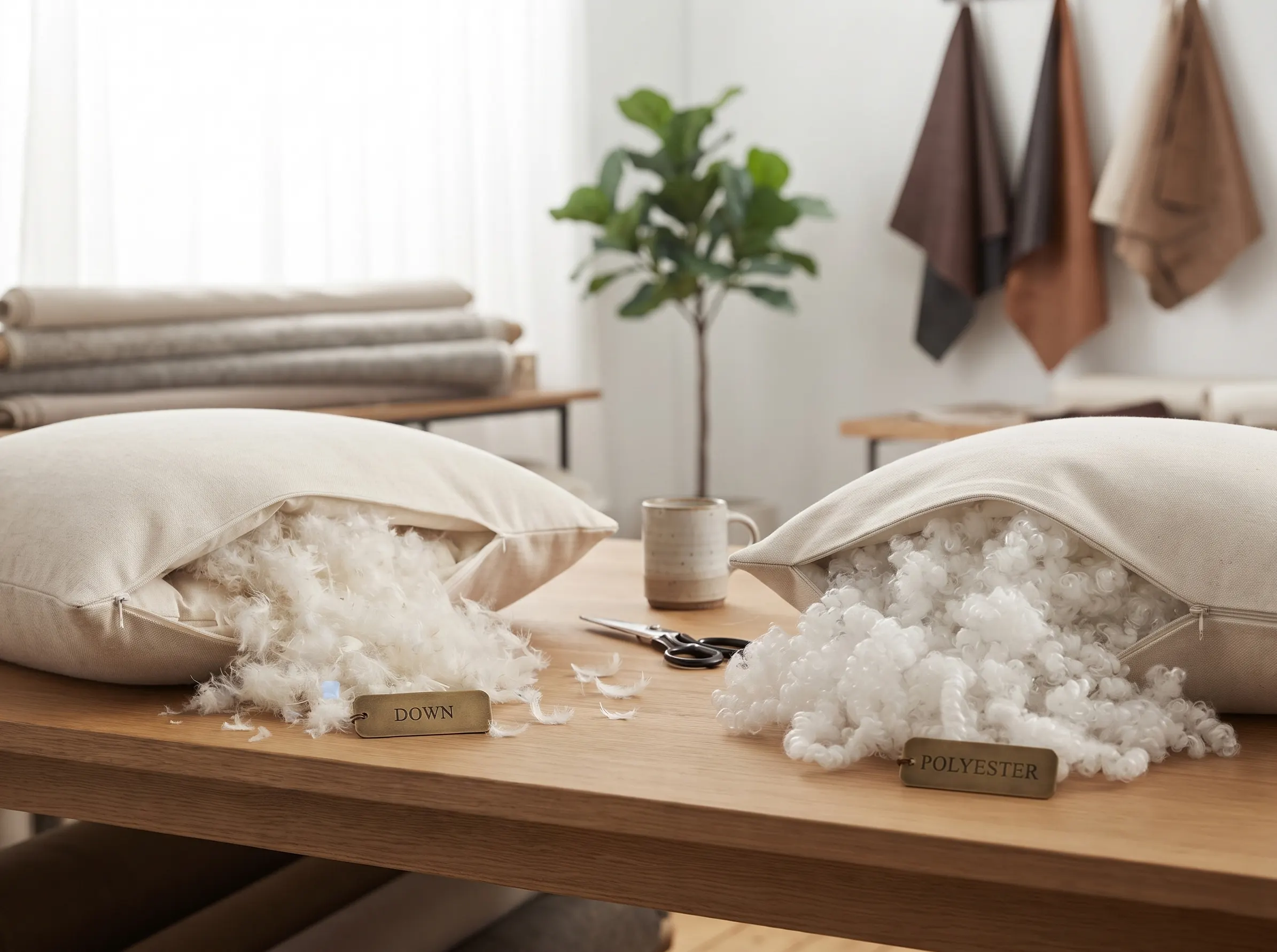
Down wins on initial luxury feel, compression recovery, and perceived value; polyester fiber wins on stability, moisture tolerance, care cost, and total cost of ownership. Neither is “better” — they lose in different rooms, not on a lab bench. The “down blend” label often means down is the guest star while feather does the heavy lifting, and feather quills are what poke through your fabric. Hotels choose fiber not out of ignorance but because they have run the replacement math — and the spec that actually wins most hotel projects is neither pure down nor pure fiber. The single most useful thing you can do as a buyer is to stop negotiating the filling in thirty seconds at the end of a meeting.
Sofa cushion filling types decide roughly seventy percent of how a sofa actually feels, yet in most buyer-supplier meetings they get less attention than the leg finish. That mismatch between attention and impact is where money gets lost.
The Blind Spot: Everyone Negotiates the Shell, Nobody Audits the Inside
Walk into any furniture showroom negotiation and watch where the time goes. Frame construction, spring systems, fabric grades, stitching — all of them get line-item scrutiny. Then someone says “standard foam with feather wrap” and the room moves on.
The supplier is not being deceptive here, mostly. The buyer is being lazy. Upholstery is a sandwich, and the filling is the layer that touches the customer’s body eight hours a day for ten years. It is also the layer most likely to be quietly value-engineered after the sample is approved, because filling is invisible in photos and barely visible in a five-minute showroom sit.
If you have ever received a bulk shipment that “felt different” from the golden sample, there is a good chance the difference was not the fabric. It was what was inside it.
The Industry Truth: Fill Decides the Feel, and the Winner Depends on the Room
Inside the supply chain, from Foshan and Shunde sofa factories to the filling plants that serve them, the working consensus is blunt. The frame determines whether the sofa survives; the filling determines whether anyone enjoys sitting on it while it does.
That is why the honest answer to the fill debate is not a winner. It is a question: where will this sofa live, and who will maintain it? Down is the king of dry, climate-controlled living rooms and the burden of humid coastal markets. Polyester fiber, especially modern cluster fiber, has closed most of the comfort gap while keeping the care cost near zero. The battle is not material versus material. It is scenario versus scenario.

What Each Material Actually Is
Before the matrix, clear definitions matter, because label vocabulary is the first battlefield.
Down is the fluffy undercoating beneath the feathers of ducks and geese, clustered without a hard quill shaft. It provides loft and insulation and compresses almost flat, then rebounds. High-grade goose down is the premium benchmark; duck down is the common commercial grade.
Feather is the outer plumage — structured, flat, with a firm quill. Feathers are cheaper than down, give cushions body and weight, but quills migrate and poke through ticking and upholstery fabric over time. In most commercial “down” cushions, feather is the volume contributor.
Polyester fiber fill is a synthetic staple or cluster fiber engineered to mimic down’s loft. Modern siliconized cluster fiber (often sold under trade names like Dacron-style clusters) opens and rebounds far better than the flat staple fiber of two decades ago.
down alternative upholstery is the marketing umbrella for any fiber engineered to simulate down’s hand feel. It is honest when it says “alternative”; it becomes a problem only when sellers blur it toward “down” in conversation.
One structure deserves its own definition before the matrix: the foam core with fiber wrap. A high-resilience foam core provides the structural skeleton and shape retention, while a jacket of polyester fiber — or a down/feather-blend wrap on higher tiers — supplies the soft first touch. This hybrid is the workhorse of contract and hospitality seating, and understanding it prevents the single most common category error in fill comparisons: judging “fiber” by a pure-fiber cushion when the product you are actually buying is a hybrid.
The Performance Matrix
| Dimension | Down & Feather | Polyester Fiber (Cluster Grade) | Buyer Takeaway |
|---|---|---|---|
| Initial sit feel | Deep, cradling, “sink-in” luxury | Supportive, slightly springier, less sink | Down wins the showroom test |
| Rebound & recovery | Compresses flat, refluffs with a shake | Springs back on its own | Fiber wins for low-maintenance use |
| Sag cycle (pure fill) | Softens over years, recoverable with beating and refill | Visible flattening in 6–12 months under regular use | Pure fiber is a short-cycle product |
| Sag cycle (foam core + fiber wrap) | Wrap softens over years; foam core survives | Holds acceptable shape 3–7 years in residential use | The hybrid buys the longevity |
| Humidity behavior | Absorbs ambient moisture, loses loft, can smell | Hydrophobic, indifferent to humidity | Down punishes damp climates and storage |
| Allergy & odor risk | Allergen carrier if poorly cleaned; odor in damp conditions | Hypoallergenic, odor-neutral | Fiber wins for hotels and rentals |
| Care cost | Professional cleaning, regular fluffing, ticking upgrades | Vacuum, spot-clean, done | Fiber’s lifetime cost is a fraction |
| Price tier (per cushion, indicative) | Roughly 2–4× fiber cost at trade level; at retail, synthetic fill typically undercuts feather fill by 30–60% | Lowest-cost compliant option | Down is a margin, fiber is a commodity — both can be either |
| Perceived value at retail | High — customers equate down with luxury | Low-to-moderate unless marketed well | Down sells itself; fiber needs a story |
All figures are directional and subject to verification against your specific supplier’s spec sheets. The sag-cycle rows deliberately separate pure fiber from the foam-core hybrid, because conflating the two is the most common error in this comparison.
The Blend Label Game: Reading What “Down Blend” Really Says
This is where most buyers get played, and where knowing the down blend sofa cushions meaning earns its keep.
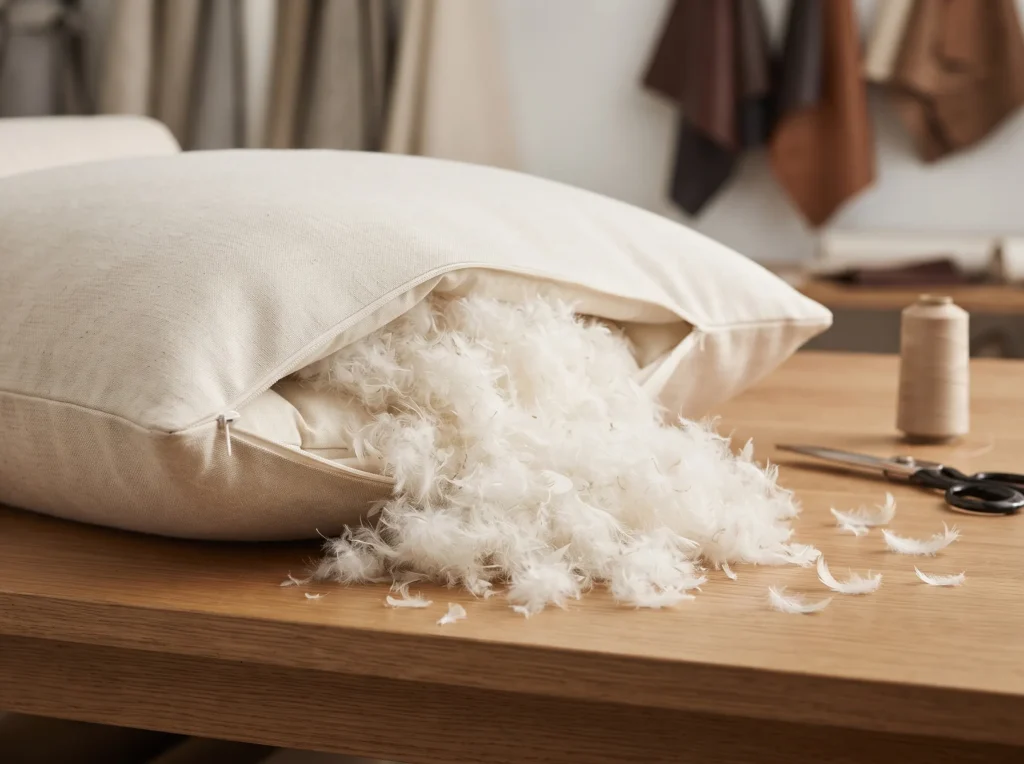
In commercial cushion production, a “down blend” or “down mix” cushion is typically a ratio of down to feather to sometimes fiber. A cushion labeled “down blend” might carry anywhere from five to fifty percent actual down by weight, with feather making up the rest. Some jurisdictions regulate the word “down” on labels — U.S. FTC labeling rules treat “down” claims against minimum down-content thresholds, and misuse is actionable — but enforcement varies by channel and import path. Treat any label claim as subject to official verification in your destination market, and verify against the FTC’s labeling guidance directly rather than a supplier’s PDF.
The vocabulary matters more than buyers realize. “Down-like” and “down alternative” almost always mean polyester fiber. “Feather mix” usually means mostly feather with token down. “Down blend” means down is present — the proportion is the question. And “100% down” at a suspicious price almost always isn’t.
| Label term | What it usually means | What to ask the supplier |
|---|---|---|
| 100% down | Genuine all-down fill, premium priced | Fill power, down cluster percentage, origin |
| Down blend / down mix | Down + feather, ratio unspecified | Exact down-to-feather ratio by weight |
| Feather mix / feather down | Mostly feather, small down fraction | Quill treatment, ticking fabric grade |
| Down alternative / down-like | Polyester cluster fiber | Cluster size, siliconization, density |
| Feather wrap over foam | Foam core encased in a down/feather envelope | Envelope fill ratio and ticking thread count |
A feather-heavy cushion is not automatically bad — feather gives body and weight that pure down lacks. The problem is quill migration. Cheap feather with short quills, insufficiently washed and not treated, will work through the ticking and then through the upholstery fabric, producing the “poking” complaints that ruin review scores and trigger chargebacks. The industry benchmark for blocking quill migration is a down-proof ticking with a thread count above 230; below that, migration is a matter of when, not if. Proper washed-and-treated feather plus certified high-thread-count ticking costs real money, and it is the first thing value-engineered.
Why Hotels Buy Fiber and Retail Showrooms Push Down
This is one of the most instructive divides in the industry, and it is entirely rational on both sides.
| Channel | Typical fill choice | The underlying logic |
|---|---|---|
| Hotel FF&E & hospitality | Foam core + polyester cluster fiber wrap | Washability, fire performance, replacement cycles, procurement audits |
| Furniture retail & e-commerce | Down blends, feather wrap, “down alternative” marketed as luxury | Showroom feel converts; “down” is a perceived-value keyword |
| Rental & multi-family | Fiber or foam-fiber hybrids | Abuse tolerance, cleaning economics |
| High-end residential design | True down blends with proper ticking | Client expects luxury hand feel; maintenance is delegated |
Hotel procurement teams are not unsophisticated about comfort. They have simply run the total-cost math across hundreds of units and thousands of cleaning cycles. Down that absorbs humidity in a coastal resort room, needs professional cleaning, and flattens unevenly under inconsistent guest use loses on every line of the spreadsheet. Fiber survives industrial laundering, dries fast, and gets swapped at end-of-life without drama.
The Hybrid Spec That Actually Wins Hotel Projects
Here is the detail most hotel buyers discover too late: the specification that wins most hospitality projects is neither pure down nor pure fiber. It is a high-resilience foam core — which carries the fire-performance and structural requirements that contract procurement demands — wrapped in a jacket of polyester cluster fiber, or a down/feather-blend wrap on the upper tiers, which supplies the soft first touch guests notice.
This structure dominates hotel FF&E for a practical reason: each layer does the job it is best at. The foam core holds shape through thousands of sits and meets flammability expectations; the wrap delivers the plush hand feel without inheriting down’s moisture and cleaning liabilities. When a supplier quotes a “fiber hotel sofa,” verify which structure is being quoted — pure fiber cushioning and a foam-core-plus-wrap build are different products at different price points and different lifespans.
Retail channels optimize a different equation: the thirty seconds a customer sits in the showroom, and the word “down” on the hangtag. A showroom down-blend cushion wins that moment almost every time. The maintenance pain arrives two years later, in a living room the retailer will never see.
The Sag Cycle: The Cost Nobody Prices In
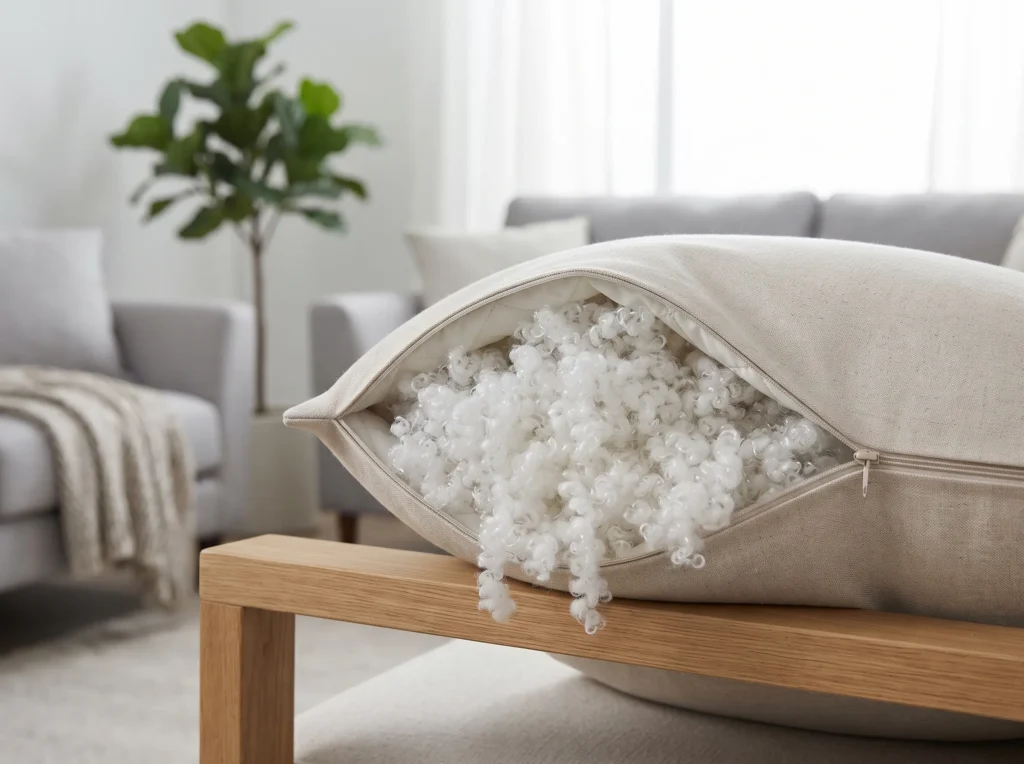
The real economics of filling are hidden in the collapse curve, not the purchase order — and the curve looks completely different for pure fiber versus a hybrid build.
| Fill type | How it degrades | Can it be recovered? | Replacement economics |
|---|---|---|---|
| High-quality down | Gradual loft loss over 5–10 years, uneven at first | Yes — beating, sunning, topping up | Refill service exists; cushion revives |
| Feather-heavy blend | Quills break, fill shifts, cushions go lumpy | Partially — redistribution helps for a while | Ticking often fails before fill does |
| Pure polyester fiber | Visible flattening within 6–12 months of regular use; clumping signals the end | No — clumped fiber is finished | Insert swaps are cheap but frequent |
| Foam core + fiber wrap | Wrap compacts over 3–7 years; foam core survives | Rewrap restores the cushion | Rewrap service is cheaper than replacement |
The counterintuitive truth: down’s apparent fragility is actually repairability, and pure fiber’s low price conceals a short cycle. A fiber cushion that has clumped is landfill; a down cushion that has flattened is a service call. But the hybrid build quietly fixes fiber’s biggest weakness — the foam core means you rewrap the jacket instead of trashing the cushion. Priced over a ten-year ownership horizon, the gap narrows dramatically, which is exactly the calculation hotels perform and retail buyers skip.
High-Risk Warnings: Where Fill Specifications Get Quietly Cheated
The most common post-shipment disputes we see in the trade trace back to three moves. The approved sample had a higher down ratio than bulk production, and no one specified the ratio on the PO. The showroom sample used real down wrap while production switched to “down alternative” — which is legal if the PO says “fiber wrap,” and theft if it says “down.”
The third move is ticking substitution. Down-proof ticking at or above the roughly-230-thread-count benchmark is a visible cost; substituting standard lining lets quills migrate within months. By the time poking complaints arrive, the container is long paid for and the supplier’s answer is a shrug. Specify the ticking thread count in the PO, not just the fill.
Verifying the Fill at the Factory
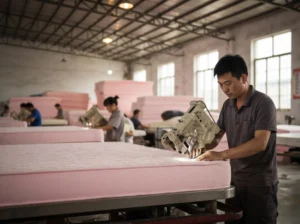
You cannot X-ray a cushion at the port. You have to verify upstream, at the factory, before production locks.
| Audit checkpoint | What to do | Red flag |
|---|---|---|
| Fill ratio on PO | Write down-to-feather-fiber ratio by weight into the purchase order | Supplier resists putting ratios in writing |
| Structure on PO | State explicitly whether cushions are pure fill or foam core + wrap | Quote ambiguous between the two builds |
| Raw material staging | Inspect down/feather bales and fiber bags on the filling line | No labeled raw material visible at the line |
| Cushion weigh-in | Weigh random production cushions against golden sample weight | Systematic underweight across units |
| Ticking inspection | Check thread count against the ~230 benchmark and request down-proof certification | Thin lining, no certification offered |
| Lab reports | Request third-party fill-content testing where required by destination labeling law | Only self-issued “test reports” available |
| Mixing records | Ask to see batch blending logs for the production lot | Logs missing or dated after your visit |
Third-party lab testing for fill content is routine in some markets and worth its modest cost on volume programs, particularly where labeling law makes the fill claim a compliance issue rather than a preference.
What This Means for Your Specific Situation
For the importer and wholesaler, the operational advice is to specify ratios and structure in writing, lock the ticking spec at or above the 230-thread-count benchmark, and price both fill options in your line plan. A fiber-based SKU and a genuine down-blend SKU at different price points serve different markets and protect you from the blended-label trap.
For the retail buyer, decide whether you are selling the showroom moment or the five-year ownership experience, and choose the fill to match the promise. Marketing down alternative upholstery honestly — as engineered comfort, not fake luxury — converts better than borrowed prestige and generates fewer returns.
For hotel FF&E programs, the industry’s collective tilt toward fiber is data, not fashion — but read the spec carefully. Specify the foam-core-plus-cluster-fiber-wrap build rather than pure fiber cushioning, demand laundering-cycle documentation and fire-performance data for the foam, and spend the savings on ticking and fabric grades that determine the guest’s tactile experience.
For the individual buyer in a humid climate, the answer that saves you grief is fiber — ideally in a foam-core-plus-wrap cushion, which fixes pure fiber’s short sag cycle. In a dry, air-conditioned home with delegated cleaning, a real down blend is a pleasure worth its maintenance. The material is not the decision. The room is.

Frequently Asked Questions
Will a down sofa leak feathers through the fabric?
It will if the fill is feather-heavy with cheap, untreated quills and the ticking thread count sits below the industry benchmark of roughly 230. Proper washed feather, certified down-proof ticking at or above that threshold, and a tight weave on the outer fabric largely solve it. If poking starts within months, the ticking was the compromise.
How much down is actually in a “down blend” cushion?
Anywhere from five to fifty percent by weight is common commercially; the label alone will not tell you. The ratio must be specified on the purchase order and verified by weight and, where feasible, lab testing. Regulatory definitions exist in markets like the U.S., but enforcement varies — verify against official FTC labeling guidance.
How long until a fiber sofa cushion goes flat?
It depends entirely on the structure. Pure polyester fiber cushioning shows visible flattening within six to twelve months of regular use — that is a short-cycle product, whatever the hangtag implies. A foam core wrapped in fiber is a different build entirely: the wrap holds acceptable shape for three to seven years under normal residential use, and when it compacts, you rewrap rather than replace. Check which structure your quote describes before you compare lifespans.
What should buyers in humid climates choose?
Polyester fiber, decisively — and preferably in a foam-core-plus-wrap build rather than pure fiber, to escape the short sag cycle. Down absorbs ambient moisture, loses loft, develops odor, and becomes a maintenance burden in high-humidity environments. Fiber is hydrophobic and indifferent. If a client insists on down in a coastal or tropical market, sell them a dry cabinet before you sell them a sofa.
Can I require a fill-content test report from the supplier?
Yes, and on volume programs you should. Third-party laboratory testing for down content and fill composition is standard practice in regulated markets, and a supplier unwilling to support it is telling you something. Specify the requirement in the PO so it becomes a contractual term rather than a favor.
Before You Sign the Next PO
What has your experience been — have you caught a fill substitution in a bulk shipment, and how did you catch it? Tell us in the comments, and if there is a filling topic you want dissected next, name it.
Recommended Resource
Interi Furniture specializes in custom furniture manufacturing for residential, hospitality, and commercial projects. Their experience in materials, craftsmanship, and project realization makes them a valuable resource for designers and buyers seeking tailored furniture solutions from China.