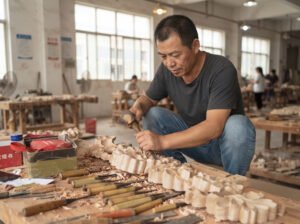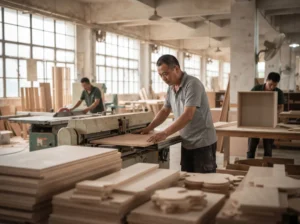

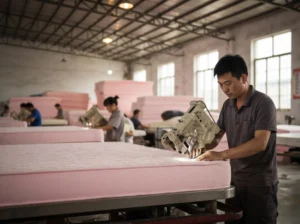






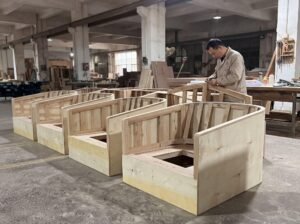
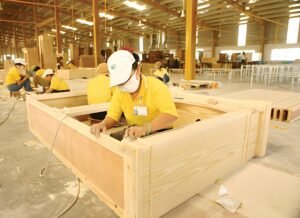

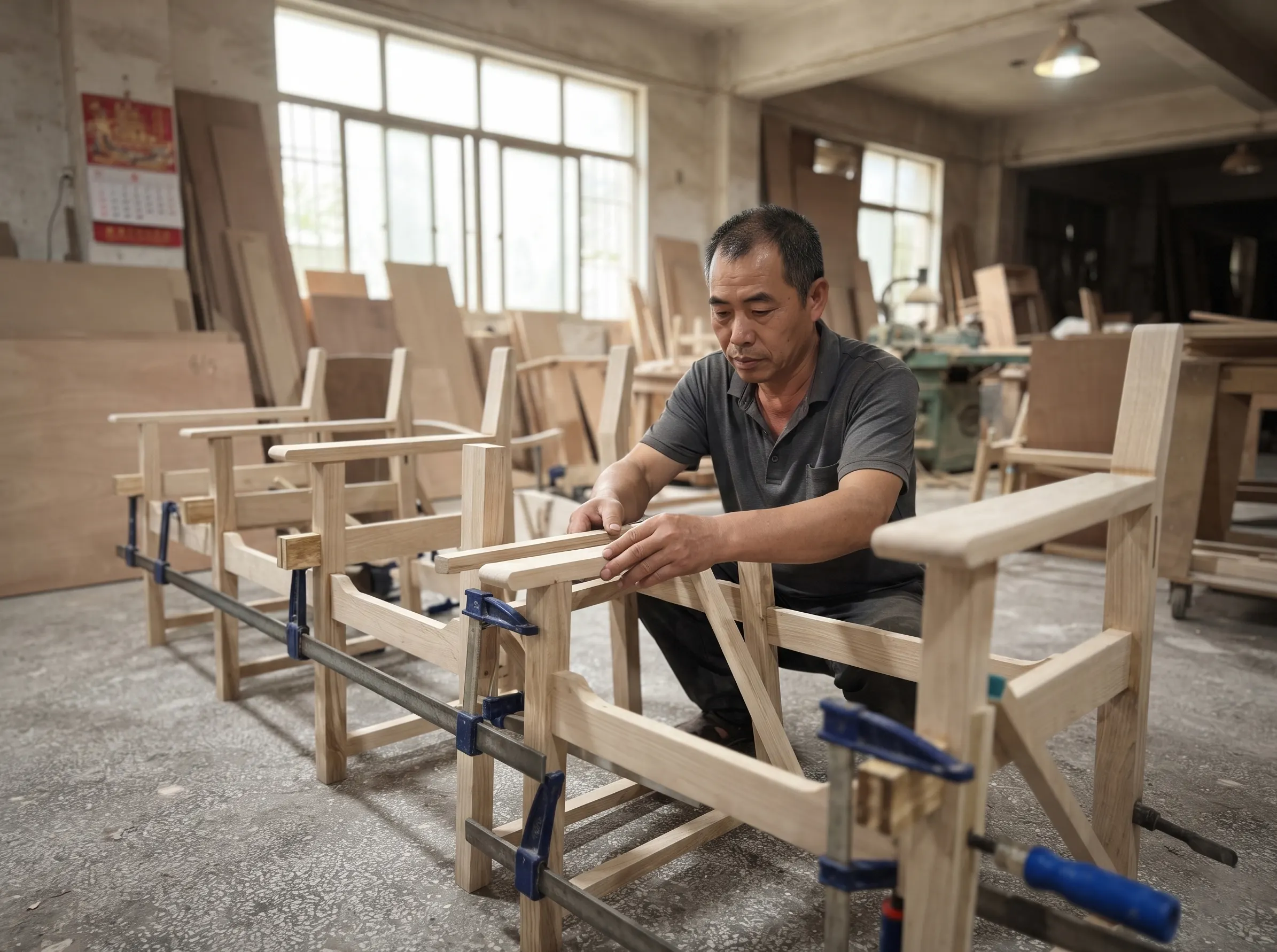
Since 2018, and with real momentum since 2023, a group of Foshan furniture entrepreneurs have been doing something no trade statistic captures properly: rebuilding their entire industrial ecosystem overseas. In industrial zones outside Ho Chi Minh City, Bangkok, Penang, and Surabaya, you now find Foshan-built machinery, Foshan-trained master craftsmen, Cantonese-speaking floor managers, and showroom-warehouse combinations that look suspiciously like Lecong. We call them “shadow Foshans.” This is not capacity transfer. It is the first wholesale export of China’s furniture ecosystem—and it changes what “Vietnamese-made” or “Indonesian-made” actually means for buyers.
A China furniture entrepreneur overseas today is rarely starting from zero. He—and it is usually a he, usually in his 40s or 50s—ships his panel saws and edge banders from Shunde, brings three or four trusted foremen, rents a factory shell near a port, and starts calling his old customers. Within eighteen months, the plant often looks, runs, and quotes like a Foshan factory with a foreign address.
For importers, wholesalers, and retail buyers, the practical implications are immediate. Your sourcing map is being redrawn whether you participate or not, and the winners will be the buyers who understand what actually moved—and what didn’t.
The “China Plus One” Noise—and Why Most of It Misses the Point
If you have sat through any sourcing webinar since 2022, you have heard the standard story: wages in Guangdong are rising, tariffs keep stacking up, so production is fleeing to Vietnam and beyond. The story is not wrong. It is simply too small.
The standard story describes individual factories chasing cheaper labor. What is happening in furniture is categorically different. According to a Foshan enterprise globalization white paper referenced in reporting by Nanfang Daily, among surveyed Foshan companies that built new overseas manufacturing bases in 2024, roughly 55% chose Southeast Asia—with Vietnam and Thailand as the top two destinations (subject to verification). That is not a migration of machines. That is a migration of a cluster.
And clusters are the whole point of Foshan. A sofa made in Shunde is not competitive because labor is cheap; Guangdong wages have not been “cheap” for fifteen years. It is competitive because within a 50-kilometer radius you can source foam, fabric, hardware, boards, packaging, molds, spare parts, and a technician who can fix a CNC router the same afternoon. When Chinese capital Southeast Asia headlines focus on factory openings, they usually miss that the factory is only the visible tip—the ecosystem around it is the real story.
This article is about that ecosystem, and about what it means for the people who actually buy the furniture.
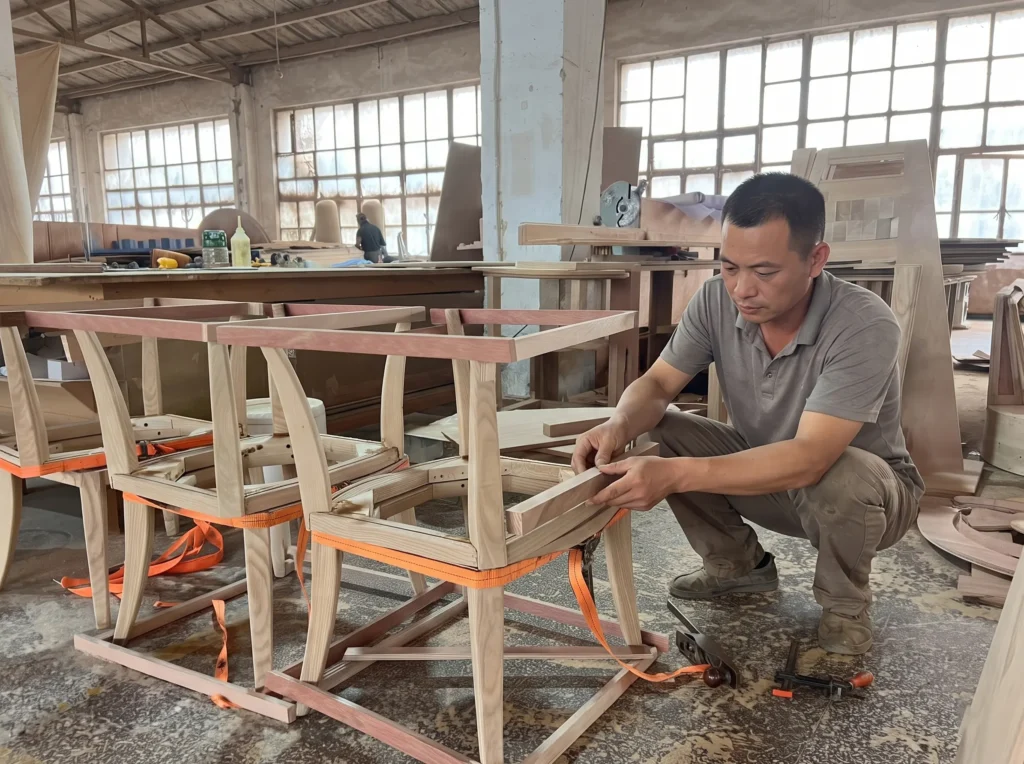
What a “Shadow Foshan” Actually Is
The term is informal industry shorthand, so let us define it precisely before the trade press gets hold of it and ruins it.
Working definition
A shadow Foshan is a production-and-trade node outside China in which the owner, core machinery, key technical staff, quality-control logic, and downstream trading relationships all originate from the Foshan furniture cluster—and which reproduces, at reduced scale, the “front showroom, back factory” model of Lecong, Shunde, or Longjiang.
Three features distinguish it from an ordinary foreign-invested factory. The owner is typically a former Foshan factory boss or trader, not a financial investor. The plant’s equipment, processes, and QC checklists are transplanted directly from the original China operation. And the customer base initially overlaps heavily with the owner’s existing export book—often including his former domestic competitors, who now place orders with him abroad.
In short, a Foshan replication abroad is not imitation. It is transplantation.
This is why the phenomenon matters more than the raw FDI numbers suggest. Publicly reported examples anchor the trend: Loctek opened a Vietnamese plant as early as 2016; Man Wah, Jiangxin, and Keeson followed with Vietnamese production bases around 2019; Solex’s Vietnam base opened in late 2025 with a reported investment of around USD 80 million; Zhongyuan Home announced plans for a USD 16 million Vietnamese facility; and Runner Group has expanded in Thailand while adding Mexico (all subject to verification). Behind each listed company stand dozens of unlisted Shunde and Longjiang bosses doing the same thing at smaller scale, with less fanfare.
Why They Are Leaving: The Four Real Drivers
Ask a Foshan factory owner why he moved and he will usually give you one answer. Ask over a long dinner and you get four. The drivers are layered, and understanding the layering matters for buyers, because each driver produces a different kind of overseas factory.
| Driver | What actually triggered it | What it produces on the ground |
|---|---|---|
| Tariffs and trade remedies | Section 301 duties on Chinese furniture; AD/CVD orders on Chinese wooden bedroom furniture, cabinets, and mattresses, with rates on some Chinese cabinet products reported up to the high double digits and beyond (subject to verification) | Plants built for US-bound volume, often category-specific |
| Customer origin requirements | US retailers and importers demanding non-China origin certificates; some buyers explicitly splitting orders across origins | Plants designed to pass origin audits from day one, with documentation discipline unusual for the region |
| Cost structure | Guangdong land, compliance, and labor costs; rising environmental and safety standards | Mid-scale plants chasing total landed cost, not headline wages |
| The bosses’ own globalization | A generation of factory owners in their 50s building an exit, a second front, or a family platform abroad | The “shadow” element: same people, same customers, new flag |
The fourth driver is the one almost nobody writes about, and it explains the pattern better than tariffs do. Tariffs explain why production for the US market moved. They do not explain why the owner moved his showroom, his sales team, and his children.
Not All of Southeast Asia Is the Same
Buyers constantly ask us to rank the countries. The honest answer is that each hosts a different slice of the Foshan model, and the differences are structural rather than cosmetic.
| Country | What it offers | Where it struggles | Best fit for |
|---|---|---|---|
| Vietnam | Deep woodworking heritage; proximity to China’s material supply chain; strong US-bound logistics; largest Chinese furniture FDI stock in the region (subject to verification) | Heavy US scrutiny on origin; rising wages around HCMC and Binh Duong; panel, foam, and hardware still largely imported | Upholstered and wooden case goods for the US market |
| Thailand | Mature industrial base, strong auto and appliance supply chains that spill over into metal and finishing; better local supplier depth | Higher labor cost than Vietnam; slower SME ecosystem for furniture-specific components | Mixed-material products, hotel and FF&E projects |
| Malaysia | Established wood industry in Penang and Johor; English-speaking management layer; decent rule of law | Smaller labor pool; some categories already hit by AD/CVD scope rulings involving Chinese components | Solid wood and mid-to-high-end case goods |
| Indonesia | Huge domestic market, abundant timber resources, lowest wage base of the four | Weakest component supply chain; port and customs friction; quality consistency still developing | Domestic ASEAN sales, resource-based products, long-horizon bets |
Notice what is missing from the table: the minimum wage. Shadow Foshan site selection is rarely about the cheapest labor. It is about the shortest line back to China’s component supply chain. That is why northern Vietnam and the Vietnam–China border corridors punch far above their wage rankings—the truck from Dongguan or Foshan can reach them in two days. The map of shadow Foshan Southeast Asia is, in practice, a map of China’s outbound logistics.
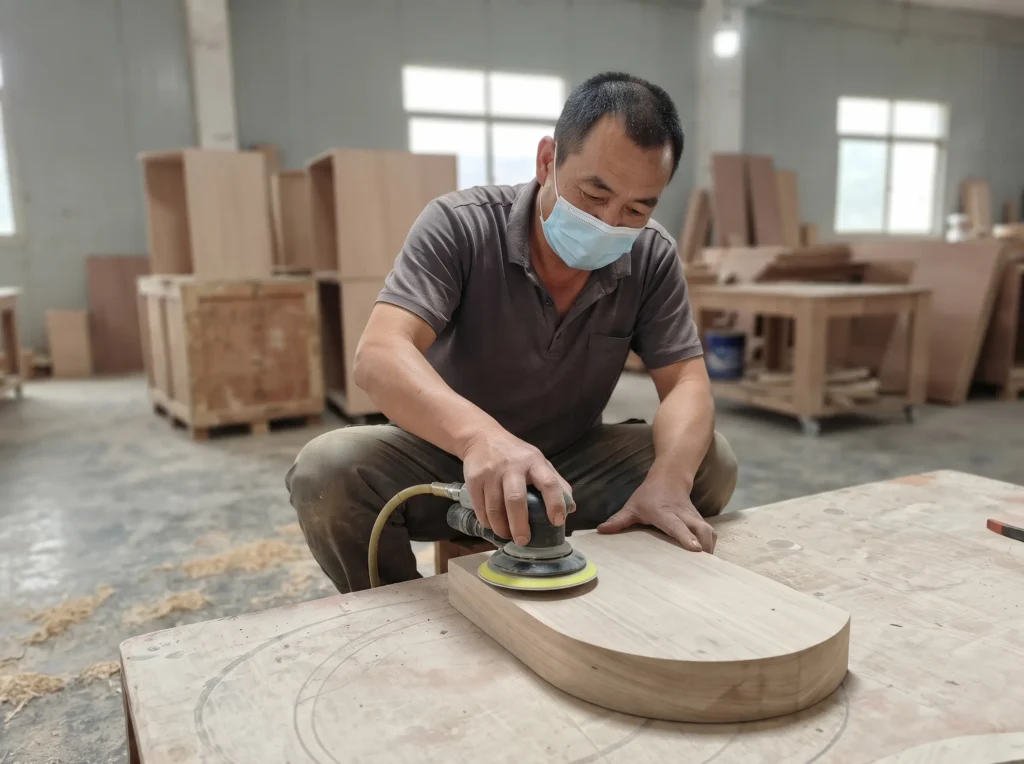
What Moves and What Doesn’t: The Real Boundary
Here is the uncomfortable truth that both cheerleaders and doomers of Chinese manufacturing get wrong. The transfer has a hard edge, and the edge runs right through the bill of materials.
| Ecosystem element | Transferability | Reality on the ground |
|---|---|---|
| Machinery | High | Container ships carry panel saws, presses, and sewing lines routinely; secondhand Foshan equipment is a regional trade of its own |
| Master craftsmen | Medium-high | A core team of 5–15 Chinese foremen per plant is common (subject to verification); locals are trained under them |
| Quality-control logic | High | Checklists, inspection stations, and tolerance culture transplant almost intact—this is why “Chinese boss in SEA” products often outscore local rivals |
| Foam, fabric, hardware, boards | Low in the short term | The upstream supply base stayed in China; Vietnamese-assembled sofas routinely use Chinese foam, textiles, and mechanisms |
| Mold and tooling making | Low | Tooling for metal and plastic components is often still made in China, at reported costs up to three times lower than local alternatives (subject to verification) |
| Trade services: inspection, consolidation, freight | Medium | Growing fast, but thinner than Foshan; buyers lose the “everything fixed in one afternoon” reflex |
This boundary is not permanent—Vietnamese and Indonesian suppliers are climbing the value chain every year—but for this procurement cycle, “Made in Vietnam” furniture often means “assembled in Vietnam from substantially Chinese inputs.” That single fact drives most of the risk section below, and it is why reports of Foshan’s death have been exaggerated. The cluster’s center of gravity is shifting from final assembly to upstream supply and management—a more profitable position, if a less visible one.
Three Misreadings That Will Cost You Money
The “capacity transfer” narrative gets three things consistently wrong, and each misreading has a price tag attached.
The first misreading is that what moved is capacity. What actually moved is the production node; the profit node, the tooling node, and the materials node largely stayed. When you negotiate with a Vietnamese factory, ask who owns the molds and where the fabric comes from. The answer frequently leads back to a Shunde trading company you were already buying from.
The second misreading is that Southeast Asian production automatically means tariff relief. It did for a while. It increasingly does not. The US Department of Commerce has already issued scope and anti-circumvention determinations confirming that wooden cabinets and vanities made from Chinese components processed in Vietnam and Malaysia remain subject to China’s AD/CVD orders (Federal Register and DOC determinations, 2022–2024). In 2020, Vietnamese customs inspections reportedly found origin violations in 100% of the wooden furniture firms examined in one enforcement sweep (subject to verification). Origin is earned through substantial transformation, not rented through an address.
The third misreading is that the first customers of these new plants are American buyers. In practice, the earliest and steadiest orders often come from Chinese industry peers needing compliant overseas capacity, and from local project and hotel channels buying “Foshan quality without the import hassle.” US buyers arrive later, which means the plants you are evaluating today were usually stress-tested by demanding internal customers first. That is good news, if you know how to verify it.
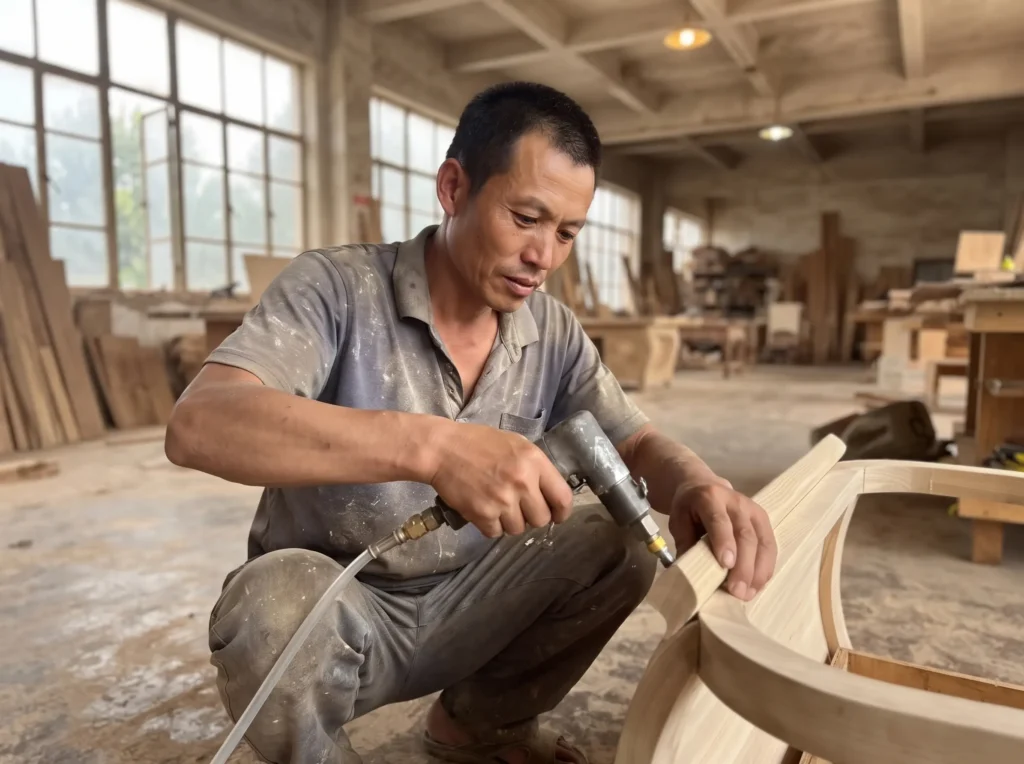
The Risks Nobody Puts in the Sales Deck
The origin trap
This is the highest-stakes risk and the one most buyers underestimate. If your product category carries AD/CVD orders on China, moving assembly to a third country does not clean the origin. US rules have been explicit: covered Chinese cabinet and furniture parts owe Chinese duties no matter where they are screwed together, and transshipment or relabeling can attract penalty tariffs reported up to 40% on top of existing duties (subject to verification). Vietnam’s trade authorities now warn exporters directly against building US-bound products on major Chinese components. The compliance bar is documentation: bills of materials, production records, and value-added evidence that survive a customs audit years after shipment.
The Vietnam quote illusion
Many buyers expect Vietnamese quotes to be dramatically cheaper. They are often disappointed. Labor is cheaper, at roughly half to two-thirds of Guangdong levels (subject to verification), but materials are not—because they are the same Chinese materials, now with freight and duty added. Tooling can cost two to three times more where it must be made locally. Landed-cost savings are real but typically sit in the high single digits to low teens for compliant products, not the 30–40% of brochure math. Any quote that looks 40% cheaper deserves forensic scrutiny of what exactly is being quoted.
The lead-time gap
Foshan’s magic was inventory depth: every component existed within an hour’s drive. In Southeast Asia, a missing hinge or a delayed fabric lot can stall a container for weeks, and local spot markets cannot absorb the shock. Plan for longer, more conservative lead times, hold safety stock on long-lead components, and treat any factory promising Foshan-speed flexibility in year one of operation with professional skepticism.
What This Means for Your Sourcing Map
The buyers who come out ahead will not be the ones who fled China, nor the ones who pretended nothing changed. They will be the ones who read the map correctly.
| Buyer situation | Recommended posture | Key verification step |
|---|---|---|
| Large importer, US-heavy book | Dual-origin strategy by category; qualify one shadow-Foshan plant per core category alongside incumbent Chinese suppliers | Walk the line and confirm where components actually originate |
| Wholesaler / distributor | Buy the plant, not the country: audit QC logic, ownership, and after-sales responsiveness rather than passports | Trace ownership to the China parent and check its export history |
| E-commerce / small private label | Use shadow Foshans as second source on your top SKUs; keep China for long-tail variety and components | Start with a small trial order and measure defect rates across two shipments |
One practical note for every buyer: the fastest way to evaluate a Southeast Asian plant is to ask its Chinese questions. Request the QC checklist, the BOM origin breakdown, and the mold ownership records. A genuine shadow Foshan will answer these instantly—because they are the same documents the boss used in Shunde. A local broker posing as a factory will hesitate.

Frequently Asked Questions
Is furniture from a shadow Foshan the same quality as furniture from Foshan?
Often close, and sometimes better than local Southeast Asian rivals, because the QC system, machinery, and foremen are transplanted from the China operation. The gap appears in materials and consistency: foam, fabric, and hardware still largely come from China, but local substitutes creep in when supply tightens, and newer local workforces produce more variance than a mature Guangdong line. Audit the BOM, not the brochure.
Why isn’t Vietnamese furniture cheaper than Chinese furniture?
Because you are paying for Chinese materials plus freight, duty, and a thinner local supply chain, offset by cheaper labor. Labor is perhaps half of Guangdong’s cost, but labor is only part of a sofa’s cost. Compliant Vietnamese products typically save high single digits to low teens in landed cost—not the dramatic discounts some buyers expect. Quotes that look dramatically cheaper usually contain dramatically less product.
How do I verify whether a Southeast Asian factory is actually Chinese-owned?
Check the local business registration for the shareholder structure, which frequently traces to a Hong Kong, Singapore, or directly Chinese entity. Ask for the export history of the parent company and cross-reference it with Chinese customs data or trade databases. On-site, listen to the production floor: Cantonese and Mandarin among supervisors, Foshan-brand machinery, and Foshan-style QC stations are strong tells. None of this is disqualifying—it is simply information you should price in.
Will Southeast Asia replace Foshan as the world’s furniture workshop?
Not in this decade, and probably not on the current model’s terms. Final assembly for US-bound volume will continue shifting, but the upstream cluster—materials, components, tooling, machinery, and the trading layer—remains overwhelmingly Chinese and is proving sticky. Foshan is evolving from the world’s factory floor into the world’s furniture supply-chain command center. Buyers should plan for a two-node world, not a replacement world.
Should I move part of my sourcing to Southeast Asia now?
If your category carries China-specific trade measures or your customers demand dual origin, yes—deliberately and by category, not emotionally. Start with your highest-tariff-exposure SKUs, qualify plants on QC and compliance rather than price, and keep China alive as your benchmark and backup. If neither pressure applies to you, the urgency is lower than the hype suggests, and your energy is better spent auditing the suppliers you already have.
Your Move
The map is being redrawn in real time, and the most useful intelligence in this industry still comes from buyers comparing notes. Which category are you being pushed to dual-source first—upholstery, case goods, or mattresses—and what is the one question you would ask a Southeast Asian plant on day one? Drop it in the comments; we read every one, and the best questions become our next factory-audit deep dives.
Recommended Resource
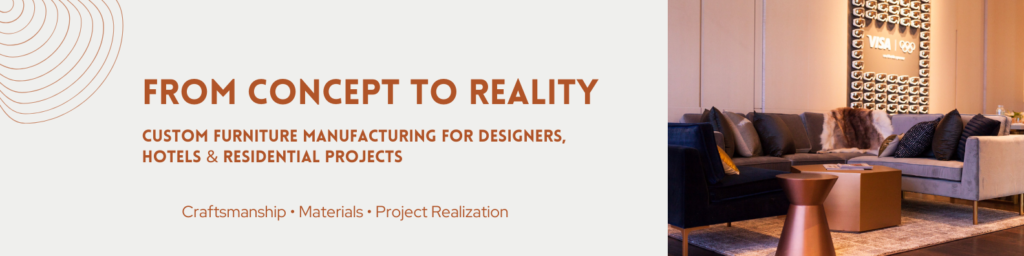
Interi Furniture specializes in custom furniture manufacturing for residential, hospitality, and commercial projects. Their experience in materials, craftsmanship, and project realization makes them a valuable resource for designers and buyers seeking tailored furniture solutions from China.