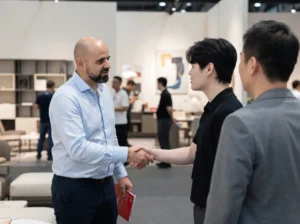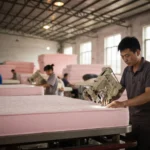


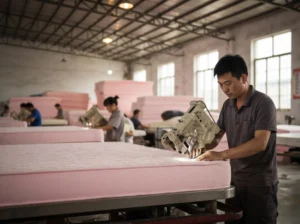

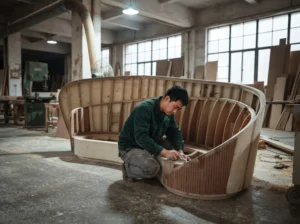
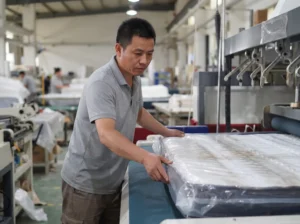





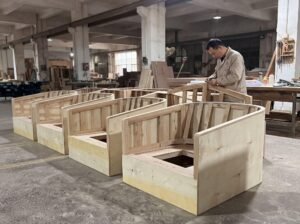

The ritual of collecting CIFF supplier catalogs feels safe. It gives first-time buyers something tangible to carry back to the hotel, a comfort object that promises orderly comparison. But here is the truth that eludes most visitors: the best suppliers at CIFF rarely lead with a product catalog. That reluctance is not a snub — it is one of the most reliable signals of factory-direct capability on the show floor. A glossy, thick brochure handed out indiscriminately often means you are talking to a trading company aggregating standardized SKUs from multiple anonymous factories. The real manufacturer shows up with physical samples, an iPad loaded with a dynamic database, and an engineer willing to sketch your custom idea on A4 paper right there in the booth. That said, catalog presence alone proves nothing. Some of the most capable OEM/ODM factories in Foshan and Dongguan still produce professional catalogs for their standard lines. The skill lies in reading what is inside the cover — not simply checking whether one exists. Learning to decode catalog content, thickness, and distribution behavior during furniture fair negotiation will save you days of wasted time and protect your margins from an unnecessary middleman markup. This nuanced reading of supplier collateral is one of the core China factory secrets that separates professional buyers from tourists.
The Catalog Anxiety: Why Buyers Feel Lost Without a Brochure
Most buyers walking into CIFF for the first time expect the ritual. You approach a booth, exchange WeChat or WhatsApp, and receive a heavy, glossy catalog you can flip through back at the hotel. When a supplier does not offer one, it feels like a cold shoulder. First-time visitors often interpret the lack of a takeaway brochure as disinterest or disorganization. That anxiety is understandable but misplaced. If this is your inaugural trip, our first time CIFF guide covers the 17 mistakes that separate tourists from professional buyers, and catalog dependency sits near the top.
The catalog culture at CIFF is shifting, yet buyer expectations have not caught up. For reference only, subject to official verification, our field observations across the Guangzhou and Shanghai editions suggest that the most sought-after OEM/ODM factories in the upholstery and solid-wood halls now treat printed catalogs as secondary tools. They reserve them for retail chain buyers purchasing standard SKUs, while leading custom buyers straight to samples and engineering dialogue. The discomfort runs deeper. Without a catalog, buyers lose their comparison crutch. They cannot photograph page 47 and email it to their team with a simple “Quote this SKU.” They are forced into real-time technical dialogue. That friction is intentional. It filters out tourists and forces serious buyers to engage on the factory’s terms — through samples, specs, and engineering conversation.

What a Catalog Actually Means in the CIFF Ecosystem
To dismantle the myth, we need to look at what a catalog actually does on the show floor. It is not a neutral information tool. It is a standardized customer-acquisition instrument designed for rapid, low-touch transactions. In the CIFF context, a thick catalog signals a specific business model — but not exclusively. The publisher is often a trading company or showroom firm that does not own production lines. They curate SKUs from five, ten, or twenty disparate factories, unify the photography, and present a seamless product matrix. The catalog’s thickness creates an illusion of scale and vertical integration. It is impressive until you ask about BOM adjustments, mold modifications, or factory audit reports.
However, the inverse is not automatically true. A factory with real R&D and production lines may still maintain a catalog for its standard collection. The difference lies in how the catalog is used. A real factory treats the catalog as a narrow window into one product stream, not the entire value proposition. When you ask about customization, they pivot immediately to samples, sketches, and engineering specs. A trading company has nowhere to pivot — the catalog IS the business.
There is also a defensive dimension for factories. Suppliers operating on the cutting edge of design — particularly in contemporary upholstery and designer-adjacent spaces — avoid printed catalogs because they become instant photocopy fodder for competitors walking the aisles. A static page is easy to photograph and reverse-engineer. A physical sample with proprietary foam layering or a custom joint detail is not.
For reference only, subject to official verification, our conversations with booth managers in Foshan’s Lecong and Dongguan’s Houjie clusters indicate that catalog printing costs for trading companies are often bundled into marketing budgets that eventually amortize into your unit price. When you accept that brochure, you are not just receiving product information. You may be holding a preview of the markup structure. By contrast, a factory that lives and dies by custom orders has limited use for a static SKU list. Their products change with each client’s spec sheet. Printing a catalog would lock them into obsolete configurations before the ink dries. Their reluctance to lead with a catalog is structural honesty — but it does not mean they cannot produce one when asked.
Catalog vs. No-Catalog: What Each Signals About Supplier Identity
This is where booth behavior becomes readable. The following breakdown comes from our combined decade of walking CIFF halls and visiting production zones in Guangdong and Zhejiang. For reference only, subject to official verification, the patterns hold across multiple furniture categories. In the spring 2026 Guangzhou edition, we watched a buyer from Florida spend forty minutes in a booth that had no printed materials whatsoever. He left with a fabric swatch, a WeChat contact for the factory owner, and a hand-drawn sketch of a modified sectional. That interaction would have been impossible in a catalog-centric booth. Yet two aisles over, a legitimate 200-employee OEM factory handed out a slim 24-page catalog covering only their standard dining chair line — while their engineer simultaneously discussed custom frame modifications on an iPad.
| Signal | Trading Company / Showroom Firm | Real Factory (OEM/ODM Core) | Hybrid Factory (Standard + Custom) |
|---|---|---|---|
| Primary handout | Thick printed catalog, 80–200+ pages, coated stock | None, or a single-page factory profile card | Slim catalog (20–40 pages) focused on one category; paired with samples |
| Digital alternative | QR code linking to a generic Alibaba or Shopify storefront | iPad with dynamic, password-protected SKU database or 3D configurator | iPad or laptop showing both standard line and custom project gallery |
| Sample strategy | Small swatches or miniatures; “we can source anything” | Full-scale prototypes; “touch this joint, feel this fill” | Full-scale prototypes of catalog items; separate area for custom samples |
| Technical depth | Recites catalog specs from memory; defers engineering questions | Discusses frame construction, foam density grades, wood moisture content on-site | Can discuss both catalog specs and custom engineering; knows workshop lead times |
| Customization posture | “Send us the catalog page number, we will check MOQ” | Sketches modifications live; discusses mold lead times and BOM elasticity | “This is our standard line, but we can modify anything. Here is what we did for a German client last quarter.” |
| Pricing transparency | Lump-sum unit pricing with vague FOB terms | Open discussion of material tiers, labor costs, and volume breaks | Transparent on standard line pricing; custom quotes require spec sheet |
| Factory access | Hesitant; offers third-party audit reports from unknown agencies | Direct invitation; shares location pins; welcomes unannounced visits | Direct invitation; may offer both showroom visit and factory tour |
The table tells the real story. The catalog is the trading company’s primary weapon. For a real factory, it is at most a sidearm. The hybrid factory — increasingly common in Foshan’s mid-to-large manufacturers — uses the catalog to qualify retail buyers quickly, then shifts serious OEM prospects to the sample table. Your job is to notice which desk they guide you toward.
What Top Suppliers Give You Instead of a Catalog
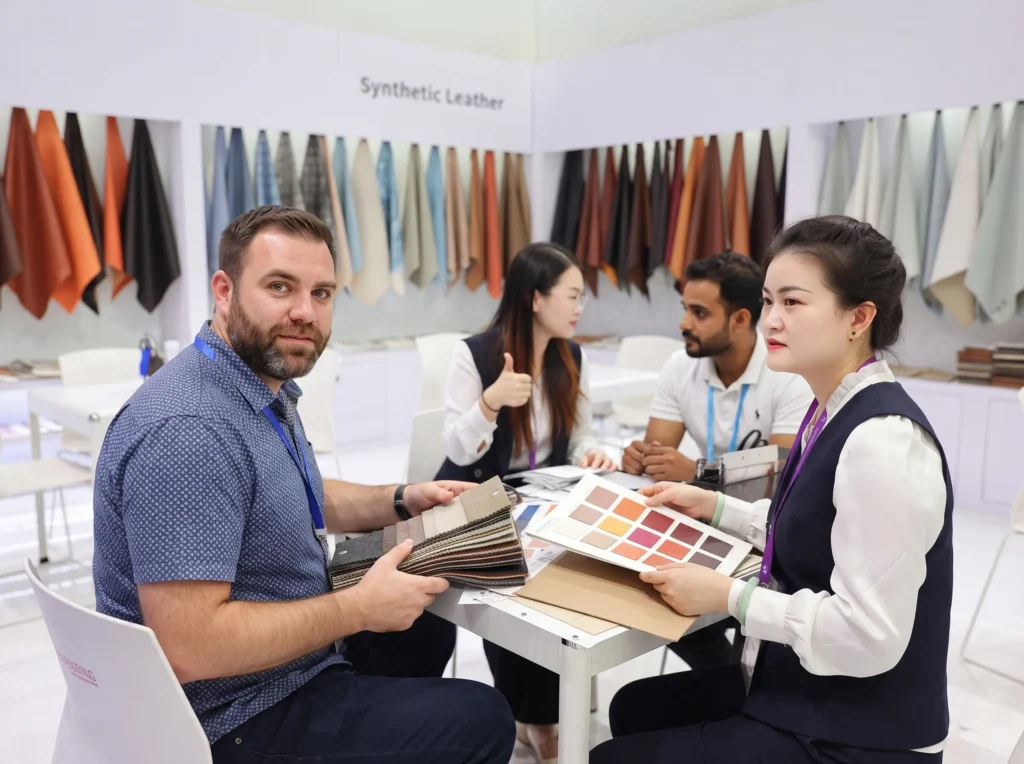
So what replaces the brochure when you are standing in front of a real manufacturer? The substitutes are richer, but they demand more from you as a buyer. The hand-drawn sketch deserves special mention. It is usually executed on plain A4 paper with a mechanical pencil. You will see dimensional annotations in millimeters, material codes like “ASH-NT” (ash, natural tone), and scribbled notes about hardware specs. A trading company sales rep cannot produce this document. It requires direct line communication with the workshop floor.
| Alternative Tool | What It Looks Like on the Floor | What It Reveals About the Supplier |
|---|---|---|
| Physical sample set | Full-size chair, sofa section, or table leg; material boards with fabric, leather, veneer, and hardware samples | Confidence in production consistency; willingness to let the product speak |
| iPad dynamic database | Live inventory, 3D renders, real-time MOQ and lead-time calculators | Investment in digital infrastructure; ability to iterate without reprinting |
| Hand-drawn sketch | A4 paper, pencil, dimensional annotations, material codes scribbled in the margins | In-house engineering or R&D capacity; OEM/ODM fluency |
| Factory-direct QR code | Links to password-protected video tours, CNC footage, upholstery lines | Nothing to hide; production transparency as a sales tool |
| Live modification demo | Adjusting seat depth, arm height, or leg profile during the conversation | Agile production setup; low mold-change cost; genuine customization capability |
These tools do not travel well. You cannot stuff a sofa sample into your carry-on as easily as a brochure. That is precisely why serious buyers book follow-up factory visits before they leave Guangzhou. The real due diligence happens after the fair, not in the hotel lobby flipping pages.
Trading Company Catalog Tactics: How Brochures Hide the Middleman
Not all catalogs are innocent. Some are deliberately engineered to obscure the trading layer. Knowing the tells protects you from margin erosion. Before you book flights, consult our guide to the 7 red flags at CIFF to pre-screen booth types from your hotel room.
| Catalog Tactic | The Red Flag | What It Conceals |
|---|---|---|
| Cross-category breadth | One brochure spans upholstery, case goods, lighting, and rugs with identical photography style | Aggregation from multiple unrelated factories; no single production competency |
| Absence of factory address | Only a Hong Kong or Shenzhen office address listed; no mention of production city | The actual manufacturing happens in a facility you will never visit or audit |
| SKU density over substance | Hundreds of items with identical spec templates (e.g., “solid wood” with no species named) | Sourcing from low-bid workshops; no material traceability |
| “One-stop solution” language | Repeated emphasis on convenience, consolidation, and single-point contact | The markup is embedded in the “convenience”; you are paying for coordination, not craftsmanship |
| Stock photography uniformity | All products shot in the same studio with the same styling | The supplier does not own the products; they are drop-shipping or white-labeling |
When we see these patterns in the upholstery halls of Area B or the dining sets in Area D, we know we are looking at a showroom operator, not a floor manager. For reference only, subject to official verification, our estimates suggest that booths distributing heavy catalogs with three or more of the above traits are trading entities in roughly seven out of ten cases. The ratio varies by hall and season, but the correlation is strong enough to act on. Crucially, a factory catalog will rarely trigger more than one of these red flags — and will usually be accompanied by immediate sample access and technical depth.
Reading the Booth: Behavioral Clues Beyond the Catalog
Catalog analysis is only half the game. The other half is watching how the booth staff behaves when you ask for one. Understanding the difference between OEM vs ODM capability changes how you read every booth interaction.
| Behavioral Clue | Likely Interpretation |
|---|---|
| Staff immediately reaches under the counter for a shrink-wrapped catalog | Scripted, low-touch sales process; likely trading company |
| Staff asks about your market, volume, and customization needs before offering any materials | Qualification mindset; likely factory seeking OEM fit |
| Staff pulls out a slim catalog but immediately turns to a sample and says “this is the real product” | Hybrid factory using catalog as qualifier, not crutch |
| Staff invites you to sit on the sample while explaining frame construction | Product-proud manufacturer comfortable with tactile scrutiny |
| Staff pulls out an iPad and navigates a password-protected database in front of you | Digital-native factory with live ERP integration |
| Staff sketches your requested modification on paper and discusses mold cost | Real engineering capacity; this person has spoken to the workshop foreman |
| Staff deflects all technical questions with “our engineer will email you” | Information firewall; you are not talking to the source |
These micro-interactions matter more than any printed collateral. We have watched buyers spend twenty minutes in a “no-catalog” booth and leave with a clearer sourcing roadmap than peers who collected thirty brochures. The brochure collectors look busy. The sample sitters get deals.

Risk Warnings: The Four Mistakes That Cost You Money
Judging professionalism by catalog weight is the first and most common error. A 200-page brochure proves nothing except a printing budget. Do not let glossy paper substitute for factory verification. Veteran buyers typically run every new contact through a factory audit checklist before issuing purchase orders.
Ignoring the silent booths is equally expensive. Some of the most capable factories at CIFF bring only three or four hero samples. They look empty compared to the SKU-packed trading booths across the aisle. Walk in anyway. Ask about their OEM history. The quiet booths often house the deepest capabilities.
Trusting cross-category breadth is another trap. A supplier offering sofas, beds, dining tables, and outdoor sets from one “factory” is almost certainly a curator, not a maker. Real vertical integration in furniture is rare and category-specific.
Failing to audit the no-catalog supplier is the final pitfall. Just because a factory skips the brochure does not mean they are automatically legitimate. Always request a factory video, a location pin, and — ideally — an unannounced visit. The absence of a catalog is a positive signal, not a guarantee. And conversely, the presence of a catalog is not a negative signal unless it displays the red flags above.
Audience-Specific Playbooks
For Bulk B2B Importers and Wholesalers
Your negotiation leverage lives in customization. At CIFF, lead with your spec sheet, not a catalog request. The opening line that works: “We are looking for OEM development in [category] with estimated annual volume of [X] containers. Do you have in-house R&D, or do you outsource mold making?” This immediately signals that you are not a brochure shopper. The factory’s response — whether they sketch on paper, pull up a CAD file, or flip to page three of a slim catalog before pivoting to samples — tells you everything. Mastering furniture sourcing from China requires moving beyond catalog-based procurement into spec-driven partnerships.
Follow-up protocol: Request the factory WeChat of the engineer or owner, not just the sales rep. Schedule the factory visit within 48 hours while you are still in China. The best slots disappear fast.
For Mid-Size Retailers and E-Commerce Sellers
You need flexibility more than scale. Your sweet spot is the factory that offers ODM with low mold-change fees. At the booth, test their agility. Point to a sample and ask: “If we change the leg profile and switch the fabric to a Belgian linen at 320gsm, what is the sample lead time and the MOQ break?” A trading company will stall. A real factory will calculate out loud — catalog or no catalog.
Your post-show workflow: Build a digital dossier. Photograph the sample, the business card, and the booth number. Record a voice memo of the technical conversation immediately after leaving. Brochure-dependent buyers lose context. You will not.
For First-Time Buyers and Small-Volume Entrepreneurs
You are the most vulnerable to catalog traps because you crave the security of a tangible takeaway. Resist the urge. Instead, use the “sample plus photo” method. Ask permission to photograph the specific sample you like, alongside the supplier’s business card held in the frame. Ask for a fabric swatch or wood chip you can carry. These physical fragments are more useful than a generic catalog page because they tie directly to a conversation and a face.
If a supplier refuses even basic photography of the sample, treat that as a reverse signal. For reference only, subject to official verification, our experience suggests that excessive photo paranoia at CIFF often correlates with either trading companies protecting their anonymous sources, or factories displaying knockoff designs they do not want documented.

Frequently Asked Questions
Is it rude to ask for a catalog if the supplier does not offer one?
Not rude, but revealing. When you ask, watch the reaction. A factory with real OEM capacity will usually explain why they do not lead with static catalogs and will pivot immediately to samples or digital files. A defensive or confused response suggests they are accustomed to buyers who need hand-holding through a SKU list. Frame your request as: “Do you have a product overview, or do you work primarily from samples and custom specs?” This gives them room to show their true workflow.
Can a factory have both a catalog and real manufacturing capability?
Absolutely — and many do. Some large factories maintain a small “standard line” catalog for retail chain buyers while running a separate OEM division. At CIFF, you can usually tell the difference by which desk the staff directs you to. The OEM side will have samples, sketches, and engineers. The catalog side will have order forms. Ask explicitly: “Is this item from your standard catalog, or can you modify the spec?” Their answer will clarify which division you are talking to. A slim, category-specific catalog paired with live technical dialogue is a strong factory signal. A thick, cross-category catalog with no sample access is the opposite.
How do I compare suppliers if I do not have catalogs to review back at the hotel?
You compare on capability, not on pages. Build a scoring matrix based on customization responsiveness, sample quality, technical communication clarity, and factory transparency. Photograph the samples and label them by booth number. Within three days of CIFF, your memory of the conversation will be more valuable than any brochure. The buyers who make the best decisions are the ones who took notes on behavior, not the ones who collected the most paper.
Why do some trading companies have such beautiful, professional catalogs?
Because the catalog IS their product. Trading companies invest heavily in design and photography because they are selling an illusion of integration. The factory, by contrast, is selling joinery, foam density, and finishing chemistry. Their marketing budget goes into the sample, not the brochure. When you see a catalog that looks like it belongs in a West Elm store, admire the graphic design — then ask to see the factory.
Should I avoid suppliers who give me a catalog?
No. Some legitimate factories still use catalogs for specific market segments. The key is not to treat the catalog as a positive signal in itself. Treat it as one data point among many. Cross-check it against samples, technical depth, and factory access. If a supplier hands you a catalog but also invites you to the workshop, discusses mold costs openly, and modifies specs on the spot, the catalog is just a convenience, not a disguise. If the catalog is their only offering, that is the problem.

Your Turn
We have shared what we see on the CIFF floor. Now we want to hear from you. Have you ever walked away from a booth feeling slighted because there was no catalog, only to realize later that you had missed a top-tier factory? Or did a beautiful catalog ever lead you to a supplier that turned out to be a trading company with hidden markups? Drop your story or your specific supplier-identification question in the comments. We read every one.
Recommended Resource
Interi Furniture specializes in custom furniture manufacturing for residential, hospitality, and commercial projects. Their experience in materials, craftsmanship, and project realization makes them a valuable resource for designers and buyers seeking tailored furniture solutions from China.