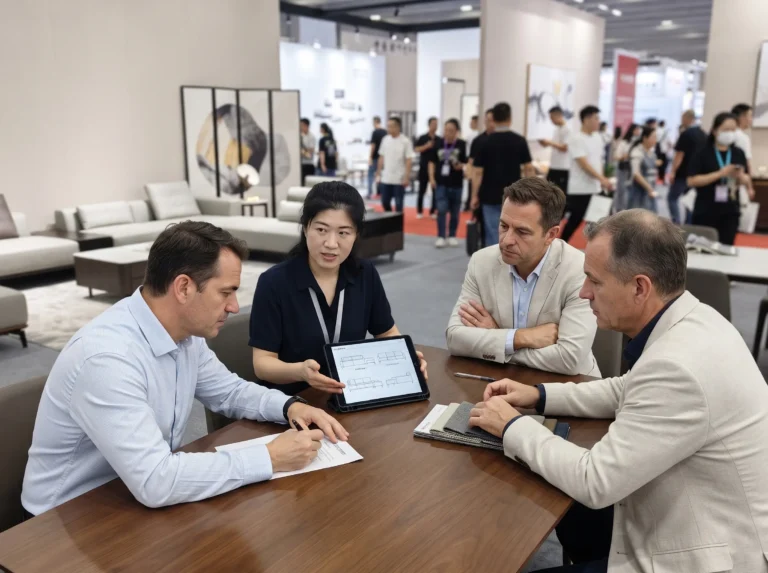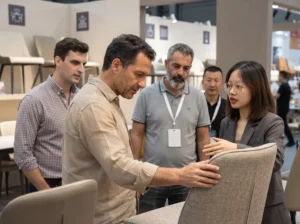





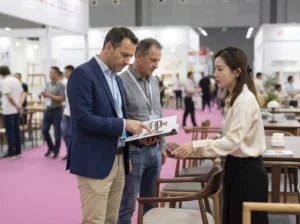


The price tag hanging on a CIFF booth sample is almost never the real factory price. In our decade of walking factory floors across Foshan, Dongguan, and Longjiang, we have consistently seen exhibition quotes sit 15% to 40% above true ex-factory cost. That gap is not accidental. It is a structural feature of how Chinese furniture manufacturers use the trade show floor to recover sunk costs, test price ceilings, and segment buyers by perceived sophistication. CIFF price negotiation is not about haggling over a few percentage points. It is about dismantling a deliberately layered pricing architecture designed to make the booth quote feel like a deal while keeping it well above the floor.
The Anxiety Behind the Booth Tag
Walk into any CIFF hall during the first two days and you will feel it immediately. The lighting is aggressive, the music is loud, and the sales rep is already sliding a calculator across the table with a number that makes your stomach drop. For first-time buyers, that moment triggers a specific kind of panic. You flew sixteen hours, paid for a hotel in Pazhou, and told your business partner back home that you were about to lock in “direct from factory” pricing. Now the quote in front of you looks suspiciously close to what your domestic distributor charges.
The pressure compounds fast. The rep leans in and whispers that this is a “fair special” available only until the hall closes. Another buyer is allegedly circling the same container load. If you do not put down a deposit today, the price “returns to normal.” Many buyers fold here. They wire a 30% deposit on the spot, only to discover three weeks later that the same factory quoted a contact on Alibaba International 22% lower for an identical SKU. The betrayal is real, and it is completely avoidable.

Dismantling the “Best Price at the Show” Myth
Let us kill a pervasive fiction first. CIFF is not the annual window for the lowest prices in the Chinese furniture calendar. That idea survives because it feels true. You are physically inside the manufacturing epicenter, surrounded by thousands of suppliers, breathing the same air as the people who actually cut the wood. Surely this proximity translates to pricing power. It does not.
The reality is that CIFF pricing is the most complex quote you will encounter all year. A single booth is simultaneously serving four incompatible objectives: brand positioning for upscale European distributors, channel recruitment for new domestic dealers, clearance of last season’s slow movers, and relationship maintenance for existing volume clients who expect face-time and favors. Each objective carries its own price band. The sales team does not disclose which band you are in. Their job is to figure you out faster than you figure them out.
Here is the counterintuitive part that most procurement blogs miss. Some factories deliberately quote high during the show. They are not trying to close on the floor. They are building a “high-low” negotiation runway. The inflated booth quote becomes the anchor. When you follow up two weeks later via WeChat or a factory visit in Shunde, they “generously” drop the price by 18%. You feel like a negotiation genius. The factory simply lands at the price they wanted all along. This strategy is especially effective on first-time attendees who lack independent market benchmarks.
Exhibition Price vs. Real Factory Price: Cost Component Breakdown
The 15%-40% premium is not margin fiction. It is cost arithmetic. Every booth at CIFF Guangzhou or Shanghai represents a six-figure RMB investment that has to be amortized across a finite number of orders. The factory does not eat that cost. You do.
| Cost Component | Typical Range (RMB) | How It Hits Your Quote |
|---|---|---|
| Booth rental and construction | 80,000 – 350,000 per show | Amortized across projected order volume; adds 3-8% per unit for mid-size exhibitors |
| Sample round-trip logistics and damage | 5,000 – 20,000 per SKU set | Factored into first-order pricing or MOQ calculations |
| Sales team lodging, meals, and transport | 15,000 – 40,000 per rep | Spread across all booth orders; more punishing for small-batch buyers |
| Production line suspension | Opportunity cost of 3-7 days idle capacity | Recovered through higher per-unit quotes on post-show orders |
| Design and prototype prep | 10,000 – 50,000 per new collection | Front-loaded into launch pricing for trend-driven categories |
For reference only, subject to official verification: In our conversations with Foshan upholstery manufacturers during the March 2026 CIFF cycle, booth construction and rental alone translated to an effective 6-12% markup on first-time buyer quotes for container-mixed orders below fifty units. Factories with premium hall positioning in Areas 9.3 to 11.3 of the Pazhou Complex pushed that figure toward the upper bound.

Buyer Type and Quote Level: How CIFF Sales Discriminate
CIFF sales reps are trained to classify you within the first ninety seconds. Your business card, the language you lead with, the questions you ask about foam density or veneer grading, and whether you mention your Amazon store or your Milan showroom — all of it feeds into a mental algorithm that spits out a quote tier.
| Buyer Profile | Typical Quote Level vs. Real Factory Price | What Signals You Send |
|---|---|---|
| First-time individual buyer / small e-commerce seller | Retail or near-retail (30-50% above factory) | Asking “do you ship to my house,” no MOQ discussion, photographing everything |
| Experienced SME retailer with mixed container experience | Distributor pricing (15-25% above factory) | Mentioning specific HS codes, asking about carton dimensions, requesting FOB terms |
| Professional B2B importer with annual volume commitments | Negotiated factory gate (5-12% above factory) | Dropping competitor names, discussing annual rebate structures, requesting factory audit |
| Existing strategic partner | True ex-factory or below (0-5% above direct cost) | Arriving with the owner’s WeChat already saved, referencing last year’s container numbers |
The discrimination is not personal. It is rational. A factory that quotes true ex-factory to every walk-in would hemorrhage margin on the tourists while gaining nothing from the whales. The trick is understanding that the first number you see is a probe, not an offer.
The “Fair Special” Psychology: Anchoring Tactics Sales Teams Use
The “fair special” is one of the most reliable scripts on the CIFF floor. It works because it exploits two cognitive biases simultaneously: anchoring and loss aversion. The rep writes down a high number, crosses it out theatrically, and presents a “today only” figure that still sits comfortably above the factory’s break-even. Your brain registers the discount, not the absolute price.
| Tactic Name | The Script | What Is Actually Happening |
|---|---|---|
| Phantom original price | “This sofa is normally $480, but for CIFF we do $390” | The $480 was never a real transaction price; it exists only to make $390 feel like a win |
| Scarcity countdown | “If you don’t lock it today, price goes back Monday” | Monday pricing is irrelevant; the factory needs your order to cover show costs |
| Deposit anchoring | “Just 30% now secures the fair rate” | You are not locking a low price; you are locking a high price with a non-refundable commitment |
| Competitive phantom | “Another buyer from Germany looked at this thirty minutes ago” | Unverifiable social pressure designed to bypass your due diligence |
| Bundle obscurity | “I give you whole-container price, very special” | Individual SKU pricing is hidden; impossible to benchmark against market rates |
Experienced buyers do not argue with these scripts. They ignore them. The only number that matters is the ex-factory price for the SKU at the MOQ you actually intend to order, delivered under the Incoterm you prefer, with payment terms that do not strain your cash flow.
Negotiation Tactics: How to Move from Exhibition Price to Factory Price
You cannot negotiate effectively without a market benchmark. That is the non-negotiable prerequisite. Before you land in Guangzhou, you should have Alibaba RFQ responses, 1688 cross-references (if you have Mandarin support), or quotes from a trusted sourcing agent for comparable specs. Walking into CIFF cold is like walking into a casino with your salary in your pocket. The house wins.
| Tactic | When to Deploy | Expected Impact |
|---|---|---|
| Silent pause after first quote | Immediately upon receiving the initial number | Forces the rep to fill silence; often triggers an unbidden 5-10% voluntary reduction |
| MOQ escalation | After the second round | Doubling your stated volume in exchange for a tiered price break; works even if you later split the order |
| Post-show factory visit threat | Day three or four | Signals you are not a booth tourist; factories with excess capacity will sharpen pencils to avoid losing a visit |
| Component-level negotiation | On upholstered or modular items | Negotiating foam density, fabric grade, or hardware separately from frame price exposes hidden padding |
| Payment term leverage | Final round | Offering faster payment (e.g., 100% TT upfront vs. 30/70) in exchange for factory-gate pricing |
For reference only, subject to official verification: Buyers who combined the post-show factory visit threat with component-level negotiation during the September 2025 Shanghai CIFF reported average reductions of 18-28% from initial booth quotes across mid-tier upholstery and case goods categories. Your mileage will vary by factory size and current order book saturation.
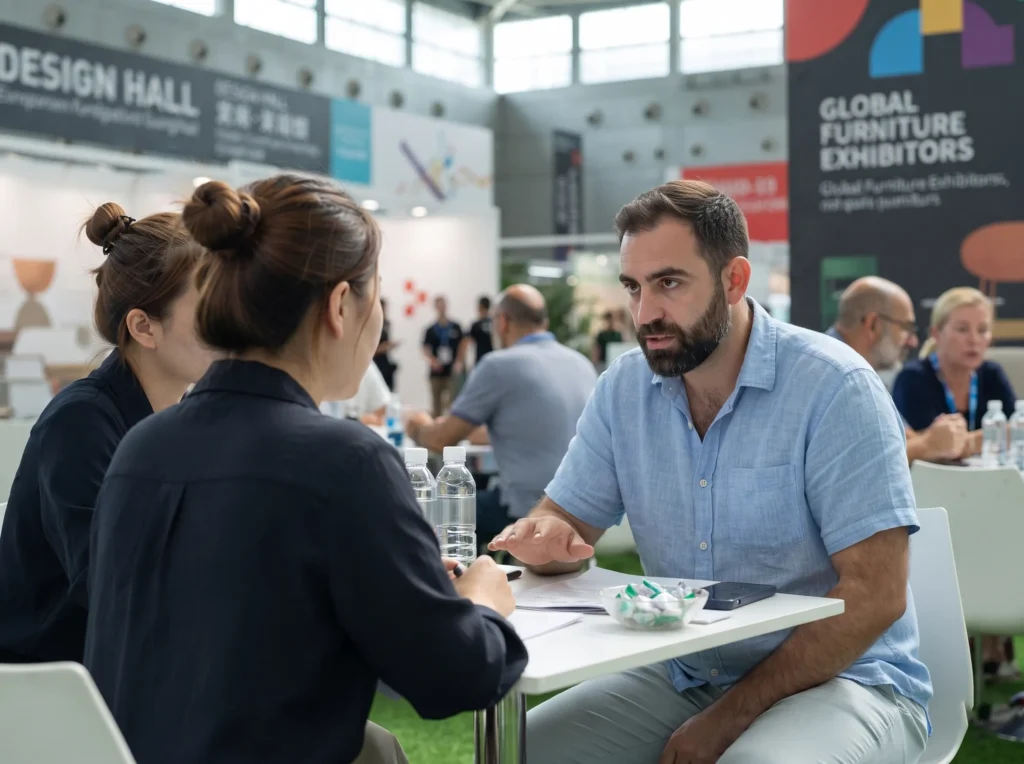
High-Risk Behaviors to Avoid on the Floor
There are specific mistakes that separate seasoned importers from the buyers who go home with a lighter wallet and a container of resentment.
Never accept a quote that expires when the hall lights go down. Real factory pricing does not evaporate at 6 PM. The “today only” constraint is a pressure tactic, not a commercial reality. If a factory genuinely wants your business, they will honor a sharpened quote for the reasonable duration it takes you to compare and decide.
Never agree to a bundled “whole container” price without line-item breakdowns. Obscure bundling is the oldest trick in the book. It hides overpriced SKUs behind underpriced ones and makes post-shipment quality disputes nearly impossible to arbitrate. Insist on per-SKU, per-unit, per-specification pricing in writing.
Never wire a deposit from the booth without verifying the receiving account against the factory’s business registration. CIFF floors have seen their share of rogue sales reps collecting deposits into personal accounts. The factory disclaims knowledge. Your money is gone.
Never skip the post-show follow-up. The booth quote is merely the opening salvo. The real negotiation happens in the two weeks after the fair, when the factory has packed up, counted its leads, and knows exactly how many deposits it actually landed. A factory that felt confident on day one may be surprisingly flexible by day ten post-show.
Audience-Specific Playbooks
For Large-Scale B2B Importers and Distributors
You hold the leverage, but only if you signal it correctly. Lead with annual volume, not with your first container. Ask about rebate structures, co-op marketing funds, and exclusive territory arrangements before you discuss unit pricing. The factory owner cares more about a guaranteed twelve-month pipeline than a one-off order. Use that. Request a factory audit within thirty days of the show. The audit is both a quality assurance tool and a powerful price negotiation mechanism. Factories know that auditors see the real production floor, the real material inventory, and the real labor cost structure. They price more honestly when they know you are watching.
For SME Retailers and E-Commerce Operators
Your challenge is MOQ. You do not need a full container, but you are being quoted as if you do. Solve this by forming buying groups before the show. Three independent Amazon sellers can present as a single volume buyer if they coordinate SKUs and shipping. Alternatively, target factories that already export to your domestic market via a shared importer. They understand your order size and are less likely to apply the full “first-time buyer tax.” Focus on stock programs and quick-ship items rather than full custom. Custom work at low volume is where booth premiums metastasize.
For First-Time Individual Buyers and Small Project Contractors
You are the most vulnerable segment on the floor. The sales rep knows it. Your job is to gather intelligence, not to close. Treat CIFF as a three-day market research exercise. Collect cards, photograph price tags with the booth number visible, and record spec sheets. Do not deposit anything. After the show, cross-reference every SKU against Alibaba, Made-in-China, and direct factory inquiries. The price differential you discover will often justify the cost of your flight. If you must buy at the show, limit yourself to cash-and-carry sample stock that you can physically wheel out of the hall.

Frequently Asked Questions
Is the CIFF booth price ever actually the lowest price available?
Rarely. The booth price is optimized for show-cost recovery and buyer segmentation, not for volume efficiency. True factory pricing typically emerges only after the show, during direct factory negotiations, and for buyers who demonstrate repeat order potential. The booth quote serves as the ceiling, not the floor.
How much can I realistically negotiate off a first CIFF quote?
For reference only, subject to official verification: Buyers who enter with market benchmarks and negotiate calmly without time pressure typically achieve reductions of 15-30% from initial booth quotes. First-time buyers who accept the first number or fold under “today only” pressure often pay the full premium. The variance depends heavily on your preparation, your perceived volume, and the factory’s current capacity utilization.
Should I pay a deposit at the show to “lock the price”?
Only if you have independently verified that the locked price is genuinely competitive. Locking a high price is not a win. It is a trap. If the factory insists on a same-day deposit, treat it as a red flag. Professional manufacturers with healthy order books do not need to strong-arm deposits from uncertain buyers.
Why do identical products have wildly different prices at adjacent booths?
Because “identical” is rarely identical. Differences in foam density, wood grade, hardware origin, and finishing process are invisible to the untrained eye but significant to the landed cost. Additionally, some booths are factory-direct while others are trading companies with additional margin layers. Always ask to see the business license or factory audit report.
Can I get true factory pricing without visiting the factory after the show?
Sometimes, but not reliably. Post-show direct communication via WeChat or email can yield substantial improvements over the booth quote, especially if you reference specific competitor quotes. However, the deepest discounts usually require a factory visit that signals serious intent and exposes you to the owner’s direct cost structure.
What is the best day to negotiate at CIFF?
Days three and four of a five-day show tend to be more flexible than days one and two. By mid-show, the factory has a realistic sense of how many leads converted and how many competitors are undercutting them. The urgency shifts from premium positioning to lead recovery. The final afternoon can be opportunistic for sample clearance, but core SKU pricing does not typically drop further on day five.
What Is Your CIFF Price Story?
We have laid out the architecture. Now we want to hear about the reality on the ground. Did you manage to cut a booth quote down to true factory cost? Did you fall for the “fair special” trap and only discover the damage later? Drop your experience in the comments, or tell us about a specific product category where the pricing gap shocked you. If you are heading to the next CIFF and want us to look at a quote before you wire a deposit, send it over. We will give you the honest, sharp, actually useful read.
Recommended Resource
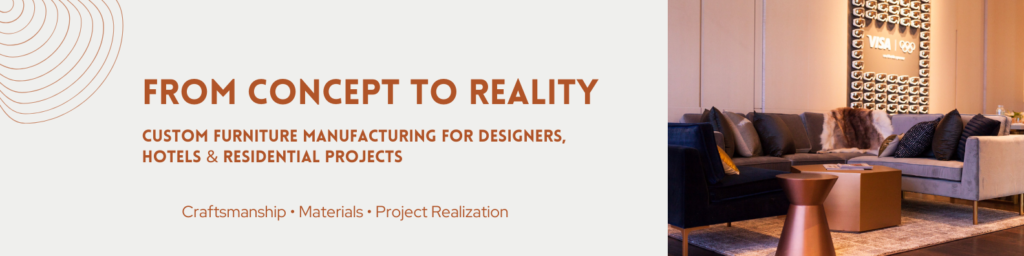
Interi Furniture specializes in custom furniture manufacturing for residential, hospitality, and commercial projects. Their experience in materials, craftsmanship, and project realization makes them a valuable resource for designers and buyers seeking tailored furniture solutions from China.