







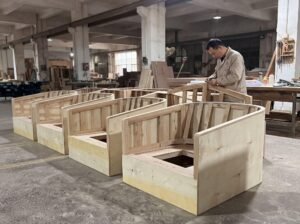
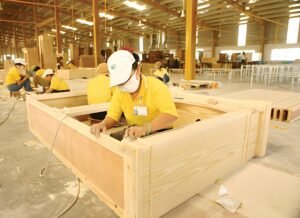

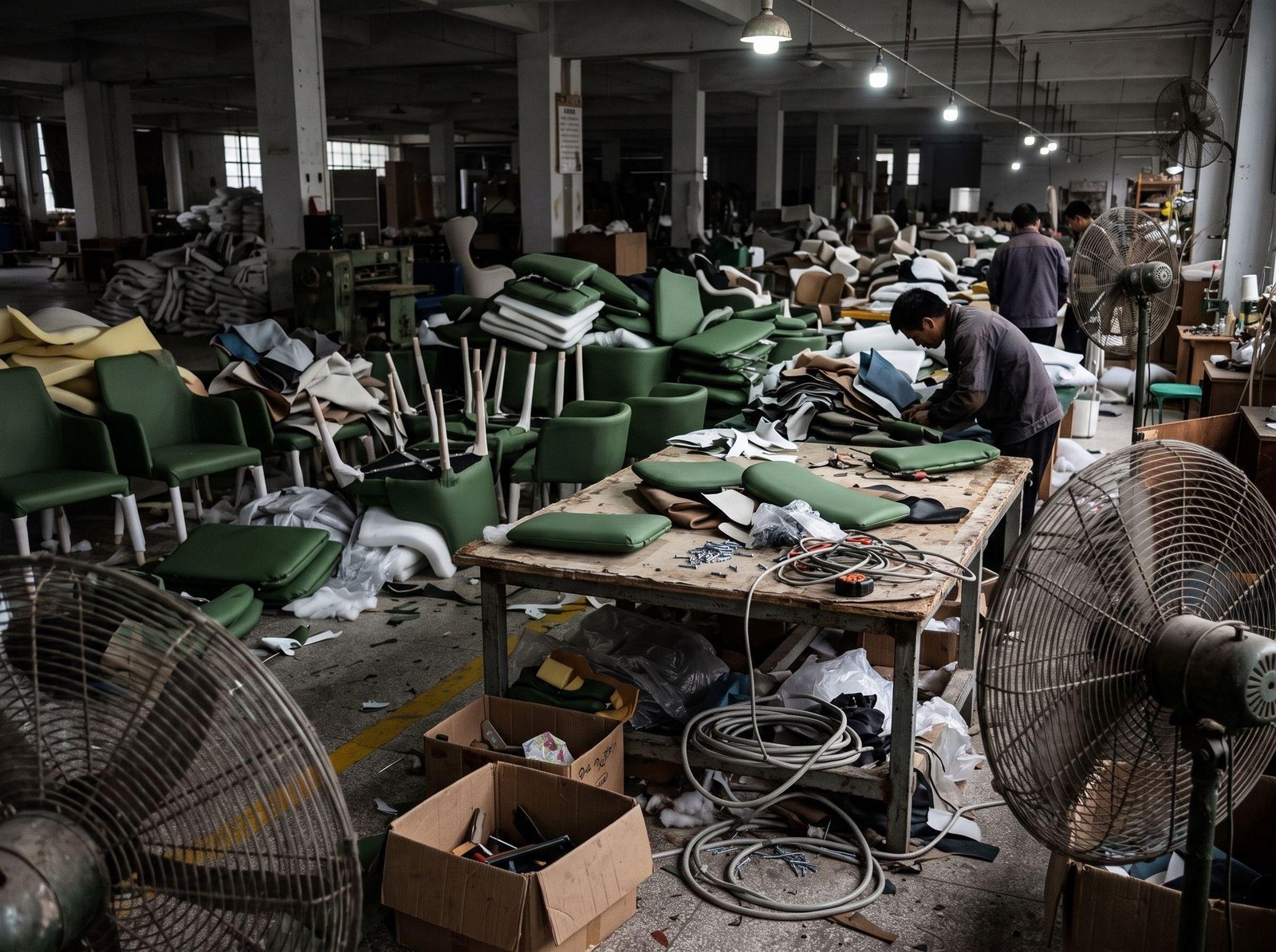
ast March. Longjiang. I’m walking past a row of workshops that look like they were built in the nineties and then… just left there. One place has its spray booth door propped open with a brick. Inside, a guy in a stained T-shirt is spraying lacquer on a cabinet. Handheld gun. No mask. No exhaust stack. Just a fan in the window, blowing fumes into the alley. I smell it from twenty feet away. Sharp. Chemical. That smell? That’s what forty percent off smells like.
I know a buyer. Boutique hotel chain, Florida. Two years ago he got burned by exactly this setup. Factory sent samples. Looked fine. Price was 40% under the next bid. He wired the deposit. Six months later, workshop shows up on a government shutdown list. Illegal VOC discharge. Deposit gone. Opening pushed back three months. “I walked the floor,” he told me over coffee in Guangzhou. “Saw the open doors. Paint cans in the corner, no labels. I just didn’t know what I was looking at.”
That’s the thing about Foshan furniture environmental impact. Nobody puts it on the invoice. The cost gets buried so deep most buyers never see it until it explodes.
What Cheap Actually Buys You
For years, the Foshan model was simple. Cut every corner that doesn’t show. Price thirty percent below everyone else. Make up the margin on volume. Environmental compliance? Just another corner to cut. Skip the activated-carbon exhaust. Buy MDF from a mill that doesn’t test for formaldehyde. Dump the spray-booth sludge down the drain when nobody’s looking.
The savings don’t show up as a line item. They show up as a number that makes you think you’ve found a genius.
The 2017 survey by the Foshan Environmental Protection Bureau looked at 70 major furniture plants. Average VOC output? 36 tonnes per plant per year. Thirty-six tonnes of benzene, toluene, xylene, and other hydrocarbons going straight into the air. Same review found exhaust equipment sitting idle. Spray wastewater dumped illegally. Hazardous waste handled with zero paperwork.
Why run the gear when it costs money? Why pay for certified boards when the cheap ones look the same? Buyer gets a great price. Environment pays. Eventually, buyer pays too.
Where the Damage Actually Lives
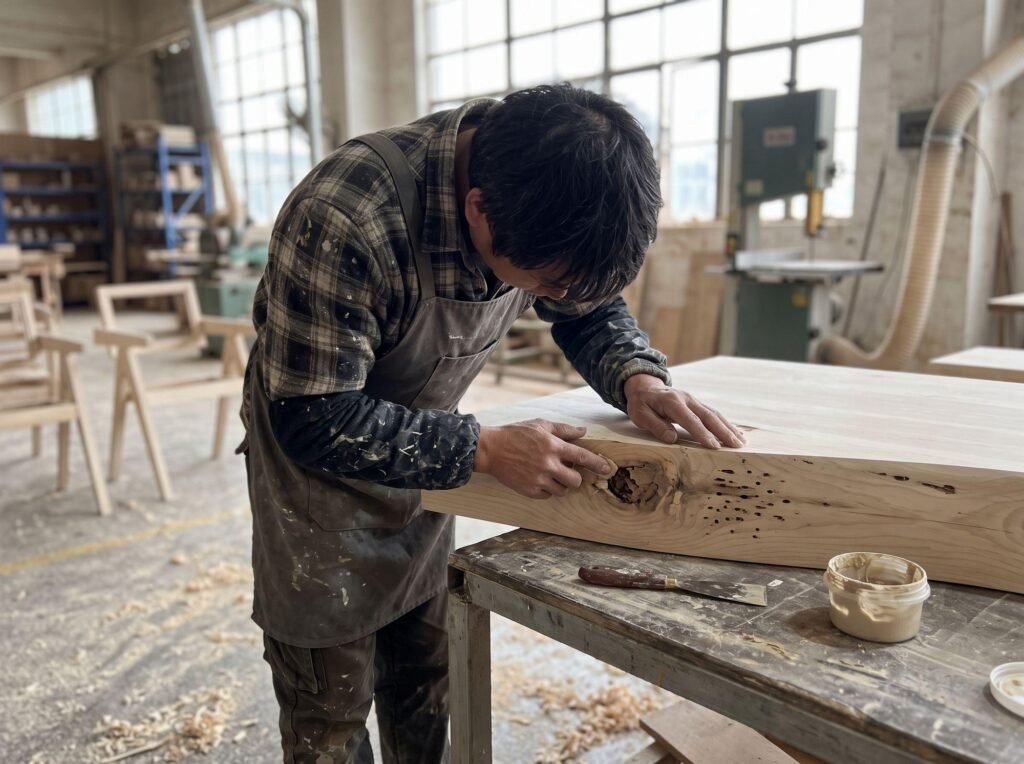
You won’t see this stuff on a polished factory tour. Three process stages carry almost all the environmental load.
Spray Finishing: The Big One
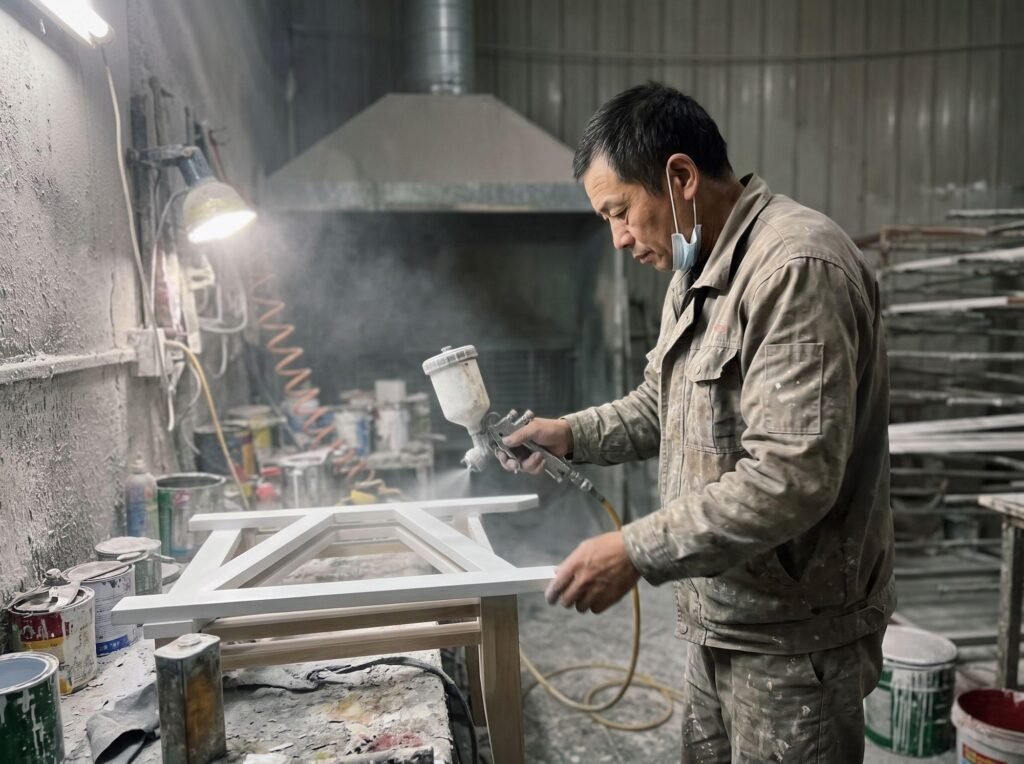
Solvent-based lacquers release VOCs that form ground-level ozone and fine particulate matter. A proper setup is enclosed. Water-curtain capture for overspray. Then exhaust treatment through spray towers and activated-carbon beds.
What I saw in that Longjiang alley? Workshop corner with a fan pointed at a window. The fan doesn’t treat anything. It just moves the problem outside.
Composite Boards and Formaldehyde
Most Foshan furniture runs on particleboard, MDF, or plywood cores bonded with urea-formaldehyde resin. Left unchecked, these panels keep off-gassing formaldehyde for years. CARB Phase 2—the California standard—caps it at 0.09 ppm for particleboard, 0.11 ppm for MDF, 0.05 ppm for hardwood plywood.
Factories that skip compliance testing save a few bucks per unit. Your hotel guest breathes the difference.
Wastewater and Hazardous Waste
Spray booths churn out sludge-laden wastewater and spent solvents. Chinese law classifies this as hazardous. Legal disposal means a licensed third-party handler, signed transfer manifests, real money. Some workshops just don’t bother.
The gap between doing it right and doing it cheap? That’s exactly where that too-low quote comes from.
The Cleanup Is Real, And It’s Not Gentle
If you think Foshan is still the Wild West of pollution, you haven’t been there lately. Since 2018—and accelerating hard through 2021 to 2024—enforcement has shifted from occasional raids to something systematic.
Longjiang’s Wrecking Ball
Longjiang Town is the clearest example. In 2021 alone, local authorities inspected 946 air-pollution-related enterprises. Ran 57 enforcement monitoring visits. Filed 43 cases. Handed out fines totaling RMB 5.706 million. That’s not a warning. That’s a wrecking ball.
And they made them rebuild. Workshops got ordered to install high-efficiency water-curtain paint-sludge removal cabinets. Then add rooftop treatment trains—spray towers, mist separators, multi-layer activated-carbon adsorption. After the retrofits, paint sludge in exhaust ducts dropped over 95%. Carbon adsorption efficiency jumped more than 30%.
Longjiang also rolled out a “two quantities, three schedules” system. Fixed guidance volumes for hazardous waste and organic wastewater. Plus mandatory replacement schedules for water-curtain wastewater, activated carbon, and paint-sludge cleaning.
National-Level Pressure
At the national level, China’s Ministry of Industry and Information Technology runs the Green Factory program. Standard GB/T 36132-2018. As of September 2025, over 6,430 factories nationwide carry the certification. The 2025 draft revision is adding carbon-management capability, green supply-chain requirements, and public data disclosure.
Green manufacturing in China isn’t a slogan anymore. It’s becoming a license to keep the lights on.
On the ground, shared spray-coating centers are replacing individual booths in some zones. Small workshops send components to centralized facilities with professional exhaust management. Water-based paint lines—still not universal, but growing—are showing up in factories that used to swear by solvent-based products.
The smell in Longjiang is different now. Not clean. But different.
Why This Is Your Problem Too
“I’m just buying furniture. Why do I care about their exhaust stacks?” I’ve heard this a hundred times. Fair question.
Lead-Time Roulette
When enforcement ramps up—quarterly campaigns, pre-holiday inspections, political event periods—non-compliant factories get shut down temporarily. Your 45-day lead time becomes 70 days overnight. No insurance covers “my supplier got closed by the EPA.”
Market-Access Walls
The EU Deforestation Regulation (EUDR) is live in 2025–2026. Demands timber traceability. CARB Phase 2 and TSCA Title VI are already mandatory for composite wood in the US. LEED and BREEAM certifications require documented low-emission materials.
A factory that can’t produce a chain-of-custody certificate or a hazardous-waste manifest can’t serve these markets. No matter how low their price.
Reputation Risk
ESG reporting used to be for multinationals. Not anymore. Boutique hotel groups, design studios, mid-size importers—they’re all getting asked by their own clients where products come from and how they’re made. When a photo of your supplier’s open drain hits LinkedIn, “we didn’t know” doesn’t cut it.
How to Actually Check What You’re Buying
Paperwork is easy to fake. Here’s what actually works.
Certifications That Mean Something
FSC CoC—Forest Stewardship Council Chain of Custody. Traces wood from certified forest to finished product. Required for EUDR. Critical for LEED/BREEAM points. Only covers wood, though. Paint and glue are separate battles.
CARB Phase 2 and TSCA Title VI put hard caps on formaldehyde. 0.09 ppm for particleboard. 0.11 ppm for MDF. 0.05 ppm for hardwood plywood. Mandatory for the US market. Tests the panel, not the finished piece. Coatings added later can reintroduce VOCs.
REACH is the EU regulation restricting hazardous substances. Heavy metals, certain flame retardants. Complex, substance-by-substance. A factory needs a testing lab relationship, not just a certificate on the wall.
China Green Factory—MIIT, GB/T 36132. Audits energy use, pollution control, resource efficiency, and carbon management. Voluntary, but a certified factory has been through a real inspection. A non-certified one might still be clean. You just have to verify it yourself.
What to Look for On-Site
Enclosed spray booths with visible exhaust stacks. Not open doors. Not a fan in a window. Ask to see the hazardous-waste transfer manifest. Every legal disposal generates a signed receipt from a licensed handler. Check if composite-board pallets carry mill-certification stamps.
A factory running water-based paint lines will usually walk you straight to them. One that isn’t will find a reason to keep you in the showroom.
Contract Language That Actually Protects You
Make environmental compliance a warranty, not a preference. Specify CARB Phase 2 or TSCA Title VI for composite-wood components. Set VOC limits for finishes. Require lawful hazardous-waste disposal with documentation. Reserve the right to demand third-party testing at the supplier’s expense if anything looks off.
The Hard Truth
The cheap-furniture model in Foshan worked because environmental compliance was treated as optional. The savings showed up in quotes that undercut everyone else by margins that should have raised eyebrows. That model is dying. Not because foreign buyers complained. Because Chinese regulators decided the Pearl River Delta has absorbed enough.
China furniture sustainability is no longer a contradiction. It’s a transition with real investment, real enforcement, and real consequences for factories that don’t keep up. Shared coating centers, carbon retrofits, water-based paint pilots, Green Factory audits—these aren’t PR stunts. They’re structural changes that raise production costs, which raises floor prices.
The factory quoting 30% below market isn’t efficient. It’s a factory that hasn’t paid its environmental bill yet.
For buyers, this means a new filter. “Cheapest wins” now comes with hidden penalties. Shipment delays. Customs rejection. ESG liability. The better rule? If the price is too low to be clean, it’s too low to be reliable.
The cleanup in Foshan is uneven. Some factories have invested heavily and can show you every receipt. Others are one inspection away from a shutdown. Know which is which before you wire the deposit. Not when the container sits in port because the paperwork doesn’t check out.

FAQ
What’s the single biggest environmental risk in Foshan furniture?
VOCs from spray finishing and formaldehyde from non-certified composite boards. Both hit indoor air quality and can get your shipment rejected in markets with strict standards like California (CARB) or the EU (REACH).
Are all Foshan factories still polluting?
No. Major upgrades since 2018 have changed things. Leading factories run enclosed spray booths with exhaust treatment, use certified low-emission boards, and hold Green Factory or international certifications. The split is between compliant and non-compliant producers. Not Foshan versus everywhere else.
How do I verify environmental claims without getting fooled?
Ask for original test reports, not photocopies. FSC certificates should have license codes you can verify online. Demand hazardous-waste transfer manifests. If you can visit, check the spray booth enclosure, look for exhaust stacks, inspect the waste-storage area. A clean factory will show you everything. A dirty one will keep you in the showroom.
Will going green raise my prices?
Yes, some. Proper VOC treatment, certified boards, and legal waste disposal cost real money. But non-compliant sourcing risks shipment delays, customs holds, and liability that cost far more than the upfront premium. You’re not paying for virtue. You’re paying for supply-chain insurance.
What should my contract actually say?
Require CARB Phase 2 or TSCA Title VI for all composite-wood parts. Set VOC limits for finishes. Include a warranty of lawful hazardous-waste disposal with documentation. Reserve your right to audit and test at the supplier’s expense if their paperwork doesn’t add up.

Recommended Resource
Interi Furniture specializes in custom furniture manufacturing for residential, hospitality, and commercial projects. Their experience in materials, craftsmanship, and project realization makes them a valuable resource for designers and buyers seeking tailored furniture solutions from China.