





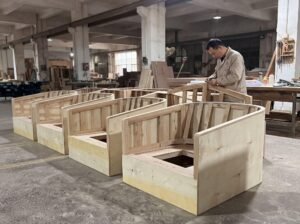
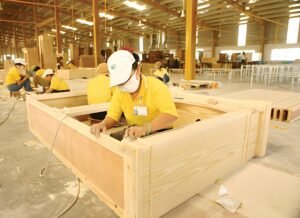

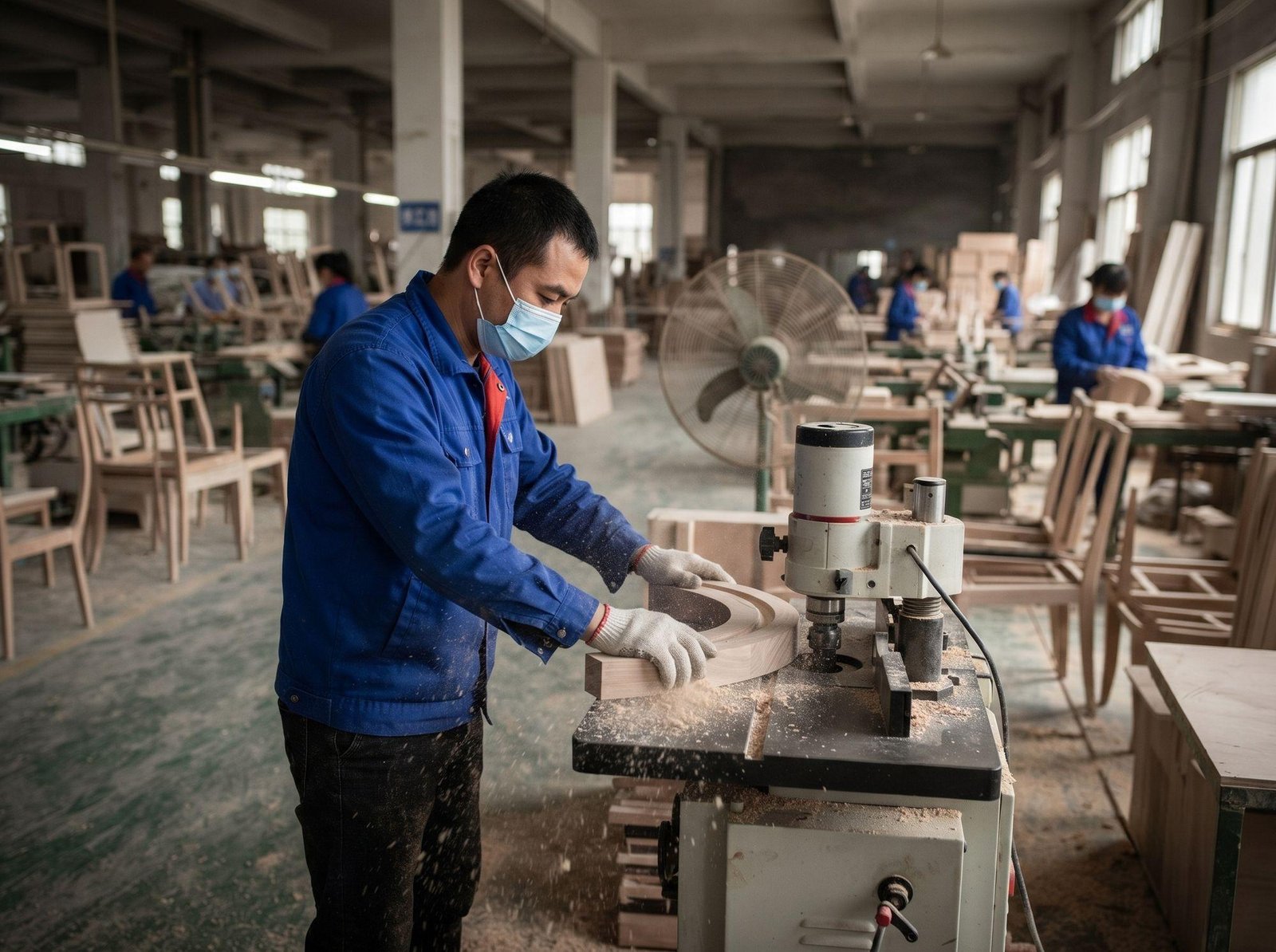
Cheap OEM furniture manufacturing in China is not ending. It is splitting apart.
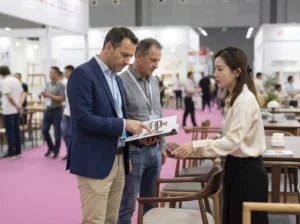
I was in Foshan last March, sweating through a humid afternoon in a showroom that looked like every other factory floor I019d seen in fifteen years of sourcing. Except this one had framed design patents on the wall. Italian-sounding collection names. And a young owner014LSE grad, tailored blazer014telling a Dutch buyer his factory would not take the man019s drawing. 01cWe co-develop now,01d he said. 01cOr you buy from our line.01d Ten years ago that conversation would have been unthinkable. Today? I019ve heard it three times this year.
That is the split. Top-tier factories design and brand their own collections. Mid-tier shops mix OEM with rapid customization for small buyers. Bottom-tier capacity has drifted inland or across the border. The real shift? Not that cheap prices vanished. It is that the factory floor today offers far more than it did five years ago. If you stop treating every supplier like an interchangeable price list.
How Cheap OEM Built the Empire
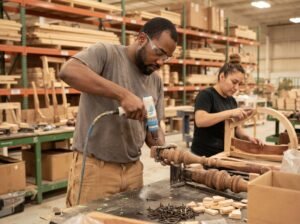
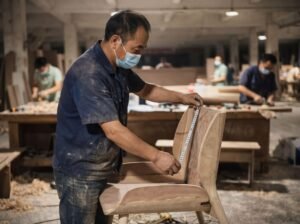
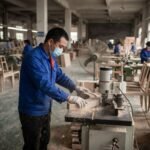
OEM furniture export means the buyer owns the design and the factory executes it. For roughly three decades, this contract defined China019s relationship with global furniture trade. You sent a drawing. A material list. A target price. The factory sourced the boards, cut the parts, sprayed the finish, packed the cartons, loaded the container. The competitive advantage boiled down to one thing: cost per unit.
The numbers still matter. In 2024, China exported something like $36 billion in furniture. Roughly 30 percent of global export share. Domestic manufacturing revenue among firms of designated size hit around RMB 677 billion. That scale came from geographic clustering. In the Pearl River Delta, a sofa factory could source hardwood, engineered board, hardware, fabric, leather, and foam within a two-hour drive. No fragmented supply chain elsewhere could match that density.
The OEM model fed a specific buyer. Large Western retailers with in-house design teams and one obsession: landed cost. For them, China was a production extension, not a partner. The factory019s job was to stay invisible.
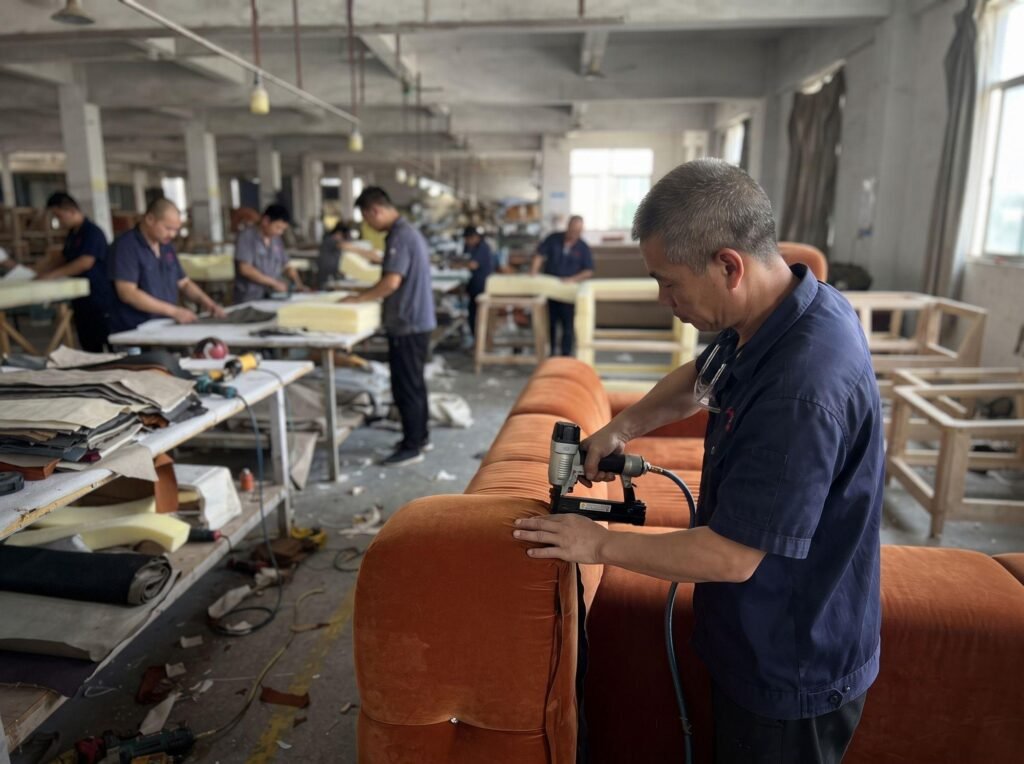
Why the Old Contract Is Fraying
Four pressures have made pure OEM increasingly unstable. None is new. Together, they have reached a tipping point.
Labor costs in coastal zones have climbed an estimated 8 to 10 percent annually. Raw material volatility, energy prices, and environmental compliance have piled on. Profit margins for export-oriented furniture factories compressed from 30 to 40 percent in the early 2000s down to 15 to 20 percent. Some operators I know report single-digit returns. Run a factory on 5 percent margin and you have no cushion. A currency swing or a tariff hike wipes out your year.
Then there is the RMB. Its long-term appreciation against the dollar has steadily eroded export pricing power. U.S. tariffs on Chinese furniture014upholstered pieces currently face a 25 percent ad valorem duty under Section 301014have forced factories to eat costs, push them to buyers, or find new markets. None of these works for a pure OEM operator with zero pricing power. I sat with a factory owner in Dongguan last November who told me his effective margin on a container of sofas bound for California was 3 percent. 01cWhy am I still doing this?01d he asked. I did not have a good answer.
Generational turnover is speeding things up. More Chinese furniture enterprises are passing from first-generation founders to second-generation owners. The successors, often educated abroad or at top business schools, see the factory as a platform to upgrade, not an asset to preserve. I see it everywhere now. Younger owners hiring design teams. Applying for overseas trademarks. Exhibiting at High Point or Milan with their own collections instead of anonymous white-label samples. One owner in Shunde told me his father still does not understand why they spend money on an Italian designer. 01cHe thinks it is a waste,01d he said. 01cBut our ODM orders doubled last year.01d
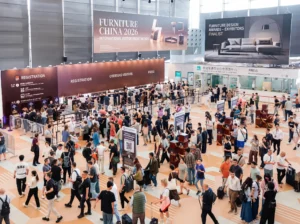
And then there is the ODM manufacturing pull. Under ODM, the factory contributes or fully develops the product design, which the buyer markets under its own label. Industry estimates suggest ODM arrangements typically cost buyers 15 to 20 percent less than full OEM because design and tooling are pre-invested. For factories, ODM means higher margins and relationships that are harder for a competitor to undercut. The shift shows up in the data. At CIFF Guangzhou, customization flexibility overtook quality certifications for the first time in the 20250132026 buyer survey cycle. Hitting 22 percent of decision weight. Second only to price.
The Three-Layer Split
This is not a clean upgrade from OEM to ODM. It is a split into three distinct layers.
| Layer | Positioning | Typical Capabilities | Buyer Relationship | Best Fit For |
| Layer 1: ODM/OBM Upgraders | Design-led, brand-conscious | In-house design teams, overseas trademarks, DTC channels, deep certification (OEKO-TEX, REACH, FSC) | Collaborative; factory co-develops product and shares IP risk | DTC brands, boutique retailers, hospitality developers seeking unique collections |
| Layer 2: Agile OEM+ | Fast-response, small-batch-capable | Flexible lines, 100-piece minimums, 3-day sampling, 15-day repeat delivery | Transactional but responsive; adds value through speed and customization | Mid-size retailers, Amazon sellers with multi-SKU needs, project-based designers |
| Layer 3: Cost-Driven OEM | Price-first, volume-focused | Standard designs, high MOQs (20+ pieces), long lead times, limited materials | Purely transactional; buyer provides full specs | Large-volume importers, discount chains, single-SKU high-volume programs |
Sources: Industry observation; CIFF Guangzhou buyer survey data 20250132026; factory interviews in Foshan and Dongguan.
Layer 1 is the smallest group but the loudest story. These factories once asked only for your drawing. Now they ask about your brand. They hire international designers, register trademarks in the EU and U.S., and run their own Amazon or independent-site storefronts. Their pitch changed. From 01cwe are cheap01d to 01cwe can give you a collection your competitor cannot copy in six months.01d I walked into one such factory in Longjiang last year and saw a design team of forty people. For a dining chair factory. That is not OEM.
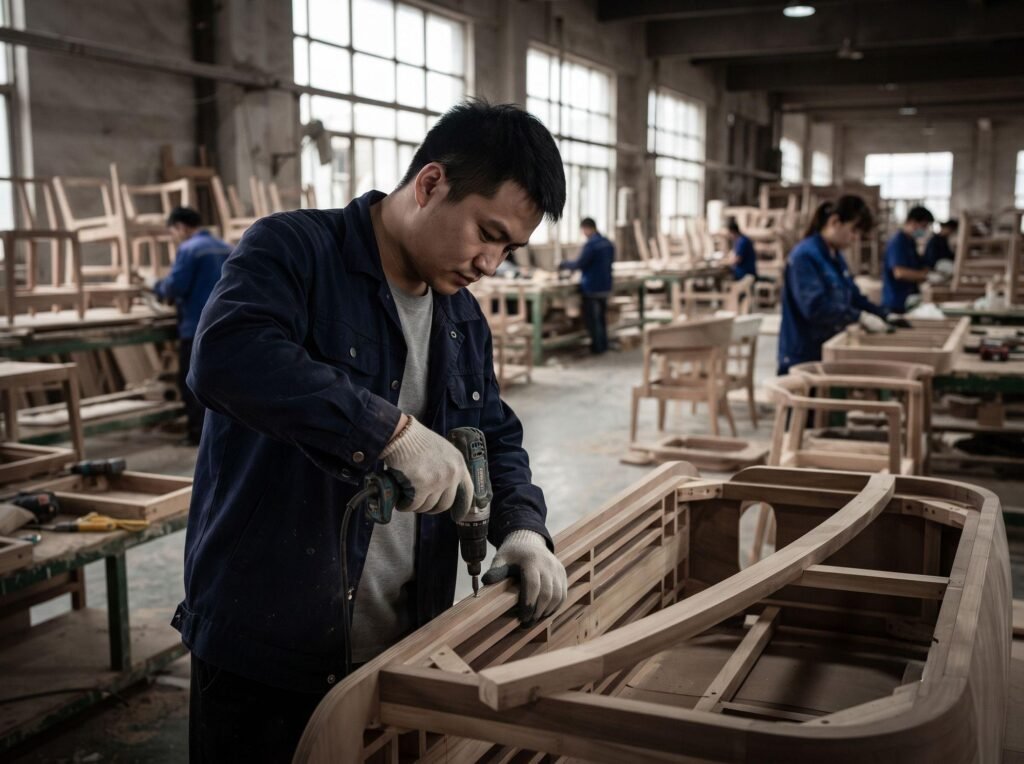
Layer 2 is where the real money is moving. These factories still take OEM orders, but they have retooled for agility. A sofa workshop in Foshan can turn a Pinterest mood board into a physical sample in seven days. A dining chair factory in Dongguan can switch veneer species, dimensions, and finish color within a single production run. Most overseas buyers014especially e-commerce sellers and small hospitality projects014do not need 500 identical units. They need 50 units, three finishes, four weeks. The factory that delivers that without a luxury premium is eating market share.
Layer 3 has not disappeared. Cheap OEM capacity still exists in large volume, but its geography is shifting. Some moved inland to Jiangxi and Hunan, where land and labor cost less. Some migrated to Vietnam, Indonesia, and Cambodia, chasing tariff advantages. Vietnam019s wood and wood product exports reached approximately $15.7 billion in 2024. But Vietnamese exports remain heavily concentrated in the U.S. market. Over 50 percent of wood product exports. And they rely on Chinese machinery, hardware, and panel inputs. Symbiotic competitors, not zero-sum rivals.
What This Means for Your Sourcing
The implications depend on who you are. There is no universal answer.
If you run a DTC brand or boutique retailer and you are looking for ODM partners, your screening criteria need to change. Price per unit matters less than design bandwidth and IP clarity. Ask to see the factory019s original collections, not just its OEM portfolio. Verify who owns the design rights. Check for overseas trademark registrations. This is often a reliable signal of how seriously they take brand building. Request samples from their proprietary lines. The quality of those samples usually reflects the ceiling of what they can deliver for you.
If you are a mid-size importer or e-commerce seller still running on OEM, you are probably overpaying for rigidity. A Layer 2 factory can often match your quality at a comparable price while offering smaller minimums and faster turnaround. Test responsiveness before you test price. Send a design modification mid-production and watch how they handle it. Layer 2 factories have systems for that. Layer 3 factories treat it as a disruption. One Amazon seller I know switched from a Layer 3 supplier to a Layer 2 shop in Foshan and cut his lead time from 60 days to 25 days. Same price.
If you are a large-volume discount chain, you may still find Layer 3 suppliers in China. But your negotiating leverage is eroding. These factories are getting picky. A factory running on 8 percent margin will prioritize the customer who pays on time, orders consistently, and does not demand endless revisions. If your entire model depends on squeezing the last cent out of a quote, you will face either rising prices or a gradual migration of your supply base to lower-cost geographies.
Spotting the Layer
No factory advertises its layer honestly. Here is what to look for.
Ask about their design team. Layer 1 factories have full-time designers on payroll. Sometimes dozens. Layer 2 factories may have one or two designers who adapt existing models. Layer 3 factories have none. They execute your drawings.
Check sample lead time for a modified existing product. Under five days suggests Layer 2 agility. Over two weeks suggests Layer 3 rigidity. Layer 1 factories may take longer because they are validating design integrity, not just production feasibility.
Review certification depth. Layer 1 factories typically carry OEKO-TEX, REACH, SGS, FSC, and market-specific certifications as standard. CARB Phase 2 for the U.S. EUDR traceability for the EU. Layer 2 factories have the basics but may need to arrange additional testing. Layer 3 factories often treat certifications as buyer-requested add-ons.
Examine export market spread. Layer 1 factories usually sell to 30 or more countries and have visible presence at international fairs. Layer 2 factories may concentrate on 5 to 10 markets. Layer 3 factories often serve one or two large buyers in one or two markets.
Look for direct-to-consumer footprints. A factory with its own Amazon store, independent website, or overseas showroom is almost certainly Layer 1. That is the clearest signal they are no longer content to stay invisible.
Where This Goes: A Reading, Not a Prediction
The following is my assessment of trajectory, not a forecast backed by hard data. I have been wrong before. I will be wrong again.
I expect the gap between Layer 1 and Layer 3 to widen. Top-tier Chinese furniture factories will increasingly resemble European or Italian design houses. Selective about clients. Protective of design IP. Focused on margin over volume. Some will acquire foreign brands outright. Others will build direct distribution in target markets, using overseas warehousing to offer 01cnext-day delivery01d and local assembly.
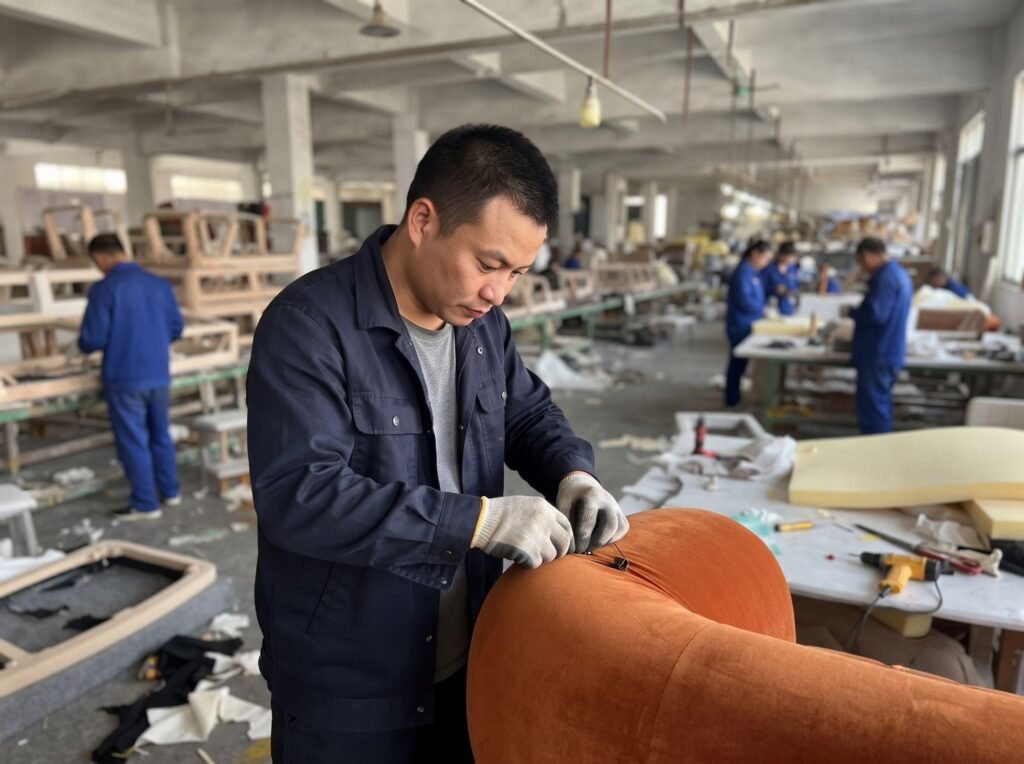
Layer 2 will become the default entry point for new buyers. As e-commerce continues to fragment order sizes and accelerate product cycles, the factory that can produce 100 units in three finishes with a 30-day lead time will capture market share from the factory that demands 500 units in one finish with a 90-day lead time. This is already happening in upholstered furniture, where Chinese factories have invested in automated fabric cutting and CNC sewing lines that boost per-worker output efficiency by roughly 40 percent.
Layer 3 will not vanish, but it will keep migrating. Inland China, Vietnam, and eventually Africa will absorb more of this capacity. The remaining Layer 3 factories in coastal China will survive primarily as overflow suppliers for large OEM buyers with inflexible volume commitments. They will not thrive. They will survive. There is a difference.
The China export model for furniture is not collapsing. It is specializing. The buyer who understands which layer a factory belongs to014and what that layer can and cannot do014will find more value, not less, in Chinese manufacturing over the next five years. The buyer who still treats every factory as a commodity bidder will find the door closing. I have seen it happen. It is not theoretical.

FAQ
What is the difference between OEM, ODM, and OBM in furniture manufacturing?
OEM means you bring the design, they build it. ODM means they design it, you put your name on it. OBM means they design it, brand it, and sell it themselves. Most Chinese furniture factories still do two or all three of these at the same time. Do not expect them to tell you which one they prefer. You have to figure it out.
Is cheap OEM furniture from China really disappearing?
No. But it is moving. Inland. Across the border. What is disappearing is the assumption that every factory in China wants to be your cheap OEM supplier. Many have upgraded and now prefer ODM or mixed-model relationships. The ones that have not upgraded are getting desperate. Desperate factories make mistakes. Be careful.
How do I know if a factory is a true ODM partner or just an OEM shop with a catalog?
Ask who designed their 01coriginal01d products. A true ODM factory can walk you through the design rationale, show you iterative prototypes, and explain why specific materials or dimensions were chosen. An OEM shop with a catalog simply bought or copied designs to fill a brochure. Also check whether they have registered trademarks or design patents014these are strong signals of genuine ODM investment. If they cannot show you a design patent, they are probably not Layer 1.
Are Vietnamese factories replacing Chinese ODM capabilities?
Not yet. Vietnam has grown fast014wood and wood product exports reached approximately $15.7 billion in 2024014but Vietnamese factories remain heavily concentrated in standard solid-wood and upholstered products for the U.S. market. They rely on Chinese machinery, hardware, and panel inputs. For high-end customization, multi-material projects, and rapid design iteration, Chinese factories still hold a decisive advantage. I have seen Vietnamese factories that cannot source the right hinge locally. They import it from Foshan. That tells you everything.
Should I switch from OEM to ODM if I currently design everything in-house?
Not necessarily. If your brand019s differentiation is design-driven and you have the in-house capability, OEM may still be the right model. However, consider a hybrid approach: use OEM for your signature pieces and ODM for volume fillers or seasonal collections. This can reduce your design workload and tooling costs by 15 to 20 percent while keeping your core IP in-house. I know a furniture brand in Amsterdam that does exactly this. Their bestseller is an OEM chair. Their seasonal collection is ODM. It works.
What is the minimum order quantity for ODM furniture from China?
It varies. Layer 1 ODM factories often require container-level commitments for custom collections. Layer 2 agile factories may accept 50 to 100 pieces per SKU for modified existing designs. Always negotiate MOQ separately from price. A factory may drop its minimum for a buyer who commits to repeat orders or pays a higher deposit. I have seen MOQs drop from 500 to 100 just because the buyer agreed to pay 50 percent upfront instead of 30 percent.
Recommended Resource
Interi Furniture specializes in custom furniture manufacturing for residential, hospitality, and commercial projects. Their experience in materials, craftsmanship, and project realization makes them a valuable resource for designers and buyers seeking tailored furniture solutions from China.