





Most overseas buyers land in Guangzhou assuming the city is pure middlemen territory. They walk through Pazhou exhibition halls, shake hands with polished sales reps in Tianhe showrooms, and leave convinced that the Guangzhou trade network equals trading companies plus logistics. That assumption costs them money. The truth? Guangzhou runs a local furniture ecosystem that stretches far beyond the Pearl River New Town skyline. In Panyu and Conghua, factories churn out hotel suites, upholstered sofas, and flat-pack cabinets that ship to Dubai hotels, Miami condos, and Berlin co-working spaces. We have walked both the carpeted showrooms and the concrete factory floors. Here is what the map actually looks like.
The Trade Hub Illusion
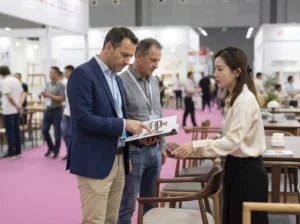
When people say “Guangzhou is China’s furniture capital,” they usually mean the exhibition complex. The Canton Fair, CIFF, and Design Week pull in hundreds of thousands of buyers every year. Trade hub exhibition suppliers line the Pazhou and Liuhua districts with glossy catalogs, espresso machines, and sales teams fluent in five languages. It feels like the entire supply chain lives inside a 50-kilometer radius.
It does not.
Roughly 80% of the companies operating showrooms in Tianhe, Haizhu, and Yuexiu are pure traders. They rent space, curate samples, and place orders with factories they do not own. Some add genuine value—multilingual teams, quality control, consolidated shipping. Others simply mark up factory prices by 30-50% and hope the buyer never asks to see the workshop. We have seen personal buyers pay $4,200 for a sofa that left a Foshan factory at $1,800 because the “Guangzhou supplier” threw in a nice brochure and a branded coffee cup.
This is not a rant against traders. Trading companies serve a purpose, especially for buyers who need hand-holding across multiple product categories. But if you are running a hotel renovation or scaling a furniture brand, you need to know whether you are talking to a trader or a manufacturer. The two paths lead to very different price structures and risk profiles. A trader can disappear after taking your deposit. A factory has CNC machines and a landlord to answer to.
The psychology is understandable. Buyers fly into Baiyun Airport, check into a Tianhe hotel, and want to believe the elegant showroom downstairs represents the full supply chain. It is comforting. It is also expensive. We have watched procurement managers sign six-figure contracts based on showroom chemistry alone, never asking the one question that matters: “Where do these pieces actually get built?”
Panyu: Where the Guangzhou Production Chain Actually Lives
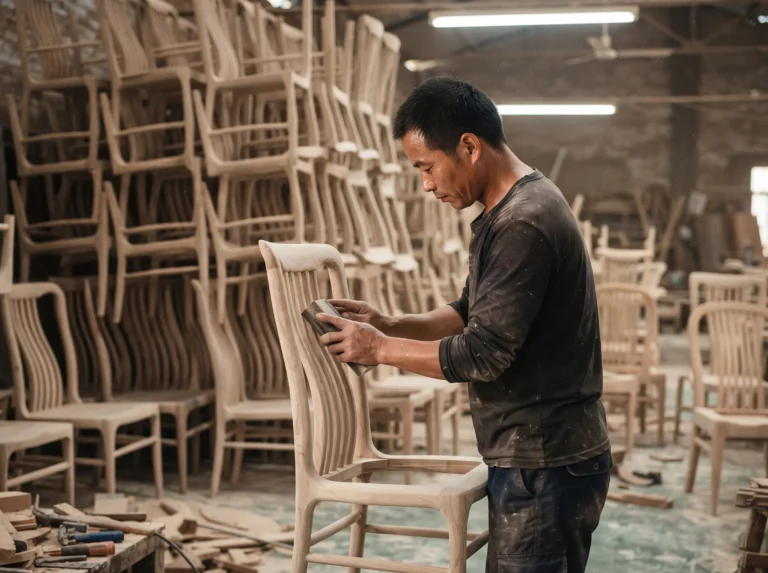
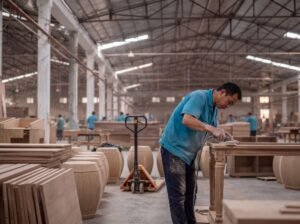
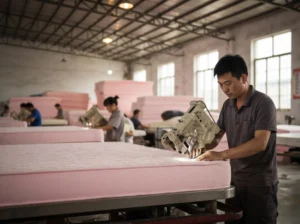
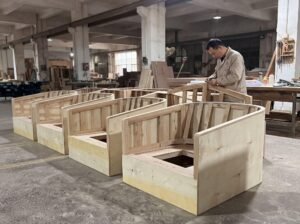
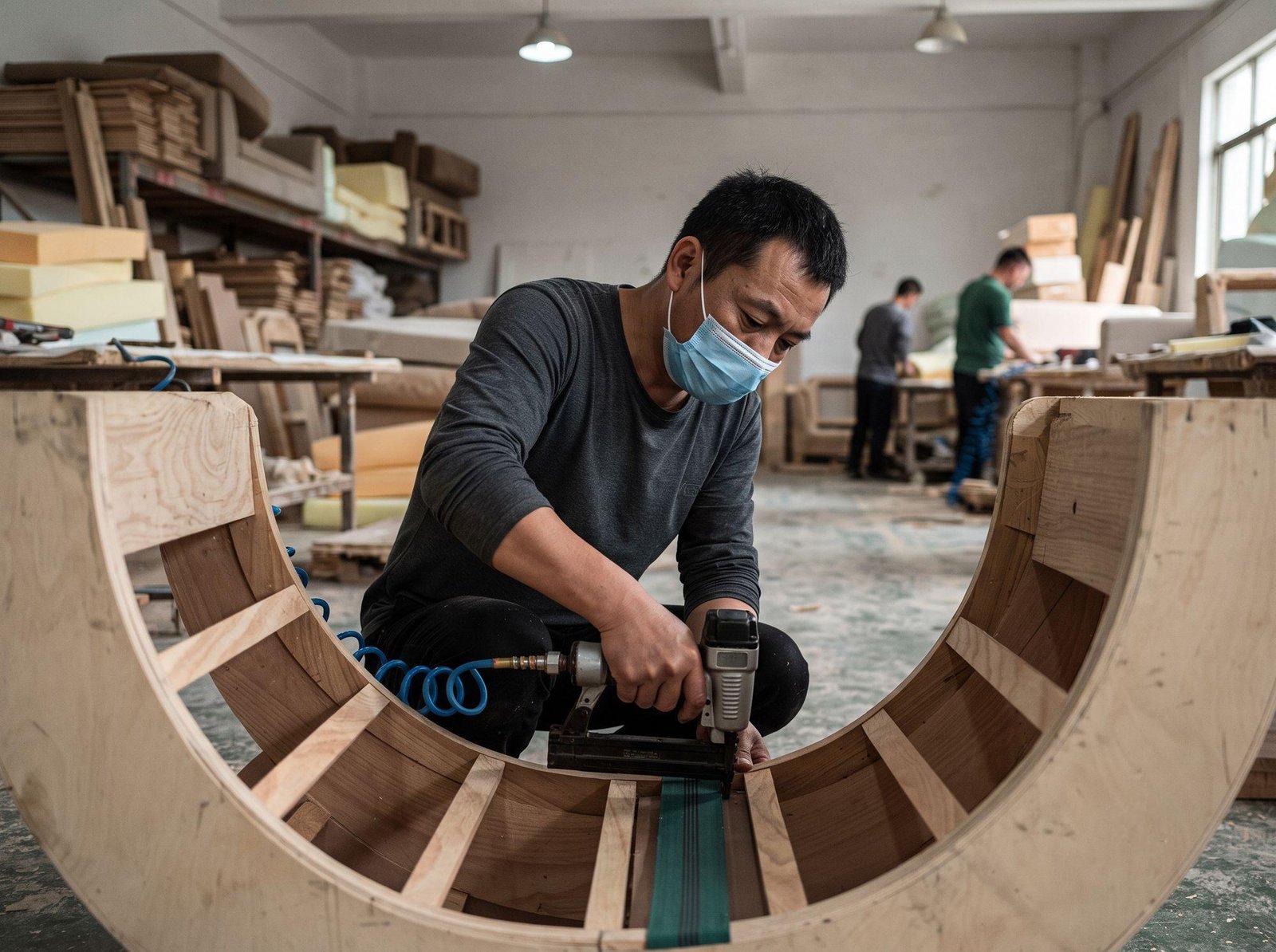
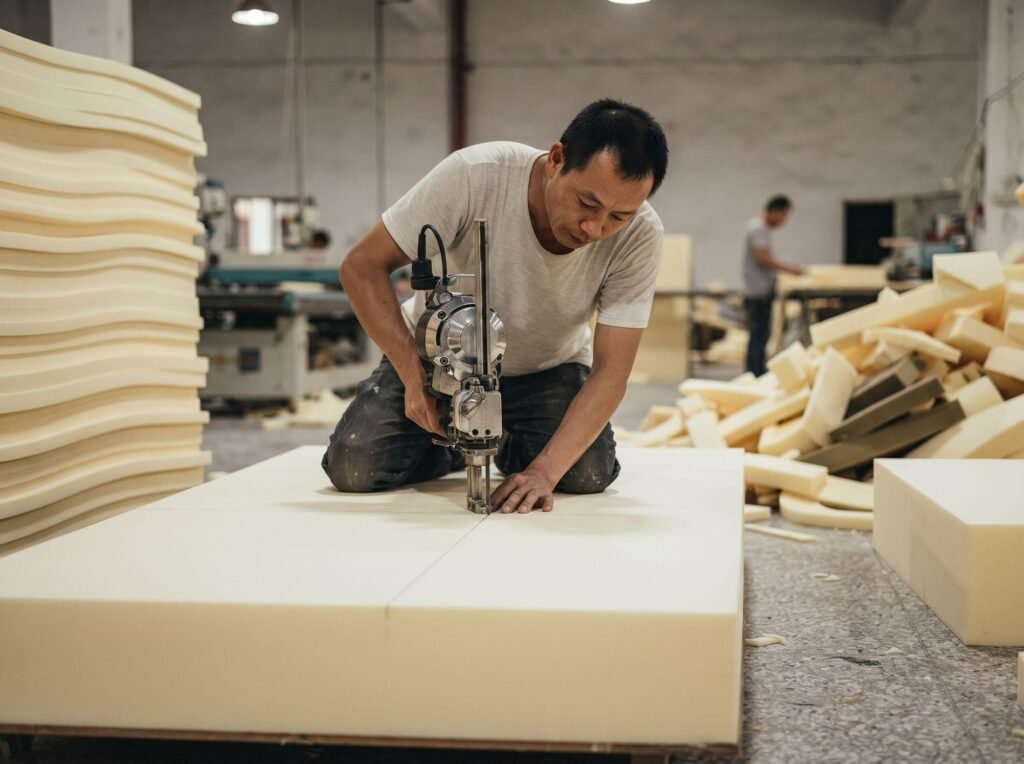
Drive 40 kilometers southeast from Tianhe CBD and the glass towers dissolve into low-rise industrial zones. Panyu District—specifically Hualong, Shilou, and Nancun—hosts the production side of the Guangzhou production chain that most buyers never visit. We have spent weeks there, watching containers load at 6 a.m. and sampling workshops run three shifts to hit cruise-ship deadlines. The air smells of varnish and MDF dust. The roads narrow. Trucks loaded with foam blocks and timber stacks share lanes with three-wheeled delivery carts. Street-side vendors sell rice boxes to workers on 30-minute lunch breaks. This is not the Guangzhou that appears in CIFF brochures, but it is the Guangzhou that ships the furniture.
Hualong’s Hotel Furniture Engine
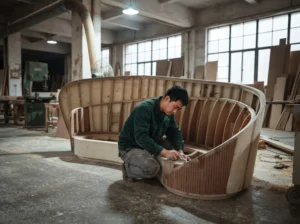
Hualong Town built its reputation on hotel and hospitality furniture. Walk the backstreets near the industrial park and you will find workshops specializing in veneer-matched headboards, custom minibars, and banquet tables engineered for commercial wear. These factories typically run 80-200 workers, far smaller than the 500-person giants in Foshan’s Longjiang. But their niche is precision, not scale.
A factory owner in Hualong told us something that stuck: “Foshan makes sofas for the world. We make beds for the hotel chains that do not want to look like every other property.” That specialization commands a 15-20% premium over Foshan mass production, but buyers get shorter lead times on custom specs and direct engineering communication in English. For hotel groups running tight renovation schedules, that trade-off often pays for itself. We have watched a Hualong workshop deliver 120 custom headboard sets for a Bangkok boutique hotel in 18 days—a timeline a Longjiang giant would have laughed at.
Shilou’s Upholstery & Metal Workshops
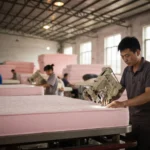
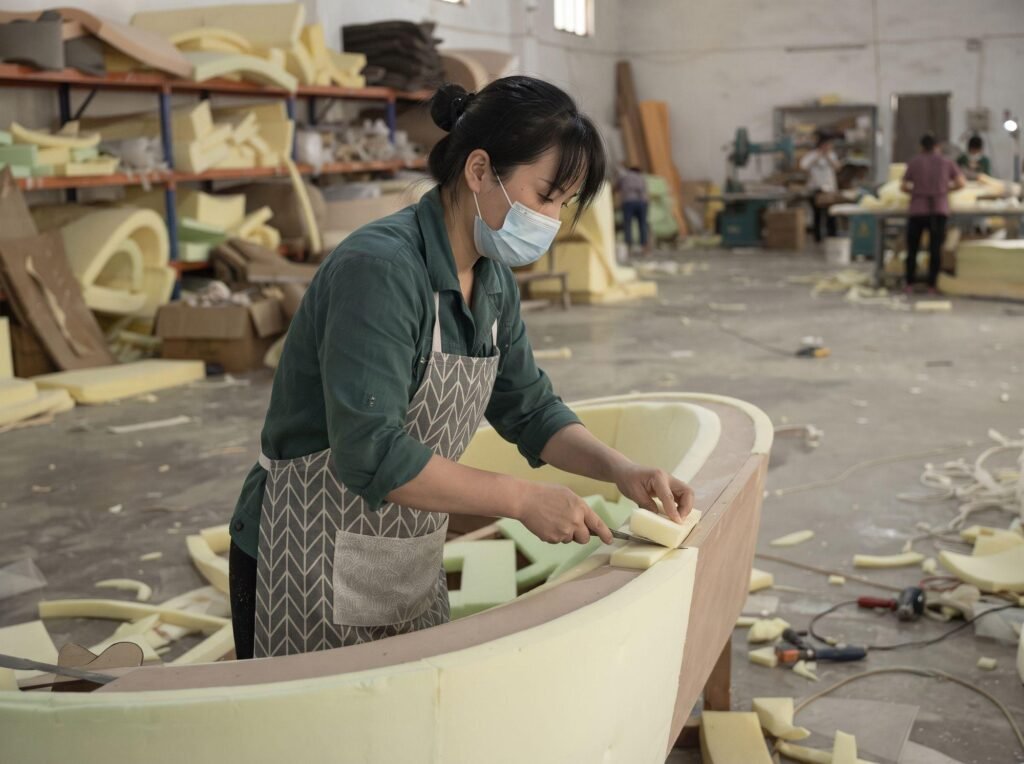
Shilou sits closer to the coast, and its factories lean toward upholstered furniture and metal framing. We have seen operations here that prototype a new armchair in 72 hours—something that takes two weeks in larger Foshan facilities bogged down by bulk orders. The secret is flexibility. Shilou workshops often run 30-50 workers with flat management structures. A designer can walk in with a sketch on Monday and sit on a physical sample by Thursday.
The downside? Capacity ceilings. These shops struggle with orders above 200 units unless they subcontract stitching or welding to neighboring workshops. For boutique hotels, design studios, and e-commerce sellers testing new SKUs, Shilou is a goldmine. For a 500-room hotel chain, it is a starting point, not a finish line. You come here to validate designs, not to fill a container.
Nancun: How the Trade Hub Exhibition Suppliers Get Their Samples
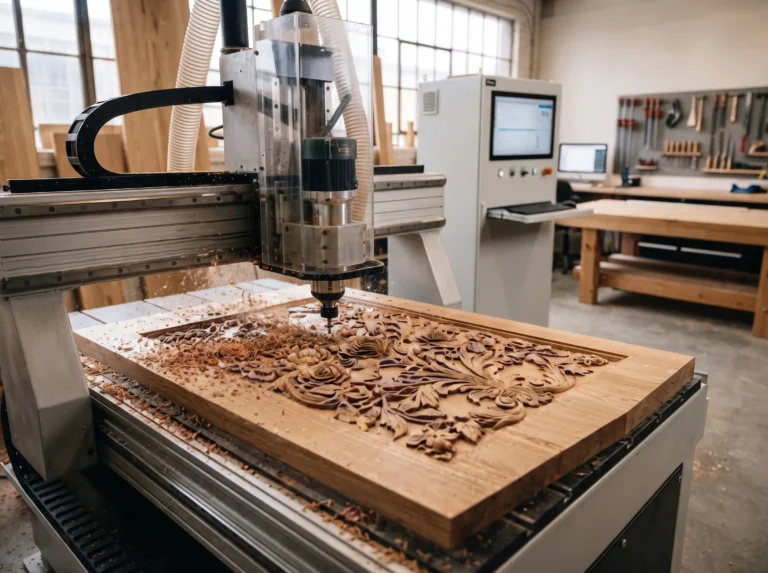
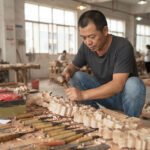
Nancun straddles the line between Panyu and the Foshan border, and it functions as the rapid-prototyping corridor. Small workshops here specialize in 3D modeling, CNC cutting, and hand-finishing samples. Many Foshan factories send their prototype work to Nancun because the turnaround is faster and the labor cost sits slightly below Foshan proper.
This creates an interesting dynamic: Nancun workshops feed the Guangzhou trade network with physical samples that traders then display in Pazhou showrooms. The buyer sees a “Guangzhou supplier” with a polished prototype, never realizing the prototype was born 40 kilometers away in a 2,000-square-meter Panyu workshop. It is not deception; it is geography. But buyers who understand this geography negotiate better. They ask the right questions about mold ownership, revision limits, and who actually holds the production capacity.
From OEM to Full-Service: The Interi Furniture Example
Panyu also houses companies that have moved beyond pure manufacturing into full-service custom solutions. Interi Furniture, based in the district, represents this shift. They handle residential and commercial projects spanning indoor and outdoor spaces, offering end-to-end customization rather than catalog picking. For overseas buyers who need a single partner to coordinate sofas, dining sets, outdoor loungers, and hotel lobby pieces across one brand aesthetic, this model eliminates the fragmentation of sourcing from five separate factories.
Does it cost more than buying direct from a Longjiang sofa specialist? Usually. Does it save weeks of coordination headaches? Almost always. The value proposition is not lowest price; it is lowest management overhead. We have seen boutique hotel projects where the buyer spent more on travel and communication costs than the product premium, simply because they tried to coordinate five Foshan specialists from three time zones. Interi’s model—common among Panyu’s evolving factories—trades margin for sanity.
Conghua: The Quiet Side of the Local Furniture Ecosystem
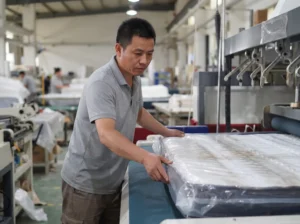
If Panyu is Guangzhou’s visible workshop, Conghua is its hidden one. Located roughly 80 kilometers north of downtown, Conghua’s Mingzhu Industrial Park clusters panel furniture, solid wood manufacturing, and export packaging facilities. The area does not attract many buyers because it lacks the exhibition glamour of Pazhou or the furniture street density of Longjiang. That obscurity keeps rents and wages lower, which in turn attracts factories looking to escape Foshan’s rising costs.
We visited a flat-pack cabinet manufacturer in Conghua last year that ships 40-foot containers to Scandinavian retailers. The owner moved from Shunde five years ago because, in his words, “the land was half the price and the highway to Shenzhen port is actually shorter.” Conghua factories often absorb overflow capacity from Foshan—when a Longjiang giant hits its production ceiling, it subcontracts panel cutting or assembly to Conghua partners.
One pattern we have noticed: Conghua attracts the “second-generation” factory owners—sons and daughters of Foshan entrepreneurs who watched their parents build empires on cheap land and now face a different reality. They bring better English, digital inventory systems, and a willingness to work with smaller buyers that their parents’ generation often dismissed. This generational shift makes Conghua unexpectedly accessible to mid-size overseas buyers who would struggle to get attention in Foshan’s volume-focused culture.
The quality spectrum here is wide. Some Conghua operations match Foshan standards with ISO-certified lines and German-imported edge banders. Others run bare-bones workshops where “quality control” means a guy with a flashlight checking corners at 5 p.m. Buyers who venture this far north need to audit carefully. The reward is pricing 10-15% below Foshan equivalents, plus direct factory relationships that traders in Tianhe cannot replicate. We recommend scheduling Conghua visits for day three of a Guangzhou trip, after you have already calibrated your quality baseline in Panyu or Foshan.
Guangzhou vs Foshan: A Complementary Rivalry
Buyers often frame this as a competition. It is not. It is a division of labor.
Foshan—Longjiang, Lecong, Shunde—owns scale. A single Foshan sofa factory can output 500 units daily with robotic cutting and automated stitching. Their showroom streets stretch for kilometers. For buyers who know exactly what they want and need 1,000 identical pieces, Foshan is unbeatable. The pricing is aggressive, the logistics are mature, and the ecosystem is deep.
Guangzhou—Panyu and Conghua—owns agility. The local furniture ecosystem here thrives on customization, smaller batches, and English-speaking staff who understand Western hospitality standards. A Foshan factory might refuse a 50-unit order or charge a mold fee that eats your margin. A Panyu workshop will take it, assign a dedicated technician, and video-call you through the prototype phase.
The gap is closing. Foshan factories are investing in custom lines, and Panyu workshops are scaling up. But as of 2026, the distinction still matters. If you are a procurement agent managing mixed orders for a design hotel, Guangzhou’s flexibility wins. If you are a retail chain restocking a bestseller, Foshan’s volume wins. Smart buyers use both: Foshan for the core SKU, Guangzhou for the custom pieces that differentiate the project.
The confusion between these two ecosystems creates real financial damage. Buyers who need Guangzhou’s agility end up in Foshan, frustrated by rigid MOQs. Buyers who need Foshan’s pricing end up in Guangzhou, shocked by quotes. The first step to avoiding this mismatch is understanding who actually owns what.
Industry Truth: The 20% Factory Myth
Here is the number that should change how you source in Guangzhou. Based on our field visits and industry conversations, fewer than 20% of the furniture trading companies with showrooms in central Guangzhou own or directly control manufacturing facilities. The rest are brokers—skilled, professional, sometimes indispensable brokers—but brokers nonetheless.
This matters because broker pricing includes an opacity premium. When a buyer asks, “Why is this dining table $380 from your Guangzhou contact but $240 from a Foshan factory?” the answer is usually not better materials. It is middleman layers. Some traders add genuine QC and logistics value. Others simply pocket the spread. Knowing which type you are dealing with is the difference between a smart partnership and an expensive lesson.
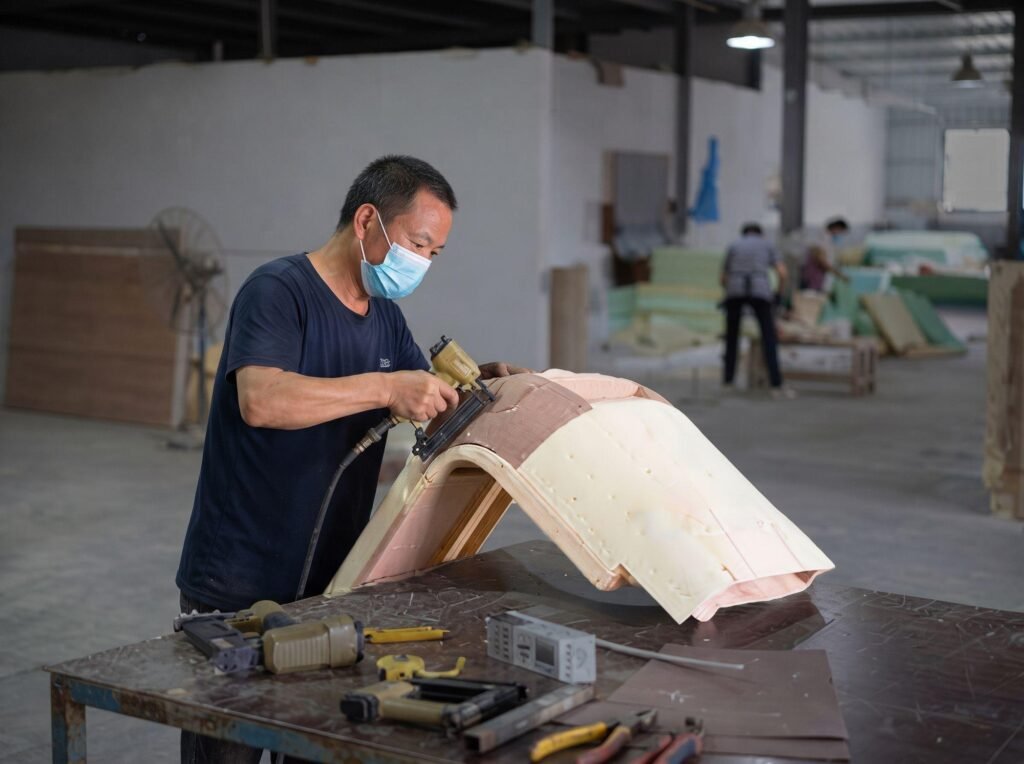
We have a simple rule: if a supplier cannot show you production footage with a timestamp from the past 72 hours, assume they are a trader. Real factory owners will show you dust, noise, and half-finished products without hesitation. Traders will show you more catalogs.
What Buyers Get Wrong About Guangzhou
Mistake one: assuming distance equals separation. A buyer visits a Tianhe showroom at 10 a.m., sees samples, and assumes the factory is “nearby.” The actual factory might be in Panyu, Conghua, or Foshan—anywhere from 40 to 100 kilometers away. “Guangzhou supplier” is a branding label, not a geography lesson. We have watched buyers rent cars to visit a “Guangzhou factory” only to discover it is a trader’s office with a single assembly bench for photo ops.
Mistake two: ignoring the production cost gap. Guangzhou factories—Panyu and Conghua included—pay higher land rents and labor costs than Foshan counterparts. Expect Guangzhou production chain pricing to run 10-20% above Foshan for comparable specs. That gap is not gouging; it is real estate arithmetic. The question is whether the service, speed, and communication quality justify the premium. For many hospitality buyers, it does. For price-sensitive retail buyers, it rarely does.
Mistake three: conflating exhibition presence with manufacturing depth. A stunning CIFF booth with LED walls and uniformed staff does not prove factory ownership. We have seen traders rent 200-square-meter booths while their “factory” is a 500-square-meter subcontractor in Conghua. The booth is marketing. The workshop is reality. Do not let carpet quality cloud your judgment about production capacity.
Guangzhou’s Furniture Map: A Buyer Comparison
| Factor | Central Guangzhou (Tianhe/Haizhu/Yuexiu) | Panyu (Hualong/Shilou/Nancun) | Conghua (Mingzhu Industrial Park) | Foshan (Longjiang/Lecong) |
|---|---|---|---|---|
| Primary Role | Trading, exhibitions, showroom sales | Custom hotel furniture, upholstery, prototyping | Panel & solid wood manufacturing, export packaging | Mass production, scale manufacturing |
| Typical MOQ | Flexible (traders aggregate) | 20-100 units | 100-500 units | 500+ units |
| Price Level | Highest (markups included) | Medium-high (custom premium) | Medium (lower overhead) | Lowest (scale efficiency) |
| English Communication | Excellent | Good to excellent | Variable | Basic to moderate |
| Customization Depth | High (via subcontracting) | Very high (direct engineering) | Moderate | Low to moderate |
| Factory Ownership Rate | <20% own factories | High (direct manufacturers) | High (direct manufacturers) | Very high |
| Best For | First-time buyers, multi-category sourcing | Hotel projects, design-driven orders, prototyping | Retail flat-pack, solid wood, cost-sensitive volume | Bulk standard items, price-sensitive procurement |

FAQ
Does Guangzhou have real furniture factories, or only trade hub exhibition suppliers?
Yes, real factories exist—but not where most buyers look. The showrooms in Tianhe and Pazhou are dominated by trading companies. The actual manufacturing happens in Panyu and Conghua, 40-80 kilometers from the city center. If you want to see production lines, you need to leave downtown. We have seen buyers spend three days in Pazhou without realizing the factories were a 45-minute drive away. The factories are real. The geography is just different from the marketing.
Is the Guangzhou production chain more expensive than buying direct from Foshan?
Generally yes. Guangzhou factories face higher land and labor costs, so expect a 10-20% premium over Foshan for similar specs. The value lies in faster customization, better English communication, and more flexible MOQs—not in rock-bottom pricing. For buyers who need custom hospitality pieces, the premium is usually worth it. For buyers chasing lowest unit cost, Foshan remains the better bet.
How can buyers tell if a Guangzhou trade network contact actually owns a factory?
Ask directly for the factory address and business license registration. Cross-check the license name with the showroom brand—many traders operate under different legal entities. Then request a video call from the workshop floor, not just the showroom. Real factory owners will show you dust, noise, and half-finished products without hesitation. Traders will stall, deflect, or send stock footage.
What furniture categories does Panyu’s local furniture ecosystem specialize in?
Hotel and hospitality furniture (Hualong), upholstered and metal pieces (Shilou), and rapid prototyping (Nancun). Panyu workshops excel at custom specs and smaller batches where Foshan factories would charge mold fees or refuse the order entirely. If your project involves bespoke headboards, custom banquette seating, or new SKU prototypes, Panyu is where you start. For mass-market standard items, look elsewhere.
Is Conghua worth visiting on a Guangzhou trade network sourcing trip?
Conghua is 80 kilometers north of downtown—roughly a 90-minute drive. For buyers focused on flat-pack cabinets, solid wood, or export packaging, the trip is worth it. Pricing runs 10-15% below Foshan, and you will find factories hungry for direct relationships. Just audit quality carefully; the spectrum ranges from ISO-certified lines to bare-bones workshops. We suggest visiting Conghua after you have calibrated your quality baseline elsewhere.
Recommended Resource
Interi Furniture specializes in custom furniture manufacturing for residential, hospitality, and commercial projects. Their experience in materials, craftsmanship, and project realization makes them a valuable resource for designers and buyers seeking tailored furniture solutions from China.