






Hotel FF&E procurement China is not a shopping trip. It is a cross-border project where design intent, factory capability, logistics sequencing, and on-site installation must interlock without drift. Most owners assume delays come from production floors. They don’t. Based on what we’ve seen walking lines in Longjiang, Houjie, and Panyu, roughly 70% of hotel furniture procurement delays start at design confirmation—the moment a rendering meets factory reality and the two don’t speak the same language. This guide maps the full lifecycle from interior concept to guest-ready rooms, with controls that protect your opening date.
The Budget Illusion: Where Hotel Owners Bleed Money
Most hotel developers allocate 80% of their FF&E budget to “buying stuff” and leave 5% for project management. Here’s the uncomfortable truth: that 5% is what determines whether you open on time. We’ve sat in too many pre-opening meetings where the owner rep is screaming about a two-week delay while the procurement agent shrugs—because nobody built contingency into the coordination layer.
FF&E sourcing from China isn’t expensive because of the furniture itself. It’s expensive because of the complexity of moving hundreds of SKUs across design, production, inspection, ocean freight, customs, and final installation without a single weak link snapping the chain. The real value of Chinese factories in hotel interior procurement isn’t price. Overseas agents can often beat Foshan quotes by 8-12% on individual items. What they cannot replicate is the ability of a single Chinese project team to digest fixed installation, loose furniture, lighting, artwork, and custom décor within one unified timeline. That integration capability has no equivalent in Western supply chains.
The Design Phase Gap: Where 70% of Delays Actually Start
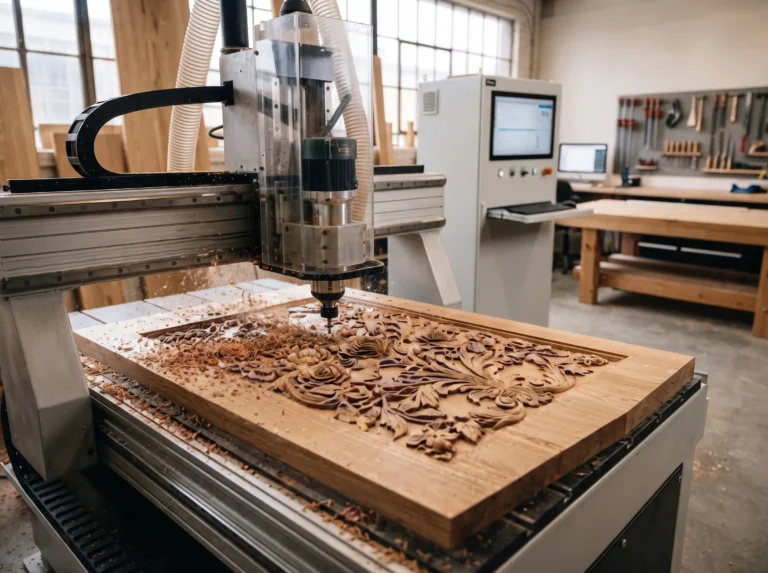
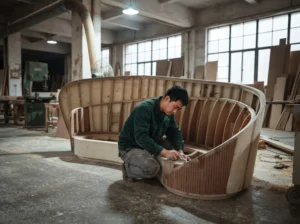
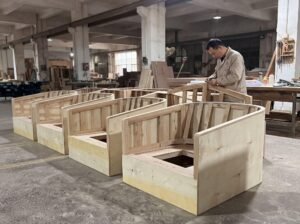
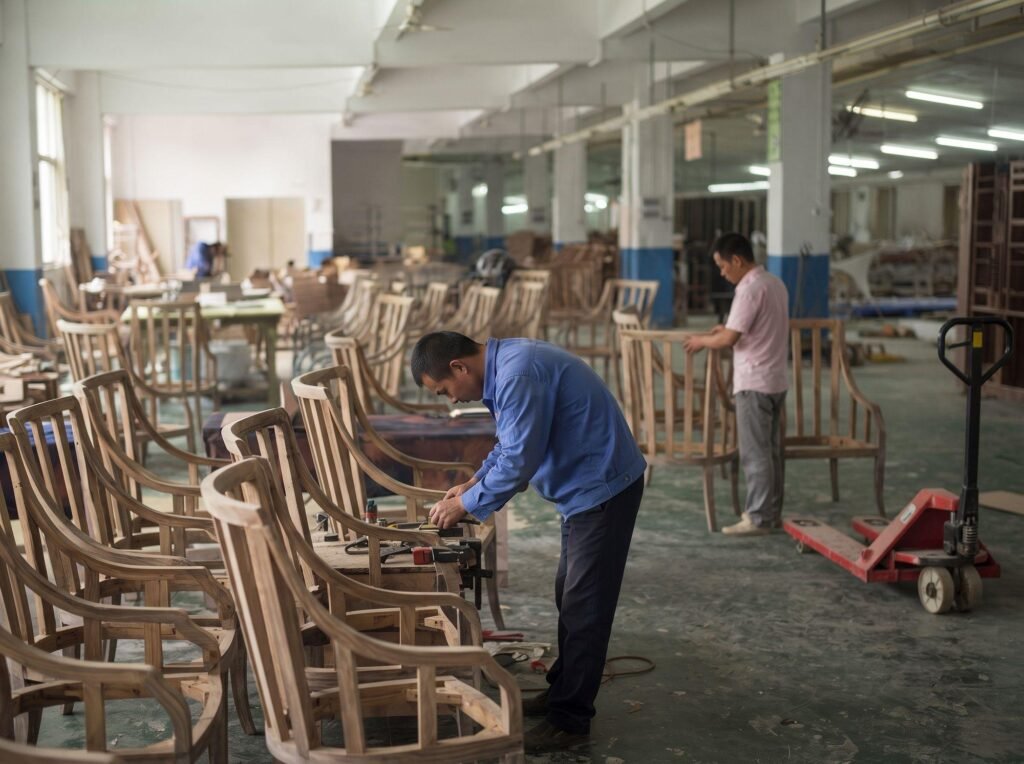
The gap between an interior designer’s rendering and a Chinese factory’s process capability is where hotel FF&E procurement China projects go to die quietly. We walked into a Longjiang factory last year where a Southeast Asian resort project had stalled. The design firm—based in Singapore—had specified curved solid wood headboards with a radius so tight that the factory’s CNC couldn’t execute it without splitting the grain. The designer had never set foot on a production floor. The factory had never pushed back during the bid stage because they assumed “the designer knows what they want.” Three months of revisions, re-sampling, and hardscape adjustments followed. The cost spiral started there, not on the assembly line.
When Renderings Hit Factory Reality
Design confirmation is the most underestimated minefield in hotel furniture procurement. Designers optimize for visual impact. Factories optimize for process feasibility. A curved sofa in a rendering might require custom foam density, new mold tooling, or woodworking curves that can’t be replicated at volume. We see this mismatch constantly.
One project for a boutique hotel in Dubai specified a brass-inlaid bedside table with hand-hammered texture. Beautiful in 3D. Impossible to quote accurately because no two hammered panels would match. The factory spent six weeks developing a semi-automated process that approximated the look. The designer approved it. Then the owner saw the first production piece and said it “wasn’t organic enough.” Back to square one. These aren’t manufacturing failures. They are communication failures dressed up as quality issues.
The Mock-up Room Trap
Hotel groups will happily wait three weeks for a mock-up room but refuse to add eight weeks to production lead time. This logic is backwards, and everyone in the industry knows it. A mock-up room answers the question: “Does this look right?” It does not answer the questions that actually kill projects: “Can the factory build this at volume without drift?” and “Will the fixed installation align with on-site hardscape dimensions?”
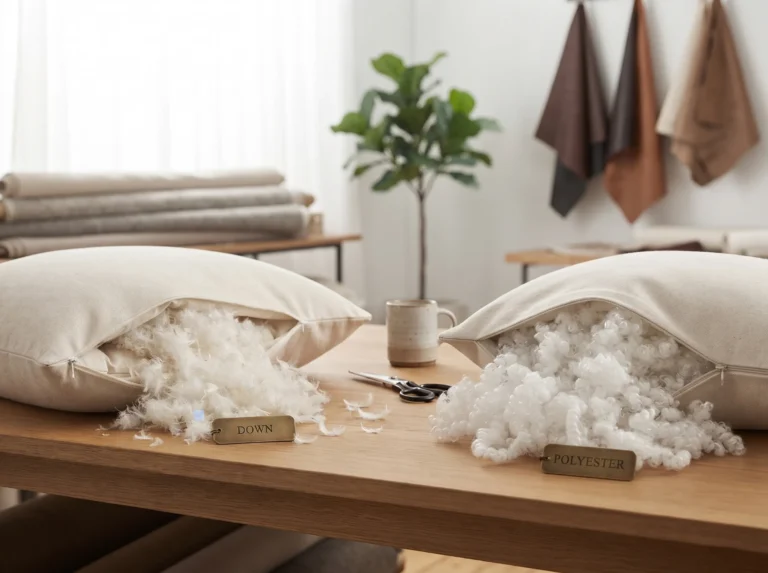
After sign-off, the risk of material variance between the approved sample and bulk production remains real. Factories change wood lots. Paint formulations shift between batches. Fabric dye lots vary. Without a locked material standard and batch tolerance written into the contract, your mock-up room is a pretty fiction.
Inside the Factory: How Hotel Orders Actually Get Made
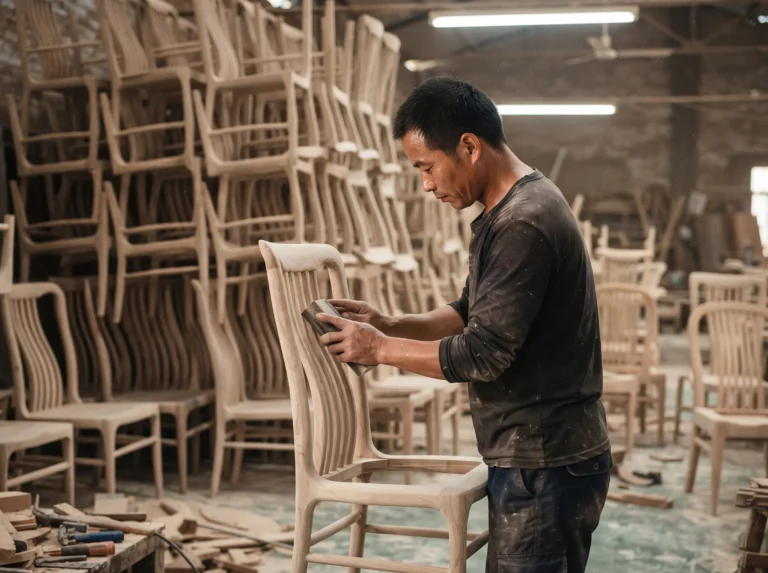
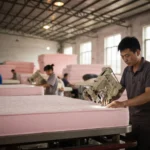
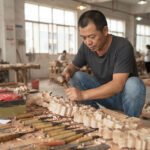
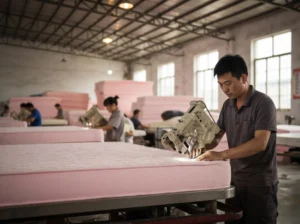
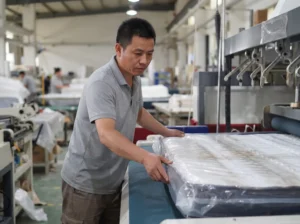
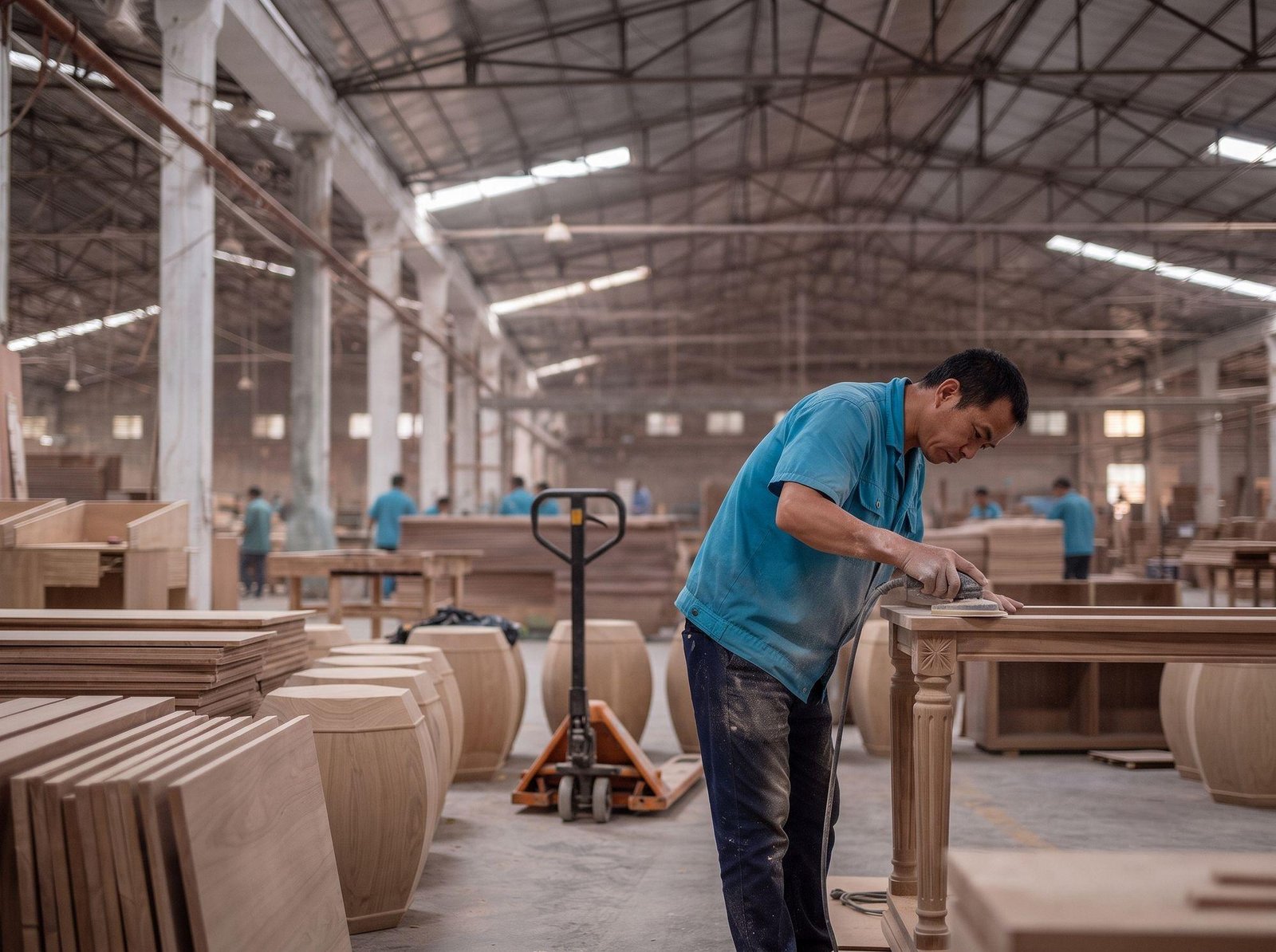
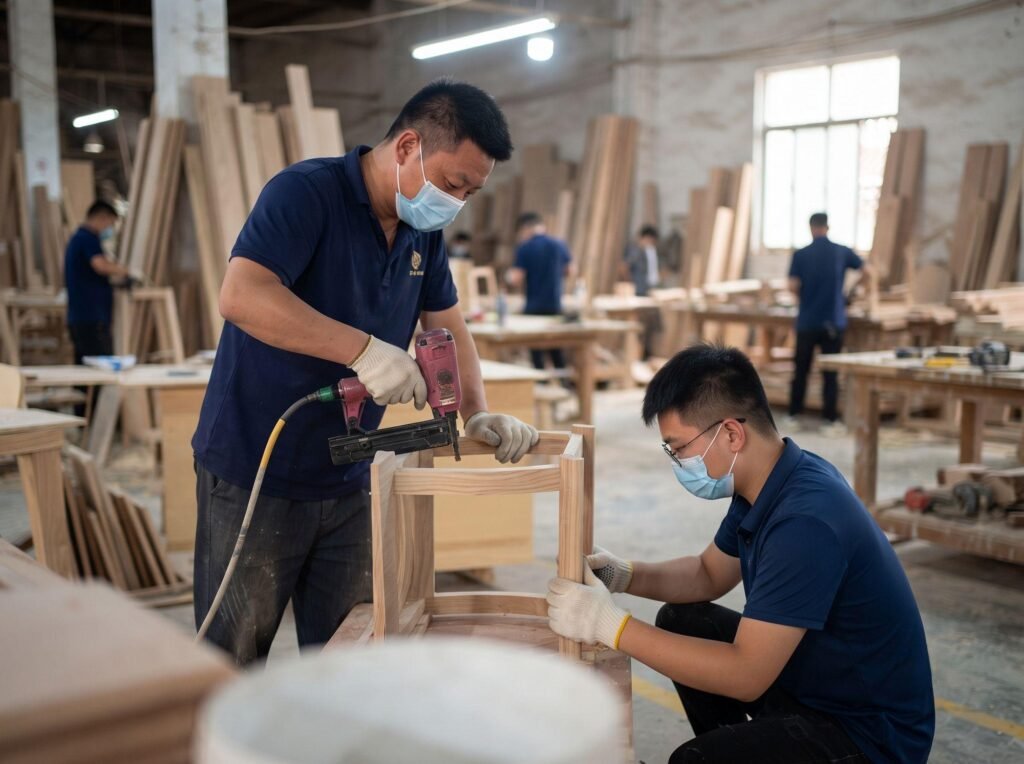
Hotel FF&E orders don’t arrive at factories as a steady stream. They hit like monsoons. Q1 and Q3 are the peak booking seasons for FF&E sourcing from China—Q1 feeding mid-year openings, Q3 feeding year-end or early-next-year launches. Walk into a Houjie factory in March and you’ll see the production schedule board covered in hotel project codes. One workshop might be running five hotel orders simultaneously. The risk of cross-contamination—wrong veneer on the wrong headboard, mixed hardware bags, confused shipping labels—isn’t theoretical. It happens when volume peaks and veteran floor managers get stretched thin.
Seasonal Spikes and the Scheduling Puzzle
Production lead time for hotel interior procurement typically runs 45-75 days on paper. In peak season, that stretches to 90-120 days at quality factories. The real complication? Your project rarely lives at one factory. Fixed installations come from Foshan. Loose furniture from Dongguan. Lighting from Zhongshan. Curtains and soft goods from Shenzhen. Project management isn’t about yelling at individual factories to hurry up. It’s about orchestrating seven or eight suppliers so that Container A (lobby) arrives two weeks before Container B (guest rooms), and Container C (restaurant) lands after the flooring contractor has finished. Miss that sequence, and you’re paying warehouse fees or idling installation crews.
Foshan vs Dongguan vs Panyu: A Capability Map
Not all Chinese furniture clusters play the same game. For hotel FF&E procurement China, knowing who does what saves you from mismatched expectations.
| Region | Core Strength | Hotel FF&E Fit | Typical Risk |
|---|---|---|---|
| Foshan Longjiang | Upholstery, custom fixed install, complete supply chain | High, especially lobby & guest room fixed furniture | Tight peak-season scheduling; small factories vulnerable to cash-flow breaks |
| Dongguan Houjie | Loose furniture, export-standard maturity, robust QC systems | High, preferred for standardized hotel room packages | Higher pricing; limited customization flexibility |
| Guangzhou Panyu | High-end custom, design-driven, small-batch boutique | Medium, ideal for boutique & design hotels | Limited capacity; large orders require subcontracting |
Industry Truth: Here’s what most procurement agents won’t tell you. When Chinese factories bid on hotel FF&E as a package, they’re not making their margin on the furniture itself. They’re charging a hidden 3-8% coordination premium on every category—fixed install, loose furniture, lighting, artwork. Is it fair? Honestly, if you tried to coordinate eight suppliers yourself, your hidden costs would run higher. The issue isn’t the fee. It’s transparency. Some factories bury this margin in unit pricing. Others list a separate “project management” line. The honest ones tell you upfront. The dishonest ones wait until change orders appear.
Logistics Is Not Shipping—It’s Sequencing
Hotel furniture procurement generates freight, but FF&E logistics is fundamentally different from moving containers of commodity goods. You are not shipping “a sofa order.” You are sequencing hundreds of individual items across multiple floors, zones, and installation phases. The packaging labels and loading sequence must be locked before the first carton leaves the factory. We saw a Maldives resort project where cartons arrived with no floor designation. The local crew spent three days on a tropical island opening boxes to figure out which villa got which headboard. That delay cost more than the freight.
Packaging by Floor, Delivery by Zone
Smart factories in Foshan have developed practices that separate amateur suppliers from professional hotel FF&E procurement China partners. One factory we work with uses color-coded exterior labels—red for lobby public areas, blue for standard rooms, yellow for suites. Inside each carton, an installation sequence card reads: “Install bed frame first. Nightstand second. Desk last.” This isn’t industry standard. It isn’t regulated. It exists only because that factory has been burned enough times by chaotic overseas sites to build the discipline. When you evaluate a factory, ask to see their packaging protocol. If they look confused by the question, keep walking.
The 3-Centimeter Nightmare
“Just ship it and we’ll figure it out on site” are the most expensive words in FF&E sourcing from China. Ocean transit takes 30-40 days. Customs clearance adds 7-14. If your fixed installation arrives and the pre-drilled holes don’t align with the electrical conduit positions in the wall, you aren’t looking at a production rework. You’re looking at a project stall.
A Sanya hotel project we reviewed had exactly this failure: the headboard panel’s cutouts for bedside sconce wiring were offset by three centimeters from the hardscape electrical boxes. The local contractor couldn’t modify the wall. The factory had to air-freight replacement panels. The direct cost of the error was $12,000. The real cost was a missed soft-opening date and the penalty clauses that came with it.
The Real Finish Line: Why Port Arrival Is Only 70%
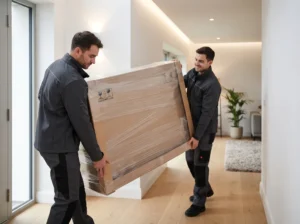
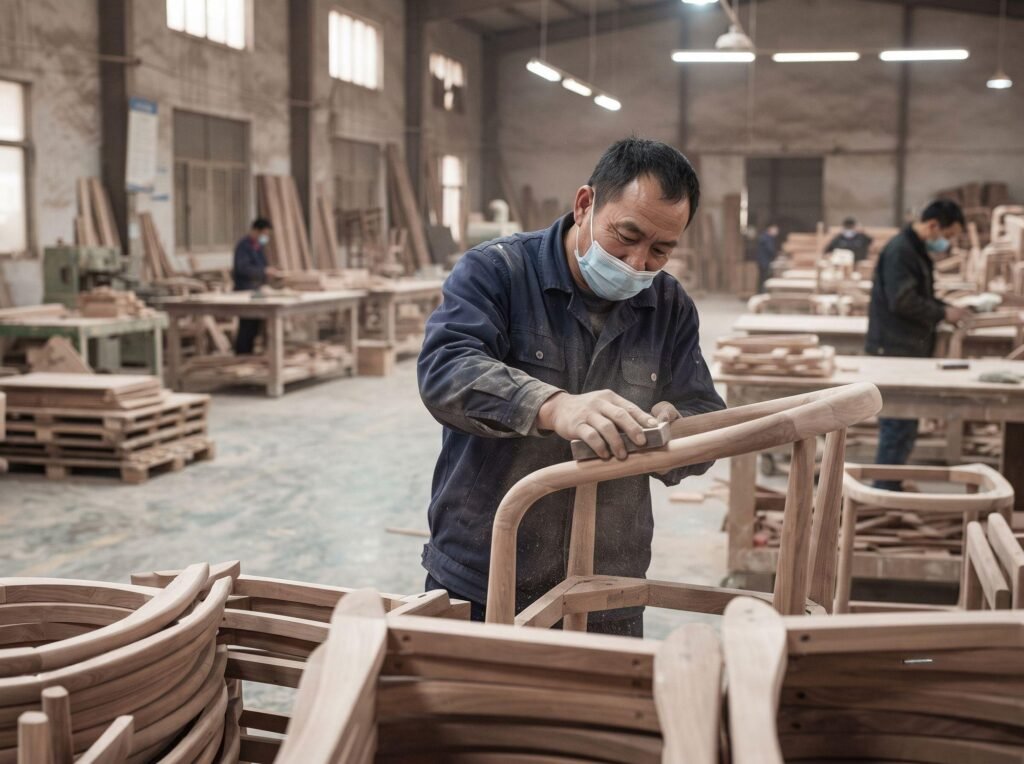
Cargo hitting the destination port is not victory. It is the end of the beginning. Field installation, fixed-installation commissioning, loose furniture positioning, lighting adjustment, and art placement constitute the invisible second half of hotel interior procurement. Chinese factories that understand hotel work don’t just manufacture. They dispatch installation supervisors who guide local crews through assembly sequences, leveling procedures, and finish-touch protocols. This handoff is where amateur suppliers disappear and professional partners prove their worth.
Installation, Commissioning, and the Hidden Handoff
The endpoint of FF&E sourcing from China isn’t the port. It’s the moment a guest swipes their key card and the room lights up correctly. Fixed installations often require field trimming. Loose furniture needs leveling on uneven floors. Lighting fixtures need wiring compatibility checks. Local contractors overseas are skilled at their trade, but they don’t know how a specific Chinese factory engineered a modular minibar cabinet or a floating vanity bracket. Without factory documentation—or better, a supervisor on site—the installation phase becomes a slow-motion troubleshooting exercise.
The Integration Edge You Can’t Buy Elsewhere
Let’s be blunt. The single greatest advantage of hotel FF&E procurement China isn’t cost savings. It’s the integration capability that no Western supply chain can replicate. Try finding one European supplier who can simultaneously deliver marble vanity tops, custom sofas, bedside wall sconces, and corridor art pieces within a single coordinated timeline. You can’t. The coordination complexity exceeds what fragmented Western markets can offer at any price. Chinese factory groups solve this by maintaining networks of specialized subcontractors—stone, metal, wood, fabric, lighting—under one project management umbrella. You pay for that umbrella. But without it, you’re managing ten vendors across six time zones.
Your Stage-by-Stage Control Checklist
Breaking hotel furniture procurement into controllable stages is the only way to prevent catastrophic drift. Use this framework to audit your project at each gate.
| Stage | Control Point | Common Pitfall | Your Action |
|---|---|---|---|
| Design Confirmation | Rendering-to-process feasibility review | Designers don’t understand factory limits | Require formal process confirmation letter from factory |
| Sampling & Sign-off | Material sample sign-off and sealing | Bulk production deviates from approved sample | Write batch color tolerance into contract (ΔE ≤ 1.5) |
| Production Scheduling | Multi-factory delivery rhythm alignment | Suppliers operate independently, causing chaotic arrivals | Appoint a single general contractor or PM firm |
| Pre-shipment QC | Floor/zone-based pre-assembly spot check | Structural issues discovered only after arrival | Require video inspection + critical milestone factory visits |
| Logistics Packaging | Packaging labels and installation sequence cards | No labeling causes on-site sorting chaos | Confirm packaging protocol in advance and embed in contract |
| Field Installation | Fixed-install dimensions vs. hardscape verification | Dimensional mismatch prevents installation | Re-verify critical dimensions after hardscape completion |

FAQ
How long does a full hotel FF&E procurement cycle from China take?
From design confirmation to guest-ready rooms, a complete hotel FF&E procurement China cycle typically spans 6-9 months. Design confirmation and sampling consume 2-3 months. Production runs 45-75 days. Ocean freight and customs take 30-45 days. On-site installation needs 2-4 weeks. Peak-season orders may add another 30 days.
What is the single biggest hidden risk in hotel furniture procurement from China?
The cost spiral triggered by late design changes. Once a factory has opened molds and locked material orders, any design revision triggers re-tooling fees, material waste, and schedule displacement. Quality issues get caught at inspection. Design miscommunication gets caught at installation. In hotel furniture procurement, timeline collapse is a bigger threat than manufacturing defects.
Should I use one factory or multiple suppliers for FF&E sourcing from China?
For standard business hotels, a single general contractor factory reduces coordination risk. For boutique or design hotels, expect 3-5 specialized suppliers. Either way, appoint one party—factory or PM firm—as the single timeline owner. Without a unified schedule, FF&E sourcing from China becomes a logistics nightmare.
How do I prevent variance between the mock-up room and bulk production?
Lock material standards at sampling. Require signed wood swatches, fabric samples, and finish samples from the exact production batch. Write batch color tolerance into the contract—ΔE ≤ 1.5 is a realistic standard for wood and fabric. Demand pre-production material submission for approval before bulk cutting begins. Without this gate, your mock-up is just a pretty prototype.
What percentage of my FF&E budget should go to project management?
Industry convention says 3-5%. We recommend 8-10% for hotel interior procurement from China. That extra margin isn’t overhead. It’s insurance. Projects that invest adequately in coordination, QC oversight, and on-site supervision almost always hit their opening dates. Projects that cut this line item to save money almost always pay for it in delay penalties and lost revenue.
Recommended Resource
Interi Furniture specializes in custom furniture manufacturing for residential, hospitality, and commercial projects. Their experience in materials, craftsmanship, and project realization makes them a valuable resource for designers and buyers seeking tailored furniture solutions from China.