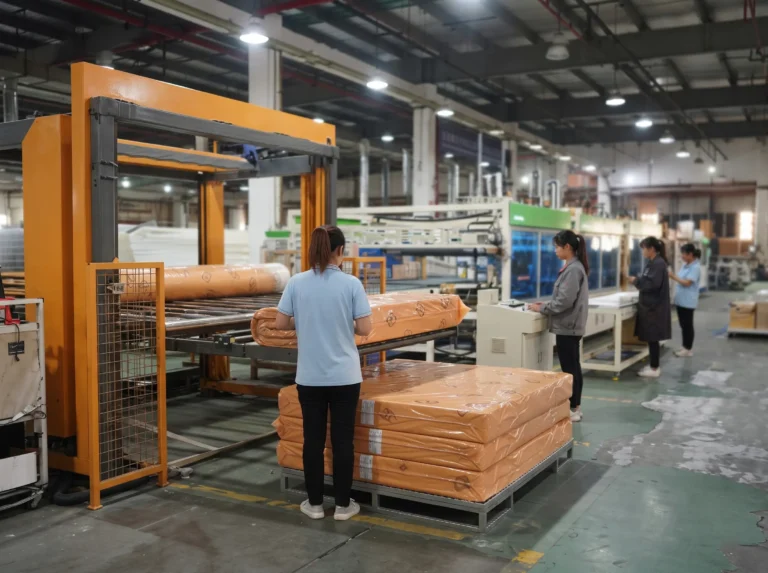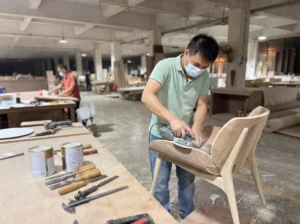


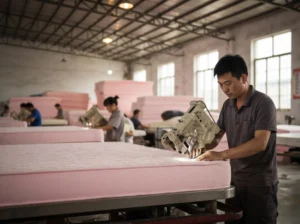






Most personal buyers do not need a sourcing agent for China furniture. The math rarely works in your favor when you are buying one sofa or a single dining set. Agents charge 5-10% commission, hide factory kickbacks in their “exclusive” supplier networks, and push overpriced logistics. For standardized pieces from Alibaba or direct factory contacts, DIY sourcing saves more than it risks. An agent only earns their fee when you are buying custom pieces, filling a full container, or navigating complex upholstery specifications. Otherwise, you are paying a middleman to forward WeChat messages.
The Anxiety Pipeline: How Agents Manufacture Fear
Walk into any Facebook group for expats furnishing homes in Asia, and you will see the same script. A “sourcing consultant” drops a horror story about a buyer who received a sofa in the wrong color, or a dining table that collapsed because “Western quality standards do not exist in China.” The subtext is always the same: without me, you are helpless. We have spent a decade walking factory floors in Foshan and Dongguan, and here is what we know. The fear is real, but the solution is often oversold. Factory mistakes happen. So do shipping damages and customs delays. But an agent does not magically eliminate these risks. They coordinate. They do not underwrite. If a factory ships the wrong SKU, the agent forwards your complaint. They do not refund your deposit. That distinction matters more than most buyers realize.
The marketing playbook relies on information asymmetry. Most personal buyers have never visited a Chinese industrial zone. They cannot picture a 200,000-square-meter factory district where one building welds metal frames and the next sprays PU leather. Agents translate this chaos into a curated experience. Sometimes that curation adds real value. More often, it is a filter that hides cheaper direct options and inserts a markup layer you never agreed to.

What Agents Actually Do (And What They Do Not)
Let us kill a myth first. A sourcing agent is not your insurance policy. They are not a quality guarantee. They are coordinators with local language skills and a WeChat contact list. The good ones visit factories, pull production samples, and push back on sloppy workmanship. The mediocre ones sit in a co-working space in Guangzhou, copy-paste factory catalogs into English, and mark up every line item.
We have watched agents in Shunde charge 8% commission on a single sofa while doing nothing beyond introducing the buyer to a factory that advertises openly on 1688.com. The buyer could have found that same factory in twenty minutes. The agent’s “value” was translating a few WeChat voice messages and sending a PDF invoice. That is not sourcing expertise. That is linguistic arbitrage.
The hard truth about agent necessity is this: it scales inversely with product standardization. The more custom, complex, or high-volume your order, the more an agent can justify their cut. The more standard, small, and simple, the more their fee looks like a tax on your inexperience.
The Real Cost Stack: Where Your Money Goes
Buyers fixate on the stated commission. They miss the rest of the stack. Here is how the money actually flows.
| Cost Layer | Typical Range | Transparency | What It Really Means for You |
|---|---|---|---|
| Stated Commission | 5-10% of order value | Disclosed upfront | The number you negotiate. Often the smallest piece. |
| Factory Rebate | 3-8% of factory invoice | Hidden | The factory pays the agent for bringing you. Your price is inflated to cover it. |
| Logistics Markup | $200–$800 per container | Hidden | Agent forces use of “their” forwarder at above-market rates. |
| FX Spread Manipulation | 1–3% on currency conversion | Hidden | Agent converts your USD at a rate worse than mid-market. |
| “Exclusive” Product Premium | 10–25% above factory direct | Hidden | Agent claims custom design; often just a catalog item with a logo swap. |
For reference only, subject to official verification: in our field interviews across Foshan and Dongguan during 2024-2025, approximately 60-70% of self-described “buying agents” admitted privately to taking factory rebates. The figure is not audited, but it aligns with what factory owners tell us over late-night factory dinners. When you add the layers, your “5% agent” often costs 15-20% more than buying direct. On a $15,000 furniture order, that is $2,250–$3,000 evaporating into opacity.
DIY Sourcing: The Capability Reality Check
Personal buyers routinely overestimate the difficulty of DIY sourcing. Yes, there is a learning curve. No, it is not insurmountable. The threshold question is not “Can I do this?” It is “Am I willing to spend forty hours on research and coordination to save $2,000?”
| Capability Dimension | DIY Sourcing Requirement | Agent-Assisted Requirement | The Honest Gap |
|---|---|---|---|
| Mandarin/English Communication | Basic; Google Translate + patience | None; agent handles all | Smaller than agents claim. Most export factories have English-speaking staff. |
| Time Investment | 30–60 hours for first order | 5–10 hours; mostly approvals | The trade-off is real. DIY demands weekends. |
| Quality Judgment | View samples, read reviews, request videos | Agent filters; you trust their eyes | High risk for first-timers on custom goods. Low risk on standard catalog items. |
| Logistics Coordination | Learn FOB and EXW shipping terms; book forwarder | Agent arranges; you pay their markup | Forwarders like Flexport or Freightos make this accessible. |
| Dispute Resolution | Direct negotiation with factory | Agent mediates; no financial liability | Agent mediation is soft power, not legal protection. |
The gap closes fast. For a personal buyer ordering a standard sectional and two beds from a factory with Alibaba Trade Assurance, DIY is genuinely viable. The factory wants your repeat business. They answer emails. They send videos. The nightmare scenarios agents describe are outliers, not norms.
Decision Matrix: When an Agent Earns Their Keep
Not all agent relationships are bad economics. The trick is matching the tool to the job.
| Scenario | Agent Value | Recommendation |
|---|---|---|
| Single sofa, standard fabric, < $3,000 | Minimal | Buy direct. Use Alibaba Trade Assurance or factory direct with escrow. |
| Full container load (FCL), mixed SKUs, > $15,000 | High | Agent justifies fee through consolidation, QC, and load planning. |
| Custom upholstery, non-standard dimensions, bespoke finishes | High | Factory communication is nuanced. An agent on the ground prevents costly misreads. |
| First-time buyer, no time, high risk tolerance for fees | Moderate | Pay for convenience, but cap commission at 5% and demand line-item transparency. |
| Small batch for Airbnb/short-term rental, 6-12 pieces | Low-Moderate | Direct sourcing with third-party inspection is usually cheaper and safer. |
This is the core of any honest furniture sourcing decision. The agent is a tool, not a talisman. Use them when the complexity premium exceeds their cost premium. Do not use them because you are afraid of a factory in Guangdong.
Red Flags: Spotting the Middleman in Agent Clothing
The line between a true buyer’s agent and a disguised trader is blurry by design. Here is how to tell which one you are talking to.
| Red Flag | What It Looks Like | What It Means |
|---|---|---|
| Refuses direct factory contact | “My relationship is exclusive. I protect you from price manipulation.” | They are marking up the factory price. A real agent introduces you. |
| Vague or bundled quoting | “Your total landed cost is $18,500.” No itemization. | Hiding markups in the aggregate. Demand line-item breakdowns. |
| Forces logistics through “their” forwarder | “Customs is too complex. You must use my broker.” | Earning a rebate on shipping. You can choose any forwarder. |
| No inspection credentials | Claims to QC but has no checklist, no photos, no report | Visual QC is not enough. Ask for AQL sampling standards. |
| Demands large upfront payment | 50% deposit to agent, not factory | Your money sits with a middleman. Pay factories directly when possible. |
We have seen agents in Longjiang tell buyers that a factory “only works through agents.” That is nonsense. Factories want volume. They do not care whether you found them through an agent or a Google search. If an agent invents gatekeeping, they are gatekeeping your wallet.

The Hidden Risks Nobody Talks About
There is a quieter risk than outright fraud. It is dependency. The longer you use an agent, the less you learn. You never build direct factory relationships. You never understand true pricing. You never develop the judgment to spot a bad sample. We call this the warm-water effect. It is comfortable until it is expensive.
Another underreported issue: agent-driven supplier lock-in. An agent with a rebate agreement will steer you toward Factory A even when Factory B offers better quality at a lower price. Their incentive is misaligned with yours. They are paid by the factory, not by you, regardless of what the contract says.
Then there is the liability gap. When a container arrives with water damage or missing cartons, the agent shrugs. “File a claim with the forwarder.” They do not absorb the loss. You do. Their 8% commission bought you coordination, not coverage.
Perhaps the most dangerous pattern we observe is the gradual erosion of buyer autonomy. After two or three orders, you stop questioning quotes. You stop requesting alternative samples. You assume the agent has your back because they remember your birthday. That is not a business relationship. That is a dependency trap dressed in courtesy.
Buyer Type Playbooks
Different buyers need different rules.
Pure Personal Buyer (Furnishing a Home)
Your order is probably one to four pieces. Total budget $3,000–$12,000. You need standard items: a bed, a sofa, a dining set. Skip the agent. Source direct from factories in China’s furniture manufacturing clusters, use Alibaba Trade Assurance for payment protection, and hire a third-party inspection firm for $200–$300 if you want eyes on the goods before they ship. Your savings will cover the inspector three times over.
Small Airbnb / Short-Term Rental Operator
You are buying 6–12 pieces across two or three SKUs. You need durability and consistent finish. An agent might help consolidate, but a better play is direct factory negotiation with a furniture quality grading system checklist. Ask for commercial-grade foam density, fabric rub counts, and frame warranties. Book a third-party inspection before loading. You get agent-level QC without agent-level markup.
Independent Interior Designer (Personal Project Procurement)
You are specifying custom dimensions, mixed materials, and tight color matches. This is where an agent can earn their keep. But negotiate hard. Cap commission at 5%. Insist on direct factory introduction. Require photo-documented QC with AQL sampling. Understand custom furniture lead times so you do not accept rushed production that compromises quality. And never let the agent control payment flow. Pay the factory directly. The agent gets their cut after you confirm satisfactory delivery.

Frequently Asked Questions
Do I need a sourcing agent for a single sofa?
No. For one-off standard pieces, an agent adds cost without adding proportional value. Buy direct, use Trade Assurance, and request a video factory tour. The $400–$800 you save on commission pays for a lot of risk mitigation.
How do I know if my agent is taking factory kickbacks?
You probably cannot know for certain. That is the problem. The red flags are refusal to introduce you directly to the factory, bundled pricing without line items, and pressure to use specific suppliers. If you suspect rebates, demand a signed disclosure. Most will not provide one.
Can I really handle shipping and customs myself?
Yes. For less-than-container-load (LCL) shipments, platforms like Freightos or Flexport let you compare forwarders, book space, and track cargo. Customs brokers in your destination country handle the paperwork. The “customs is too complex” line is often a sales tactic. For reference only, subject to official verification: personal buyers in the US, UK, and Australia successfully self-clear customs daily with the right broker.
What is the difference between a sourcing agent and a trading company?
A sourcing agent represents your interests and should charge you a transparent fee. A trading company buys from the factory and sells to you, hiding their margin in the product price. Many “agents” are actually traders. The test is simple: do they let you pay the factory directly? If not, they are a trader.
Is DIY sourcing actually cheaper, or do hidden costs eat the savings?
DIY is cheaper for standard, small orders. The hidden costs—your time, a bad sample, a shipping mistake—are real but manageable. On a $5,000 order, even a 10% DIY mistake still costs less than a 15-20% agent stack. Scale matters. The larger and more complex the order, the more an agent’s expertise offsets their fee.
Should I let my agent handle payment to the factory?
Generally, no. Paying the agent instead of the factory introduces an unnecessary intermediary into your financial chain. If the agent disappears or misappropriates funds, you have no direct recourse against the factory. The factory may also refuse responsibility for defects because they received payment from the agent, not you. Always pay factories directly when possible, and use escrow services like Alibaba Trade Assurance for additional protection.
What Is Your Next Move?
We have laid out the math. Now we want to hear your story. Have you worked with a sourcing agent who delivered real value—or one who vanished after the deposit cleared? Are you staring at a factory catalog right now, wondering whether to click “contact supplier” or hire help? Drop your experience or your specific scenario in the comments. We read every one, and we will give you a straight answer.
Recommended Resource
Interi Furniture specializes in custom furniture manufacturing for residential, hospitality, and commercial projects. Their experience in materials, craftsmanship, and project realization makes them a valuable resource for designers and buyers seeking tailored furniture solutions from China.