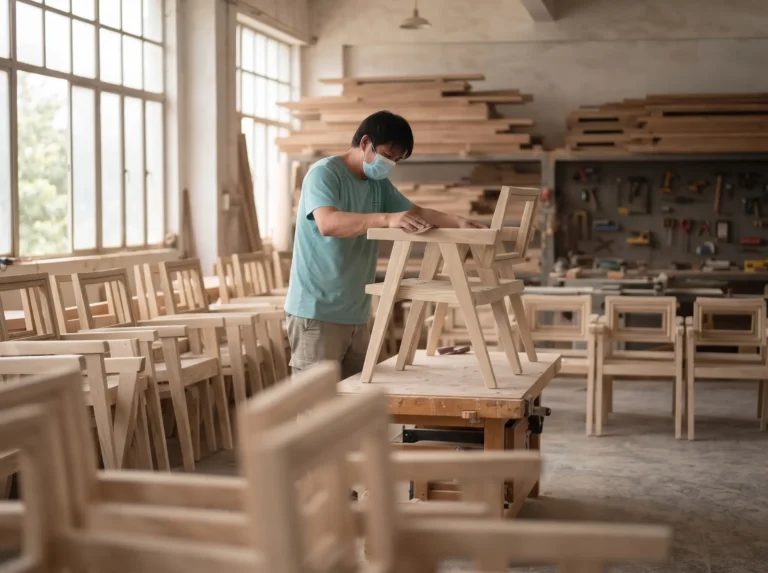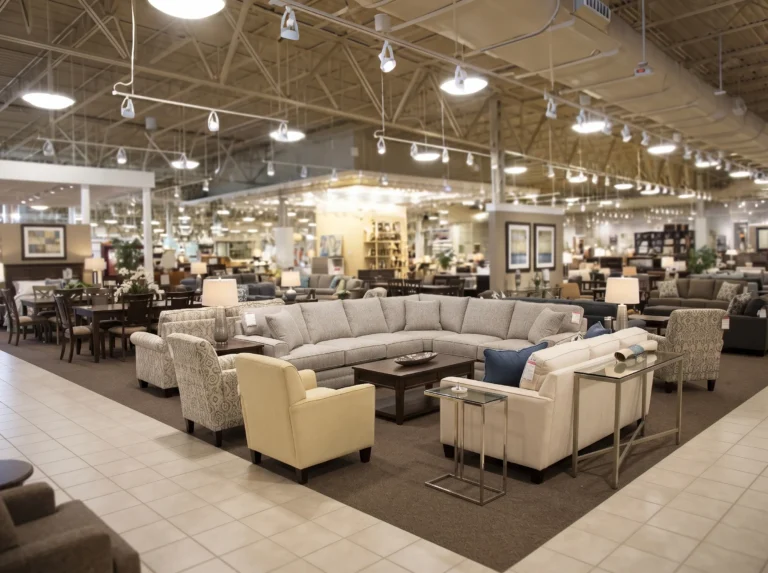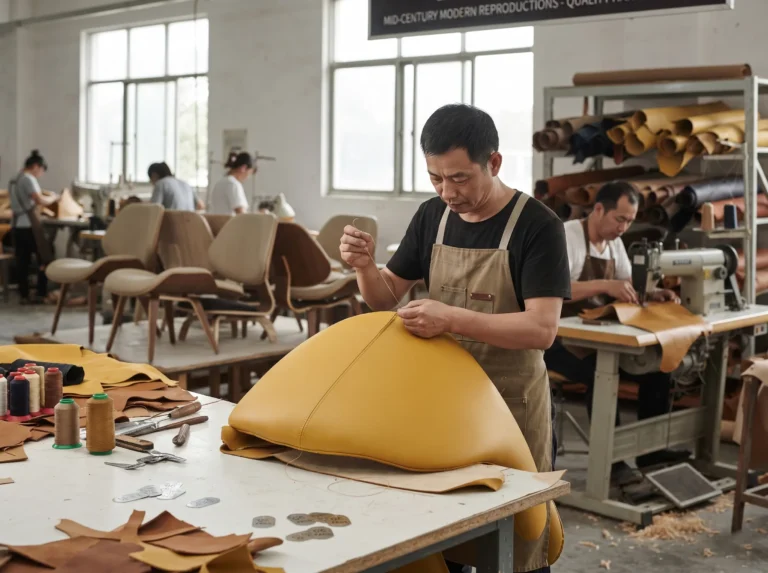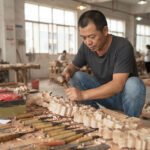


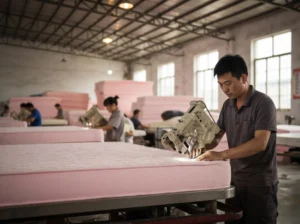

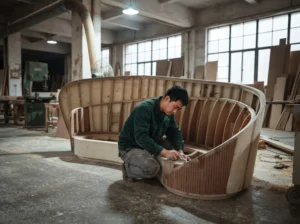
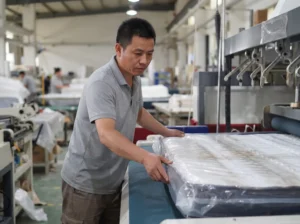





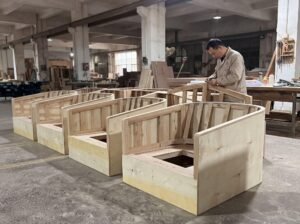

A narrow tier of Chinese factories now builds furniture with the same Italian leather, the same German and Italian hardware, and the same multi-coat finishing systems you will find in Milan showrooms. The fifty percent price gap is not a quality gap. It is a brand-premium gap, built from century-old narrative equity, Milan Design Week marketing burn, European distributor margins, and cross-border tariff stacks. For buyers who value material honesty over label prestige, China luxury furniture quality at the top tier offers genuine value for money furniture without the markup architecture. This is not a story about “cheap China.” It is an Italian furniture comparison that starts on the factory floor in Foshan Longjiang, not in a Milan boutique.
The Buyer’s Dilemma: Sticker Shock and Stereotypes
You walk into a Milan showroom. A full-grain leather sectional sits under perfect lighting. The price tag could fund a decent down payment on a studio apartment. You hesitate. Then you scroll through Alibaba at midnight or wander a Guangzhou showroom and see something visually similar at forty to sixty percent less. Your instinct whispers trap. Your budget screams opportunity. This is the exact paralysis we see in buyers from Manhattan penthouses to Bali boutique hotels. The anxiety is not irrational. The market is noisy. Thousands of Chinese factories claim “Italian standard” while running economy-grade vinyl and shortcut joinery behind the scenes. Separating the real premium players from the pretenders requires understanding where the money actually goes, not just where the container ships from.
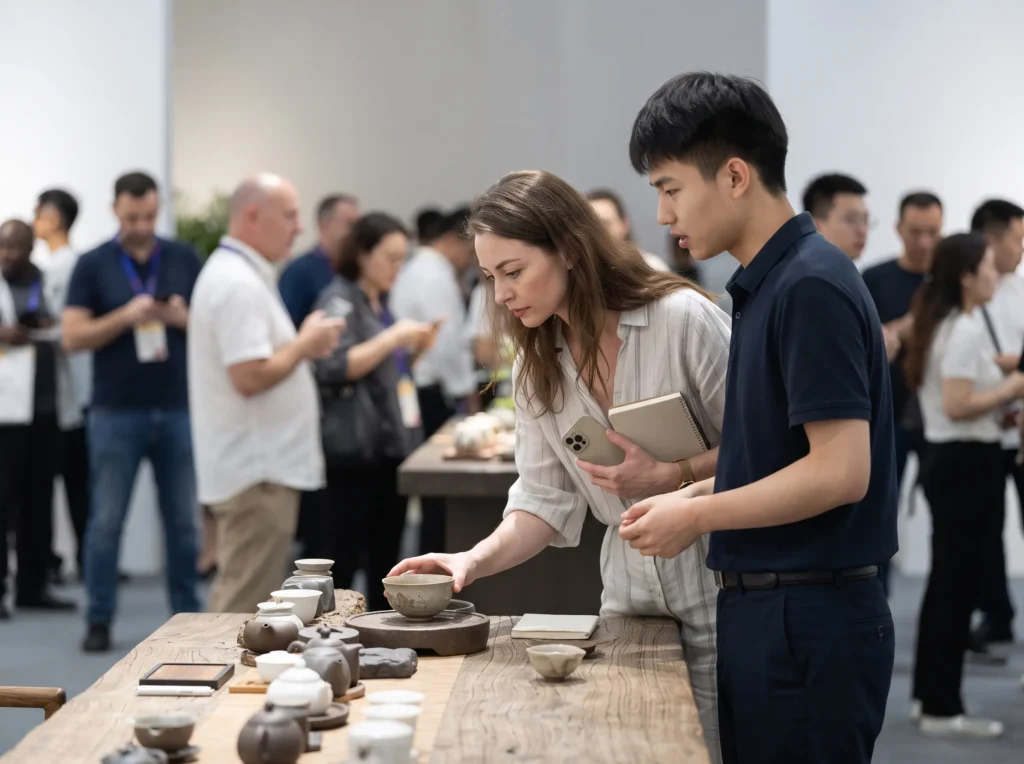
Dismantling the Myth: Italy Does Not Own the Periodic Table
The furniture industry loves a binary. Italy equals artisanship. China equals mass production. That framing sells showrooms but it obscures supply chains. Here is what we have seen on the ground in Dongguan Houjie and Foshan Longjiang over the last decade.
The same Italian tanneries that sell full-grain hides to Poltrona Frau and Minotti also sell to a handful of Chinese factories. Mastrotto leather does not check a passport at the warehouse door. The same Sayerlack UV and polyurethane coating systems used in Brianza are imported by Chinese factories chasing export-grade finish durability. North American FAS-grade black walnut is not “Italian wood.” It is timber that ships from Missouri or Ontario to Milan and to Guangzhou through different freight forwarders. The material genome of high-end furniture is global. Italy’s edge is not elemental access. It is curation, design narrative, and century-old brand equity.
That distinction matters. When you pay Italian retail, you are often paying for distribution depth, not deeper material quality. For reference only, subject to official verification, industry estimates suggest that between five and eight percent of Chinese furniture export volume originates from factories capable of true Italian-tier material and process standards. The rest is mid-market noise dressed in showroom lighting.
Key Terms for Buyers
| Term | Definition |
|---|---|
| FOB出厂价 | Factory door price before international freight and insurance; the baseline for comparing true manufacturing cost |
| 品牌溢价 (Brand premium) | The markup attached to heritage narrative, design IP, and emotional value rather than material or labor cost |
| 渠道加价率 (Channel markup) | The cumulative margin added by importers, national distributors, regional dealers, and retail showrooms |
| 扪工 (Upholstery craftsman) | The skilled worker who hand-stretches leather or fabric over foam and frame; critical to final silhouette and tension |
| 榫卯 (Mortise and tenon) | Traditional hardwood joinery using interlocking projections and recesses without metal fasteners |
| 开放漆 vs. 封闭漆 (Open-pore vs. closed-pore finish) | Open-pore leaves wood grain tactile; closed-pore fills grain for a glass-smooth, mirror-like surface |
China Premium vs. Italian: Material and Craftsmanship Standards
The following table breaks down the material and process parallels we have observed in factories that genuinely compete at the Milan tier.
| Standard Dimension | Italian Tier Benchmark | China Premium Tier (Verified Capability) | Typical Mid-Market China |
|---|---|---|---|
| Leather source | Italian full-grain, Mastrotto or equivalent tanneries | Same tanneries, same grading protocols; often identical hide lots | Split leather, bonded, or corrected grain with heavy PU overlay |
| Solid wood spec | FAS-grade North American walnut or oak; 8-12% moisture content | Same FAS grading; kiln-dried to identical moisture targets | Lower grade lumber; higher moisture variance; finger-jointed shortcuts |
| Hardware | Salice, Hettich, or Italian bespoke mechanisms | Same branded hardware; some factories use Italian OEM suppliers directly | Unbranded local hinges and soft-close systems |
| Foam density | 45D high-resilience foam in seat cores; multi-density layering | 45D HR foam with identical density and compression set ratings | 25D-35D foam; faster sag; shorter lifecycle |
| Finish system | 8-coat process: sealer, stain, open-pore or closed-pore topcoat | Same Sayerlack or equivalent chemistry; same spray-booth humidity control | 3-4 coat shortcut; uneven film build; premature peeling |
| Joinery and framing | Hardwood corner blocks, mortise-and-tenon, doweled and glued | Hardwood corner blocks; mortise-and-tenon in solid wood lines; metal reinforcement in upholstered frames | Staple-and-glue framing; plywood corner blocks |
| Upholstery handwork | Hand-tied springs, hand-stitched welts, precision tufting | Same hand-tied eight-way spring systems; experienced upholstery craftsman teams | Sinuous wire or webbing; machine-only closing |
The table tells a clear story. At the top tier, the material stack is fungible. The difference is factory discipline, not geography. A Sayerlack topcoat sprayed in a humidity-controlled booth in Dongguan cures the same way it cures in Como. The upholstery craftsman in Foshan who has spent fifteen years wrapping foam and pulling leather taught himself by studying the same exported samples that trained his predecessors. In other words, China luxury furniture quality at this level is a supply-chain reality hiding behind language barriers and outdated stereotypes.

Price Decomposition: Where the 50% Gap Actually Comes From
Buyers often assume a lower price implies a missing ingredient. In our experience sourcing across both ecosystems, the discount is structural, not subtractive.
| Cost Layer | Italian Brand Retail | China Premium Factory Direct (FOB) | Nature of the Gap |
|---|---|---|---|
| Factory ex-works cost | Baseline material + labor + overhead | Roughly comparable; sometimes 10-15% lower due to local labor rates | Modest; not the driver |
| Brand premium / design royalty | 25-40% markup for heritage narrative and design IP | Minimal; most Chinese premium factories lack global pricing power | Major driver |
| Marketing and show events | Milan Design Week, Salone del Mobile, global showroom network | Trade-show booths in CIFF or local showrooms; digital outreach only | Significant |
| European distribution layers | Importer, national distributor, regional dealer, local boutique | Often factory-to-buyer or factory-to-agent; fewer hops | Major driver |
| Import duties and freight | EU-to-US or EU-to-Asia tariffs; white-glove last-mile | China export FOB; buyer assumes ocean freight and destination duty | Context-dependent |
| After-sales and warranty reserve | Embedded in retail price; white-glove service networks | Varies widely; often leaner or agent-mediated | Real gap; not to be ignored |
Add these layers together and the “half price” narrative makes sense. You are not buying lesser leather. You are buying fewer intermediaries and less narrative rent. The factory in Longjiang is not discounting because they use cheap foam. They are discounting because they have never paid for a Salone del Mobile booth that costs more than a suburban villa.
Factory Profiles: Who in China Can Actually Compete with Milan
This is where the conversation gets sharp. Not every factory with a polished showroom in Louvre Furniture Mall is playing at this level. In our walks through production floors, the real contenders share common traits.
| Region | Known Cluster Strength | Premium Capability Signal | Common Pretender Red Flag |
|---|---|---|---|
| Foshan Longjiang, Guangdong | Upholstery capital; massive ecosystem of foam, fabric, and leather vendors | In-house upholstery craftsman teams with ten-plus years experience; direct Mastrotto or Gruppo Mastrotto supply contracts | Showroom replicas of Minotti or Baxter silhouettes with downgraded internals |
| Dongguan Houjie, Guangdong | Historic export base; strong Taiwanese-invested factories from the 1990s | ISO 9001 plus FSC chain-of-custody; Sayerlack or ICA finishing lines | “Italian design” banners with no material provenance documentation |
| Ningbo, Zhejiang | Solid wood and bentwood expertise; strong Japanese and Northern European OEM history | Precision 5-axis CNC for curved components; kiln-drying to JIS or NHLA standards | Mid-grade rubberwood sold as “walnut” through heavy staining |
| Hangzhou / Jiaxing area | Soft upholstery and mattress crossover; e-commerce fulfillment strength | OEKO-TEX or CertiPUR foam certification; clean supply chain auditing | Fast-fashion furniture cycles; quality drifts between batches |
For reference only, subject to official verification, our field estimate is that fewer than three dozen factories across these clusters consistently execute at the material and process tier described above. The rest are trading on proximity to greatness.
Risk Assessment: When “Premium Chinese” Is Just Marketing
We would be doing buyers a disservice if we pretended every “high-end” Chinese label is a hidden gem. The pretender economy is real.
| Risk Signal | What It Looks Like | Why It Matters |
|---|---|---|
| Vague leather terminology | “Top-layer cowhide” or “genuine Italian leather” without tannery name | Corrected-grain or split hides with heavy pigment finish; will not age or develop patina |
| No wood species declaration | “Solid wood” or “imported wood” without NHLA grade or origin | Rubberwood, acacia, or poplar stained dark; unstable in dry climates |
| Hardware anonymity | “High-quality hinge” instead of Salice, Hettich, or Grass branding | Cycle-life failure in under three years; sagging doors and misaligned drawers |
| Finish oversell | “Eco-friendly paint” with no VOC spec or brand chemistry | Uneven color fastness; sticky film; poor UV and moisture resistance |
| Certificate theater | Framed ISO certificates in the showroom that do not match the production floor | Audit shopping; certificate belongs to a sister facility or expired years ago |
The honest truth is that many buyers who think they are getting Italian quality at Chinese prices are actually getting Chinese mid-market at inflated prices. The showroom is stagecraft. The factory floor is the script. If you cannot smell leather in the cutting room or see branded chemical drums in the finishing area, you are paying for a photograph, not a product.

What China Has Not Closed: The Honest Gap
We are not here to declare victory. There are areas where Italian furniture still holds legitimate advantage, and buyers deserve to know them before they wire a deposit.
Design originality remains the clearest gap. Italian houses invest in design studios, design royalties, and generational design memory. Most Chinese premium factories excel at execution and adaptation. True authorship is rarer. You will find excellent interpretations of mid-century or contemporary silhouettes. You will find fewer pieces that shift the design conversation.
Brand narrative and after-sales architecture are also weaker. An Italian brand can dispatch a technician to repair a scratch in London or Los Angeles within forty-eight hours. A Chinese factory direct buyer often relies on local agents, video calls, or DIY solutions. If white-glove service and design provenance are non-negotiable for your project, Italian retail may still be the rational choice. We are comparing material and craftsmanship standards in this article, not design philosophy or service ecosystems.
Sourcing Playbooks by Buyer Type
For High-End Residential Owners
Focus on material provenance over silhouette. Ask for the tannery name, the foam density spec, and the finishing chemistry brand. Request video walkthroughs of the actual production line, not just the showroom. If a factory hesitates to show you the spray booth or the upholstery craftsman station, they are not confident. Negotiate FOB terms and arrange your own freight forwarder to maintain transparency. Inspect the crate before it seals.
For Hotel and Commercial FF&E Procurement
Batch consistency matters more than single-piece beauty. Demand a production control plan with AQL inspection protocols. Specify the exact leather batch and wood moisture content in your purchase order. The premium Chinese tier is capable of hotel-grade durability, but only if you lock the spec in writing. Do not accept “same as sample” without quantified tolerances. A hotel lobby sees more abuse in six months than a living room sees in six years.
For Independent Interior Designers
Your reputation rides on install-day reality. Partner with factories that have export-case packing experience and documented damage rates. Ask for reference projects in your target market. The best Chinese premium factories have quietly supplied contract projects in Dubai, Sydney, and Manhattan. They just do not advertise it on Instagram because their NDAs are tighter than their mortise joints.

Frequently Asked Questions
Can Chinese furniture really use the exact same leather as Italian brands?
Yes, at the top tier. Full-grain hides from Italian tanneries like Mastrotto are commodity inputs sold to qualified buyers globally. A factory in Foshan with the right credit line and volume commitment can pull from the same lot as a factory in Meda. The hide does not know which passport the upholsterer carries. What matters is whether the factory grades, cuts, and stitches with the same discipline. We have stood in cutting rooms where the hide tags literally showed the same lot numbers we later saw in an Italian atelier.
Why is the price difference so large if the materials are similar?
Because retail price is not material cost. Italian brands carry design royalties, multi-layer distribution margins, Milan Design Week amortization, and import tariff stacks. Chinese premium factory-direct pricing strips most of that away. You are paying for the object and the ocean freight. You are not paying for the story. The leather is the same. The margin architecture is not.
How do I verify a factory actually uses the materials they claim?
Ask for supplier invoices or mill certificates with lot numbers. Reputable factories keep chain-of-custody paperwork for FSC wood, Mastrotto leather, and Sayerlack coatings. If they refuse, treat it as a signal. Also, visit if possible. The smell of genuine full-grain leather in the cutting room and the sight of branded chemical drums on the finishing floor are harder to fake than a showroom vignette. A factory that runs Mastrotto will usually be proud to show you the warehouse tags.
Is the craftsmanship truly comparable, or just the materials?
Craftsmanship is harder to benchmark because it is human and variable. That said, the best Chinese factories have absorbed decades of OEM know-how from Italian and Japanese clients. Their upholstery craftsman teams and finishing technicians are skilled. The gap is usually in consistency across large batches and in the subtle ergonomic refinements that come from decades of design-house feedback loops. For static pieces like dining tables and case goods, the gap is minimal. For complex upholstered shapes with compound curves, Italian atelier experience still shows in the final proportions.
What are the biggest red flags when visiting a Chinese “luxury” furniture factory?
Certificate frames that do not match the facility name. Showrooms full of obvious knockoffs with swapped logos. Spray booths that smell of cheap nitrocellulose instead of catalyzed polyurethane. Wood storage yards with no humidity control. And sales teams who cannot explain the difference between open-pore and closed-pore finishing. These are not premium signals. They are exit signals. Trust your nose and your eyes more than the framed certificates.
Will Chinese premium furniture hold resale value like Italian pieces?
Generally, no. Resale value in furniture is driven by brand name and design provenance, not by leather grade alone. A Minotti sofa commands secondary market interest because of the label. A comparable unlabeled Chinese piece, even with identical hides, does not carry that narrative equity. Buy Chinese premium for use value and honest material quality. Do not buy it as a speculative asset. The value lives in the living, not the resale.
What Is Your Experience?
Have you sourced high-end furniture from China? Did the delivered piece match the showroom promise, or did you discover hidden shortcuts after unboxing? Drop your material or factory question below. We read every comment and use them to sharpen our next factory-floor report.
Recommended Resource
Interi Furniture specializes in custom furniture manufacturing for residential, hospitality, and commercial projects. Their experience in materials, craftsmanship, and project realization makes them a valuable resource for designers and buyers seeking tailored furniture solutions from China.