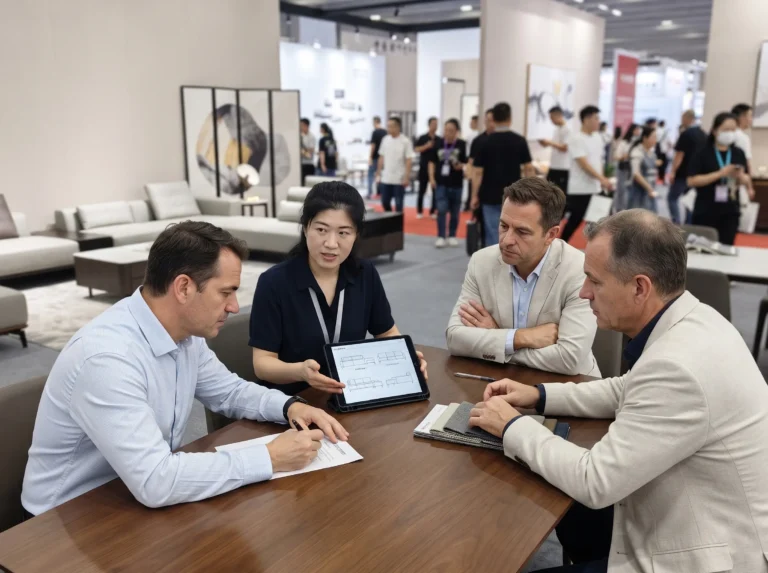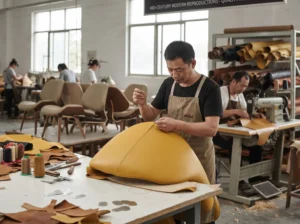


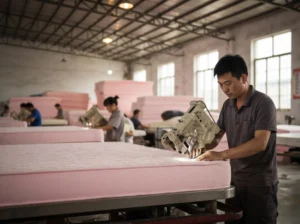

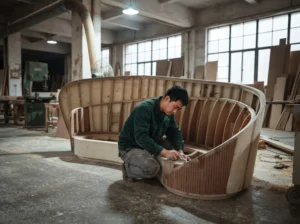
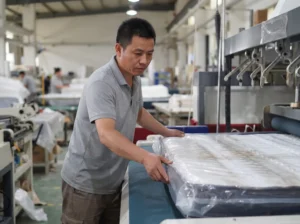



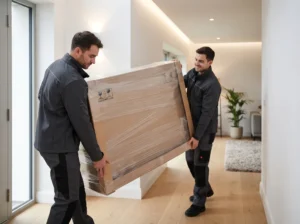

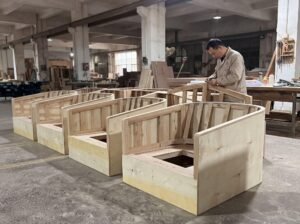
Most “Chinese brand” furniture listings on Amazon do not come from the coherent brand entity they claim to be. We have walked factory floors in Foshan, Dongguan, and Shenzhen, and the reality is blunt: the sofa you see under a polished “Founded in 2015 with a passion for minimalist living” story is often the exact same product sold under four other brand names by the same trading company, or straight off an OEM line that also supplies a “US-based” private label. The brand page is theater. The factory floor is the script no one reads. If you are trying to figure out whether your money is going to a real manufacturer, a middleman with twenty storefronts, or a dropshipper repackaging Alibaba stock, this is the map you need.
The Disconnect: Why Buyers Feel Duped
You browse Amazon, spot a dining set with a slick brand logo and a founder story about a design studio in Shenzhen. The photos are clean. The reviews look solid. You buy it. Three weeks later the box arrives, the instructions are generic, the hardware bag has no brand markings, and when a leg cracks you realize the “brand” has no website, no phone number, and a support email that bounces. You are not alone. This is the standard post-purchase arc for a huge slice of Amazon furniture seller China inventory.
The frustration runs deeper when you start noticing patterns. That mid-century modern bookshelf you almost bought under Brand A? Brand B has the identical unit, down to the cam-lock hardware and the same stock photo with a different logo cropped in. Brand C sells it for forty dollars more with a “premium” tagline. You begin to suspect the obvious: these are not three competing design houses. They are three labels slapped on the same factory carton. Your suspicion is correct more often than Amazon’s interface lets on.
The Myth of the “Chinese Brand” on Amazon
Here is the first misconception we need to kill. When Amazon tags a listing as a “Chinese brand” or when shoppers use that phrase, there is an implicit assumption that the seller is a Chinese factory running its own direct-to-consumer storefront. Cut out the middleman, pass the savings on, right? That model exists, but it is the minority case, not the default. The majority of what gets labeled “Chinese brand” furniture on Amazon flows through trading company matrices, private-label aggregators, or cross-border ecommerce operators who have never touched a CNC router.
Amazon itself does not officially define “Chinese brand.” There is no badge, no verification protocol, no supply-chain disclosure requirement that forces a seller to reveal whether they own the factory, rent a corner of it, or simply found the SKU on 1688.com last Tuesday. Brand Registry 2.0, Amazon’s trademark-protection program, only checks that you hold a valid trademark. It does not check factory ownership. It does not check whether your “brand” is one of seventeen storefronts run out of a single office in Nanshan District, Shenzhen. The opacity is structural, not accidental.
Amazon “Chinese Brand” Furniture: The Three Real Source Models
After years of sourcing trips and conversations with factory owners, cross-border operators, and freight forwarders in Guangdong, we break the real supply chain into three buckets. The proportions below reflect our field observations and industry conversations. For reference only, subject to official verification.
| Source Model | What It Looks Like on Amazon | What Is Actually Happening | Typical Red Flags for Buyers |
|---|---|---|---|
| Factory Direct Brand Store | A single-brand storefront with a narrow catalog, often in one category (e.g., only dining chairs or only bed frames). Claims “designed and manufactured by us.” | The factory registered the trademark, passed Brand Registry, and runs the Amazon account itself. Usually has lower marketing polish but more consistent stock and packaging. | Limited SKU range; packaging carries the same brand name; slower but more substantive customer service responses |
| Trading Company Matrix | Multiple “independent” brands, each with its own storefront, polished logo, and founder story. Catalogs overlap heavily. | One Shenzhen or Dongguan trading company operates ten to fifty Amazon accounts. They buy from the same pool of factories, sometimes customize colors or legs, and price-test across brands. This is the dominant model in the sub-$500 furniture segment. | Identical product dimensions and hardware across brands; stock photos with different logos; reviews mentioning “same as my other chair from [different brand]” |
| Private-Label Reseller (US/EU-based) | Listing appears under a “US brand” with American customer service and premium pricing. Often claims “designed in California.” | A US or European buyer placed an OEM/ODM order with a Chinese factory, designed the packaging and brand book, and imports via FBA. The factory may simultaneously sell a white-label version under its own Amazon account or via a trading company. | “Designed in [Western city]” but no mention of manufacturing origin; price 30–80% higher than visually similar units; same factory code on the warranty card as cheaper alternatives |
The trading company matrix deserves extra attention because it is the engine most shoppers never see. We have spoken with operators in Shenzhen’s Bao’an and Longhua districts who manage thirty to forty Amazon seller accounts across home categories. They use the same pool of photographers, the same copywriting templates, and the same 3PL warehouses in California or New Jersey. When one brand gets hit with a suspension or a review purge, they shift inventory to another account. The product never changes. Only the logo and the price do.
Brand Narrative vs. Factory Reality: What the Product Page Hides
The product page is where the illusion gets built. We are not talking about minor exaggerations. We are talking about origin stories invented whole cloth by marketing teams who have never visited the factory that actually cuts the wood.
| What the Listing Says | What the Factory Floor Tells Us | Why It Matters to You |
|---|---|---|
| “Founded in 2015 by designers passionate about Scandinavian minimalism” | The trademark was filed in 2022 by a trading company. No in-house design team exists. The “Scandinavian” sofa is a catalog ODM model offered to any buyer. | You are paying for a story, not for design R&D. The same sofa may sell under three other names at different prices. |
| “Ethically manufactured in our own facility” | The factory is a third-party OEM in Foshan that also produces for Walmart suppliers and European wholesalers. The seller has no equity stake. | “Own facility” implies vertical integration and quality control investment. If it is just a purchase order, that implication is misleading. |
| “Rigorous 3-step quality inspection” | The factory runs standard QC per AQL 2.5, which is baseline, not exceptional. The seller likely never visits the line. | This language creates a false sense of premium oversight. Most furniture factories in China operate at similar baseline QC levels. |
| “Thousands of happy customers” with 4.5+ stars | Review profiles show clusters of unverified purchases, Vine-heavy early reviews, or merged-variation review stacking from unrelated products. | The social proof may be engineered. See the next section on algorithm incentives. |
The gap between narrative and reality is not unique to Amazon, but Amazon’s interface makes it especially potent. A polished A+ Content page with lifestyle photography and a brand story module can make a trading company’s white-label sofa look like a curated design studio’s flagship piece. The buyer has no easy way to cross-check. There is no “verify factory ownership” button next to the Buy Box.
Amazon Algorithm Incentives: Why Information Asymmetry Thrives
Amazon’s A9 algorithm does not reward transparency. It rewards velocity, review density, and conversion rate. That creates a system where the incentives run directly against the buyer’s need for honest sourcing information.
| Algorithm Mechanism | How It Rewards Opacity | Real-World Impact on Furniture Buyers |
|---|---|---|
| Review weighting in search rank | Sellers with higher star counts and more reviews rank higher, regardless of review authenticity. | A trading company matrix can push the same product through five brands, accumulate reviews across all of them, and dominate page one. The buyer sees “5,000 reviews” and assumes market validation. |
| Vine program access | Registered brands can enroll products in Vine to seed early reviews. Costs are manageable for trading companies running multi-brand portfolios. | A new brand with zero track record can launch with thirty “official” Vine reviews in weeks, creating an instant credibility halo. |
| Variation merging | Sellers can merge new ASINs into existing parent listings to inherit reviews. | A “new” dining chair inherits reviews from a previous color variant or even a different product, making the listing look established and trusted. |
| Buy Box priority for FBA | FBA sellers get preference. Trading companies and factory direct stores both use FBA, so the fulfillment method does not distinguish source model. | You cannot use “Ships from Amazon” as a proxy for seller legitimacy. A dropshipper and a factory can both be Prime-eligible. |
| Brand Registry protection | Once enrolled, sellers can suppress competitor content and control the detail page, but Registry does not verify supply chain. | A trading company with a registered trademark can look more official than a factory direct store that has not bothered with Registry. |
We want to be clear: Amazon is not deliberately enabling deception. The platform’s architecture was built for product discovery and transaction speed, not for supply-chain journalism. But the practical effect is that a buyer evaluating a “Chinese brand” sofa on Amazon has almost no native tools to determine whether the seller is factory-direct, a trading company, or a private-label reseller. The information asymmetry is baked in.
Price Tier Analysis: Same Factory, Different Brand, Different Markup
One of the most useful exercises we run with buyers is to trace a single factory SKU across multiple Amazon listings. The price dispersion is often shocking. Here is a simplified but representative pattern based on our sourcing records. For reference only, subject to official verification.
| Price Tier | Typical Amazon Price | Likely Source Model | What You Are Actually Paying For |
|---|---|---|---|
| Budget ($80–$150 for a dining chair) | Lowest on page, often with coupon stacking | Trading company matrix, white-label ODM | The product, minimal packaging, and algorithm-optimized pricing. Support is usually template-based. |
| Mid ($150–$280 for same chair) | Moderate, with “brand story” A+ Content | Trading company matrix with upgraded photos, or factory direct brand testing higher price point | Better photography, possibly thicker cardboard, and a narrative that justifies the markup. The chair itself is often identical. |
| Premium ($280–$450 for same chair) | Highest, with “designed in USA” language | US private-label reseller or brand aggregator | Western customer service, curated unboxing experience, and the comfort of buying from a “local” brand. The factory origin is the same. |
The takeaway is uncomfortable but honest: in the sub-$500 furniture segment on Amazon, price is often a poor signal of manufacturing quality. It is a better signal of branding investment, photography budget, and target demographic. We have seen the same particle-board nightstand sell for $49 under one brand and $129 under another, with the only material difference being the logo sticker and the thickness of the instruction manual.
High-Risk Scenarios: Where Buyers Get Burned
Transparency means flagging the danger zones, not just the mechanics. Here are the situations where the gap between brand promise and factory reality hurts most.
The “US Brand” Mirage. You pay a premium for a listing that feels domestic—American phone support, a .com domain, lifestyle shots from a Brooklyn loft. The product ships from a California warehouse, so it feels local. But the warranty card inside lists a factory in Longjiang, Foshan, and when you dig into customs records you see the importer of record is the same Chinese factory that sells a white-label version for half the price. You did not buy American craftsmanship. You bought American packaging.
The Quality Consistency Trap. You buy a bookshelf from Brand X and love it. You buy a matching desk from Brand Y, notice it is the same factory code on the box, and assume the quality will match. It does not. Factory lines run different grades of MDF, different batches of veneer, and different paint lines depending on the purchase order. Same factory does not mean same spec. Without access to the PO details, you are guessing.
The Review Mirage. A listing shows 4.7 stars with 2,000 reviews. You feel safe. Then you click “most recent” and see a cluster of one-star reviews about collapsing frames, missing hardware, or support ghosts. The high average is propped up by old Vine reviews and merged variations. The recent signal is red. Amazon’s interface defaults to “top reviews,” which hides this decay.
The Accountability Void. When something goes wrong—a cracked tabletop, a toxic smell, a missing part—you need a responsible party. In the trading company matrix model, the “brand” is a shell. The Amazon account is one of many. The factory has no direct relationship with you. The US 3PL just moves boxes. You are left in a circular blame loop with no leverage.
Audience-Specific Playbooks
Different buyers need different defensive strategies. Here is how we break it down.
For Individual Consumers and Self-Use Buyers
Do not trust the brand story module. Treat every sub-$500 furniture listing as a potential white-label product until proven otherwise. Check the review timestamps. Look for recent negative patterns. Cross-search the product image on Google Lens or Alibaba image search to see if the same unit appears under other names. If the dimensions, hardware, and assembly style are identical across brands, you are looking at a shared factory source. Buy the cheapest reputable option with decent recent reviews, or pay the premium only if you are genuinely buying better service, not better wood.
For Small Retailers and E-Commerce Resellers
If you are planning to source from Amazon listings for resale, stop. Amazon is a retail channel, not a wholesale platform. The “brand” you see is almost certainly not the factory, and they will not sell to you B2B. If you want to import furniture for resale, go to the source. Visit the Foshan furniture market, use verified factory directories, or attend the CIFF Guangzhou fair. Buying off Amazon to resell on Amazon is a margin death spiral.
For Interior Designers Recommending to Clients
Your credibility is on the line. Before specifying an Amazon “Chinese brand” piece, do basic provenance work. Ask the seller for the factory name and location. A legitimate factory direct brand will usually share this. A trading company will deflect. Check whether the brand has an independent website with real contact information, not just an Amazon storefront. If the only web presence is the Amazon listing, that is a signal, not a guarantee, of shallow backing.

Frequently Asked Questions
Is every “Chinese brand” on Amazon just a trading company?
No. Factory direct brands exist, and some are genuinely building long-term businesses. They tend to have narrower catalogs, less polished marketing, and slower response times because they are manufacturers first, marketers second. The problem is that they look less professional than the trading company storefronts, so buyers often pass them over. You have to dig to find them.
Can I tell from the Amazon listing whether a seller owns the factory?
Not reliably. Brand Registry does not verify factory ownership. The “Manufacturer” field in product details is self-reported and often generic. Your best proxy is catalog depth: factory direct brands usually focus on one category and have a limited range. Trading companies often sell everything from sofas to dog beds under the same brand umbrella. For reference only, subject to official verification.
Why do identical products have such different prices?
Because price on Amazon is driven by branding spend, review acquisition cost, FBA fee structures, and target margin, not purely by manufacturing cost. A US private-label reseller pays for Western customer service, better photography, and premium packaging. A trading company running five brands on the same SKU is price-testing to see which narrative converts better. The factory invoice is often the same.
Are Amazon reviews trustworthy for furniture?
Treat them as a noisy signal, not a verdict. Look at the distribution, not just the average. Read the most recent fifty reviews. Check for Vine review concentration in the early pages. If a product has 4.8 stars but the last month is filled with complaints about quality drop-offs, believe the recent trend. Also watch for reviews that mention buying “the same item under a different name”—that is gold.
Is it safer to buy a “US-based” brand than a “Chinese brand” on Amazon?
Not inherently. Many “US-based” furniture brands on Amazon are private-label operations sourcing from the exact same Chinese factories. The US entity provides customer service and branding, but the product origin is identical. The safety comes from the seller’s operational integrity and return policy, not from the country on the brand registration. This is the core of the brand vs factory Amazon puzzle.
What is the best way to verify where my furniture actually comes from?
After purchase, check the shipping carton for a factory code or manufacturer sticker. Search that code online. Look at the warranty card or instruction manual for a factory address. If the product has a QR code for assembly videos, see what domain it resolves to. These small traces often reveal more than the Amazon listing ever will.
Your Turn
We have laid out the machinery. Now we want to hear from the floor. Have you bought furniture on Amazon under a “Chinese brand” and later discovered it was identical to another listing? Did you ever trace a product back to its factory source? Drop your experience or your specific sourcing question in the comments—we read and respond to every one.
Recommended Resource
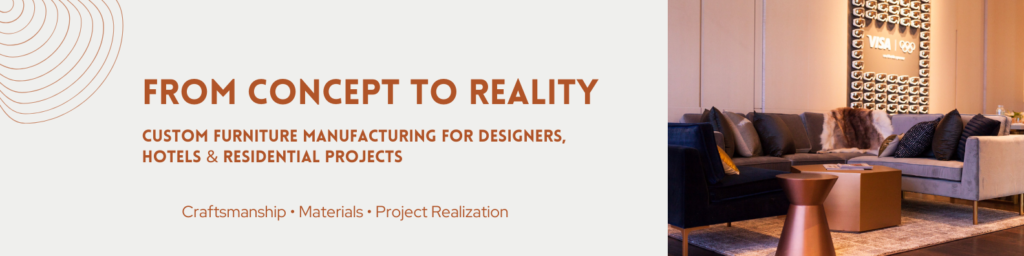
Interi Furniture specializes in custom furniture manufacturing for residential, hospitality, and commercial projects. Their experience in materials, craftsmanship, and project realization makes them a valuable resource for designers and buyers seeking tailored furniture solutions from China.