










Chinese New Year does not cost you seven days of production. It costs you eight to ten weeks of significant disruption — roughly two to three weeks before the official holiday as the workforce drains away, the holiday itself, and about four weeks of ramp-up after it. During the pre-holiday window, remaining crews run rush orders at unsustainable pace and quality control quietly thins. During the post-holiday window, return rates are unpredictable, temp workers flood the lines, and your “first batch after CNY” carries the second-highest defect risk of the entire year. The only reliable planning tool is each factory’s own CNY cutoff date — the last date it will accept or confirm orders before the holiday — which typically falls two to three weeks before the official break. Treat that cutoff as a hard deadline, because the factory does. Custom and new-product orders need four to six months of runway, not weeks. CNY is a natural force. Fighting it fails. Planning around it wins.
Why Buyers Keep Getting Burned by a “Seven-Day Holiday”
Ask any experienced furniture importer about CNY and they will tell you the same story, with minor variations: the factory confirmed a pre-holiday ship date in October, the goods slipped two weeks, the container missed the vessel, and the retail shelf sat empty in March.
The failure pattern is almost always the same. The buyer looked up the official holiday length — typically seven to nine days of statutory holiday — and built the production plan around that number. What the buyer did not model was the human system behind the factory: several hundred workers, each with a home village, a train ticket, and a family decision that has nothing to do with the purchase order in your inbox.
The official holiday is the visible tip. The invisible mass is the migration that surrounds it.
The Real CNY Timeline: Seven Days of Holiday, Eight to Ten Weeks of Disruption
The single most important concept in this article is the CNY production shutdown furniture buyers actually face versus the one they plan for. The planned version is a line on a calendar. The real version is a wave with a defined shape: a sharp pre-holiday contraction, a total blackout, and a slow four-week climb back.
| Phase | Approximate Window | What Actually Happens on the Floor | Risk Level |
|---|---|---|---|
| Pre-holiday contraction | 2–3 weeks before CNY | Worker absence accelerates sharply; factories stop accepting new orders at their individual cutoffs; remaining crews run swollen rush books | High |
| Final production push | Last 7–10 days before CNY | Skeleton crews only; QC staffing thinnest of the year; finishing and packing rushed | Critical |
| Official holiday | Statutory holiday period (dates vary yearly; subject to verification) | Factory gates closed; information flow largely cut | Low (nothing moves) |
| Return window | 1–2 weeks after holiday | Workers trickle back at their own pace; many job-hop or delay | High |
| Ramp-up | ~4 weeks after holiday | Temp workers on lines; new hires learning; rework rates elevated; output climbs gradually | High |
| Full output | Roughly 5–6 weeks after holiday | Stable crews, normal defect rates, reliable scheduling | Normal |
Two clarifications matter here. First, the contraction is back-loaded: the serious workforce drain concentrates in the final two to three weeks, not a month or more in advance. Earlier than that, factories are still fully staffed — they are simply filling every slot with pulled-forward orders. Second, the climb back is front-loaded with risk: a factory can reopen its gate while a fraction of its skilled workers are actually at their stations.
For buyers searching Chinese New Year factory closure and finding a seven-day calendar entry, the search result answered the wrong question. The right question is not “when is the factory closed” but “when does the factory stop being reliable” — and that answer lives in the factory’s own cutoff date, which we return to below.
The Factory Cutoff Date: Your Only Hard Number
Here is the most practical concept in this article. Every factory sets its own CNY cutoff — the last date it will accept new orders, confirm production slots, or guarantee pre-holiday completion. Industry practice, consistent with guidance from sourcing operators on the ground in Foshan, is that this cutoff typically lands two to three weeks before the official holiday, though it varies by factory, order size, and how full the book already is. A large factory with a packed Q4 may close its order book earlier; a small workshop chasing volume may keep accepting orders it cannot properly build.
Ask every supplier one question in writing, every autumn: what is your CNY cutoff date for new orders and for guaranteed pre-holiday ship dates? Then treat the answer as a real deadline, not a soft preference. An order confirmed one day after the cutoff is not an order with a small delay. It is an order in the post-holiday queue, whatever the sales rep says. Pair the cutoff with the surrounding dates — final material intake, last inspection booking window, last container gate-in — because each of those has its own cutoff a few days earlier.
Why the Pre-Holiday Window Is the Year’s Biggest Quality Trap
Industry veterans in Foshan and Dongguan say it with a shrug: the last stretch of pre-holiday production is the annual quality valley. This is not a rumor. It is structural.
Why quality collapses before CNY
The mechanism is human, and it is consistent across factories of every size. In the final two to three weeks, the workers still on the floor are running on borrowed energy. Their minds are on train tickets, family reunions, and the year-end wages they are still waiting to collect. Experienced QC inspectors — the ones who catch a misaligned drawer glide or a wobbling table leg in seconds — are often among the first to leave, because seniority buys earlier leave approval. What remains is a thinner, less experienced inspection layer reviewing a larger volume of rushed output.
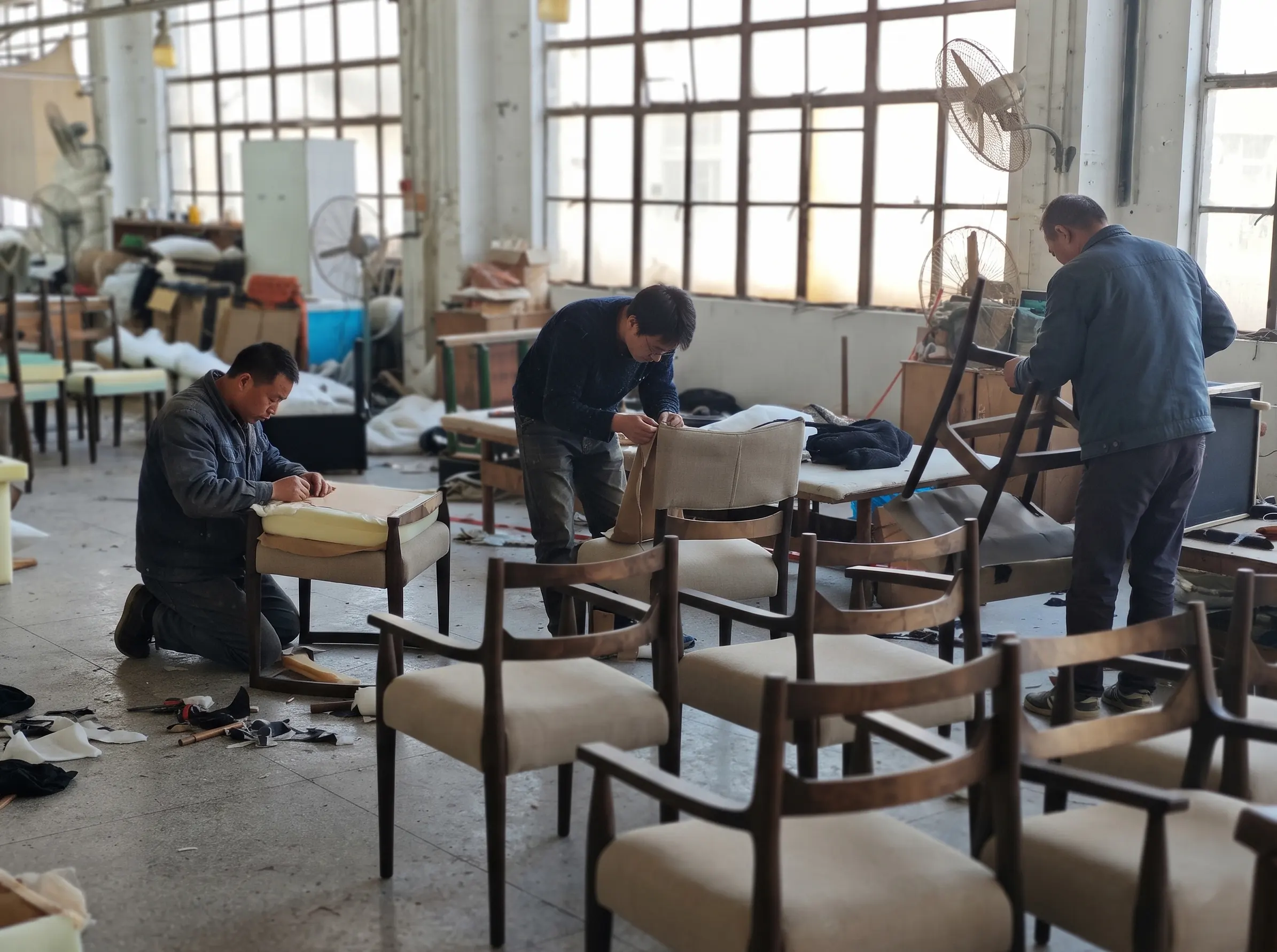
At the same time, the order book is swollen. Every buyer who understood the calendar tried to pull orders forward before the cutoffs, so the factory is running maximum overtime with a draining crew. Glue lines that should cure overnight get four hours. Veneer pressing gets done in one cycle instead of two. Upholstery seams that would normally trigger a rework are waved through because “the container leaves tomorrow.”
The result is a specific, recognizable defect profile in pre-holiday shipments: rushed joinery, under-cured finishes, upholstery pulled too tight or too loose, hardware torqued inconsistently, and cartons packed by exhausted hands. None of these are exotic defects. All of them are expensive to find on a warehouse floor in Rotterdam or Los Angeles instead of at the factory gate.
Which product categories suffer most
| Category | Pre-Holiday Vulnerability | Why |
|---|---|---|
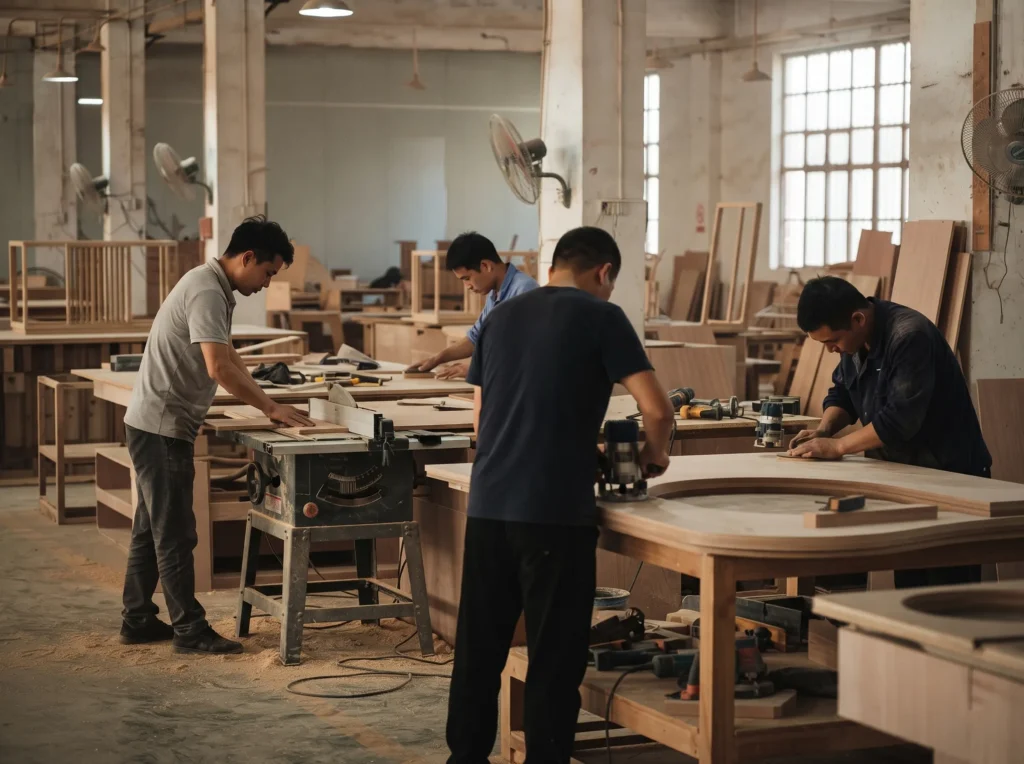
| Solid wood casegoods | Extreme | Joinery and curing are time-dependent; cutting corners is invisible until failure |
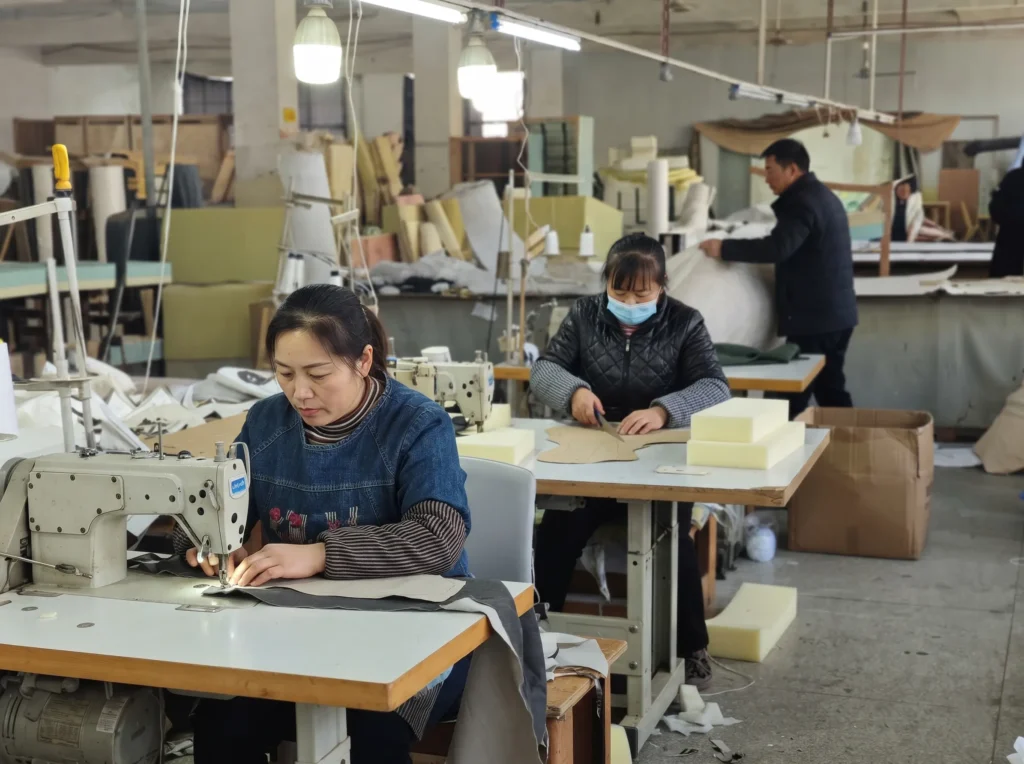
| Upholstered sofas and chairs | High | Hand-work intensity; seam and cushion consistency degrades fast under fatigue |
| Mattresses | Moderate | More machine-dependent; edge cases appear in quilting and border attachment |
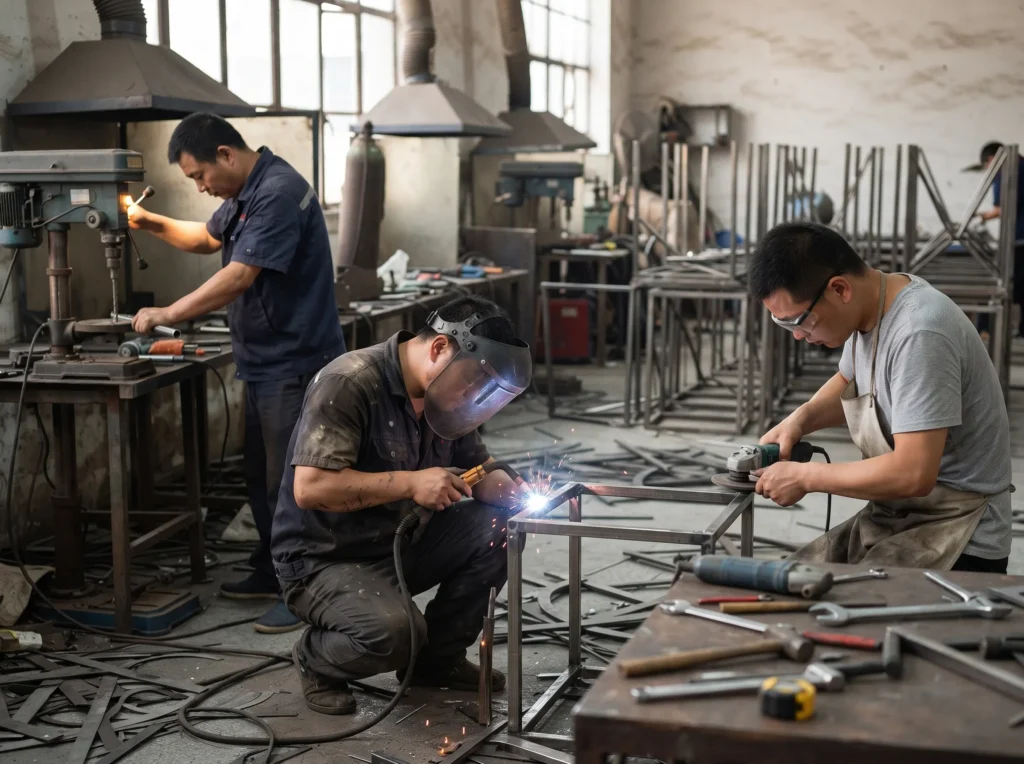
| Metal and glass furniture | Moderate | Welding quality varies with operator fatigue; tolerances drift |
| Flat-packed engineered wood | Lower but real | Line production is stable; risk concentrates in packaging accuracy |
The honest buyer question is not “will the factory maintain quality” but “am I paying full price for a depleted-crew shift.” If your order lands in the final ten working days before the holiday, assume elevated risk and act accordingly: book third-party inspection, extend the sampling plan, and refuse delivery-date pressure that leaves no room for rework. Our quality inspection checklist covers what to verify at each stage.
The Post-Holiday Trap: Your “First Batch” Is the Second Risk Peak
If the pre-holiday window is the first risk peak, the post-holiday period is the second — and for many buyers, the more expensive one, because they let their guard down. The holiday ended, the factory said “we are back,” and the assumption was that normal service resumed.
It had not.
The return-rate reality, quantified
Return-to-work rates after CNY vary by factory, region, and year, but the pattern is measurable. Leading large-scale manufacturers — the export-oriented office furniture groups, for example — commonly report post-holiday return rates above 95 percent, helped by dormitory benefits, reliable year-end wage settlement, and deep order books. Mid-size and smaller factories more often land in the 85–90 percent range, and a factory that loses one skilled sewer in eight has lost a production cell, not a statistic. Treat these figures as directional industry data, not a guarantee — every number is subject to verification with your specific supplier, and asking directly is professional, not rude.
One nuance matters for planning: the large-factory advantage is mostly about speed of return, not immunity from disruption. A 500-worker factory at 96 percent return still reopens with a reshuffled workforce, new hires in the gaps, and two to four weeks of ramp-up before quality normalizes. Size buys you a shallower dip and a faster climb. It does not buy you a flat line.
The temp-worker problem
Post-holiday ramp-up leans heavily on temporary workers, and temp workers in furniture manufacturing create a predictable defect pattern. They are slower. Their work needs more supervision. Their error rate on anything involving judgment — pattern matching on upholstery, stain color on wood, weld consistency on frames — is meaningfully higher than the crew they replaced. Quality does not snap back on the first day of full attendance. It climbs back over roughly four weeks, as the new mix of workers gels into a functioning line.
This is why the first batch shipped after CNY deserves the same inspection skepticism as the last batch before it — sometimes more. Our guide on how to inspect furniture before shipment is worth re-reading before your first post-holiday QC booking.
The Two-to-Four-Week Gap Between “Reopened” and “Running”
Between a factory’s announced reopening date and the date it actually reaches stable, full-quality output, there is almost always a gap. Two to four weeks is the common range. The gap is not a lie, exactly. It is institutional optimism.
When a sales manager tells you “we resume after Lantern Festival,” they are describing the gate opening, not the line stabilizing. Here is what the reopening sequence actually looks like on the floor: the factory reopens; workers return over one to two weeks; absenteeism is checked against orders; HR scrambles to hire; new workers are onboarded; materials ordered before the holiday arrive unevenly; the first production runs are slow and generate rework; supervisors re-balance lines repeatedly. Through all of this, the sales team — measured on responsiveness — keeps telling customers things are “basically back to normal.”
Treat every post-holiday date commitment as a range, not a point. If your supplier says full production on a given date, plan your downstream logistics two to four weeks beyond it, and verify against actual output evidence — photos of the line, production logs, or a third-party factory audit — rather than reassurance.
When CNY Collides with Canton Fair and the Christmas Rush
CNY is dangerous alone. CNY stacked on top of Canton Fair season and the Christmas export cycle is where timelines go to die. Buyers sourcing through the fair system should cross-reference this with our Canton Fair 2025/2026 planning guide, because the two calendars interlock brutally.
The stacking effect
| Combination | How It Compounds | Typical Failure |
|---|---|---|
| CNY + Christmas orders | Buyers push holiday orders into October–December production slots, then discover the pre-holiday quality window | Christmas goods rushed through the worst QC window of the year |
| CNY + Canton Fair cycle | Autumn fair orders chase shrinking pre-cutoff slots; spring fair orders land in the ramp-up zone | Fair-sourced orders inherit eight to ten weeks of hidden delay |
| CNY + new product launches | New SKUs need stable, experienced crews for first-article runs — and four to six months of runway | First articles built by temps, or by factories that stopped accepting new orders weeks ago |
The Christmas collision deserves special attention because it is the most expensive version of this mistake. A container of furniture that ships late in January does not just miss a warehouse slot — it can miss the entire selling season. Retail purchase orders with delivery windows tied to Q4 shelf dates carry penalties that dwarf the freight savings buyers thought they were capturing by ordering “as late as possible.”
The correct move for Christmas-volume orders is to complete production before the pre-holiday contraction begins — meaning production slots secured well before each factory’s cutoff, and for standard items, orders placed by early autumn at the latest. The fair order placed in November with a “January ship date” should be treated as a coin flip even when the factory signs it confidently.
Not All Factories Survive CNY Equally — but None Are Exempt
A buyer’s exposure to the eight-to-ten-week wave depends on which kind of factory sits on the other side of the contract. The return-rate data above gives the shape: large, export-focused manufacturers commonly hold above 95 percent return rates; mid-size and smaller factories more often sit at 85–90 percent. That gap shows up in the calendar as a difference in ramp-up speed, not in whether there is a ramp-up at all.
| Factory Type | CNY Resilience | What Drives It | What It Does NOT Buy You |
|---|---|---|---|
| Large export-focused manufacturer (500+ workers, dormitories, year-round order book) | High return speed | Wage reliability, benefits, worker loyalty; return rates commonly above 95 percent in leading firms | Immunity — reshuffled crews and two to four weeks of ramp-up still apply |
| Mid-size specialist factory (100–300 workers, niche category) | Moderate | Core crew stability; depends on owner’s relationship with key workers; return rates often 85–90 percent | Deep bench — a few departures gut a process |
| Small workshop / trading-company-owned line | Low | Workers are mobile; minimal retention infrastructure | Predictability — reopening dates and crew quality are the least reliable |
| Factory with strong local workforce (workers’ families nearby) | Higher than average | No migration bottleneck; return rates near total | Scale — often the smallest operations, thinnest QC layers |
There is also a geographic note worth knowing. In some manufacturing regions, local government and industry clusters have spent years building “return and stay” incentives — subsidized housing, schools, local entertainment industries — specifically to flatten the post-holiday labor cliff. Factories in these clusters tend to reopen with far fewer missing hands. Our Discover China industry-belt guides document which clusters have invested in this.
The practical takeaway: ask your supplier two questions in Q3 every year. What share of your workers returned after last CNY? What is your cutoff date this year? The answers — or the hesitation before them — are better supplier intelligence than any factory tour.
The Buyer’s Working Playbook: Cutoff Dates and Backward Planning
Everything above converges on one operational discipline: anchor your plan to each factory’s stated cutoff date, then plan backwards. Buyers searching for furniture production delay CNY protection are really searching for a sequencing method. Here it is.
The backward-planning framework
| Your Order Type | Working Rule | Rationale |
|---|---|---|
| Standard reorder, no CNY crossing | Place 60–90 days before needed ship date | Normal lead time plus buffer |
| Standard order needing pre-holiday completion | Confirm before the factory’s stated CNY cutoff — typically 2–3 weeks before the holiday | Cutoff is the factory’s own hard line; after it, you are in the post-holiday queue |
| Custom or new-product order crossing Q4/CNY | Place 4–6 months ahead of required delivery, per sourcing operators’ published guidance | Tooling, sampling, first-article runs, and material lead times cannot be compressed into the pre-holiday window |
| Order that would ship in the ~4 weeks after CNY | Add 3–4 weeks to whatever lead time you are quoted | Ramp-up reality, not gate reopening |
| First post-holiday batch of a repeat SKU | Book pre-shipment inspection regardless of history | New crew composition |
| Christmas-critical volume | Production complete before the contraction begins; orders placed by early autumn for standard items, earlier for custom | Shelf dates do not negotiate |
Note the deliberate difference between standard and custom. Two to three months of lead time is generous for a catalog reorder. It is dangerously short for a custom sofa program or a new-material dining range, where sampling, material approval, and first-article correction consume months before bulk production even starts. This is exactly where the new-product-launch scenario bites: buyers who finalize a custom design in November and expect January production are not facing a delay. They are facing a queue.
For importers and wholesalers
Your leverage is volume and forecast sharing. Give factories your best six-month demand signal by early autumn, before cutoffs tighten, and explicitly designate which POs must clear the pre-holiday window. Factories prioritize buyers who help them plan; a shared forecast is often worth more than a deposit escalation. Reserve QC budget for both ends of the wave — it is cheaper than one container of rejected goods.
For e-commerce sellers doing year-end replenishment
Your Q4 replenishment order is the classic CNY casualty. If your sell-through data justifies a top-up in November, you are already at or past most factories’ cutoffs for reliable production. The fix is earlier demand forecasting: set your replenishment trigger by early autumn so production clears before the contraction. If you must order into the window, reduce SKU complexity and insist on inspection — a uniform repeat of a proven SKU survives tired hands better than a new configuration.
For hotel FF&E and project procurement
Project timelines with penalty clauses should treat CNY as a force-majeure-grade scheduling fact regardless of what the contract says. When the installation date is fixed — hotel opening, lease commencement — place furniture orders with completion targets set before the contraction, and carry the storage cost if early delivery is inconvenient. Storage is cheap. A missed opening is not. Our FF&E procurement guide covers the full contract structure for time-critical projects.
For first-time and individual buyers
If this is your first order crossing CNY, assume your quoted lead time is optimistic by several weeks in either direction, and budget accordingly. The cheapest risk transfer available to you is a third-party inspection before balance payment — non-negotiable for post-holiday shipments.
The Honest Summary
Chinese New Year is not an obstacle to manage. It is a season to design around. The buyers who get hurt planned against the seven-day calendar and got hit by the eight-to-ten-week reality. The buyers who thrive know each factory’s cutoff date, finished critical production before the workforce drained, treated post-holiday dates as ranges, inspected both ends of the wave, and never mistook a sales rep’s optimism for a production schedule. This is the core of how to plan furniture orders around Chinese New Year: respect the wave, and it costs you nothing; ignore it, and it taxes everything.

FAQ
How far in advance should I place a furniture order to avoid CNY disruption?
For standard orders that must ship before the holiday, confirm before each factory’s stated CNY cutoff — typically two to three weeks before the official holiday start. For custom or new-product orders crossing the Q4–CNY period, allow four to six months from order to required delivery. Exact dates shift every year and vary by factory — subject to verification against the current year’s official schedule and your supplier’s written plan.
Should I accept goods rushed out in the final weeks before the holiday?
Accept them only with enhanced inspection. The final one to two weeks of pre-holiday production carry the year’s highest defect concentration because crews are depleted and QC staffing is thinnest. If your order lands in that window, extend your sampling plan, book a third-party pre-shipment inspection, and build rework time into your logistics buffer.
How do I estimate real lead times for orders placed right after CNY?
Take the quoted lead time and add three to four weeks for anything scheduled in the first month after the holiday, then verify against evidence — line photos, production logs, or an audit — before releasing your freight booking. Factories typically reopen at the gate before they reopen in reality; stable output usually returns roughly four weeks after the announced restart, though this varies by factory and year.
Can I trust “back to work after Lantern Festival”?
Treat it as the gate-opening date, not the full-production date. The interval between reopening and stable, quality-normal output is commonly two to four weeks and can be longer at smaller factories or in years with low return rates. Large manufacturers often return crews faster — above 95 percent in leading firms versus 85–90 percent at many SMEs — but ramp-up applies to them too. Ask directly about last year’s return rate, and convert verbal commitments into written ones with consequences.
How do I keep Christmas-season orders clear of the CNY window?
Complete production of Christmas-critical volume before the pre-holiday contraction begins — for standard items, that generally means locking production slots by early autumn, and for custom work, placing orders four to six months ahead. Anything scheduled into late-autumn production for a January ship date should be treated as high risk, with inspection and penalty terms agreed in advance. Our Christmas shipping countdown guide walks through the full backwards calendar.

What’s Your CNY Story?
Have you absorbed a CNY delay that a supplier’s “no problem” failed to prevent — or built a planning system that sailed through the eight-to-ten-week window untouched? Tell us what happened, which product category was involved, and what you would do differently. The most instructive war stories get a follow-up analysis in a future deep dive.
Recommended Resource
Interi Furniture specializes in custom furniture manufacturing for residential, hospitality, and commercial projects. Their experience in materials, craftsmanship, and project realization makes them a valuable resource for designers and buyers seeking tailored furniture solutions from China.