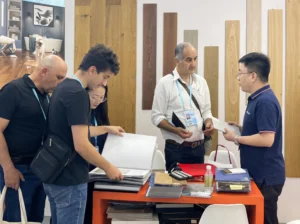








Zone B, a Tuesday morning, the furniture halls just past opening hour. I watched two buyers get the same sofa quote within half an hour — $148 FOB, MOQ 50, same booth, same sales rep, same smile.
Buyer number one frowned. “Too expensive.” Gone.
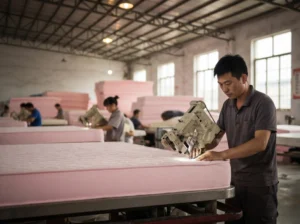
Buyer number two opened a notebook. “What’s the foam density?” Same product. Different conversation — and I’d bet real money on different final prices.
That booth, honestly, is the whole of Canton Fair price negotiation. The first number you hear is a starting point, not a deal. And no — there is no magic industry percentage that tells you how “high” it runs. Whatever fixed figure you’ve seen floating around online, treat it as an unverified rule of thumb, subject to verification against your category, your quantity, your timing. What actually moves a quote isn’t a louder discount demand. It’s boring stuff: clear specs, realistic volume, payment and delivery terms written down. Hand the supplier that, and the number usually adjusts itself.
The Two Mistakes You See All Day in the Furniture Halls
The nod, and the slash.
The nod: buyer hears the quote, nods, wires the deposit. Three months later — surprise — the “leather” is PU, the cartons are single-wall, and the warranty reply takes two weeks. The slash: buyer hears the number, winces, and demands 30% off without asking a single question about what’s inside it.
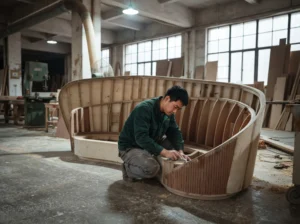
I did the slash myself once, years back, at a factory in Shunde. Sales manager smiled, said yes to my number. And quietly changed the frame timber. I caught it at inspection. Some buyers don’t catch anything.
Both mistakes come from the same bad habit: treating the first number as information. It isn’t. It’s a figure stacked on assumptions you haven’t heard yet. Spend your first five minutes digging those out — materials, dimensions, what’s in, what’s out. Judge the price after that, not before.

So What Is the First Quote, Exactly?
Definition time, because everything below rests on this. The first quote is the initial verbal or written price a supplier gives you at the booth for a stated product — before anyone’s talked configuration, volume, delivery, or payment in any depth.
In plain terms: a preliminary commercial offer, priced partly on guesswork about you. Comparing two first quotes with no spec sheets behind them? That’s like comparing two cars when one listing forgot to mention the engine.
Why One Booth’s Number Looks Nothing Like the Next
An opening quote can carry several things at once, and they stack differently for every supplier. Skip the hunt for a hidden “standard markup.” Go find the actual basis of the number instead.
| Factor | What may sit behind it | Ask at the booth |
|---|---|---|
| Detail in your inquiry | Vague needs get priced as risk; detailed ones get priced as work | Bring a written spec sheet; ask what the supplier assumed |
| How the supplier prices | Capacity, material buying scale, target markets — all differ | Ask what drives the price: materials, labor, structure, volume |
| Order size and mix | MOQs, SKU consolidation, batch planning all nudge unit cost | Get price points at realistic quantity tiers |
| Commercial risk | New buyers, far markets, fuzzy payment talk — all real risk | State your payment approach and timeline plainly |
None of this means the number’s dishonest. It means it’s conditional. Your job: find the conditions.
Why Initial and Final Prices Diverge — and What to Ask Instead
There’s no universal discount percentage hiding in a furniture quote. The gap between a first offer and a signed price comes from checkable things — specs, volume, customization, packaging, payment terms, and where the factory’s production line sits that month.
So drop “how much can I cut” entirely. Better questions exist.
| Factor | Clarify this | Do this |
|---|---|---|
| Product specifications | Materials, dimensions, construction, finishes, hardware | Get a full spec sheet per quoted item |
| Order volume | MOQs, volume pricing | Compare realistic tiers at identical specs |
| Customization and services | Design changes, samples, packaging, after-sales | Define scope in writing before comparing |
| Commercial terms | Payment schedule, delivery terms, order timing | Request revised quotes under stated conditions |
The goal was never a magic discount. It’s knowing what drives the price well enough to say — straight-faced — whether the offer beats the others for what you actually need. Working buyers compare furniture quotations like-for-like, on paper, assumptions visible. Not in their heads, walking out of Hall 10.3.

Four Methods That Earn Their Keep
These come out of repeated sourcing runs through Foshan and Shunde. They work because they hit the factors behind the price — not the seller’s pride.
| Method | How it runs | Best when | Watch out |
|---|---|---|---|
| Compare specifications | Walk the quote line by line — materials, dimensions, construction, finishes, hardware, packaging — and price each option separately | The quote is thin, or bundles everything into one number | Some downgrades change structure or certification, not just price |
| Request quantity-based pricing | Ask for two or three realistic tiers; confirm the MOQ, and that every tier keeps the same spec | You can flex volume or consolidate SKUs | “Price breaks” that quietly swap materials |
| Discuss payment and delivery terms | Ask if payment schedule, timing, or delivery shifts the number; weigh savings against your protections | Your purchasing process is settled and documented | Trading payment security for a discount on a first order |
| Follow up in writing | One consolidated email after the show — specs, quantities, packaging, delivery, payment — and ask for a written quote you can line up against the rest | You’re weighing several suppliers before committing | Booth numbers that never get confirmed in writing |
Field notes, quickly.
Compare Specifications
Ask for the spec sheet before you ask for a better price. Simple as that. I once sat with a buyer holding three quotes for “the same” dining chair, forty dollars apart. The spec sheets explained every cent — different foam, different joinery, different carton. No haggling needed. Just reading.
One caveat: parts don’t always downgrade one by one. Change the frame material and you may be looking at different tooling, different certification — a different product, basically. Treat spec changes as engineering calls, not levers to pull.
Request Quantity-Based Pricing
Factories think in batches. So ask in batches — twenty, fifty, a hundred, whatever’s real for you. And ask why the price steps down where it does. A supplier who can answer that has actually costed your order.
Discuss Payment and Delivery Terms
Clean, fast, documented payment is worth real money to an exporter, and some of that can flow back to you as price. But order matters. Protections first, savings second. On a first order, an inspection clause beats two points off — it’s not close.
Follow Up in Writing
The booth builds the relationship; the email builds the deal. A client of mine used to fire off fourteen one-line questions over two weeks and collect fourteen mushy answers. Then she consolidated everything into a single structured inquiry. Same suppliers, same products — but the quotes landing in her inbox were suddenly comparable for the first time.
At the Show vs. After the Show
Different jobs. The show is for seeing, touching, screening. The inbox is for comparing and committing. Mix them up and you’ll either trust a verbal number too much or let a warm lead go cold.
| On-site | Post-show | |
|---|---|---|
| What it’s for | Understanding the product, sizing up the supplier, shortlisting | Turning chats into comparable written offers |
| Walk away with | Spec sheets, samples, contacts, a price indication | Formal quotes at identical specs and trade terms |
| Your leverage | Multi-item interest, realistic volumes, a clear timeline | Consolidated SKUs, defined payment position, competing written offers |
| The classic error | Treating a friendly booth price as binding | A vague “just checking in” email that makes the supplier re-price your fog |
| Deals take shape | Screening | Comparison, negotiation, commitment |
Day five gets mythologized, so let me be straight: revisit your shortlisted booths, sure — some exhibitors want to close open discussions before teardown. But prices don’t magically drop on the last day. Plenty of vendors have hit their targets by then; some are half-packed by lunch. One more touchpoint, not a treasure window.
And when sales says “I need to check with my manager”? Take it literally. Ask when the revised quote lands and whether it depends on specific order conditions. Reverse-engineering their approval chain gets you nothing. A documented offer gets you everything.
Three Moments to Ease Off the Gas
More pressure isn’t always more savings. Sometimes it’s just risk, relocated somewhere you can’t see yet.
| Situation | Why caution pays | The pro move |
|---|---|---|
| A quote lands far below the rest | Different specs, excluded services, a different cost structure — cheaper isn’t automatically better | Verify materials, dimensions, inclusions line by line before shortlisting |
| A custom order priced suspiciously lean | A supplier under a workable margin may struggle to hold quality across the whole run | Negotiate inspection points, material lock-ins, acceptance criteria — not the unit price |
| A long-term program at the supplier’s floor | A partner earning nothing recovers it somewhere — your rush order’s queue slot, your claim’s reply speed | Guard the relationship’s economics; sustainable pricing from a reliable factory beats a hero number from a cornered one |
New to furniture sourcing from China? Build the verification reflex before the bargaining reflex. Unapproved material swaps, vague packaging specs, samples that don’t match bulk — documented, recurring risks in this chain. You control them with specs and contracts. Not with the last two percent of a discount.
Same Playbook, Different Emphasis by Buyer Type
Wholesalers and volume buyers: lead with quantity tiers, and say your reorder cadence out loud. Repeat business is your best card — but only if the supplier believes it. Program terms settle after the show, in writing, not at the booth over coffee.
E-commerce sellers and small-B: your squeeze is SKU sprawl and cash-flow rhythm, not volume. Consolidate first. One structured inquiry covering every SKU beats fourteen scattered questions, and the quotes actually sit next to each other on the page.
First-timers: live in the spec sheet. Write your requirements down. Demand the exact configuration behind every quote. Confirm every verbal number in writing before money moves. You won’t out-bargain a factory sales veteran on day one — fine. You don’t need to. You need paperwork you can check.

Frequently Asked Questions
How much should you negotiate off an initial Canton Fair quotation?
Nobody honest can hand you a number. The room to move depends on specs, volume, customization, payment terms, and the supplier’s capacity that month. Get like-for-like written quotes and ask each supplier how changes shift the price. That conversation beats any percentage rule you’ll find online.
Is it better to negotiate at the show or after?
Both — different jobs, though. The show is for learning and screening. The written follow-up afterwards is where comparable numbers show up. Anyone who’s actually studied how to negotiate furniture prices at the Canton Fair figures out fast that a documented email inquiry beats a noisy booth performance, every time.
What should the follow-up email actually contain?
Three things do the heavy lifting: a complete spec sheet per SKU, a quantity framework with realistic tiers, and your payment and delivery position, stated clearly. Send that and the supplier has everything needed to price properly — and you’ve got a document that lines up neatly next to the competition’s.
A supplier’s quote sits far below the rest. Is that a win?
It’s a reason to check, not a win. Walk the spec line by line, verify the factory’s registration and export history, and ask flat-out what’s excluded. A number low enough to end the comparison should be starting one instead.
When do you stop pushing the price down?
When the next concession costs you something real — agreed specs, quality controls, delivery commitments — or when the supplier’s “yes” comes wrapped in hedging about materials and timelines. The cheapest price isn’t the smallest number on the table. It’s the smallest number that still delivers what was promised.

Your Turn
What’s the widest gap you’ve ever seen between two quotes for the “same” product — and which spec difference explained it? Drop it in the comments. Best cases go into our next trade-show field report.
Recommended Resource
Interi Furniture specializes in custom furniture manufacturing for residential, hospitality, and commercial projects. Their experience in materials, craftsmanship, and project realization makes them a valuable resource for designers and buyers seeking tailored furniture solutions from China.