


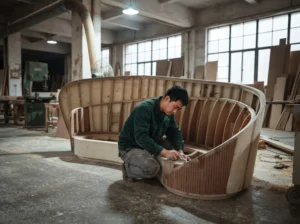
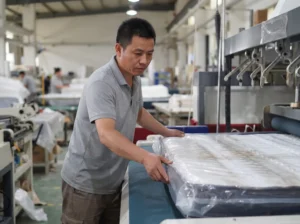





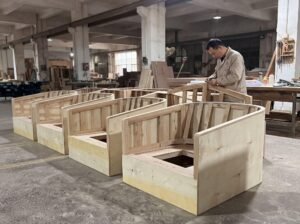
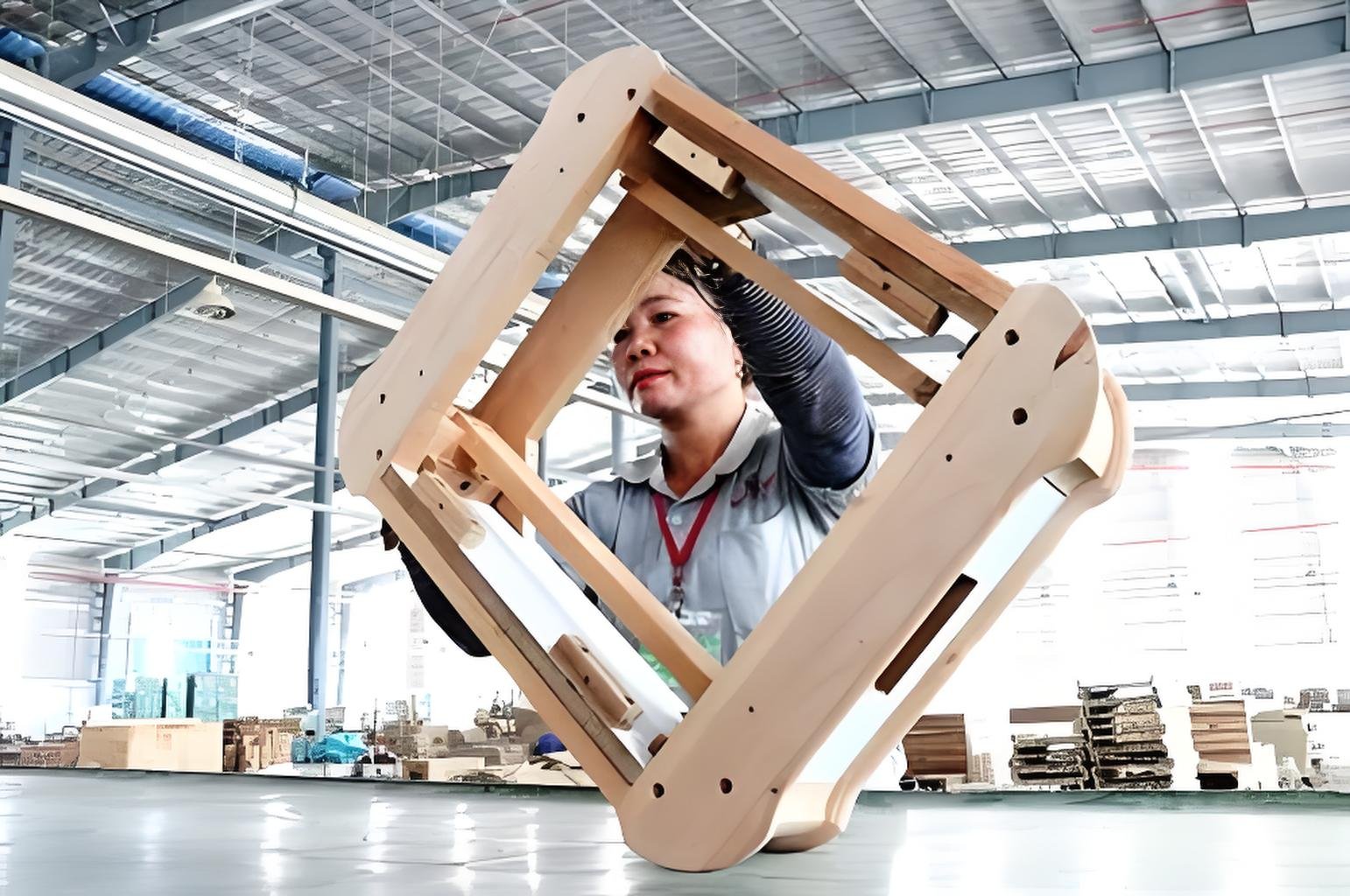
A China factory visit preparation breaks down into four modules: pre-trip planning, tools to carry, on-site workshop verification, and a structured question list. Whether you are making a preliminary business call or conducting a full factory audit, the goal is the same—cut through the polished reception and see what the factory actually does when no buyer is watching. This furniture sourcing visit guide is built from real field visits across Foshan, Dongguan, and Suzhou. It covers everything from booking the appointment to spotting red flags that sales staff never mention in their WeChat brochures.
Pre-Trip Planning: Casual Drop-In vs. Real Audit
Most buyers waste their first factory visit. They show up with a product photo on their phone, ask for a price, and leave with a vague quote. That is not sourcing. That is tourism.
Schedule at least two weeks ahead. Real furniture factories in the Pearl River Delta run on tight production slots. A workshop that looks idle on Tuesday morning might have shifted your target sofa line to the night shift to free up daytime space for your tour. Ask for the specific production line you want to see. If the factory refuses or claims it is “under maintenance,” that is your first signal.
Send your product specifications in advance. Not just a photo. Include dimensions, material grades, expected order volume, target market certification (CARB Phase 2 for the US, E1/E0 for Europe), and your QC tolerance. A factory that comes back with detailed questions about your spec has done this before. A factory that replies with “no problem, we can do everything” within two hours is either desperate or not reading your brief.
Plan for two visits. The first is reconnaissance. You are mapping the facility and reading body language. The second is the real prepare factory audit—unannounced, mid-production, when the factory is not expecting a photo shoot. If you only have budget for one trip, make it unannounced. Arrive on a Wednesday afternoon. The panic on the reception desk tells you more than any ISO certificate on the wall.
Verify the address before you fly. Search the factory name on Baidu Maps and cross-check with the business license registration. Many trading companies in Guangzhou rent temporary “factory showrooms” in Foshan for buyer visits. The real workshop is elsewhere, or it does not exist. Unlike electronics, furniture requires heavy fixed assets—sanding machines, spray booths, drying ovens—that cannot be faked in a rented showroom.
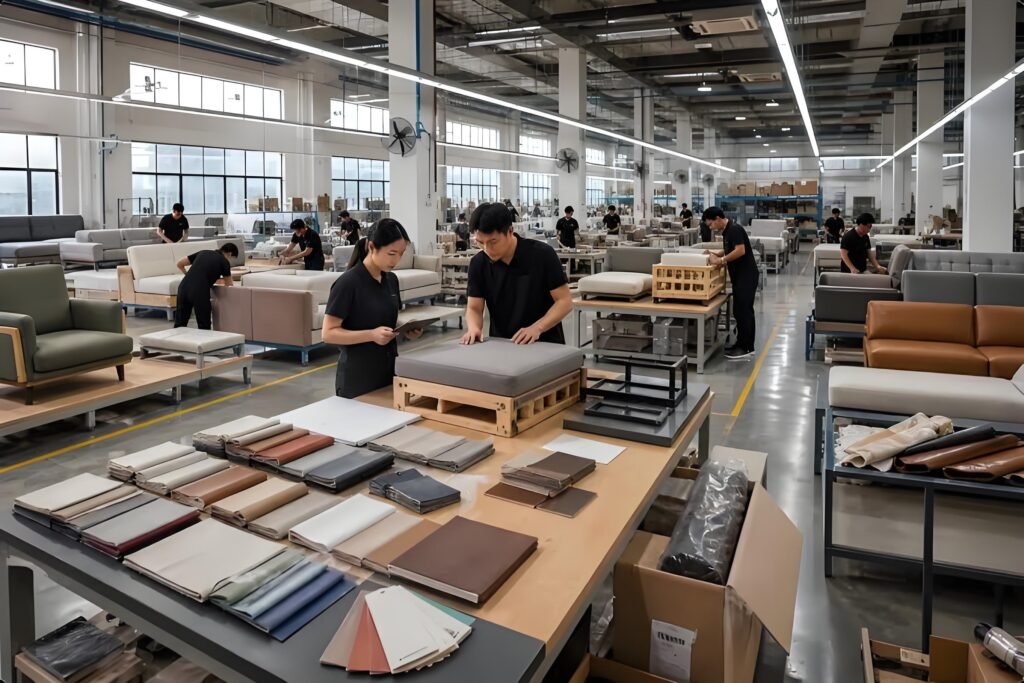
What to Bring: The Real Factory Visit Checklist Furniture
Your factory visit checklist furniture should look different from a generic manufacturing audit. You are checking organic materials that warp, fabrics that fade, and foam that degrades.
Physical Samples and Swatches. Bring your benchmark product, not just photos. If you are sourcing a dining chair, bring the exact chair you want matched. Chinese factory technicians think in physical references, not Pinterest boards. A 2cm difference in leg taper means nothing on a PDF. It means everything when the sample arrives at your warehouse.
Color Reference Tools. A Pantone fabric swatch book is standard. But for furniture, you also need a physical wood color sample. Factory color departments work from lacquer reference boards, not digital codes. Bring your target finish on a small wood block. If matching upholstery, carry a D65 daylight comparison lamp. Fluorescent factory lighting shifts color temperature by 2000K or more. What looks “warm beige” under a factory tube looks “cold grey” in a Hamburg showroom.
Measurement and Hardness Tools. A digital caliper (0.01mm precision) is non-negotiable. For upholstered products, add a portable foam hardness tester (Asker C type or Shore A). Most buyers never check this. They assume “high-density foam” means something. It does not. Density (measured in kg/m³ or pounds per cubic foot) tells you how much raw material is packed into a given volume. A 35 kg/m³ foam is light and soft. A 50 kg/m³ foam is dense and supportive. But density alone does not predict durability. You also need to check compression set—the percentage of thickness the foam permanently loses after being compressed for 22 hours at 70°C. A foam with 10% compression set bounces back. A foam with 25% compression set collapses into a permanent dent within months. A handheld indentation force deflection (IFD) gauge costs under $80 and changes the conversation entirely.
Documentation and Recording Gear. Bring a printed checklist, not just your phone. Phones die, WeChat glitches, and factory Wi-Fi is often restricted. Print your question list, spec sheet, and a blank workshop observation log. A portable moisture meter for wood (pin-type, 6–30% range) is critical for solid wood furniture. Wood shipped at 18% moisture content to a dry climate will crack within six months. The factory knows this. They will not tell you unless you test.
Personal Protection. Disposable N95 masks are essential in sanding and spray booths. Factory-provided paper masks are usually cosmetic. Bring your own safety glasses and steel-toe shoe covers. Do not rely on the factory’s safety briefing. In most mid-sized workshops, “safety briefing” means “watch your step.”
The Four Core Workshops: What to Actually Look For
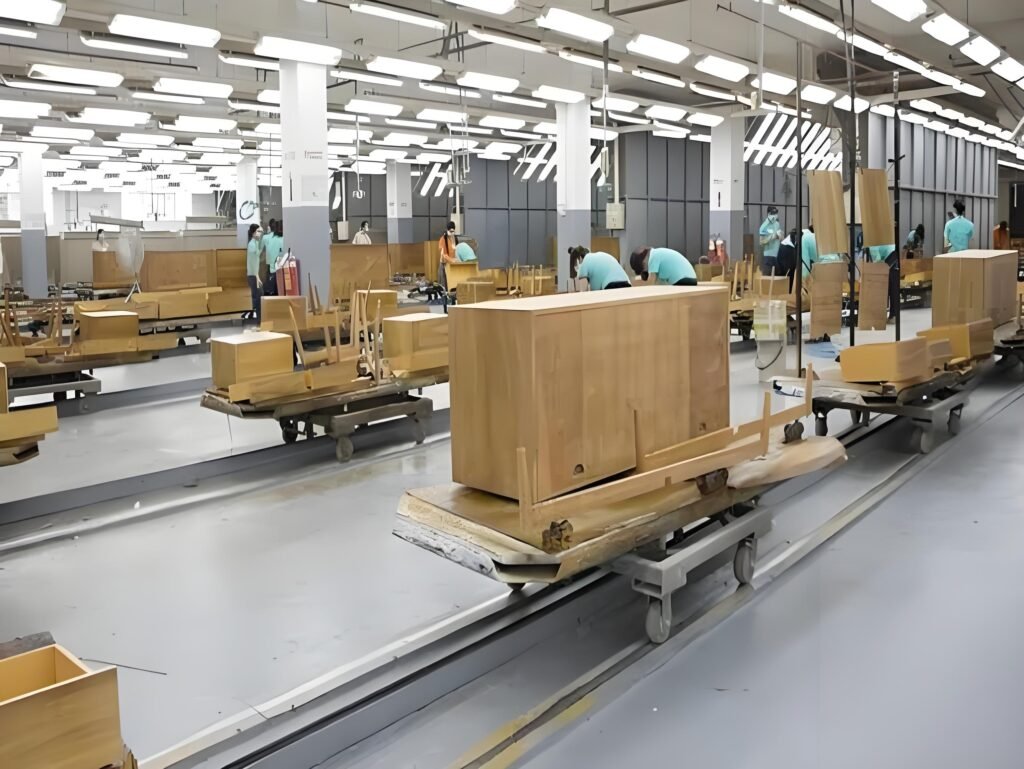
A furniture factory is four distinct production zones, each with its own failure modes. Your factory visit checklist furniture must treat them separately.
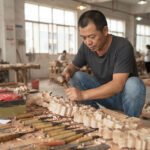
Woodworking Shop
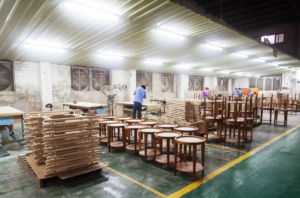
Start at the raw material intake, not the finished goods area. Look at the timber stacks. Are they sticker-stacked with airflow gaps, or piled in solid cubes? Proper drying requires 2.5cm spacers between layers. If wood is stacked tight, moisture pockets form. That is where mold and warping start.
Check the CNC routing area. Is there a dedicated dust extraction system, or is the floor covered in sawdust? A factory that lets sawdust accumulate lets tolerances drift. Sawdust settles on glue joints and finish surfaces, causing adhesion failures six months later. Look at the cutting blades. Dull blades tear wood fibers instead of cutting them. Fuzzy edges require extra filler and sanding, which weakens the joint.
Ask to see the glue mixing station. For plywood and laminated components, glue type matters. UF (urea-formaldehyde) is cheap but off-gasses. EPI or PUR adhesives cost more but meet stricter emission standards. A factory using UF glue for export furniture is cutting corners on your customer’s health.
Upholstery Workshop
This is where most buyers get lost. They look at the finished sofa and miss the frame underneath. Ask to see a sofa in mid-assembly, before the fabric goes on. The frame should be kiln-dried hardwood, not green pine or poplar. Tap the wood with your knuckle. Green wood sounds dull. Kiln-dried wood rings.
Check the spring system. Sinuous wire springs are standard for mid-range furniture. Eight-way hand-tied is premium. But many factories substitute elastic webbing and call it “spring suspension.” It is not. Elastic webbing fails within 18 months. Look at the attachment points. Are springs clipped to the frame with metal fasteners, or stapled with pneumatic staples? Staples pull out. Clips do not.
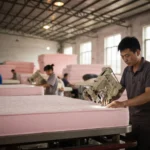
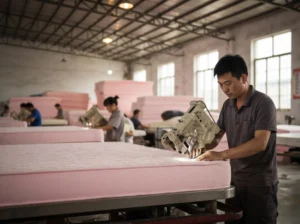
Inspect the foam cutting station. Is foam cut with a vertical bandsaw (rough, uneven) or a CNC contour cutter (precise, repeatable)? CNC-cut foam cells stay intact. Bandsaw-cut foam has torn cell walls that collapse faster. If you are buying in volume, this single detail determines your return rate.
Finishing and Spray Booth
The spray booth is the most dangerous place to cut corners. Walk in and smell the air. A proper booth has negative pressure, water-curtain filtration, and activated carbon exhaust. If your eyes water within thirty seconds, the ventilation is inadequate. If workers are not wearing supplied-air respirators, the factory does not care about its own staff, let alone your end customer’s VOC exposure.
Check the drying racks. Are pieces spaced for airflow, or stacked to save floor space? Lacquer dries by solvent evaporation. Stacked wet pieces create “soft spots” where the finish never fully cures. Those spots turn sticky in humid climates and attract dust forever.
Look at the sanding sequence between coats. A proper finish requires sanding with progressively finer grit (120 → 180 → 240 → 320) between each lacquer layer. If the sanding station only has one grit size, the finish will telegraph through. You will see sanding scratches under the topcoat six months after delivery.
Packaging and Loading Bay
Most buyers skip this area. That is a mistake. Packaging is where hidden damage happens. Check the corner protection. Is it expanded polystyrene (cheap, cracks on impact) or EPE foam (flexible, resilient)? For high-value items, ask about honeycomb cardboard corner guards. They absorb compression forces that crush standard foam.
Look at the crate construction. Is the plywood export crate built with screws, or stapled together? Stapled crates fall apart in container trans-shipment. Screwed crates with corner brackets survive. Check the container loading photos. Does the factory photograph each layer, or just the closed door? Layer photos prove proper weight distribution. A door photo proves nothing.

The Two Question Lists: Preliminary Visit vs. Formal Audit
This is where your prepare factory audit strategy splits. Mix them up, and you either scare away a good factory or get charmed by a bad one.
Preliminary Business Visit
You are evaluating fit, not conducting interrogation.
● “What percentage of your output is OEM versus ODM?” A factory that only does OEM is an order-taker. A factory with ODM capability has design engineers who can solve problems. That matters when your sample arrives with a joint that does not quite work.
● “Can I see your current production schedule for the next 30 days?” A factory that shows you a full schedule is busy and honest. A factory that claims “we are always flexible” is either lying about their volume or desperate.
● “Who is your biggest export market, and what certification do you hold for it?” If they say “Europe,” ask about EUDR readiness. The EU Deforestation Regulation (EUDR) entered into force in 2023 and is phasing in during 2024–2025, replacing the older EUTR framework. A factory that only mentions FSC or EUTR without a EUDR due diligence system is behind the curve. They need geolocation data for timber sources, risk assessment protocols, and traceability documentation—not just chain-of-custody certificates.
● “What is your typical sample lead time, and who pays for the courier?” Factories that ask for courier payment upfront are usually small. Factories that absorb sample freight for confirmed orders have done this before.
Formal Factory Audit
This is where you verify claims. Bring a checklist. Take notes. Do not accept verbal answers.
● “Show me your business license, export license, and environmental compliance certificate.” Photograph them. Check the registration capital. A factory registered with 1 million RMB is not running a 50-million-RMB operation. That is a furniture industry universal red flag.
● “What is your actual monthly capacity for my product category, and what is your current utilization rate?” If they claim 500 containers per month but the parking lot has three trucks, the math does not work.
● “What percentage of your production is subcontracted to external workshops?” Many furniture manufacturers outsource carving, welding, or upholstery to small satellite workshops. That is standard practice. But if more than 30% of your specific product line is outsourced, you are not auditing the real producer. You are auditing a coordinator.
● “Show me your last three months of QC pass-rate records, sorted by defect type.” A factory that cannot produce this document does not track quality systematically. A factory that shows you a perfect 99.5% pass rate is either faking the data or not inspecting properly. Real factories have defect clusters. The question is whether they know where they are and whether they are fixing them.
● “Walk me through your raw material incoming inspection process.” Do they check moisture content? Do they verify wood species with density testing? Do they test fabric for color fastness (ISO 105-B02) before cutting? A factory that skips incoming inspection is passing all risk to you.
Advanced tactic for volume buyers: Conduct a raw material inventory spot-check. Walk to the timber yard unaccompanied if possible. Check species labels against your spec. A factory claiming “American white oak” might be using Chinese oak (Quercus aliena) which has different density and staining behavior. Bring a wood identification kit or genuine reference material. Request an unplanned production line stop. A factory that refuses is hiding something. One that complies and shows you jig setup, blade sharpness, and feed rate is confident in its process control.
For Personal Home Buyers: A Simplified Factory Visit Guide
If you are a private homeowner ordering custom furniture directly from China, you do not need the full corporate audit protocol. But you still need to protect your money.
Before you go: Confirm the factory accepts small orders. Most real furniture manufacturers have an MOQ of 20–50 pieces per item. A factory that happily accepts a single sofa order is almost certainly a trading company marking up a workshop you will never see. That is fine if you know it. It is a problem if you think you are getting “factory direct” pricing.
What to bring: Your room dimensions, floor photos, and a clear mood board. Chinese factory sales staff are visual thinkers. They do not parse verbal descriptions like “transitional with a hint of coastal.” They parse images. Bring fabric swatches and a paint chip from your wall color. The more visual reference you carry, the less room there is for “I thought you meant…” disputes later.
What to ask: Skip the capacity questions. Instead, ask: “Can I see a finished piece that matches my order, and can I sit on it?” Physical comfort is not on a spec sheet. Ask: “What happens if the color is wrong when it arrives at my home?” Most factories will not pay for international return shipping on a color dispute. Get that in writing before you wire the deposit.
What to check: Look at the packaging for a single item. Is it crated, or just wrapped in bubble film? A $4,000 dining table wrapped in bubble film will arrive with corner damage. A crated table with foam corner guards has a fighting chance. Ask for photos of your specific items being packed, not generic stock photos.
Payment safety: Never pay 100% upfront. The standard deposit is 30% to start production, 70% before shipping. For personal buyers, negotiate a third-party inspection holdback—5% held until you confirm receipt in acceptable condition. Most factories resist this. The ones that agree are confident in their quality.
Red Flags and Hidden Risks
Even with the best factory visit checklist furniture, some risks are designed to stay invisible.
The “Showroom Factory” Trap: A pristine showroom attached to a dusty workshop is normal. A showroom with no workshop attached is a trading company. Ask to see the workshop before you see the showroom. If the sales manager insists on the showroom first, be suspicious.
The Certificate Wall: ISO 9001, BSCI, FSC—certificates are easy to buy or photocopy. Verify certificate numbers on the issuer’s website. A factory with 15 certificates on the wall but no original documentation in the office is decorating, not certifying.
The Rush Sample: A factory that produces your sample in three days is either not making it from scratch (they bought a similar item locally and modified it) or they dropped everything else to impress you. The second option sounds good until you realize your production order will not get that same priority.
The Hidden Outsourcing: During your tour, count the product types being made. If the factory claims to specialize in solid wood dining furniture but you see metal chairs, upholstered sofas, and glass tables on the same floor, they are a general trading hub, not a specialized manufacturer. Specialization drives quality consistency. Generalization drives variance.
The Social Proof Fake: “We supply IKEA, Ashley, and Wayfair.” Maybe. But maybe they supplied one sub-component to one of those brands in 2019. Ask for specific purchase order references, not brand names. Real supply relationships have PO numbers, delivery dates, and QC reports.

FAQ: What Buyers Actually Ask Before a China Factory Visit
What should I ask a furniture factory in China?
Start with capacity verification, outsourcing percentage, and QC documentation. Then drill into material sourcing, finishing standards, and packaging protocols. The questions in the “Formal Factory Audit” section above are the minimum set.
How do I prepare for a factory audit in China?
Send specifications two weeks ahead. Book the appointment with a specific production line request. Bring physical samples, measurement tools, and a printed checklist. Plan for two visits if possible, with the second unannounced.
What tools should I bring to a furniture factory visit?
A digital caliper, portable foam hardness tester, wood moisture meter, Pantone swatches, and a D65 daylight lamp. For advanced audits, add a spectrophotometer and an IFD gauge.
Is visiting a Chinese furniture factory worth the cost?
For orders above $30,000 or long-term partnerships, yes. For one-time small orders, probably not. Use a third-party inspection service instead. The flight and hotel cost rarely justifies a single $5,000 purchase.
Can I visit a factory without an appointment?
You can, but you will learn less. Factories clean up for scheduled visits. An unannounced visit reveals the real workflow, safety conditions, and material storage. If you can only do one visit, make it unannounced.
What is the difference between a trading company and a factory?
A factory owns production equipment, employs production staff, and controls manufacturing. A trading company coordinates between you and an anonymous workshop. Both can work, but you should know which one you are talking to.
How do I check if a factory is environmentally compliant?
Ask for the environmental impact assessment (EIA) approval document. Check the spray booth ventilation and dust extraction systems. Smell the air. If your eyes water, their workers’ eyes water too—and that is a compliance failure, not just a comfort issue.
Final Word: Preparation Separates Buyers from Tourists
A China factory visit preparation is not about being paranoid. It is about being precise. The factories that respect your checklist are the ones worth working with. The factories that dismiss your questions as “too detailed” are the ones hiding sloppy processes behind a friendly smile.
Bring the right tools. Ask the hard questions. Look at the floor, not the walls. Check the scrap pile, not just the finished goods. And remember: a factory visit is not a date. You are not there to be charmed. You are there to verify that the people making your furniture understand their craft well enough to put your customer’s name on it.
That is what Furniture Discover exists for—to tell you what the industry brochures won’t.
Recommended Resource
Interi Furniture specializes in custom furniture manufacturing for residential, hospitality, and commercial projects. Their experience in materials, craftsmanship, and project realization makes them a valuable resource for designers and buyers seeking tailored furniture solutions from China.