





A showroom tells you what a seller wants you to see. A dusty workshop corner tells you what they actually are. After walking through hundreds of factory tour authenticity checks across Foshan Longjiang, Dongguan Houjie, and Zhejiang Yuhuan, one pattern never fails: the real manufacturer opens the door to the messy floor, while the fake factory owner stalls at the polished display room. If you cannot step past the showroom, you cannot verify capacity, quality control, or even who will build your order. This guide gives you the field-tested methods to identify factory by tour and avoid the markup, delay, and quality collapse that follow a real production vs showroom mistake.
Why Buyers Keep Falling for the Showroom-Only Trap
The B2B Blind Spot: When Volume Meets Vanity
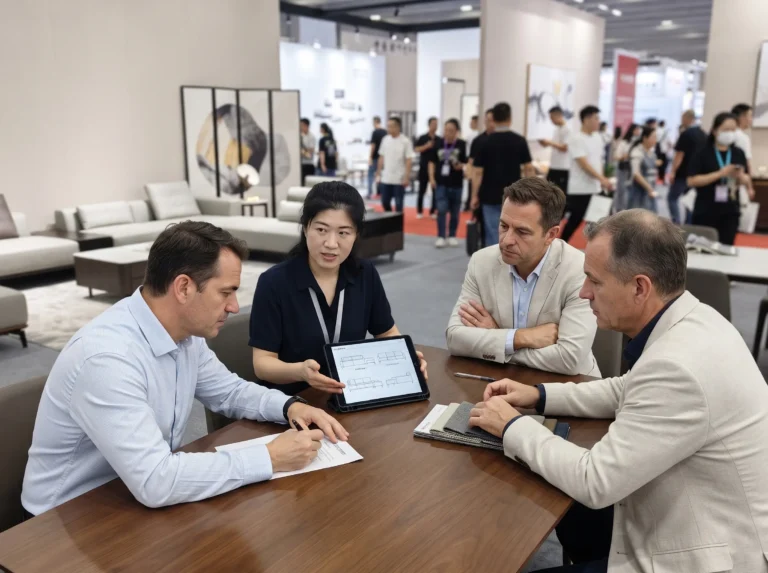
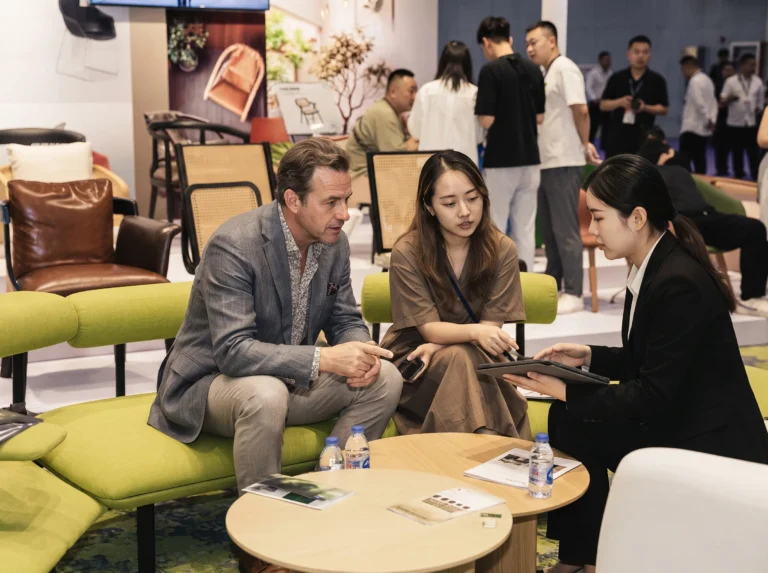
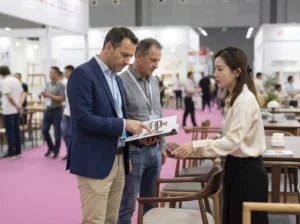
For a procurement manager landing in Guangzhou Baiyun Airport on a Monday morning, the trip is already expensive. Flights, hotels, interpreters, sample freight—costs stack before the first factory gate opens. The temptation to accept a slick showroom visit is real. A “factory representative” in a tailored blazer pours oolong tea under recessed LED lights. Leather swatches are fanned like a poker hand. The buyer thinks, This looks professional. This looks efficient.
But that polished room is the trap.
In Foshan Longjiang, the heart of China’s upholstered furniture belt, I watched a showroom-only trader present himself as a “manufacturer” to a Brazilian hotel group. The buyer signed a 340-unit guest room contract. Three months later, the frames arrived with plywood grade three steps below the sample. The “factory” had never existed. The trader had subcontracted to a low-margin workshop in Jiangxi Nankang without telling the buyer. The hotel opening was delayed 11 weeks. The cost overrun hit $47,000.
This is not rare. It is routine.
The factory tour authenticity problem hits B2B buyers hardest because volume amplifies risk. A showroom-only trader can hide:
● Capacity fraud: No owned production line means no guaranteed slot during peak season.
● Quality drift: The workshop that actually builds the order is chosen by margin, not by your spec sheet.
● Customization failure: Structural changes to a sofa frame or headboard require direct engineer-to-engineer communication. A middleman adds a broken telephone.
● Delivery collapse: When the hidden subcontractor falls behind, the trader blames “raw material delays” or “Chinese New Year shutdowns” that were never real.
The Personal Buyer Trap: Small Order, Big Markup
For an overseas homeowner buying 12 chairs and a dining table for a new apartment in Singapore, or a small Airbnb operator in Lisbon sourcing 8 bedroom sets, the showroom feels safe. The photos are gorgeous. The English is fluent. The WeChat replies come in minutes.
But the same dynamic applies at smaller scale.
A couple from Sydney contacted what they believed was a “direct Foshan factory” through a beautifully curated Instagram page. The showroom visit was seamless—marble samples, fabric books, even a “production video” on loop. They paid a 40% deposit. The final goods arrived with MDF substituting for promised solid oak, and the “factory” stopped answering emails after delivery. The showroom had been rented for the day. The actual source was a trading company marking up prices 65% above true factory cost.
Real production vs showroom is not an abstract debate. It is the difference between knowing who builds your furniture and trusting a stage set.
What a Real Factory Actually Looks Like Behind the Door
The Three Honest Signals of a Genuine Manufacturer
After years of onsite production inspection walks in the Pearl River Delta and Zhejiang clusters, three signals separate the real from the rented:
1. Dust, Noise, and Half-Finished Goods Are Not Hidden
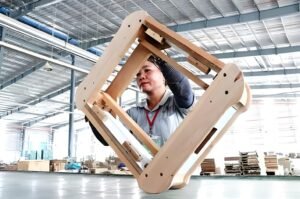
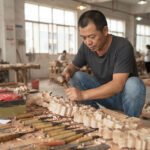
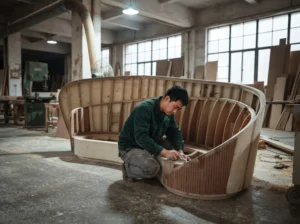
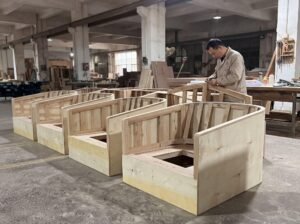
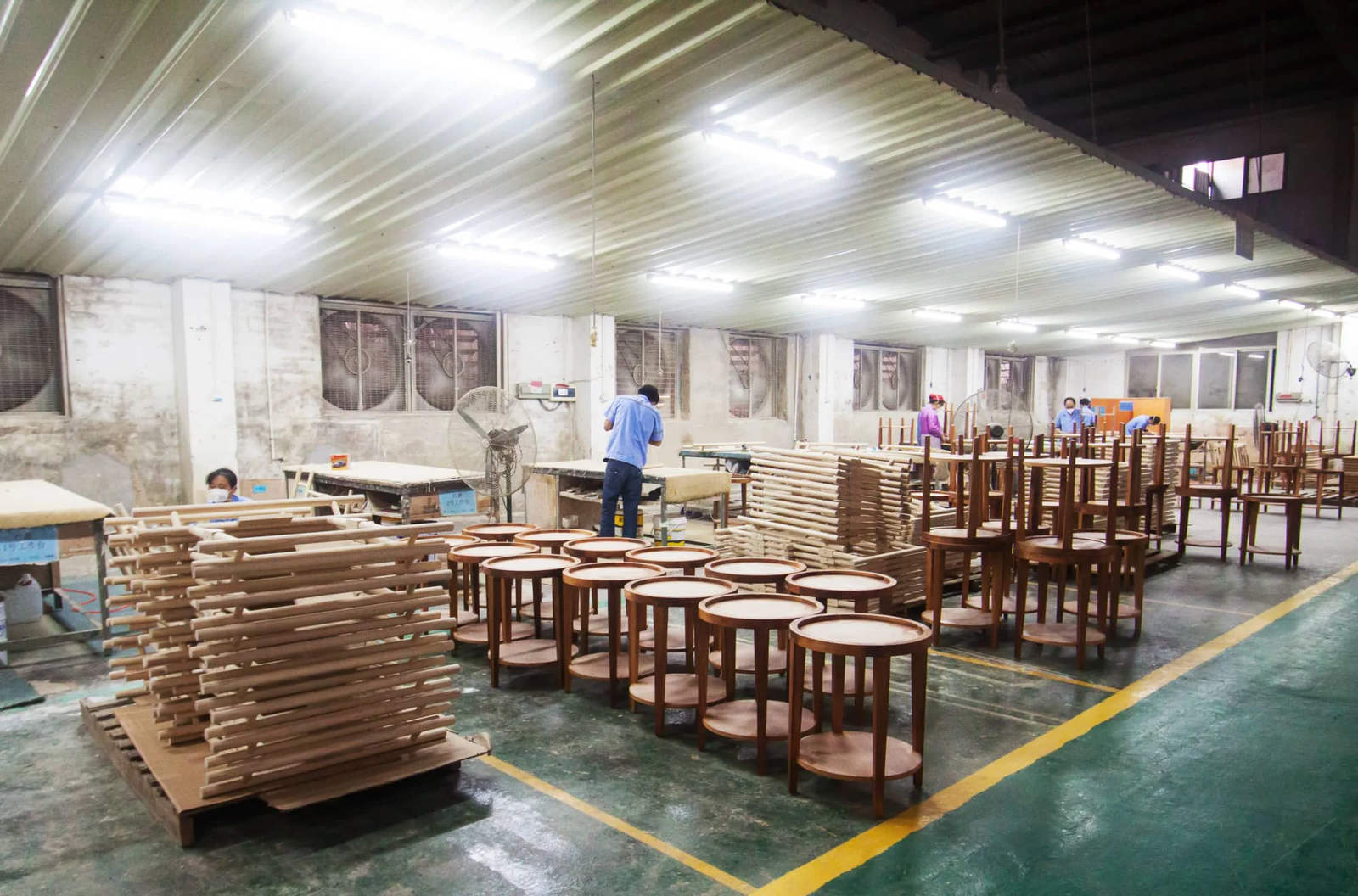
In a genuine Dongguan Houjie solid wood factory, the first thing that hits you is sawdust. Not the theatrical sprinkle of a movie set—real accumulation under band saws, in the corners of CNC routing stations, piled against the walls of the rough mill. A real factory manager does not apologize for this. He points to it. “This is where your table starts. White oak rough plank. See the moisture meter? 8.2%. We dry it in-house.”
The honest manufacturer wants you to see the raw input because the raw input proves they control the process. If a facility is spotless from the loading dock to the spray booth, it is either a brand-new automated plant (rare) or a showroom with a workshop costume.
2. The Production Schedule Is Visible and Verifiable
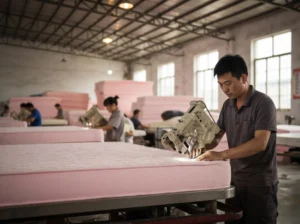
Walk into a Foshan Longjiang upholstery plant on a Tuesday afternoon in October. The whiteboard above the cutting table shows order numbers, fabric codes, and ship dates. A buyer from a Dutch e-commerce brand can point to her PO number and see where it sits in the queue. The factory owner does not flinch. He explains the bottleneck: “Your sofa is cut. Sewing starts Thursday. The foam supplier is late, so we are using backup stock from our own warehouse.”
This is the transparency that makes factory tour authenticity valuable. A trader cannot show you a real production schedule because they do not control one. They might show a spreadsheet, but it is a projection, not a live floor plan.
3. Engineering and Sales Share the Same Roof
In a real factory, the person who quotes your custom dimensions can walk you 30 meters to the engineer who will adjust the CAD file. In a showroom-only trader operation, the “sales manager” is a commissioned closer. Ask a technical question—Can you reduce the arm height by 4cm and switch to a no-sag spring system?—and watch the delay. The trader has to message the actual factory. The real factory owner calls the engineer over.
The Floor Truth: What Different Furniture Categories Reveal
Not all workshops look the same. Knowing the category helps you identify factory by tour:
| Furniture Category | Real Factory Floor Evidence | Showroom-Only Red Flag |
|---|---|---|
| Solid Wood / Dining | Rough lumber stacks, kiln drying records, visible joint clamps, hand-sanding stations with genuine dust accumulation | “All wood is imported from Europe” claims with no customs docs; showroom smells of air freshener, not timber |
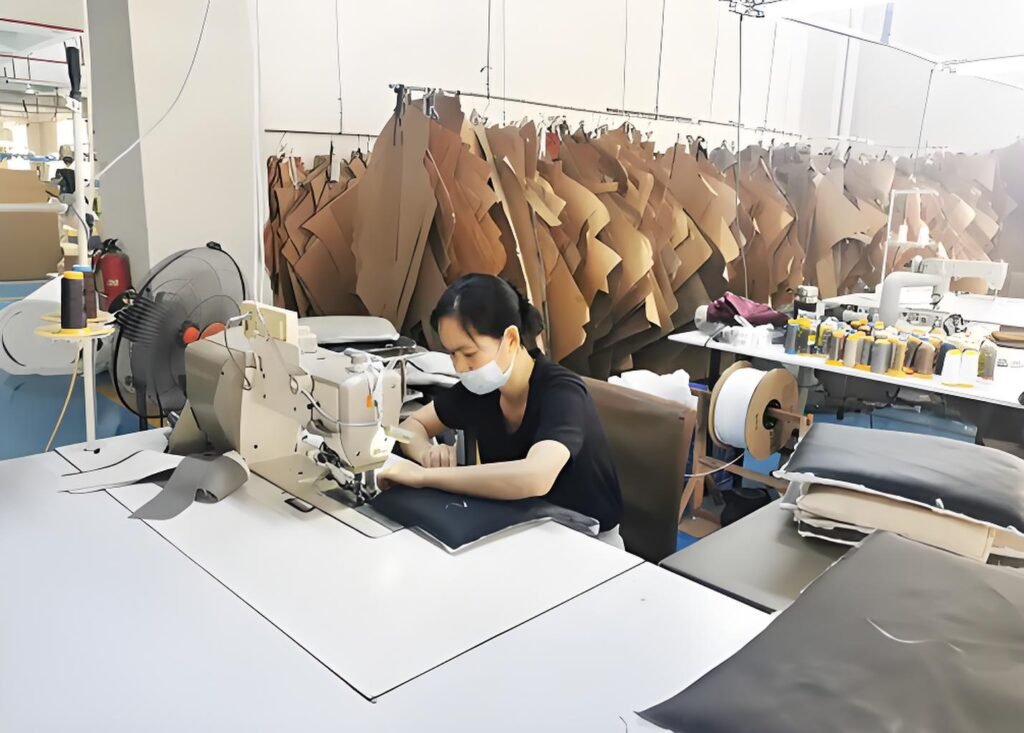
| Upholstery / Sofas | Foam block storage, spring unit assembly benches, fabric roll racks with SKU labels, stitching floor with thread debris | Perfectly staged sofa displays with no cutting table visible; claims “we sew everything” but no sewing floor |
| Metal / Outdoor | Welding stations with spatter marks, powder coating line with color charts, tube bending dies organized by diameter | Chrome samples that look outsourced; no welding smoke, no powder coat overspray on walls |
| Marble / Stone | Wet cutting area with slurry drainage, bridge saw with diamond blade wear, polishing pads in use | Pristine stone slabs with no cutting noise; “factory” located in city center with no heavy freight access |
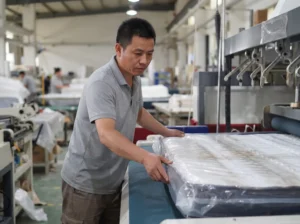
| Mattresses | Spring coiling machines, foam pouring stations, quilting lines with visible thread waste, compression packing zone | Only finished mattresses on display; no raw foam blocks, no spring unit assembly |
The Four Playbooks of a Showroom-Only Trader
Understanding the enemy is not paranoia. It is risk management. After observing showroom-only trader operations across dozens of factory tour authenticity investigations, four distinct playbooks emerge:
Playbook 1: The Rented Showroom with Fake Badges
The trader leases space in a furniture exhibition building—Foshan Louvre or Lecong International Convention Center—and dresses it as a “factory direct” outlet. Wall plaques claim “ISO 9001 Certified” and “10,000㎡ Workshop.” The certificates are photocopied from another company. The workshop area is a rented photo studio.
How to break it: Ask for a live video call showing the factory gate with the company nameplate. Then ask for the last 3 months of export customs declarations. The exporter name on the declaration is the legal production entity. If the seller cannot produce a single customs doc with the name they are selling under, you are looking at a trader. Do not rely solely on business license address matching—in China, complex corporate structures, tax-optimization subsidiaries, and separate sales entities are standard practice. A factory may operate under one registered name for domestic tax purposes and another for export. The customs declaration is the only document that cannot be easily faked.
Playbook 2: The “Partner Factory” Misdirection
When pressed for a workshop visit, the trader admits they are a “trading company” but claims they have “exclusive partner factories” under “strict quality control.” This sounds reasonable. It is often fiction.
In one Zhejiang Yuhuan case, a trader showed a “partner factory” that was actually a public workshop renting bench space to anyone. The trader had no exclusive relationship. The workshop was simultaneously producing orders for three other trading companies. The buyer’s “exclusive” quality control was a 15-minute walk-through once a month.
How to break it: Ask to visit the “partner factory” unannounced. A real partnership survives a random Tuesday. A fake one requires “two days notice to arrange.”
Playbook 3: The Video Tour Deception
Since COVID-19, video factory tour authenticity checks have become standard. Traders adapted. They hire a videographer to shoot a generic workshop, then edit in logos and voiceovers. The same video is sent to 200 buyers.
How to break it: Demand a live video call. Ask the host to walk to a specific machine and show the current date on a phone. Ask to see a specific order number on the production board. If the host stalls, the “live” tour is a recording.
Playbook 4: The Partial Tour with a Hidden Subcontractor
This is the most sophisticated. The trader owns a small workshop—maybe 2,000㎡—but pitches capacity for 50,000㎡. They show you the real small workshop, then route overflow orders to a cheaper, unvetted subcontractor.
How to break it: Compare the workshop size to the claimed annual output. A 2,000㎡ facility cannot produce 800 containers per year. Ask to see shipping records for the last 12 months. Real factories keep customs declarations and bill of lading files.
The Full Risk Spectrum: What Happens When You Buy from a Showroom Ghost
Financial Risk: The Hidden Markup Layer
A showroom-only trader is not evil by default. Some provide genuine value—language support, consolidated logistics, payment security. The problem is opacity. When a buyer believes they are dealing direct with a Foshan factory, they expect factory pricing. The trader knows this and hides the margin.
In a typical real production vs showroom scenario:
● True factory cost for a 3-seater sofa: $340 FOB
● Trader’s purchase price from that same factory: $340
● Trader’s price to the buyer: $580
● Buyer believes they negotiated “direct factory” savings
The $240 difference is not criminal. The crime is the lie about who is building the product.
Operational Risk: When the Ghost Factory Fails
A hotel project in Dubai ordered 220 guest room sets through a “factory” that was actually a one-man trading desk in Shenzhen. The real workshop was in Ganzhou, Jiangxi. When the hotel’s interior designer changed the headboard dimensions mid-production, the message had to travel: designer → Shenzhen trader → Ganzhou workshop manager → Ganzhou engineer. Four nodes. Three days lost. The final product arrived with the old dimensions because the engineer never received the revised CAD file.
A real factory with direct client access solves this in a 20-minute WeChat call with screen sharing.
Quality Risk: The Sample-to-Bulk Collapse
The showroom sample is always perfect. It was built for inspection. The bulk order is built for margin. When a trader controls the subcontractor choice, they choose the workshop that offers the lowest quote to protect their markup. That workshop cuts corners—thinner foam, lower-grade plywood, skipped drying cycles.
Without onsite production inspection, the buyer discovers the collapse only when the container opens 8,000 miles away.
After-Sales Void: Who Fixes the Defect?
A real factory has a reputation to protect. They fix a cracked chair leg because they want the next order. A showroom-only trader has a WeChat account and a rented office. When defects arrive, the response cycle is: delay, deny, disappear. The buyer has no legal leverage against a trading company with no fixed assets.

FAQ: Factory Tour Authenticity & Showroom Verification
Q1: Are all trading companies bad? Should I only buy from factories?
No. Legitimate trading companies provide real value—consolidation, language support, payment security, and quality pre-inspection. The problem is showroom-only traders who pretend to be factories. A transparent trader who admits their role and shows you their partner factories openly is often safer than a dishonest “factory” that is actually a middleman.
Q2: Can a factory be too clean to be real?
Yes. A factory floor with zero dust, zero noise, and zero raw material clutter is either:
● A newly built automated plant (verify with investment records)
● A showroom with a workshop costume
● A facility that has been “cleaned” specifically for your visit, meaning they paused production
Real workshops have controlled chaos. The dust is in the right places. The noise is from actual machines. The clutter is from active orders.
Q3: What if the seller says their factory is “too far” from the showroom?
This is common in Foshan, where sales offices cluster in Lecong and actual factories sit in the outskirts of Shunde, Nanhai, or even Dongguan. A 30–50 km gap is completely normal. Many successful manufacturers maintain downtown sales offices to attract talent and receive clients, while keeping production in industrial zones with lower land costs. The red flag is when the seller refuses to arrange transport to the workshop or invents excuses. A real factory owner is proud of the facility and will arrange the trip.
Q4: How do I verify a factory’s export experience?
Ask for:
● Customs export declarations with the factory name as exporter. This is the most reliable proof because it is government-issued and hard to fabricate.
● Bill of lading copies showing consistent shipping volumes.
● Client references from the same country (with permission).
● Alibaba or Global Source verification badges that match the factory name on the export docs.
Do not rely on business license address matching as a smoking gun. In China, a single business group may hold multiple licenses: one for domestic sales, one for export, one for raw material import. The registered address on the license may be the group headquarters in a city center office, while the actual workshop is 40 km away. This is legal, common, and not evidence of fraud.
Q5: Can a small workshop still be a “real factory”?
Absolutely. Many high-quality Foshan furniture makers operate in 3,000–5,000㎡ facilities. Size does not equal legitimacy. What matters is transparency: Do they own the machines? Do they employ the workers? Do they control the production schedule? A small, honest workshop is preferable to a large, deceptive trading company.
Q6: What are the warning signs during a video factory tour?
● The camera never moves far from a single “perfect” corner
● The same 3-5 workers appear in every shot (likely staged)
● No raw materials visible—only finished goods
● The seller cannot answer technical questions without pausing to message someone
● Background noise does not match the claimed activity (silence during “cutting” shots)
Q7: How do personal buyers avoid the showroom trap without flying to China?
Use the five-step video verification protocol above. Additionally:
● Insist on a live video call, not a pre-recorded “factory tour”
● Pay via escrow or trade assurance, never direct wire to a personal account
● Order a sample first, then request a video of your specific sample being built
● Use third-party inspection services like SGS or Bureau Veritas for a few hundred dollars
Q8: What legal protections exist if a showroom trader defrauds me?
If you have a signed contract and proof of misrepresentation, Chinese contract law does protect foreign buyers. However, enforcement is difficult against shell trading companies with no fixed assets. Prevention is far more effective than litigation. This is why factory tour authenticity verification before payment is critical.
Recommended Resource
Interi Furniture specializes in custom furniture manufacturing for residential, hospitality, and commercial projects. Their experience in materials, craftsmanship, and project realization makes them a valuable resource for designers and buyers seeking tailored furniture solutions from China.