








Here is the uncomfortable truth in one paragraph: a large share of Alibaba suppliers listed as “Manufacturer” are trading companies, and most buyers never find out until the quality problems arrive. You can filter the obvious fakes in 30 seconds by reading account signals, confirm identity in 10 minutes with a video audit, and the single most reliable test is simple — a real factory will show you its workshop floor live, on your terms. Trading companies are not the enemy; disguises are. A good trader who prices like a trader can be a genuine asset. A trader billing factory-direct prices is the problem this article teaches you to spot fake operations before money changes hands.
Why the “Manufacturer” Label Deserves Your Suspicion
Most overseas buyers assume the platform has already done the vetting for them. The badge says “Manufacturer,” the storefront shows machines, and the profile claims 200 employees — so the buyer moves straight to price negotiation. That is exactly where the fake factory Alibaba problem lives, in the gap between a label and a load-bearing wall.
Alibaba’s ecosystem rewards suppliers who claim factory status. Factory-direct positioning wins more inquiries, commands better prices, and attracts larger buyers. The commercial incentive to stretch the truth is structural, not personal, and it exists across every major furniture category from sofas to metal frames.
The buyer’s real question is not “is this badge real.” The real question is how to tell if an Alibaba supplier is a factory in the operational sense — meaning the entity that controls the machines, the workers, and the production schedule your deposit depends on.
What Alibaba Verification Actually Checks — and What It Does Not
Alibaba’s verification landscape is tiered, and the tiers are routinely collapsed into one misleading impression. Based on platform documentation and standard industry practice, there are two levels buyers routinely confuse.
Verified Supplier vs. Assessed Supplier
A Verified Supplier badge indicates that the company’s registration and submitted documentation passed the platform’s file-level verification — legal existence, matching paperwork, basic business details. It confirms the file, not the factory floor.
An Assessed Supplier designation goes a step further and involves an on-site audit conducted by a third-party inspection firm engaged through the platform. The audit examines facilities, operations, and management systems — but it is still a snapshot of one entity at one point in time, commissioned within a commercial relationship, and it is not a perpetual guarantee of manufacturing reality.
Here is the part buyers miss most: the Verified tier is a paid membership product. According to Cosmo Sourcing, annual fees for the Verified Supplier program run to roughly $12,500 for China-based suppliers, with costs varying by country. Figures are subject to verification and change over time, but the structural point stands — a badge obtained through a paid tier verifies that a supplier invested in the program and passed document checks. It does not certify production capacity, and traders with clean paperwork qualify just as easily as factories with four welding lines.
All platform rules, tier definitions, badge meanings, and fee structures are subject to verification against Alibaba’s official, current documentation — treat any third-party summary, including this one, as orientation rather than gospel.
What “Fake Factory” Actually Means
A fake factory, in this article’s usage, is not a scammer shipping empty containers. It is any supplier that presents itself as a manufacturer while functioning as a middleman — sourcing from one or more actual factories, controlling no production assets of its own, and capturing the factory-direct price premium through that misrepresentation. The harm is not the trading function. The harm is the identity laundering: the buyer pays for capacity control, quality accountability, and schedule authority that do not exist.
The 30-Second Signal System
None of these signals alone is proof — with one near-exception at the top of the table. Together, they form a filter strong enough to eliminate most disguised traders before you spend a single minute on messaging. This is the fast screen that teaches your eye how to spot fake storefronts at a glance.
| Signal | What You See | What It Usually Means | Strength |
|---|---|---|---|
| Business license scope | Registered scope reads “sales / wholesale / trading” vs. “production / manufacturing” | The single most decisive desktop check — scope is legal language, not marketing | Strong |
| Product scope | Sofas, lamps, kitchenware, pet furniture, and phone cases in one storefront | A “general store” catalog is nearly impossible for one factory to produce | Strong |
| Company name keywords | “Trading,” “Import & Export,” “Commerce” in the registered name | A probability tilt only — names can mislead in both directions | Medium |
| Image style consistency | Product photos with mismatched lighting, backgrounds, and watermarks | Photos sourced from multiple real factories or scraped from competitors | Medium-strong |
| Certifications displayed | Badges featured heavily but workshop photos absent | Documents verified, capacity unverified | Medium |
| Company age vs. scale | Two-year-old account claiming 500 workers and five factories | Real capacity takes years to build; numbers rarely inflate that fast upward | Medium-strong |
| Response behavior | Instant answers on any product in any category, no technical depth | Sales agent model — typical of trading desks, not engineers | Medium |
| Registered address | Downtown office tower rather than an industrial zone | Offices negotiate; factories sit in industrial clusters — but see the caveat below | Medium |
On the license scope signal: ask for the Chinese business license and read the business scope line yourself or with a translator. “销售、批发、进出口” (sales, wholesale, import-export) is a trading company until proven otherwise; “生产、加工、制造” (production, processing, manufacturing) is the language of a factory. Everything else in this table adjusts probability — this row approaches a verdict.
On the address signal: a registered address inside a furniture cluster is encouraging, but it is not evidence. Companies routinely separate their registered address from their production address, and a trader can register inside Foshan while owning nothing but an office. Registered address in the cluster does not mean the factory is in the cluster — only the live video audit resolves where production actually happens.
Signal Strength: Reading the Table Like a Local
Experienced buyers grade signals rather than counting them. The logic mirrors how a customs officer reads a passenger: no single detail convicts, but a cluster of weak signals compounds.
| Tier | Signal Pattern | Your Move |
|---|---|---|
| Green | Narrow catalog, manufacturing scope on license, consistent images, plausible scale | Proceed to contact; verify anyway |
| Yellow | One strong middleman signal, everything else clean | Ask direct identity questions early |
| Red | Multiple strong signals stacked — general store catalog plus sales-only scope plus instant universal answers | De-prioritize unless pricing justifies the trader risk |
The single-category storefront deserves its own note. A focused catalog is necessary for factory status but never sufficient. Trading companies have learned to specialize, so depth of catalog alone proves nothing.
The 10-Minute Deep Verification
Once a supplier passes the 30-second screen, ten minutes of structured checks separate storefront theater from production reality.
| Step | What to Check | What a Real Factory Shows | The Red Flag |
|---|---|---|---|
| Business license scope | The registered business scope on the Chinese license, read in the original language | Language covering manufacturing and production | Scope limited to sales, commerce, or import-export only |
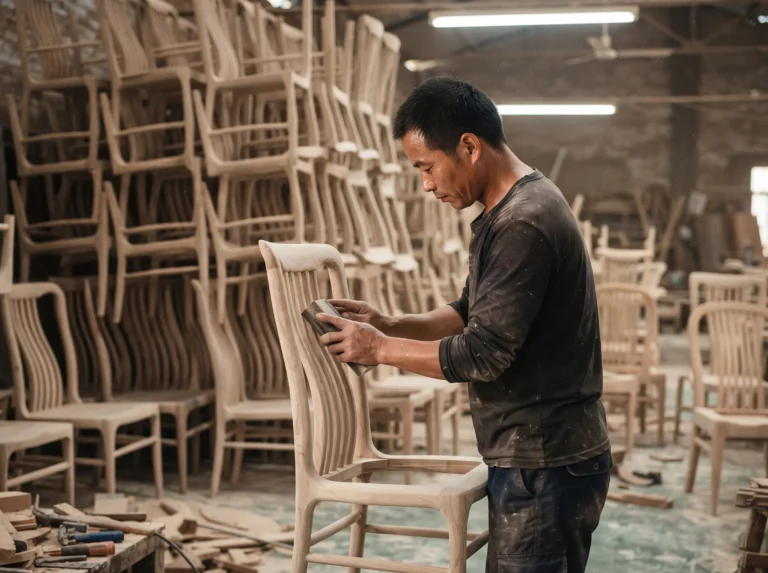
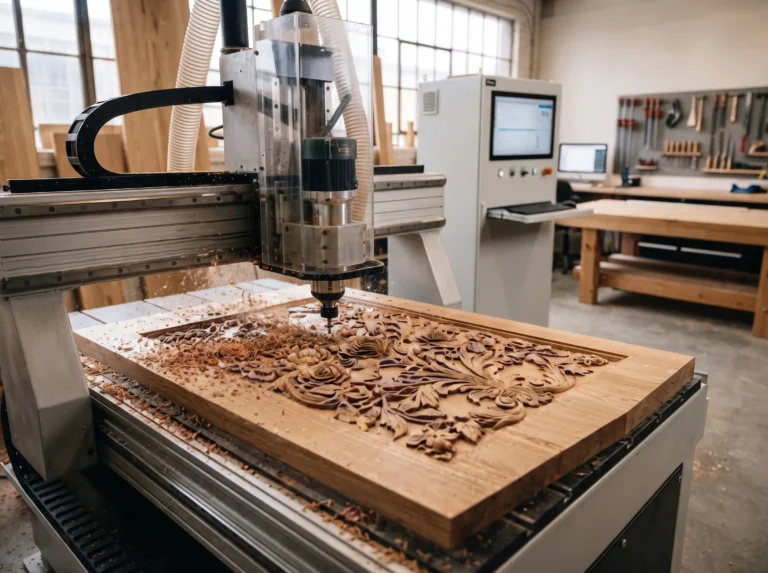
| Live video audit | Workshop, machines, raw material storage, workers at stations | A floor you can direct — “show me the cutting area” | A pre-recorded tour or a showroom dressed as a factory |
| Address triangulation | Registered address vs. live video background vs. industrial-zone reality | All three pointing to the same production site | A registered address that is clearly an office while the video shows a rented floor elsewhere |
| Cluster match | Whether the production site sits in a known furniture belt | Foshan or Shunde for sofas, Longjiang for chairs, Guanfacun for boards | A “furniture factory” in a city with no furniture industry |
| Technical depth | Questions about materials, tolerances, and production time | Specific, numbers-driven answers from someone who sounds like production | Vague reassurance from a pure sales voice |
Notice the license scope check appears in both the 30-second table and the 10-minute routine. That repetition is deliberate: it is the cheapest check with the highest information value, and traders who pass everything else still fail here.
What to Demand in a Live Video Audit
The audit’s power comes from control. You choose the moment, and you choose the camera path.
Ask to see the raw material warehouse first, because empty shelves tell you more than full ones. Ask the camera operator to walk from cutting to assembly to packing without cuts, because staged tours edit out the rented corners. Ask them to show a machine’s control panel with the day’s production counter, and ask one worker on the floor how long they have worked there. A real factory answers all of this casually; a disguised trader starts negotiating what the camera may see.

Three Traps That Even Careful Buyers Fall Into
The Certification Worship Trap
Badges are documents, and documents are easy for an organized trader to obtain through legitimate channels — especially when the entry tier is a paid membership with file-level checks. Verification confirms the paper trail, not the production line. Even the Assessed tier, with its genuine on-site audit, captures one moment in one facility rather than permanent capacity. Use certifications as a hygiene check, never as identity proof.
The Photo Theft Trap
Photo theft runs in both directions and is more common than buyers expect. Factories steal from each other; traders steal factory galleries; some suppliers repurpose photos from entirely unrelated businesses. Images on a listing are marketing material and should be treated as unverifiable until a live video corroborates them.
The Staged Video Tour Trap
A growing service industry rents factory floors by the hour for verification performances. Static, pre-recorded “factory videos” with cinematic editing are now a standard trader asset. The countermeasure is unchanged: live, interactive, unannounced timing, with you directing the route.
Factory vs. Trading Company: An Honest Comparison
The trading company vs factory question is not a morality play. Each structure carries a distinct risk and value profile, and the right answer depends on your order size, category complexity, and tolerance for coordination work.
| Dimension | Real Factory | Trading Company (Honest) | Trading Company (Disguised) |
|---|---|---|---|
| Price structure | Factory-direct cost basis | Cost plus service margin, disclosed | Cost plus margin, hidden behind factory claims |
| Quality accountability | Direct — you know who built it | Delegated — depends on trader’s factory network | Opaque — the actual factory may not know you exist |
| Production control | You influence the schedule directly | Trader coordinates; adds a communication layer | You wait behind other orders you cannot see |
| Flexibility | Narrow, deep — one or few categories | Broad — can bundle furniture, lighting, hardware | Broad, but with inflated factory claims |
| Risk profile | Concentrated in one partner | Distributed across the trader’s network | Concentrated and hidden |
What an Honest Trading Company Actually Is
A trading company is a coordination business: it aggregates demand, manages factory relationships, handles export documentation, and sells convenience. The model is legitimate, ancient, and — in the right situation — the most efficient path from Chinese production to your warehouse. The industry’s problem is not the existence of traders. It is the systematic pricing of trading services at factory-direct rates through identity misrepresentation.

When a Trading Company Is the Smarter Partner
There are real scenarios where insisting on a factory works against you. If your order bundles multiple product categories, no single factory will build your sofa, your lamps, and your packaging — a trader will. If your volume is below a factory’s minimum order threshold, a trader’s consolidated orders may get your goods produced at all.
First-time importers often underestimate the coordination burden: inspection booking, export paperwork, mixed-container consolidation. A good trader sells exactly this competence. The smart buyer’s position is not “no traders.” It is: trade with traders, on trader terms, at trader prices — and save the factory-direct premium for relationships that are actually factory-direct.
Risk Controls If You Work With a Trading Company
Walking away is one option. Managing the relationship with clear eyes is often the more profitable one.
| Risk Control | What It Means in Practice | Why It Works |
|---|---|---|
| Price for the real identity | Negotiate against trader-level market pricing, not factory-direct benchmarks | Removes the hidden premium that disguises exist to capture |
| Contract with the real party | Sign with the exact legal entity on the license; verify the bank account matches | Preserves legal recourse if quality collapses |
| Third-party inspection | Book pre-shipment inspection independent of the supplier | An inspector answers to you, not to the sales desk |
| Visibility into the source | Ask which factory produces your order; require production photos with your PO number | Forces traceability the disguise was designed to hide |
| Payment discipline | Stage payments against milestones, not goodwill | Caps your exposure at every phase |
Playbooks by Buyer Type
| Buyer Type | Your Primary Risk | Your 30-Second Priority | Your 10-Minute Priority |
|---|---|---|---|
| Importer / wholesaler | Margin erosion from hidden trader premiums | Price structure consistency across catalog | Business scope plus cluster-matched production site |
| E-commerce seller | Quality inconsistency across reorder batches | Catalog focus and image consistency | Live video audit with PO-level traceability |
| Individual / small buyer | Overpaying for middleman layers on small volume | Signal triage — skip red-tier accounts entirely | Honest trader acceptance plus staged payment |
Importers should weight price-structure analysis heaviest, because the disguised trader’s entire profit lives in the spread. E-commerce sellers should weight consistency heaviest, because a trader switching source factories between batches is how five-star products become two-star returns.

FAQ
Can I trust the “Verified Manufacturer” badge on Alibaba?
Distinguish the tiers first. A Verified badge means registration and documents passed file-level checks — it is a paid membership tier, not a capacity audit. An Assessed Supplier designation involves a third-party on-site audit, which is stronger but still a snapshot in time. Treat any badge as a hygiene signal and keep verifying independently. Tier definitions and verification scope are subject to verification against Alibaba’s official documentation, which can change.
Why is a trading company’s quote sometimes lower than a factory’s?
Factories carry fixed costs — machines, rent, idle labor — that traders avoid by renting capacity flexibly across a network. A trader quoting below a factory is often rational, not fraudulent. The problem is only the quote combined with a factory identity claim.
What exactly should I ask to see during a video factory tour?
Raw material storage, the machine line with a live production counter, workers at stations, and the finished-goods warehouse — in one continuous walk, on a live call, at a time you choose. Refusal to show any of these is information.
Should I drop a supplier if I discover they are a trading company?
Only if they claimed otherwise, or if your margins assumed factory-direct pricing. If the trader is honest about identity, competitively priced, and passes your inspection controls, they may serve you better than a small factory would.
What if I rely on one signal and get it wrong?
Single signals mislead by design — which is why the license scope check anchors this system while everything else adjusts probability. Re-run the 30-second screen, read the business scope in the original Chinese, then demand the live video audit. Ten minutes of verification costs nothing; a misidentified partner costs a container.

Your Next Container Starts With Better Questions
The buyers who lose money to disguised traders rarely lack intelligence — they lack a screening habit. Run the 30-second signal scan on every new account this week, then share what you find. What is the most convincing “factory” storefront you have ever seen that turned out to be a trading desk? Drop it in the comments — your red flag might save another buyer’s deposit.
Recommended Resource
Interi Furniture specializes in custom furniture manufacturing for residential, hospitality, and commercial projects. Their experience in materials, craftsmanship, and project realization makes them a valuable resource for designers and buyers seeking tailored furniture solutions from China.