







If you’ve ever sourced custom furniture from China, you probably know the exact moment of dread: the container arrives, you cut the straps, and something immediately looks off. The color’s wrong. The dimensions don’t match your drawings. The seating feels different from the sample. You call the factory. They respond with the same four words every time: “We produced per drawing.” You’re stuck. They’re defensive. And whatever happens next—selling it anyway, discounting it, or lawyering up—the money and time are already gone.
After years of deep involvement in China’s furniture manufacturing clusters, running projects that range from single-item fabric swaps to full hotel FF&E rollouts, a pattern keeps surfacing: custom furniture fails not because factories can’t build, but because buyers and factories never aligned on what “build” meant in the first place. Requirements stayed vague. Standards were verbal. Liability was nobody’s job. Then the goods arrived, and both sides realized they’d been picturing completely different products.
This article lays out a 6 stage process paid for in real rework costs and project delays. Every stage has a deliverable, an acceptance gate, and a risk interception point. The core argument is simple: custom furniture not nightmare—if you move control upstream, before the factory cuts the first piece of material.
Three Hard Truths About Why Custom Furniture Fails
Most people blame the factory. After years in the field, the reality is more nuanced. Three cognitive gaps sit between buyer and supplier. Until you close them, switching factories won’t fix anything.
Hard Truth 1: Your Definition of “Custom” and the Factory’s Definition Are Completely Different
You send a Pinterest image and say: “I want this style, firmer seating, for a hotel lobby.” The factory extracts almost nothing from that image: silhouette, approximate dimensions, maybe fabric type. But your tactile expectation of “firmer,” your implied durability and fire-resistance requirements for “hotel lobby,” your millimeter-level preference on armrest curvature—all of that lives in your head. The factory has to guess.
The result? They build what they think you want. You get a sofa that looks roughly right but sits too soft, has rounded arms you didn’t want, and the fabric sheen is off. The factory is frustrated: dimensions are within tolerance, fabric color code was approved. You’re frustrated: this isn’t what you pictured.
Project tracking data is unambiguous: 70% of custom disputes originate in requirement clarification. The factory could build it. You just never told them what “it” actually was.
Hard Truth 2: “Production Per Drawing” Hides the Biggest Trap in the Industry
Factories love this phrase. It’s technically accurate, but it carries a massive liability carve-out: the factory is responsible only for what’s on the drawing—dimensions, structure, material specs. Whether the final piece looks good in your showroom, feels right to the touch, or complements the furniture beside it—these are aesthetic judgments, and they sit outside the factory’s responsibility zone.
This is the most invisible cognitive gap in China’s custom furniture sector. Buyers assume “per drawing” equals “per effect.” Factories assume “drawing signed, liability ended.” Without a physical Sealed Sample serving as an arbitration standard, both parties are measuring against floating benchmarks.
Hard Truth 3: Arguing After Failure Costs Multiples More Than Preventing It
Fabric batch color drift. Hardware mold deviation. Transit damage. These happen. But most buyers and factories never pre-negotiated: What counts as factory liability? What’s a material characteristic exemption? Who pays for rework logistics?
The direct result is predictable: two weeks of finger-pointing, one week of negotiation, then reluctant rework by the factory and a delayed launch by the buyer. The time cost and opportunity cost often exceed the product value itself.
The Six-Stage Workflow, Start to Finish
Stage 1: Requirement Clarification—Stop Making the Factory Guess
The goal here is singular: translate the picture in your head into technical language the factory’s process engineer can execute.
Don’t just send an image and wait for a quote. Produce a Requirement Brief containing: inspiration images from multiple angles, a functional needs list (usage scenario, load-bearing requirements, durability specs), a target cost range, and a non-negotiable details list. Then hold a technical briefing with the factory’s process lead in the room. Confirm face-to-face that they understand your expectations on curved surfaces, joint methods, and finishing effects.
Plenty of buyers skip this to save time, jumping straight to “just quote me.” The result is predictable: either the quote misses critical processes and triggers add-ons later, or the factory prices to their lowest standard and delivers something unrecognizable. Records show that spending three to seven days on thorough requirement clarification in Stage 1 cuts prototype rework rates by over 40%.
Required Deliverables: Requirement Brief, Technical Briefing Minutes, Material Substitution Confirmation Sheet
Acceptance Gate: The factory can independently restate core requirements and produce a preliminary technical solution without you present
Most Common Pitfall: Sending a mood board and demanding a quote; the factory estimates from experience, triggering massive rework downstream
How to Avoid: Mandate a Process Feasibility Assessment from the factory, flagging which structures are unachievable and which processes carry abnormal costs. Knowing the boundaries upfront beats discovering them halfway through production
Stage 2: Supplier Matching & Quoting—Reading the Cost Structure Behind the Numbers
Selecting a factory isn’t about how beautiful their showroom samples look. It’s about whether they’ve executed projects similar to yours. Ask for production process photos or videos from past cases—not polished finished-product shots, but half-assembled pieces on the workshop floor. That reveals their real capability.
When you receive the quote, deconstruct it: material cost, labor cost, line-switching cost, mold cost, management cost. Many buyers see small-batch customization quotes and cry foul, assuming the factory is gouging them. The reality is more nuanced: Chinese factories quote higher for small-batch customization because line-switching and management costs are structurally higher than mass production, not because they’re padding margins.
What’s line-switching cost? A production line normally runs standard models at two hundred units per day. Switching to your custom order requires equipment re-debugging, worker retraining on the new sequence, and elevated scrap rates for the first two days. In a mass order, these costs get diluted across two hundred units. In your fifty-unit order, each piece carries a heavier allocation. Management costs work the same way: order tracking, QC, and after-sales support don’t shrink proportionally with order size.
Understanding this logic lets you negotiate on genuinely compressible items—material alternatives, mold sharing—rather than blanket price pressure that forces the factory to cut quality where you can’t see it.
Required Deliverables: Supplier Capability Assessment Form, Quote Deconstruction Comparison Table
Acceptance Gate: The quote contains at least two levels of BOM detail, with line-switching and management costs listed separately
Most Common Pitfall: Entering a price war and ending up with a quote that “looks cheap but quietly shrinks everywhere”
How to Avoid: Treat the factory as a partner, not an adversary. Have them walk you through the cost structure openly. You help them save costs; they help you protect quality. That’s the only sustainable win-win
Stage 3: Prototyping & Sealing—Your Only Cheap Chance to Get It Wrong
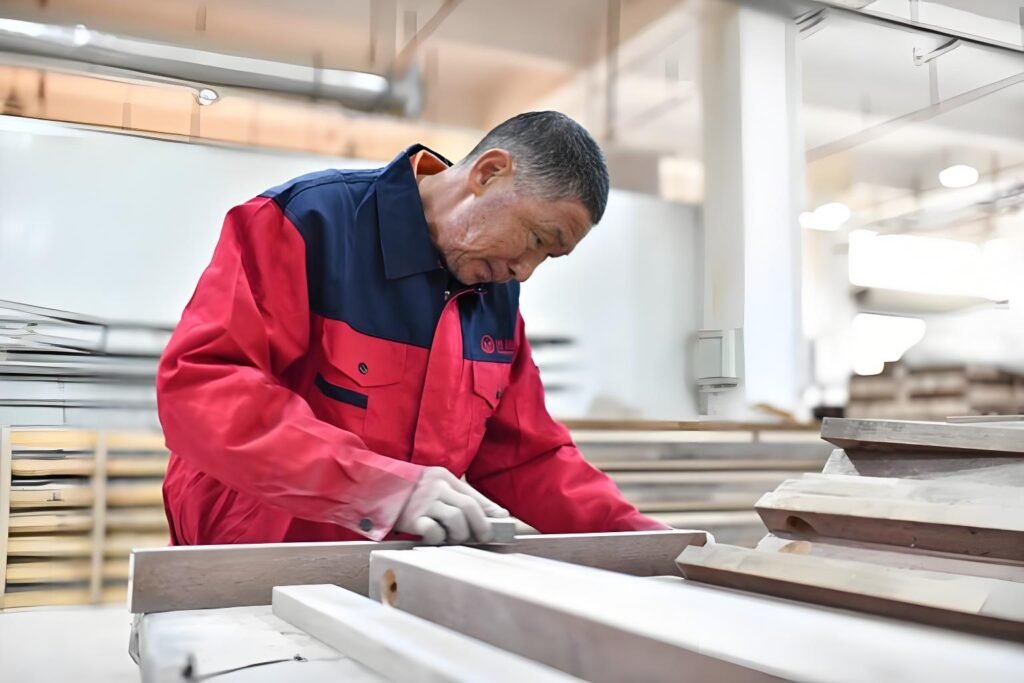
Prototyping is the only stage where mistakes are affordable. Once mass production starts, any change becomes exponentially expensive.
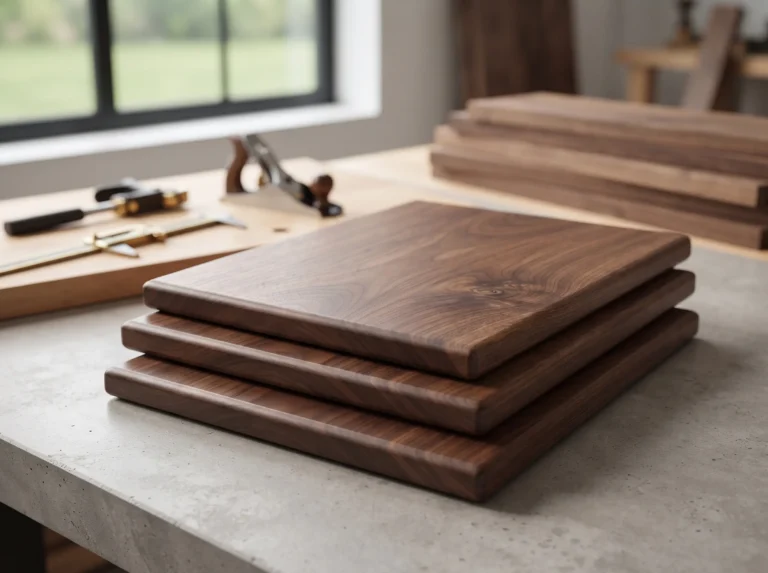
Lead times vary significantly by category. Upholstered furniture typically runs seven to fifteen days, driven by fabric cutting and foam shaping. Solid wood takes fifteen to twenty-five days because moisture content control, machining, and multi-coat finishing each have non-compressible drying times. Metal furniture falls in between at ten to twenty days, with welding and surface treatment as the primary time consumers.
Don’t send one person to approve the prototype. Run a “three-party review”: design checks aesthetics, procurement checks cost and process feasibility, and the factory’s process lead checks production difficulty. All three in the same room, recording issues live, agreeing on corrections on the spot.
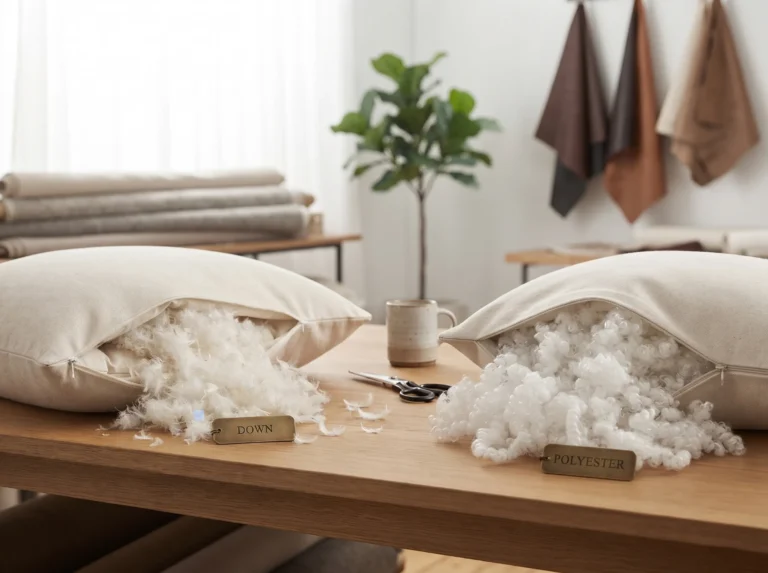
When sealing samples, don’t just seal the finished piece. Archive fabric swatches, hardware samples, and color panels simultaneously, labeling batch numbers and supplier information. The data is stark: projects with strict full-process sealed samples achieve 94% consistency between bulk goods and samples. Projects with photo-only approval or no sealing at all drop to 67%.
Required Deliverables: Sealed Sample Confirmation, Material Swatch Archive Bag, Prototype Issue List & Correction Record
Acceptance Gate: The sealed sample achieves production-ready consistency with the Requirement Brief; all materials are traceable to specific batches
Most Common Pitfall: Approving samples overseas via photographs, where screen color deviation and proportional distortion leave you stunned when the bulk goods arrive
How to Avoid: Mandate photos and videos under both natural light and standard D65 light source, with 360° rotating footage for critical angles. When feasible, delegate third-party QC or an on-site representative for physical confirmation. This expense is non-negotiable
Stage 4: Production Monitoring—Don’t Let the Factory Quietly Change the Process
Before mass production launches, hold a Pre-Production Meeting (PPM). The single most important verification: are the material batches about to hit the line the same ones used for sealing? Different fabric batches can show visible color shifts. Different wood batches can vary in grain and moisture content, affecting dimensional stability.
Require a detailed Production Schedule marking every critical process node: cutting, machining, assembly, finishing, upholstery. This isn’t about micromanagement—it’s about having the right to request process photos at critical nodes. Finishing and upholstery are irreversible once complete. Catching a problem at the finished-goods stage means catastrophic rework costs.
Production cycles typically run thirty to sixty days depending on category and volume. If a factory promises twenty days, be suspicious: are they planning to skip a process step, or compress a two-coat finish into one?
Required Deliverables: Production Schedule, First Article Inspection Report, In-Process Inspection Record
Acceptance Gate: The first article achieves internal QC consistency with the sealed sample before bulk authorization
Most Common Pitfall: Factories switch material batches or simplify processes to catch up on lead time, and you discover it only at the finished-goods stage—too late
How to Avoid: Contractually mandate that “material batch changes require prior written notification and approval.” Require process photos for irreversible stages. Don’t be an absentee buyer
Stage 5: Staged QC—Keep Problems at the Factory, Not on the Boat
Once international logistics start, any quality issue becomes a cross-border dispute. A sea freight round trip takes at least forty days. Rework and re-ship adds another forty. An eighty-day delay can destroy a seasonal sales window or a project handover deadline.
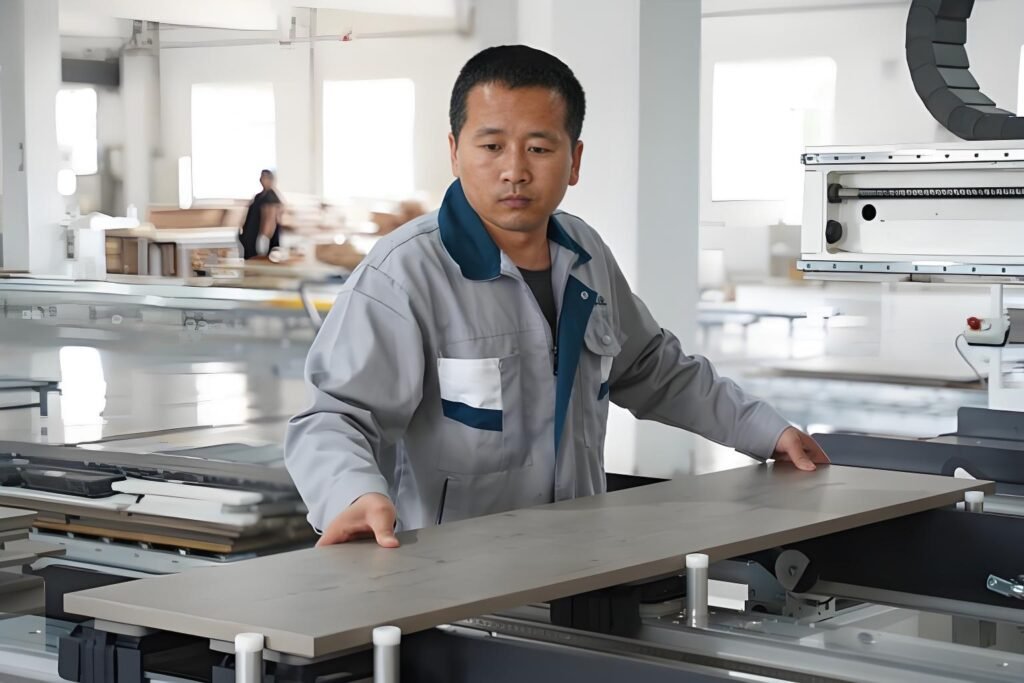
QC must happen at the factory, and it must happen in stages. Enforce three mandatory checkpoints:
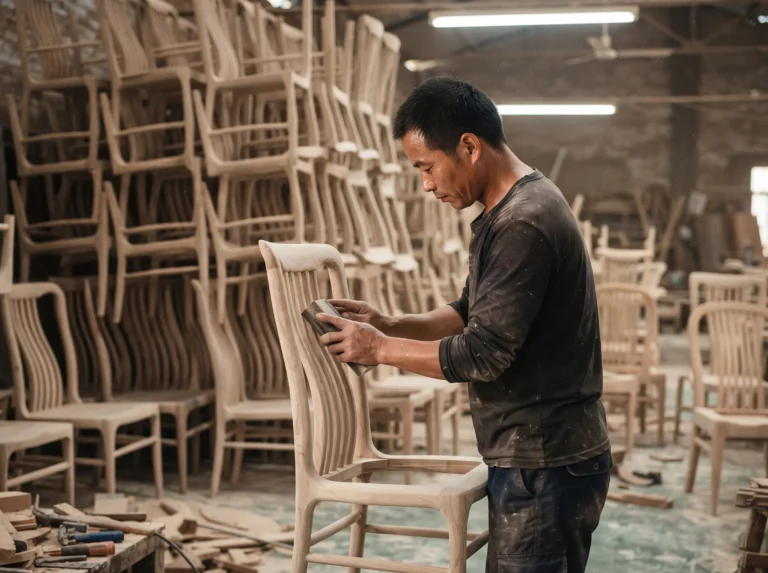
White-Body Inspection: Structure, dimensions, joint gaps. The piece hasn’t been finished yet, so internal construction is fully visible. If dimensions are off or joints don’t align, this is the easiest and cheapest point to fix.
Post-Finishing/Upholstery Inspection: Color consistency, hand feel, fill uniformity. This is the aesthetic acceptance gate, checked item-by-item against the sealed sample. Don’t accept the factory’s “bulk is close to sample”—close means different.
Pre-Packaging Full Inspection: Function, appearance, accessory completeness. Open packages and verify that hardware kits, instructions, and shipping marks are correct.
Use a Staged QC Checklist for item-by-item verification. Classify defects as Class A (reject—structural safety, severe color mismatch), Class B (rework—dimensional out-of-tolerance, functional defects), or Class C (concession—minor scratches, micro-flaws that don’t affect use). Record everything, photograph everything.
Rework rates vary significantly by customization type: ODM modification runs 3–5%, semi-custom 8–12%, full bespoke 15–20%. Tilting your QC resources toward higher-risk types is the most cost-efficient strategy.
Required Deliverables: Staged QC Checklist, Pre-Shipment Inspection Report, Non-Conforming Product Handling Record
Acceptance Gate: Zero Class A defects, closed-loop Class B rework, written buyer confirmation for Class C defects
Most Common Pitfall: Relying solely on factory self-inspection reports or conducting only sampling inspection, allowing defective products to sail overseas
How to Avoid: For first orders or high-value orders, arrange third-party QC (e.g., SGS, BV) or an in-house on-site representative. Inspection fees typically run under 1% of order value but can prevent rework losses that multiply by thirty to fifty times
Stage 6: Project Review—Turning One-Time Potholes into Permanent Bridges
The shipment’s gone. The invoice is paid. Most people move on to the next project immediately. That’s the most expensive mistake you can make—months of hard-won experience, paid for in rework and delays, just evaporates.
The review happens within thirty days of delivery. Compare the original Requirement Brief against the final delivered goods. Document deviations and root causes: Was the requirement unclear? Did the factory misinterpret? Did a material batch change? Was the QC standard itself flawed?
Update the Supplier Profile: this factory is strong on upholstery but mediocre on solid wood finishing; that factory responds fast to small batches but struggles with large-volume scheduling. These tags help you match suppliers faster on the next project, cutting technical briefing time by half.
Archive this project’s sealed samples, QC standards, and common defect patterns into a Project Standard Package. Next time you run the same category, pull the package. Don’t start from zero.
A supplier that has undergone three or more structured reviews typically shows dispute rates 30% below industry average on subsequent projects. That’s not luck. That’s the compound interest of accumulated knowledge.
Required Deliverables: Project Review Report, Updated Supplier Profile, Project Standard Package
Acceptance Gate: Technical briefing time for subsequent same-category orders is reduced by 50% or more; repetitive defect rates decline
Most Common Pitfall: The team scatters after project closure, nobody documents lessons, and the next project steps into the same holes
How to Avoid: Make review a mandatory procurement workflow node, led by the purchasing head with design and QC participating. This isn’t a blame session; it’s a technical calibration meeting to align both parties’ cognitive baselines

The Numbers—Why These Six Steps Stop 90% of Disputes
After tracking extensive projects across multiple years, we categorized dispute root causes. The pattern is revealing:
| Dispute Root Cause | Share | Corresponding Stage | Reduction After Workflow Intervention |
| Vague requirement definition | 35% | Stage 1 | Down to 8% |
| Sample-to-mass inconsistency | 25% | Stage 3–4 | Down to 4% |
| Missing QC standards | 20% | Stage 5 | Down to 5% |
| Supplier capability mismatch | 12% | Stage 2 | Down to 3% |
| Communication & liability ambiguity | 8% | All stages | Down to 2% |
The core of success proof custom is front-loaded control. Stage 1 and Stage 3 together cover 60% of dispute origins. When requirements are technicalized and samples are physicalized, both sides shift from guessing to executing against confirmed standards. The space for disagreement collapses.
Stage 5’s staged QC is the final firewall. A problem caught at the factory costs 10–20% of product value to rework. A problem caught at your overseas warehouse costs three to five times that.
One more number that might surprise you: projects that completed the full six-stage process showed a 2.3× higher client repurchase rate than projects that didn’t. Once buyers experience “customization is controllable,” they upgrade Chinese supply chains from “one-off experiment” to “long-term strategic asset.” That’s the largest hidden return of process standardization.
Workflow Adjustments by Customization Type
Not all custom projects are built the same. Understanding which type you’re running directly determines your workflow, budget, and risk profile.
ODM Modification—Adjusting dimensions, fabric, or color on an existing model. This is the simplest form. Compress the workflow to four core stages: requirement clarification → sealed sample confirmation (you can often skip full prototyping and confirm material swatches only) → production monitoring → shipment QC. Supplier evaluation simplifies to capacity and scheduling verification. Cost runs 1.2–1.5× standard, prototyping 7–12 days, production 30–45 days.
Semi-Custom—Modifying partial styling or function based on an existing structure. Think changing a standard sofa’s armrest to a curved profile, or adding a drawer bank to a standard cabinet. This requires all six stages, though Stage 3 prototyping can be moderately compressed with focus on validating structural modification points. Cost 1.5–2.5×, prototyping 12–20 days, production 45–60 days.
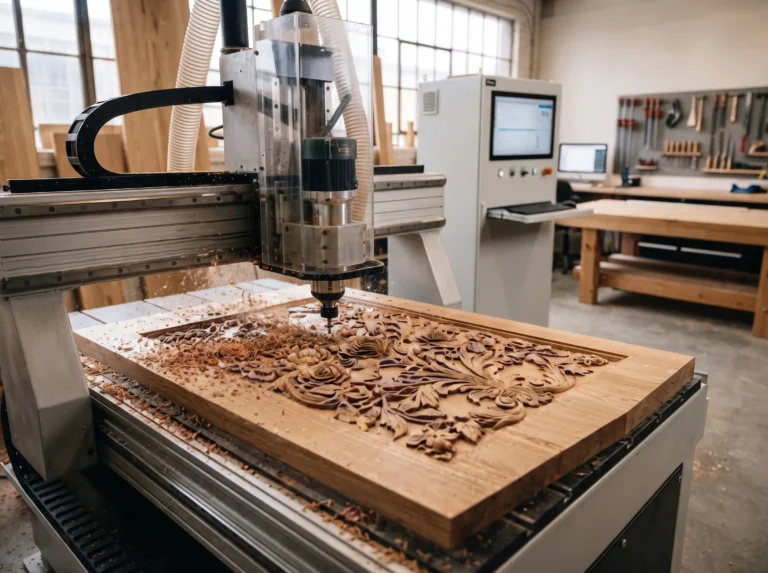
Full Bespoke—Complete originality from concept to production. The most complex. Extend Stage 1 to 7–10 days, introducing 3D rendering or CNC prototyping as an intermediate confirmation step. Stage 3 must yield a fully functional prototype, not just an appearance model. Stage 5 QC standards must be written into contract appendices at Stage 1 to prevent later standard disputes. Cost 2.5–5×, prototyping 20–35 days, production 60–90 days.
Factory size matters too. Large factories with annual output above RMB 500 million typically handle ODM modification well, but their responsiveness and flexibility for full bespoke often lag behind smaller flexible factories in the RMB 50–100 million range. Matching order type to factory scale is the most critical judgment call in Stage 2.
Core Action Checklist
1. Before launching any custom project, produce a Requirement Brief and hold a technical briefing—translating aesthetic language into technical parameters is the only entry point that avoids 70% of disputes.
2.Accept the real cost structure of small-batch customization—line-switching and management costs are fixed; price suppression only forces hidden quality degradation.
3.Sealed samples are not optional; they are mandatory—physical samples and material swatches are the only arbitrable standards during mass production.
4.Establish three QC checkpoints: white-body, post-finishing, and pre-packaging—intercept problems at the factory, not in cross-border arguments after delivery.
5.Complete review and archiving within 30 days of project closure—converting single-project experience into organizational assets cuts cognitive costs for subsequent orders by 50% or more.
Practical Toolkit
18 Essential Forms for the 6-Stage Customization Workflow(Excel)

FAQ
Q: What is the typical MOQ for custom furniture?
A: ODM modification usually starts at one container (approx. 20–30 units) or the minimum purchase volume of the fabric/leather. Semi-custom, involving process adjustments, typically raises MOQ to 50–100 units. Full bespoke, given mold and prototyping costs, often starts at 200 units. Some flexible factories accept trial orders as small as 10 units, but unit prices rise significantly. That’s normal cost structure, not gouging.
Q: Why do factories say “production per drawing” yet cannot guarantee the outcome?
A: The factory’s liability boundary stops at the dimensions, structure, and material specifications marked on the drawing. Visual proportion, tactile feel, and gloss are aesthetic dimensions that must be locked via Sealed Sample and material swatches. Drawings solve the “correct or not” problem; sealed samples solve the “looks like or not” problem. You need both.
Q: Why is the prototyping cycle so different between upholstered and solid wood furniture?
A: Upholstered prototyping centers on fabric cutting and foam shaping, typically 7–15 days. Solid wood involves moisture content control, machining, assembly, and multi-coat finishing—each drying wait time is non-compressible, typically 15–25 days. Metal furniture welding and surface treatment cycles fall in between, roughly 10–20 days.
Q: How can I effectively monitor production if I cannot visit the factory?
A: Use the “remote three-piece toolkit”: require the factory to submit process photos and short videos by node (critical angles); delegate third-party QC agencies (e.g., SGS, BV, Intertek) for on-site inspection; use digital order-tracking tools requiring the factory to upload production schedules and actual progress. For high-value orders, first article inspection is strongly recommended to be conducted on-site or via third-party delegation. This cost is non-negotiable.
Q: What is a reasonable lead time for a custom project?
A: From requirement confirmation to shipment, ODM modification typically takes 45–60 days, semi-custom 60–75 days, and full bespoke 90–120 days. If a factory promises significantly shorter timelines, be alert to potential skipping of prototyping or QC compression. Lead time pressure is the single biggest driver of quality failures.
Q: How should minor color differences between bulk goods and samples be handled?
A: At Stage 3 sealing, fabric/leather swatches should be archived with batch numbers, and the contract should specify acceptable color deviation ranges (e.g., referencing GB/T 250 or AATCC Gray Scale Grade 4+). Color variation in natural materials (solid wood, genuine leather) is a material characteristic, not a quality defect. This must be disclosed to buyers at Stage 1 and written into exemption clauses.
Recommended Resource
Interi Furniture specializes in custom furniture manufacturing for residential, hospitality, and commercial projects. Their experience in materials, craftsmanship, and project realization makes them a valuable resource for designers and buyers seeking tailored furniture solutions from China.