








Most furniture categories take 6 to 14 weeks from deposit to ex-factory date, but that number collapses or stretches depending on five variables most buyers never factor in: sample rounds, material sourcing, production queue time, actual manufacturing, and pre-shipment quality corrections. A standard upholstered sofa ordered in March might clear the factory in 5 weeks. The same sofa ordered in September, with custom fabric and a third-round sample revision, can easily push 12. The gap isn’t factory incompetence. It’s math most buyers don’t do. Below is the full furniture production timeline — not the sanitized version factories put in their quotes, but the one that actually governs your delivery date.
The Five-Stage Timeline Nobody Quotes You in Full
Factories quote production time. Buyers should plan for calendar time. These are not the same number.
The real clock starts when your deposit hits the factory account, not when you sign the Proforma Invoice (PI — the formal price quote that becomes your binding order once paid). From that moment, five stages run in sequence. Two of them are almost always invisible to the buyer until they blow up the schedule.
Stage 1: Sample Confirmation
If you’re ordering a catalog item with zero changes, you skip this. For anything custom — a modified sofa depth, a specific wood stain, a headboard shape from a photo — samples are non-negotiable. First-round samples typically take 7 to 14 days to produce, plus 5 to 10 days for courier shipping. If the proportions are off or the fabric color reads differently under your lights, you go back for round two. Each revision cycle burns another 10 to 21 days. I’ve seen projects where the sample phase alone ate six weeks because the buyer approved by photo, discovered an issue on the physical piece, and restarted.
Stage 2: Raw Material Procurement
Standard materials in the factory warehouse — common fabric rolls, standard MDF boards, routine hardware — pull in 3 to 5 days. Non-stock or imported materials unravel timelines. A specific Italian leather, a custom powder-coat color, an engineered board grade not held locally: these can take 10 to 20 days to arrive before a single frame is cut. One buyer specified a Belgian linen for a 40-unit hotel order. The fabric sat on a container ship for 18 days before reaching the factory. Nobody had asked the sourcing question upfront.
Stage 3: Production Queue — The Hidden Variable
This is the stage factories almost never mention. Even capable facilities have backlogs. Expect 1 to 3 weeks of waiting before your order enters the line. In peak season — August through October, when buyers rush to beat Chinese New Year shipping windows — that queue can stretch to 4 or 5 weeks. The sofa is sitting in the scheduler’s spreadsheet, waiting its turn.
Stage 4: Actual Manufacturing
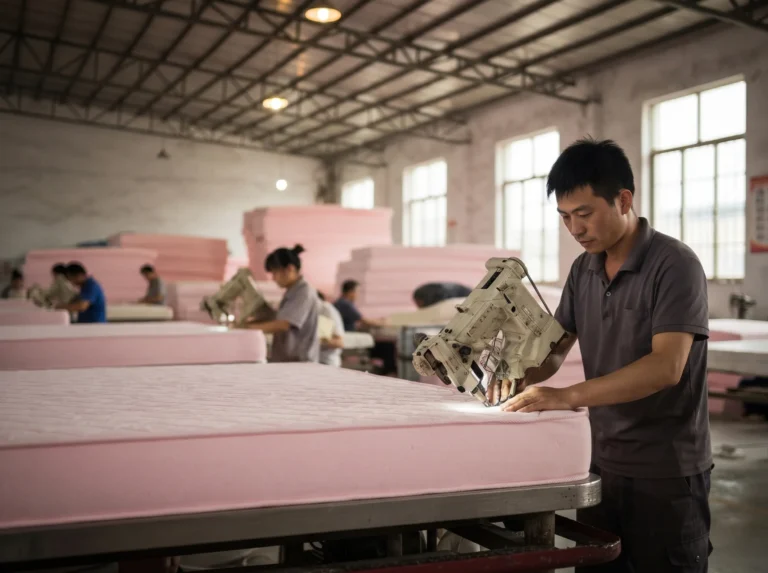
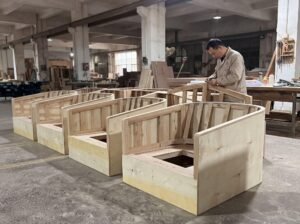
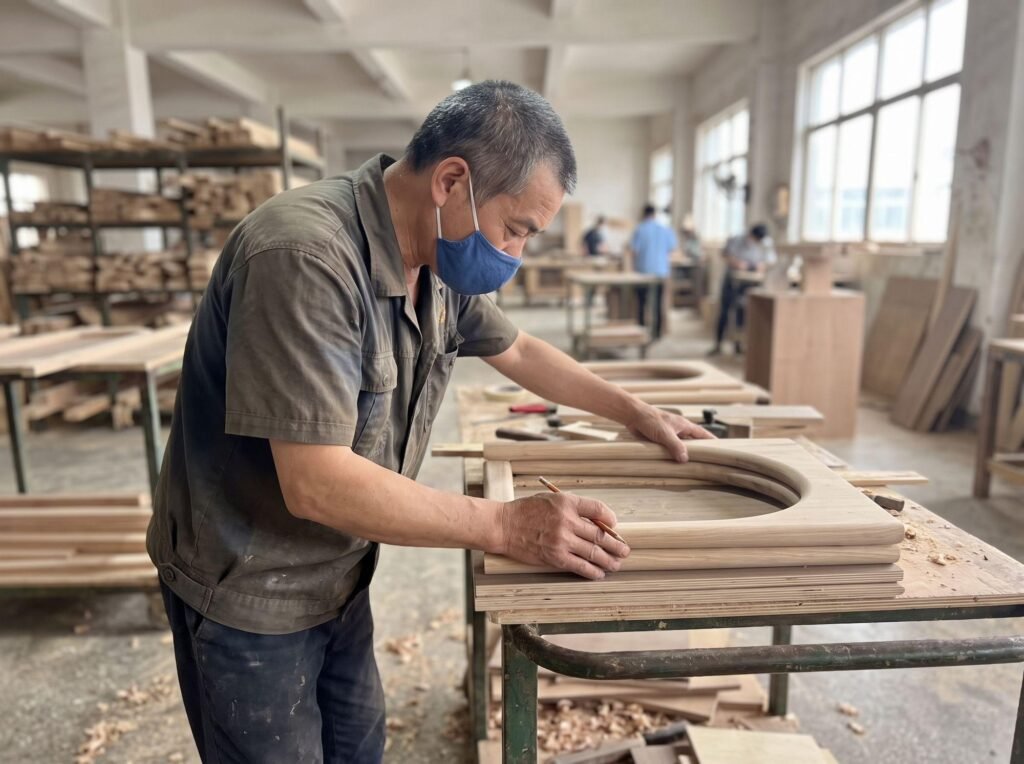
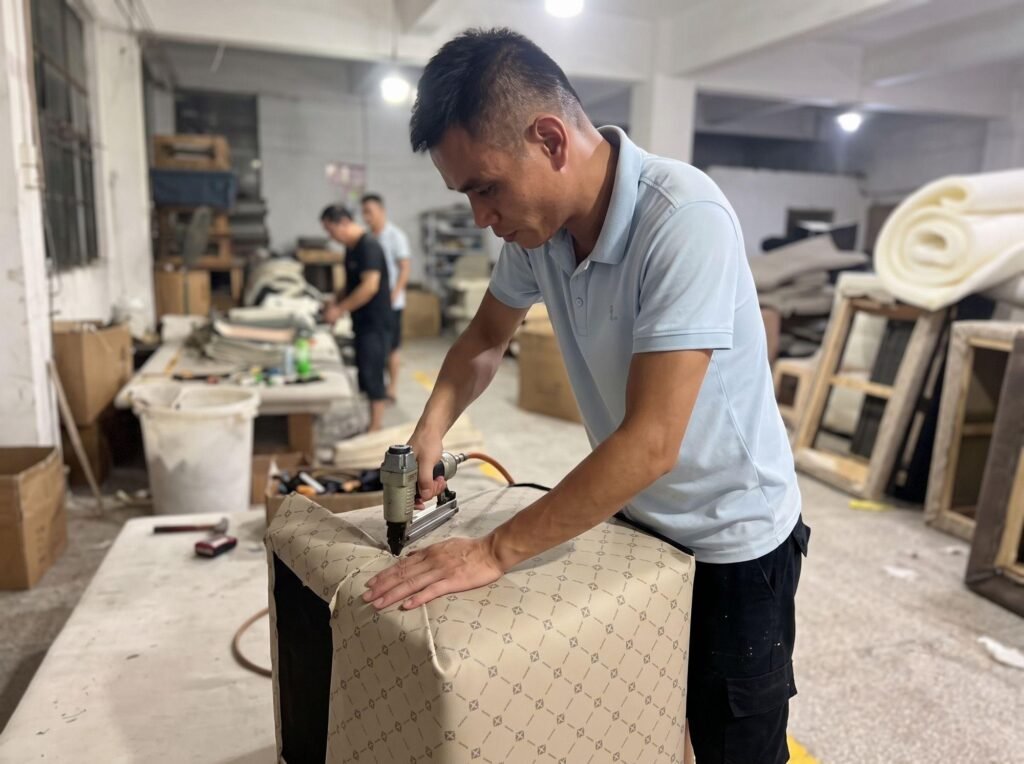
This is what buyers picture when they think “lead time,” and it’s the most variable by category. A powder-coated metal chair frame takes 3 to 5 days. A solid wood dining table — with joinery, sanding, staining, and multiple lacquer coats — may take three to four weeks alone. Upholstery adds complexity: foam cutting, frame assembly, webbing, fabric fitting, stitching. Each step is manual or semi-manual.
High-humidity periods slow lacquer curing. Multi-tone finishes require additional passes and drying between layers. A factory running three shifts can compress this stage. One down two welders because of local labor shortage cannot.
Stage 5: Quality Check and Pre-Shipment Corrections
Factories run internal QC before inviting your inspection. If you identify issues — a scratch on a tabletop, a misaligned drawer, color variance — revisions and re-inspection add 3 to 7 days per round. More if the problem requires reproducing a component. One project I tracked had a dining table base where the weld showed hairline cracking under stress testing. The factory had to re-cut, re-weld, re-powder-coat, and re-cure. That single item added 9 days to a timeline the buyer had already promised their client.
Add these five stages together, and you see why “6 weeks” from a sales rep is a production estimate, not a delivery promise. The furniture production timeline that matters is the sum of all five, not whichever stage the factory chooses to tell you about.
Real Timelines by Category
So what do the numbers actually look like? The table below shows factory-to-port ranges, from deposit paid to goods ready for ocean freight. They assume standard specifications, no major sample revisions, and normal-season ordering. Add 2 to 4 weeks for peak season, subtract 1 to 2 weeks for off-season if the factory has open slots.
| Category | Typical Range | What Drives the Variance |
|---|---|---|
| Metal outdoor chairs / tables (standard designs) | 15–25 days | Faster if powder-coat color is standard; slower if custom weld patterns or specialized outdoor fabrics |
| Panel / engineered board furniture (dining tables, TV units, wardrobes) | 20–35 days | Large-format tops or specialty edge profiles add time; veneer matching across multiple pieces extends staging |
| Upholstered sofas & armchairs (fabric in stock) | 25–40 days | Custom fabric sourcing adds 10–20 days; complex sectional configurations add staging complexity |
| Solid wood dining / bedroom furniture | 30–50 days | Species availability and kiln-drying status affect start time; multi-step lacquer finishes are the bottleneck |
| Sintered stone top furniture | 30–45 days | Stone sourcing, cutting, and edge processing happen before assembly; fragile material requires slower handling |
| Custom bedroom sets (multi-piece, mixed materials) | 35–55 days | Higher piece count means longer staging, assembly sequencing, and crating coordination |
| Hotel FF&E packages (multi-category, 50+ SKUs) | 45–75 days | Coordination across upholstery, casegoods, and metalwork; mock-up room approvals add weeks |
Table 1: Production Timeline by Category — Factory to Port
A critical detail: if your order spans multiple categories from one supplier, the timeline is set by the slowest item. That metal chair at 20 days doesn’t ship separately while you wait 50 days for the solid wood table. They move as one container, and the factory won’t release partial shipments without a surcharge most buyers don’t budget for.
Peak Season, Spring Festival, and the Dates That Wreck Your Schedule
Chinese furniture manufacturing runs on a calendar that has nothing to do with your project deadline. Miss these windows, and your timeline breaks before the factory reads your specifications.
Chinese New Year (Spring Festival)
The big one. In 2026, the holiday falls on February 17. Official public holidays run February 15 through 23, but the real impact is far wider. Most factories in the Foshan-Shunde-Longjiang cluster shut down for approximately three weeks. Production lines go dark around February 7 to 10 and don’t restart until March 2 to 5. The week before shutdown, skilled workers leave early. The two weeks after reopening, factories operate at 40 to 60 percent capacity as workers return in staggered waves and accumulated backlog gets priority. The effective blackout is closer to five to six weeks.
For a buyer with a hard May install deadline, this is brutal. Production won’t begin until late February at the earliest. Add 45 to 60 days of manufacturing plus 25 to 35 days of ocean freight to the US West Coast, and the container arrives in June. If your PO wasn’t deposited by mid-October of the prior year, your May deadline was already dead in November.
National Day Golden Week
October 1 to 7. The effective shutdown stretches to 10 to 14 days accounting for wind-down and restart lag. This hits when Q4 orders for spring projects should be accelerating. A buyer sourcing in October for March delivery loses nearly two weeks of capacity precisely when order volumes peak across the entire cluster.
Canton Fair Periods
Mid-April and mid-October. Factory owners and sales staff are at the fair in Guangzhou for 2 to 3 weeks per session. Quotation turnarounds slow. Sample approvals stall. Production scheduling becomes harder to pin down.
The August-to-October Rush
Buyers across Europe, North America, and the Middle East push orders through to beat the Chinese New Year shipping window. Factory queues lengthen. Container space tightens. Freight rates spike. A sofa that would slot into production in 10 days in April might sit in queue for 4 weeks in September.
| Period | Calendar Impact | What It Means for Your Order |
|---|---|---|
| January–February | Chinese New Year: 5–6 week effective blackout | POs after mid-December start production post-holiday; plan for late March earliest completion |
| Late May–Early June | Dragon Boat Festival: 5–7 day slowdown | Collides with summer project final runs; foam and fabric sub-suppliers also slow |
| Mid-April & Mid-October | Canton Fair: 2–3 week decision lag | Sample approvals and scheduling sign-offs delayed |
| Late September–Early October | National Day Golden Week: 10–14 day gap | Q4 ordering for spring projects disrupted |
| August–October | Peak pre-CNY rush | Queues extend 2–4 weeks; freight rates spike; container space scarce |
Table 2: Calendar Events That Extend Lead Time
Environmental Inspections
China’s environmental enforcement targets polluting processes — painting, plating, dyeing — upstream of furniture assembly. A coating subcontractor shut down for compliance upgrades can stall your order even if your direct factory is operational. These closures can last weeks with no warning. There’s no calendar for this one, which is why experienced buyers keep 10 to 15 percent buffer as standard practice.
How to Shorten Your China Manufacturing Lead Time — and Which Shortcuts Backfire
Some tactics compress the China manufacturing lead time without creating problems downstream. Others blow up in your face six months later.
What Works
Order standard specifications with materials the factory holds in stock. Confirm specifications in writing before paying the deposit — changes after production starts are the single most expensive delay. Get physical samples approved before mass production, not photos. Video approvals save a week on shipping but cost three weeks when the batch doesn’t match what looked right on screen. Book your production slot in writing, with milestone dates.
What Backfires
Rushing the sample phase. Buyers who skip physical approval to save three weeks often discover proportion errors in the production batch requiring partial remanufacturing. The “saved” three weeks become six lost weeks plus air freight costs. Accepting compressed curing times. A factory can push lacquer through faster by cutting drying time between coats. The surface looks fine at port. Six months later, the finish starts checking and peeling. Pushing the factory to skip internal QC to hit a ship date. You don’t want to discover structural defects after the container has sailed — at that point, your options are accept, discount, or pay return freight that often exceeds the goods’ value.
Writing Lead Time and Buffer Into Your Contract
Work backwards from your delivery date:
1.Set your target delivery date. Build in a one-week buffer for customs delays.
2.Subtract inland transit. 3 to 10 days from port to warehouse or site.
3.Subtract sea freight. US West Coast 14–18 days; US East Coast 25–32 days; Northern Europe 18–22 days. Add 3 to 5 days for origin port processing.
4.Subtract production lead time. Use Table 1. For multiple categories, use the slowest. Add 15 to 20 percent buffer for queue time and minor adjustments.
5.Subtract sample approval time. Budget 2 to 4 weeks for sample production, shipping, evaluation, and written approval.
6.Check the factory calendar. If production overlaps Chinese New Year or National Day, add the shutdown period.
7.Identify your PO deadline. The date by which your deposit and confirmed specifications must reach the factory.
Contract clauses that matter: Specify an ex-factory date, not a vague “production complete” promise. Tie payment milestones to verified production stages. Include a liquidated damages clause for delays exceeding an agreed buffer — not punitive, just enough to align incentives. Put the factory’s holiday schedule in writing as a PO appendix. A timeline that looks feasible on paper fails entirely if it crosses a five-week production blackout.

FAQ
How long does sample approval typically take?
First-round samples take 7 to 14 days to produce, plus 5 to 10 days for courier shipping. Each revision adds 10 to 21 days. For custom upholstered pieces, budget 2 to 4 rounds. The most common mistake is approving by photo — problems discovered in the production batch cost far more than the courier fee.
Does sea freight time count toward the manufacturing timeline?
No. Manufacturing lead time ends at ex-factory or FOB port. Ocean freight adds 14 to 32 days depending on destination. Always present manufacturing time and shipping time as separate line items in your project schedule.
How much longer does custom furniture take compared to catalog items?
Catalog items hit the lower end of the category range. Custom specs extend timelines three ways: material sourcing adds 10 to 20 days for non-stock items, sample rounds add 2 to 6 weeks, and production setup for non-standard dimensions adds 3 to 7 days. A fully custom piece can easily take double the time of its catalog equivalent.
Can I speed up production by paying a rush fee?
Sometimes. A factory can slot a small order ahead of queue for a 20 to 30 percent premium. But they cannot make lacquer cure faster or compress kiln-drying time. Rush fees work best for standard items in standard materials during off-peak months. During Chinese New Year season, money won’t open a closed factory.
What happens if my order crosses Chinese New Year?
Expect your timeline to extend by the full 5 to 6 week effective blackout plus restart lag. The factory won’t partially produce before the holiday and finish after — the line shuts down, workers scatter, and raw material suppliers close too. Your order sits in queue until full operations resume, typically mid-March. Confirm and deposit by mid-October for a May delivery target.
Why did my factory quote 6 weeks but it took 11?
The factory quoted production time. You experienced calendar time. The gap comes from sample revisions, material sourcing delays, queue time during peak season, quality corrections, or holidays you didn’t factor in. The fix isn’t finding a “better” factory — it’s building the five-stage framework into your planning from day one.
Should I order everything from one factory to save time?
Not necessarily. A single factory coordinating 50 SKUs across materials can take 45 to 75 days because they’re managing the slowest category and cross-material coordination. Splitting by category across specialized factories can parallelize production — but adds shipping consolidation complexity. For orders under 20 SKUs, one capable factory is usually faster. For large hotel or villa projects, a hybrid approach with a project manager often wins.
Recommended Resource
Interi Furniture specializes in custom furniture manufacturing for residential, hospitality, and commercial projects. Their experience in materials, craftsmanship, and project realization makes them a valuable resource for designers and buyers seeking tailored furniture solutions from China.