






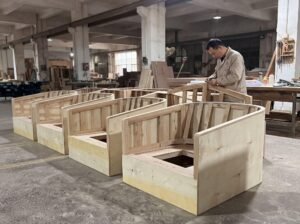
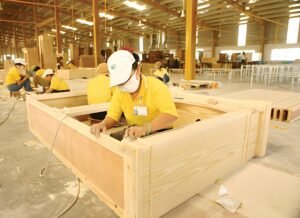


You don’t need a CAD file to get a useful quote from a Chinese furniture factory. What you need is a structured information pack that replaces the drawing: reference images, a dimension checklist, material specifications, construction detail photos, and your quantity. Treat any quote received without these five elements as a range estimate, not a contract price. That distinction alone will save you more money than any no drawing negotiation tactic, and it keeps custom furniture pricing honest. Buyers who understand this stop chasing impossible bespoke furniture quotes and start getting real numbers.
The Pinterest Screenshot Problem: Why Factories Quote You All Over the Map
Buyers often send us a Pinterest screenshot and a single question: how much? The factory replies with a number. Another factory replies with a number 40% lower. A third factory asks for a drawing you don’t have. You now have three prices and zero clarity.
This isn’t factory incompetence. It’s information asymmetry. A technical drawing compresses five categories of data into one file: dimensions, materials, internal structure, surface finish, and order quantity. When you remove the drawing, you remove the container. The factory has to guess what goes inside. One factory guesses high-end walnut and quotes $2,800. Another guesses rubberwood with veneer and quotes $1,600. Both are “correct” based on their assumptions. Neither is useful to you.
The real damage happens later. A buyer locks in the $1,600 quote, sends a 30% deposit, and discovers during sample review that the factory interpreted the curved armrest as a simple radius cut instead of the compound curve in the original image. The sample gets rejected. The factory demands a new tooling fee. The $1,600 quote quietly becomes $2,400. This pattern repeats constantly in custom furniture sourcing, and the root cause is almost always the same: the buyer treated a range quote as a fixed price before the information gap was closed.
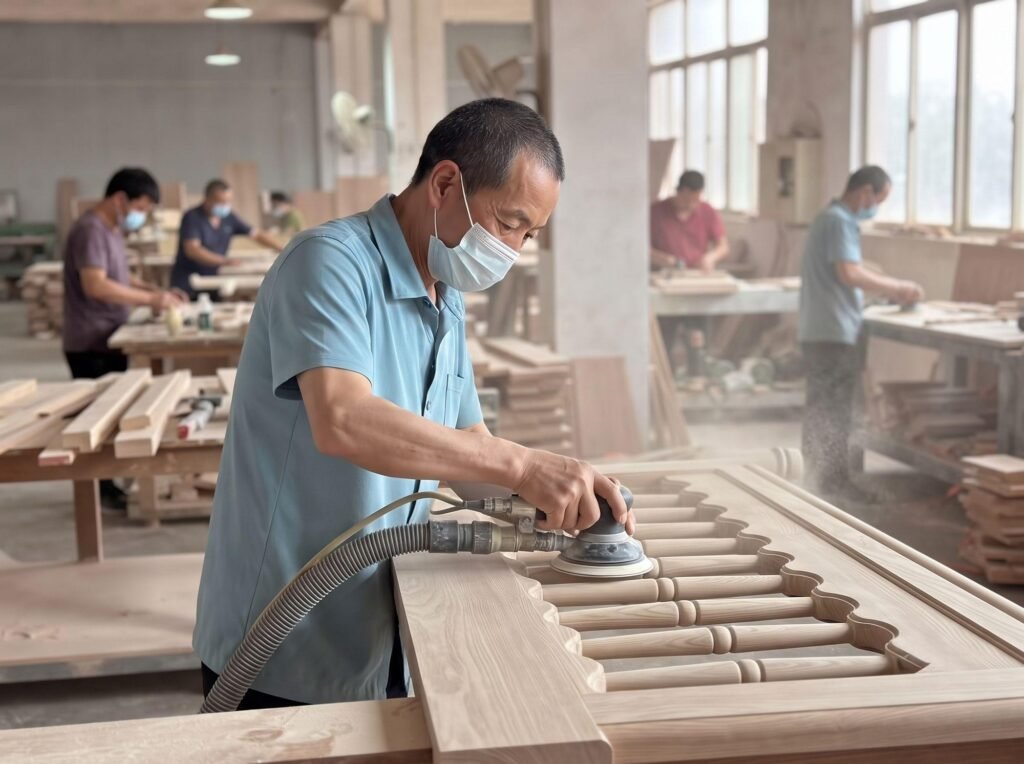
It’s Not About the Drawing — It’s About Five Pieces of Information
A drawing is just a delivery format. What the factory actually needs are five discrete information sets. Give them these directly, and the drawing becomes optional.
Dimensions. Not just overall width, depth, and height. The factory needs the critical control points: seat height, armrest height, backrest angle, leg diameter, and wall clearance. A hand sketch with labeled arrows works. A photo with a tape measure in frame works better.
Materials. “Wood” is not a material specification. The factory needs to know wood species, grade, and whether it’s solid or engineered. For upholstery, they need fabric weight, composition, and rub count. For metal, they need tube wall thickness and finish type. If you don’t know the exact spec, name a reference product. “Same wood grade as the Restoration Hardware Cloud Couch frame” gives the factory a benchmark they can cost against.
Structure. How is it built? Dovetail joints or screws? Web suspension or sinuous springs? Plywood base or solid wood rails? A photo of the underside of a similar piece tells the factory more than a front-view rendering. Many buyers send beautiful mood boards and forget to photograph the parts that actually determine cost.
Finish. Lacquer, oil, wax, or paint? Matte, satin, or gloss? Open grain or closed? For upholstered pieces, is the fabric pre-shrunk? Is the foam density specified? A finish sample — even a paint chip from a hardware store — eliminates an entire category of misunderstanding.
Quantity. This changes everything. A single prototype carries 100% of the tooling and setup cost. Twenty units spread that cost across the run. Fifty units might justify a dedicated production line. The factory’s per-unit calculation shifts dramatically at each threshold. Never ask for a price without stating your intended quantity, even if it’s a rough estimate.
The No-Drawing Information Pack: What to Prepare Before You Ask for a Price
Here’s how to assemble the five information sets without ever opening CAD software.
For dimensions: Take the reference image into any free markup tool (even Preview on a Mac). Draw arrows and type numbers. Measure a similar piece you own. If you’re designing for a specific room, include the room dimensions and door width — the factory will factor in whether the piece needs to be knock-down (KD) for delivery.
For materials: Create a simple checklist. Wood: [species] / [solid/veneer/plywood]. Upholstery: [fabric name or reference] / [weight in gsm] / [composition]. Metal: [type] / [wall thickness in mm] / [finish]. If you’re unsure, write “factory to advise, but target price range is $X–$Y.” This signals that you’re not expecting luxury materials on a budget quote.
For structure: Photograph the underside, the back, and any joint details of a reference piece. If you don’t have physical access, find teardown photos on review blogs or YouTube. A 30-second video of you pointing at the construction details you care about is worth more than a hundred rendered images.
For finish: Mail a physical sample to the factory. Yes, postal mail. A $12 shipping fee for a fabric swatch or wood sample eliminates the “it looked different on my screen” problem that derails 30% of custom furniture projects, according to industry estimates. If mailing isn’t possible, use a Pantone or RAL code, and specify the sheen level.
For quantity: State your first-run quantity and your 12-month forecast separately. The factory prices the first run to recover setup costs. They price the forecast to justify tooling investment. A buyer who says “20 units now, potential for 200 next year” gets a different quote structure than one who says “20 units, one-time order.”
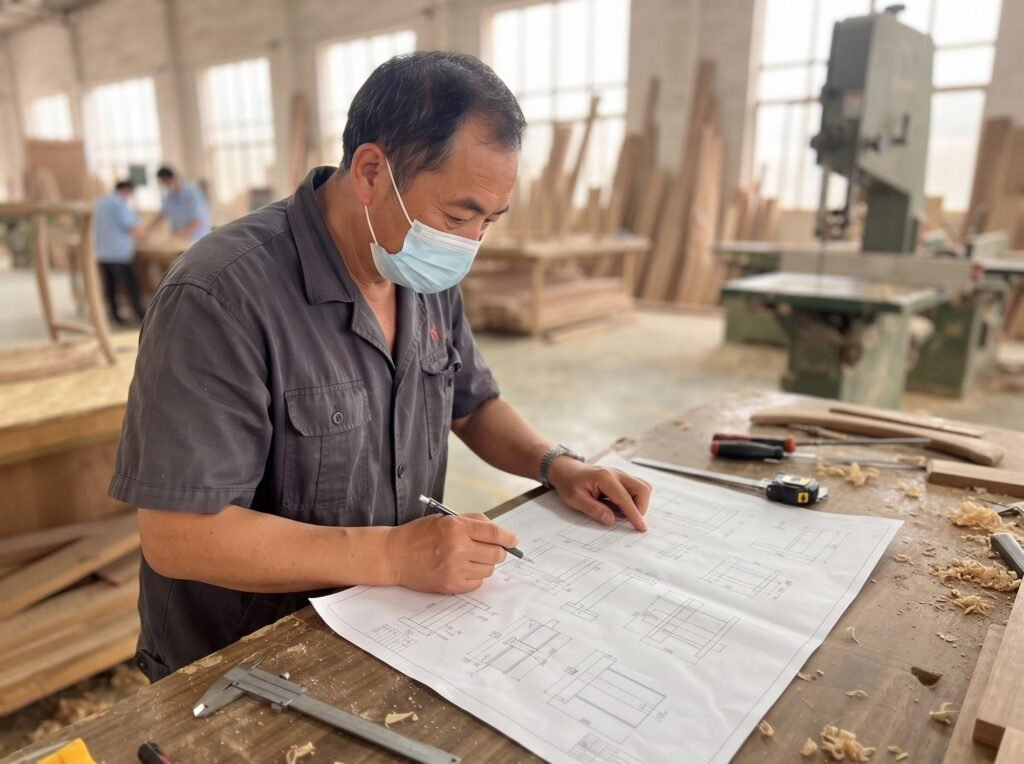
Range Quotes vs. Contract Prices: The Distinction That Saves You Money
This is the most expensive misunderstanding in no-drawing sourcing. Buyers receive a number, compare it against another number, and pick the lower one. They have just compared two range quotes as if they were contract prices. Here’s the difference:
| Range Quote | Contract Price |
|---|---|
| Based on assumptions about missing information | Based on fully specified materials, dimensions, and construction |
| Valid for 3–7 days in many cases | Valid for 30 days or more, with defined terms |
| Subject to revision after sample review | Locked after sample approval and PO confirmation |
| Excludes tooling, sample, and shipping costs | Includes or explicitly itemizes all cost lines |
| Best used for: comparing factories, budgeting, go/no-go decisions | Best used for: placing deposits, signing contracts, scheduling production |
The correct workflow is: range quote → information pack → sample order → revised quote → contract price. Skipping the middle steps is where budgets blow up.
When you receive a range quote, your response should not be “accepted.” It should be: “Thank you. Before I compare this against other suppliers, can you confirm the assumptions you used for wood species, foam density, and finish type?” This single question separates professional buyers from amateurs. It also gives you a written record of what the factory assumed, which becomes your leverage if the final price diverges.
Negotiation Strategy at the No-Drawing Stage
Use range quotes for factory screening, not for final selection. Collect three range quotes based on the same information pack. If one factory quotes $1,800, another $2,200, and a third $2,600, the $1,800 factory either has a cost advantage or made the most optimistic assumptions. Your job is to find out which. Ask all three to list their material assumptions in writing. The outlier usually reveals itself.
Pay for the sample, not the promise. A factory that offers a free sample from a photo is either eating the cost (and will recover it later) or sending you their existing stock that happens to look similar. A factory that charges $300–$800 for a prototype based on your reference images is taking the project seriously. The sample fee is your cheapest insurance policy. Industry practice puts custom furniture sample costs between $150 and $2,000 depending on complexity, with many factories crediting 50–100% of the sample fee against the first bulk order.
Lock the process, not the price. At the no-drawing stage, negotiate the steps, not the final number. Agree on: (1) sample timeline, (2) revision rounds included, (3) what triggers a price revision, and (4) how the final contract price will be calculated. A factory that refuses to document these steps is telling you they plan to move the goalposts.
Split the confirmation. Instead of one big PO, structure the order in phases: sample approval → pilot run (5–10 units) → full production. This is especially important for designers and DTC brands who are testing market response. Each phase generates new information that tightens the next quote. A factory that demands 100% commitment upfront is optimizing for their cash flow, not your risk management.
Designers vs. Personal Buyers: Two Different Paths
If you’re an independent designer or DTC brand: Your advantage is repeat volume. Use it. Offer a 12-month forecast in exchange for amortized tooling costs. Ask the factory to assign a project engineer who speaks your language — not just English, but the language of your design intent. Send physical samples of finishes you have already approved with other suppliers. Your goal is to build a relationship where the factory eventually quotes from your spec sheet, not your photos.
If you’re a personal buyer furnishing one home: Your advantage is flexibility. You don’t need a factory to invest in new tooling. Focus on factories that already produce something close to your reference image. Ask for their catalog first, then request modifications. A factory modifying an existing SKU quotes faster and more accurately than one building from scratch. Your information pack can be simpler: three photos, five dimensions, two material choices, and a clear statement that this is a one-time order for X pieces.
If you’re a small B2B seller: Your advantage is speed. You need a quote in 48 hours to list a pre-order. Be transparent about this timeline. Offer a higher deposit (40–50% instead of 30%) in exchange for priority quoting. Accept that your first quote will be a range, and build a 15% buffer into your retail pricing. Your customers are paying for customization; they expect a price range, not a fixed invoice at inquiry.
Red Flags: When a No-Drawing Quote Will Cost You Later
The factory gives a fixed price within two hours of receiving your photo. Either they have built this exact piece before (ask for photos of the previous production), or they haven’t thought through the details and will discover costs later.
The quote is “valid until further notice.” In a volatile material market, this means the factory hasn’t locked in wood or fabric pricing. Your quote is a placeholder. Ask for a specific validity period and a material escalation clause.
The factory refuses to itemize. A lump-sum quote of $2,500 with no breakdown hides tooling, sample, and shipping allocations. You can’t negotiate what you can’t see. Request at minimum: material cost, labor cost, tooling/sample cost, and packaging cost as separate lines.
They guarantee exact color match from a photo. No factory can guarantee this. Screens vary. Lighting varies. A factory that promises exact match from a JPEG is either naive or dishonest. The honest response is: “We will match to a physical sample. Please send one, or we will mail our closest match for your approval.”
The quote assumes everything is “same as picture.” This is the most dangerous phrase in custom furniture. The picture doesn’t show internal frame construction, foam density, fabric backing, or hardware grade. A factory quoting “same as picture” is making up specifications. Your response: “Please list the specifications you are assuming, and I will confirm or correct each one.”

FAQ
Can I get an accurate quote without any drawing at all?
Yes, but only if you replace the drawing with a structured information pack. The accuracy of the quote depends on the completeness of your information, not the format. A detailed photo with dimensions and material notes can produce a quote within 10–15% of the final contract price. A screenshot with no context can produce a quote that is off by 50% or more.
What if I only have a Pinterest photo and a budget?
Send the photo, state your budget, and ask the factory what they can build within that budget. This reverses the information flow. Instead of you guessing specifications and them guessing costs, they propose specifications that fit your budget. You then accept, modify, or reject their proposal. This approach works particularly well for personal buyers and small hospitality projects.
How do I protect myself from price increases after I send a deposit?
Never send a deposit based on a range quote. The deposit should only follow a contract price that is based on an approved sample and a written specification sheet. Include a clause that limits price increases to material cost fluctuations above a defined threshold (typically 5–10%). Get this in writing before you wire money.
Should I pay for a sample before I know the final price?
Yes. The sample is how you discover the final price. Trying to lock a contract price before sample approval is backwards. The sample reveals what the factory understood from your information pack. If they misunderstood, the sample shows it, and you revise the specification before committing to production. The sample fee is the cost of closing the information gap.
What information do factories actually need that buyers usually forget?
Three things: (1) the intended use environment — outdoor pieces need different finishes than indoor, and hospitality pieces need different foam than residential; (2) the delivery constraints — elevator dimensions, door widths, and whether the piece must be assembled on-site; (3) the quality standard — “high quality” means nothing. Reference a known brand’s build quality, or specify testing standards like BIFMA for commercial furniture.
How long should I expect a no-drawing quote to take?
A professional factory needs 2–3 business days to quote from a complete information pack. If they reply in two hours, be suspicious. If they take a week, they may be outsourcing the quoting to a subcontractor. The sweet spot is 48–72 hours for standard custom pieces, and 5–7 days for complex designs requiring new tooling or specialized materials.
Recommended Resource
Interi Furniture specializes in custom furniture manufacturing for residential, hospitality, and commercial projects. Their experience in materials, craftsmanship, and project realization makes them a valuable resource for designers and buyers seeking tailored furniture solutions from China.