







After you wire the deposit, the factory will most likely reply with three words: “In production.”
That phrase contains roughly zero useful information. You are holding a 45-day contract and have no idea what happens between day 15 and day 40. By the time a problem surfaces, the intervention window has usually closed—the goods are nearly ready, but the color is wrong; or the deadline has arrived, but the fabric is still stuck in customs.
Factories are not deliberately hiding things. Their real problem is a daily stream of variables: a sub-supplier delays shipment, a big customer jumps the queue, humidity in the spray booth stops the lacquer from drying. A fixed schedule, in their eyes, is an optimistic fiction. That does not mean you have to sit and wait. Understand what the factory actually does after order confirmation, identify the few nodes that matter, and you can shift from passive waiting to active control.
This article breaks the standard furniture mass production stages workflow in China into seven phases. All time data, delay ratios, and rework rates come from 360+ tracked projects and industry-standard practice. We will start by looking at why the factory timeline is always a vague number, then walk through each of the seven stages, examine how production differs across furniture categories, identify the three milestone nodes that actually matter, and close with the five buyer-side mistakes that most often slow the line down.
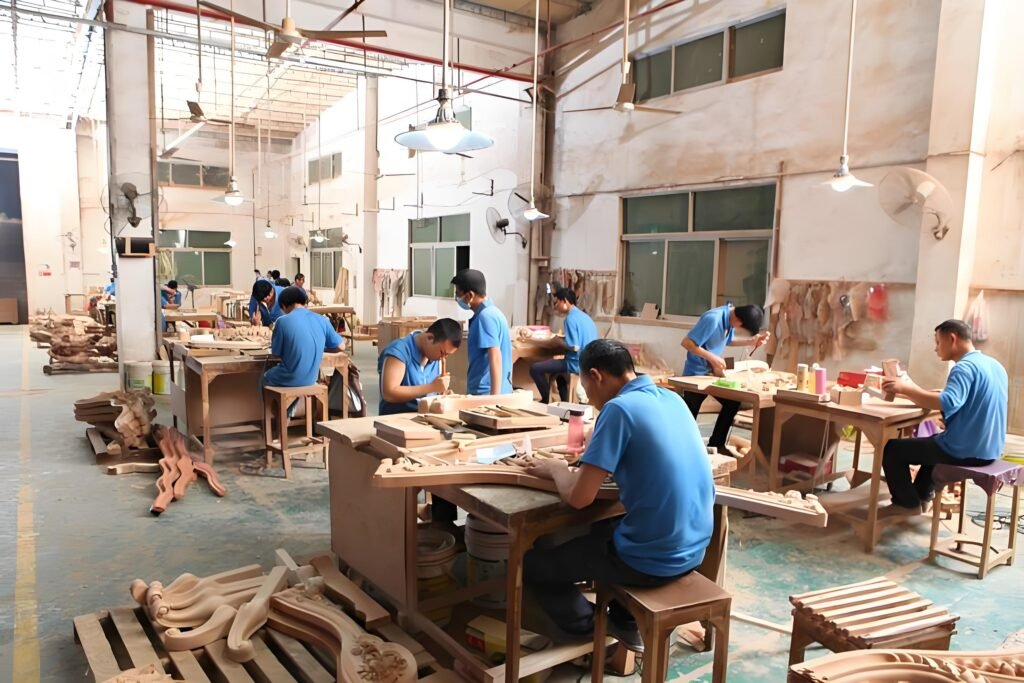
Why the Factory Timeline Is Always a Vague Number
The “45 days” a factory quotes hides an arithmetic problem most people never see.
From the moment you sign the contract to the day the order actually hits the assembly line, an average of 12–18 days of front-end preparation is required. That is before any wood is cut or fabric is sewn. In other words, front-end prep consumes over 40% of the total lead time, while the real assembly work accounts for only 25%–30% of the full cycle. Many buyers assume the factory rolls up its sleeves the day the deposit lands. In reality, the first two weeks may be spent waiting for hardware to arrive.
Two parallel tracks run inside the factory. Sales gives you a rough range—call it the “promise track.” Production planning holds the material arrival sheet, equipment load chart, and labor roster, adjusting daily—call it the “execution track.” When these two tracks do not match, friction between buyer and factory is the inevitable result.
Here is an open secret in the industry: factories rarely process orders in strict chronological order. Large-account recurring orders, high-margin rush jobs, and internal showroom samples routinely get inserted ahead of standard queue items. Even if your contract says 45 days, your actual line entry can slip by 3–7 days because of queue jumping. The factory will not volunteer this, because from its perspective this is routine capacity management.
The uncontrollable nature of outsourced components is the core reason factories hesitate to commit to precise dates. A finished-goods factory typically controls only assembly and surface treatment. Board, hardware, fabric, and foam all come from independent suppliers. When the fabric supplier delivers five days late, the finished-goods schedule unravels, yet the factory’s leverage over upstream partners is limited. When you press for status, the factory can only say “in production”—revealing the problem does not fix it, and may trigger unnecessary interference.
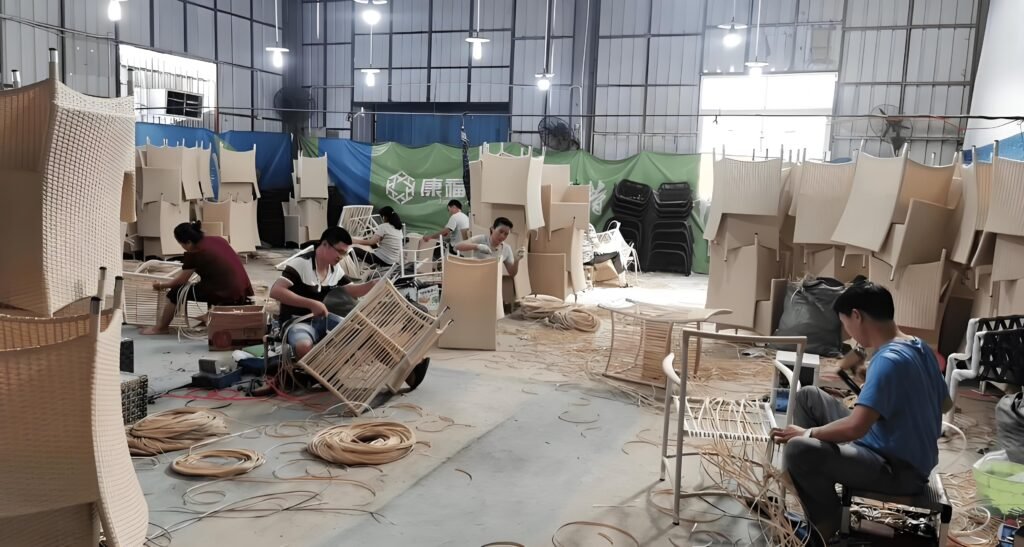
The 7-Stage Production Map — From Order Confirmation to Port Delivery
Stage 1: Order Confirmation & BOM Breakdown (Day 1–3)
Stage Objective: Turn the customer PO into a production order the factory can execute internally.
Sales hands the order to planning. A planner breaks down the BOM—specs, quantities, and routing for every component. Engineering simultaneously confirms whether the drawing is the final revision and flags any dimensional conflicts or process infeasibilities. For custom orders, any open sampling issues must be closed first.
Large factories usually wrap this up within 48 hours; departments are specialized and the handoffs are streamlined. Small factories may have sales talk directly to the workshop and turn it around in a day, but BOM accuracy tends to suffer, which raises the risk of downstream problems.
Key Deliverables: Production order, BOM breakdown table, and preliminary MRP. Once these three documents are out, the factory has officially accepted the job internally.
Where things usually go wrong: Drawing revisions are not locked. Some buyers keep tweaking dimensions after deposit, forcing the factory to rebuild an already broken-down BOM and scrap already purchased materials. Another common issue is a BOM entry that says “custom hardware” without a part number or supplier reference—purchasing gets the sheet and has no idea what to order.
What buyers can do at this stage: Before paying the deposit, get written confirmation of the drawing revision number and BOM lock status. For custom accessories, provide supplier information or physical color cards and swatches. Do not make the factory guess.
Stage 2: Raw Material & Sub-Supplier Procurement (Day 4–15)
Stage Objective: All materials must be on-site, inspected, and in the warehouse before the line can move.
Purchasing places orders with sub-suppliers per the MRP. Standard materials—standard board, domestic hardware, regular fabric—usually sit in safety stock and arrive within three to five days. The headache is non-standard materials: imported fabric, special-veneer wood, custom die-cast parts. These require fresh procurement and can take 10–20 days. Upon arrival, IQC conducts sampling inspection; rejected lots are returned or accepted under deviation.
Standard materials kit in 7–12 days; orders with imported or custom materials need 10–20 days. During peak season, when fabric and hardware suppliers themselves are running at capacity, this window can stretch another 30%–50%.
Key Deliverables: Material arrival list, IQC inspection report, and warehouse-issued kit-complete notice.
Based on our project tracking statistics, roughly 60% of production delays originate in raw-material and outsourced-component procurement, not in the factory’s own assembly work. Every buyer should memorize that number. Fabric color variance forcing full-lot rejection, inconsistent hardware surface treatment, import materials stuck in customs—these are outside the finished-goods factory’s control, yet they directly hit your lead time.
What buyers can do at this stage: At order confirmation, ask the factory to list the procurement source and expected arrival date for every material. For key fabric or leather, request a bulk sample sent in advance for pre-approval. After kit completion, ask the factory to send photos of the IQC report. Do not settle for verbal confirmation.
Stage 3: Pre-Production Sample Approval & Line Scheduling (Day 12–18)
Stage Objective: Lock quality standards with a physical sample and fix the exact date the order enters the line.
Once materials are in (or key materials are in), the factory builds the PPS. This is not a sample knocked together from leftover stock. It uses the exact same materials, molds, and process path as mass production and becomes the sole quality benchmark for the full run. The PPS is internally signed off by engineering, quality, and production before submission to the buyer. At the same time, planning formally slots the order into the line calendar and assigns workstations and teams.
PPS build takes 3–5 days, plus your confirmation cycle of 2–5 days. Each revision round adds another 3–5 days. Some factories skip the PPS to save time and jump straight to mass production. That is usually the moment quality control falls apart.
Key Deliverables: Mutually signed PPS approval document and a dated production schedule with stage targets.
Common failure points: Buyers approve the PPS from photos to save time. Screen color shift, lighting conditions, and camera angles all distort the true appearance of material and color. When the mass-production batch arrives and the shade is off, the factory points to your signed PPS. Another trap is a schedule that only shows total lead time with no intermediate nodes—you have no idea when materials kit, line start, or first-article inspection actually happen.
What buyers can do at this stage: For first orders or new suppliers, insist on physical PPS confirmation. For repeat orders with unchanged material batches, a 360-degree HD video is the minimum. Demand a written schedule with specific dates: material kit, line start, first-article inspection, and goods-ready. After PPS approval, freeze all spec changes and enter a formal change-freeze period.
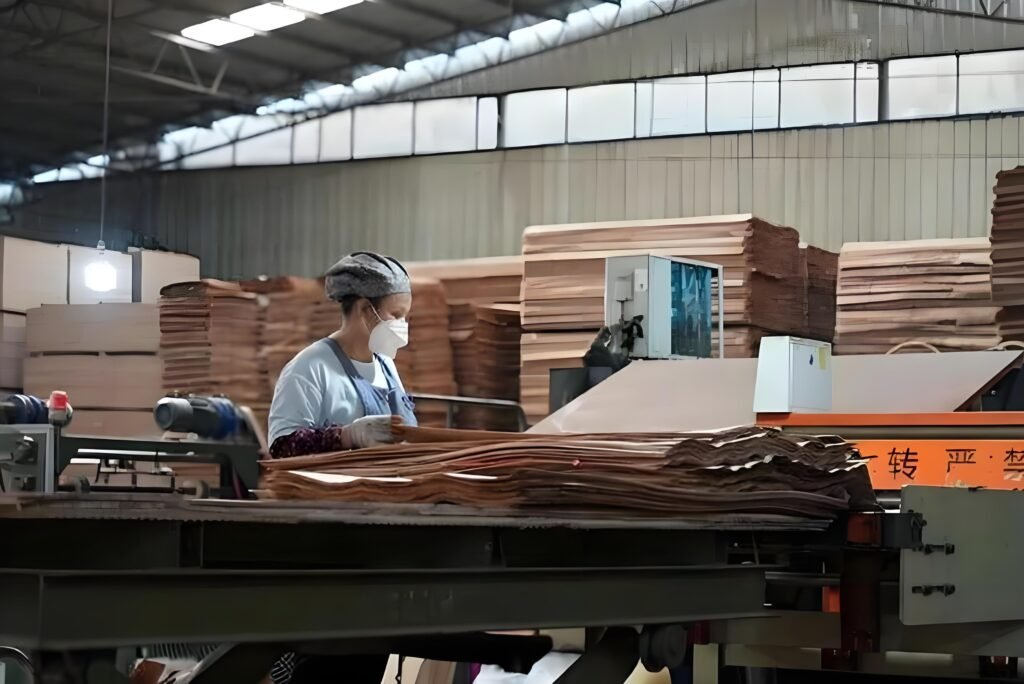
Stage 4: Core Component Processing & WIP Transfer (Day 18–30)
Stage Objective: Turn raw materials into semi-finished pieces ready for assembly or upholstery.
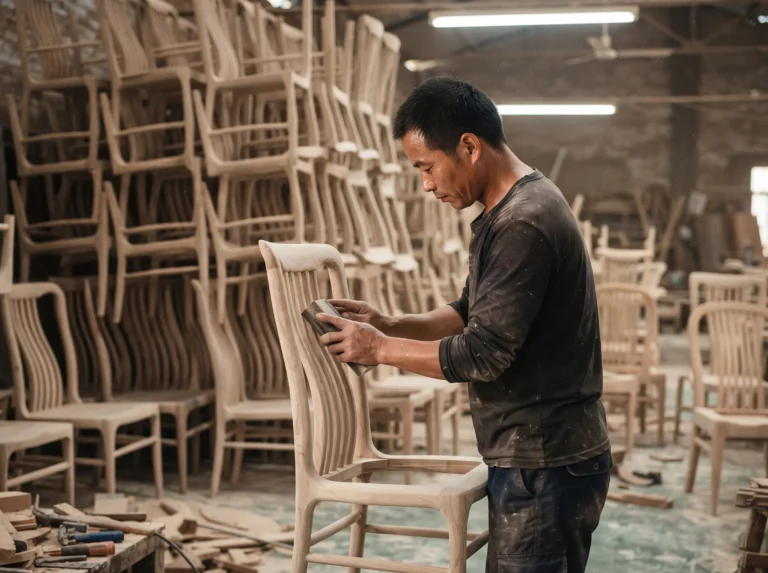
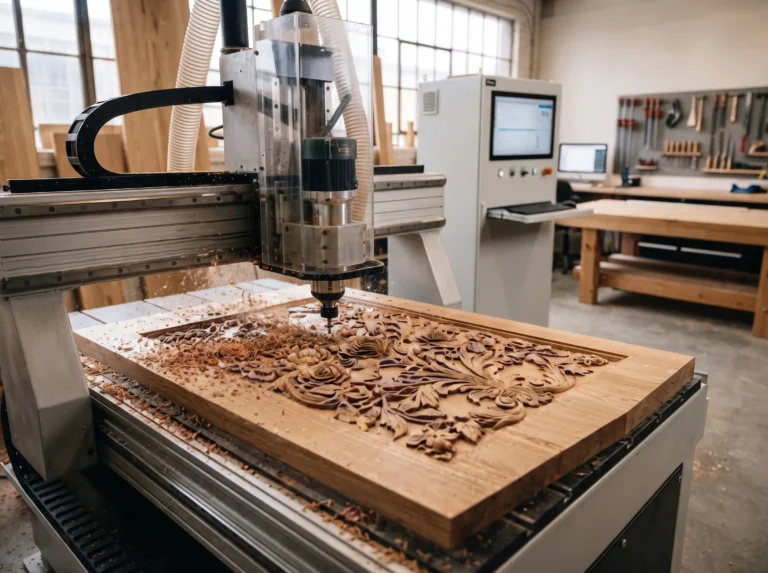
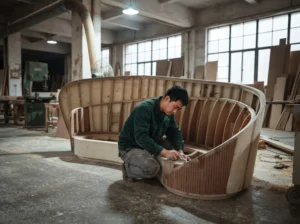
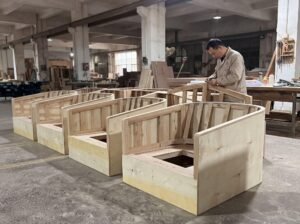
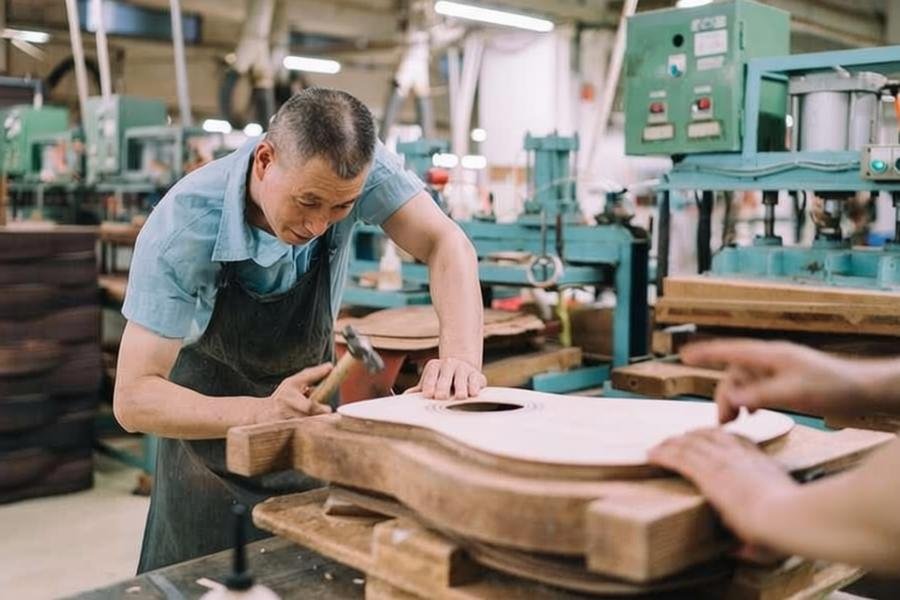
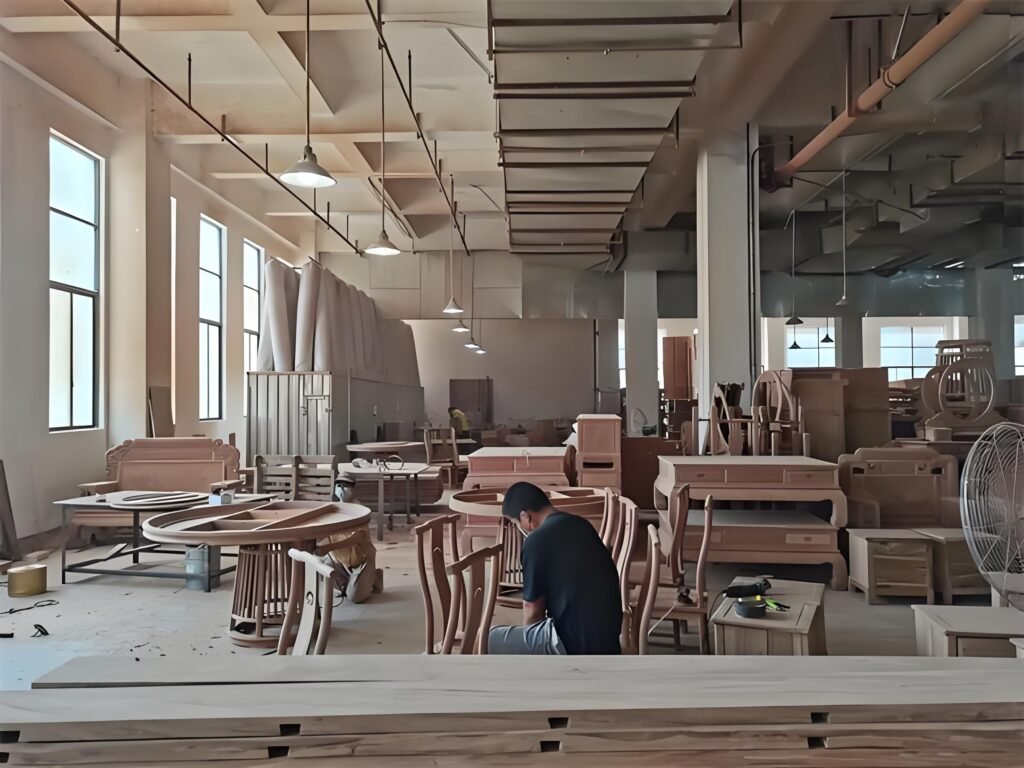
Processes diverge sharply by category at this stage. Solid wood moves through cutting, planing, joinery machining, and sanding. Upholstery moves through board cutting, foam cutting, and wood-frame nailing. Metal moves through laser cutting, bending, welding, and grinding. Finished components move to WIP warehouse or shop-floor staging areas, waiting for kit completion before the next stage.
Duration is 5–15 days, depending on category and order volume. Solid-wood machining takes the longest; upholstery board and frame work can run in parallel and are comparatively shorter.
Key Deliverables: First-article inspection report (FAI) for critical components, WIP transfer cards, and daily completion report.
Problems at this stage tend to hide in the details. A slight dimensional deviation in a machined part causes assembly interference later. Inadequate sanding roughness hurts finish adhesion. WIP left in a staging area absorbs moisture and warps, only discovered at assembly. Typical rework rate for solid wood at this stage is about 3%–5%, concentrated on joinery fit precision and surface sanding quality.
What buyers can do at this stage: Schedule a mid-production inspection to spot-check critical component dimensions and workmanship. Ask the factory for a daily operation brief and watch the bottleneck processes—sanding for solid wood, welding for metal, board cutting for upholstery. Pressuring the factory to “speed up” at this stage is pointless; the pace here is driven by material supply and process rigidity, not factory will.
Stage 5: Assembly, Finishing/Upholstery & Surface Treatment (Day 28–45)
Stage Objective: Integrate semi-finished pieces into finished goods and complete final surface treatment.
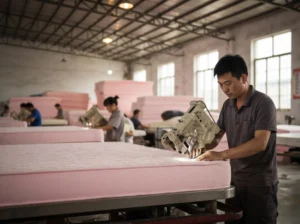
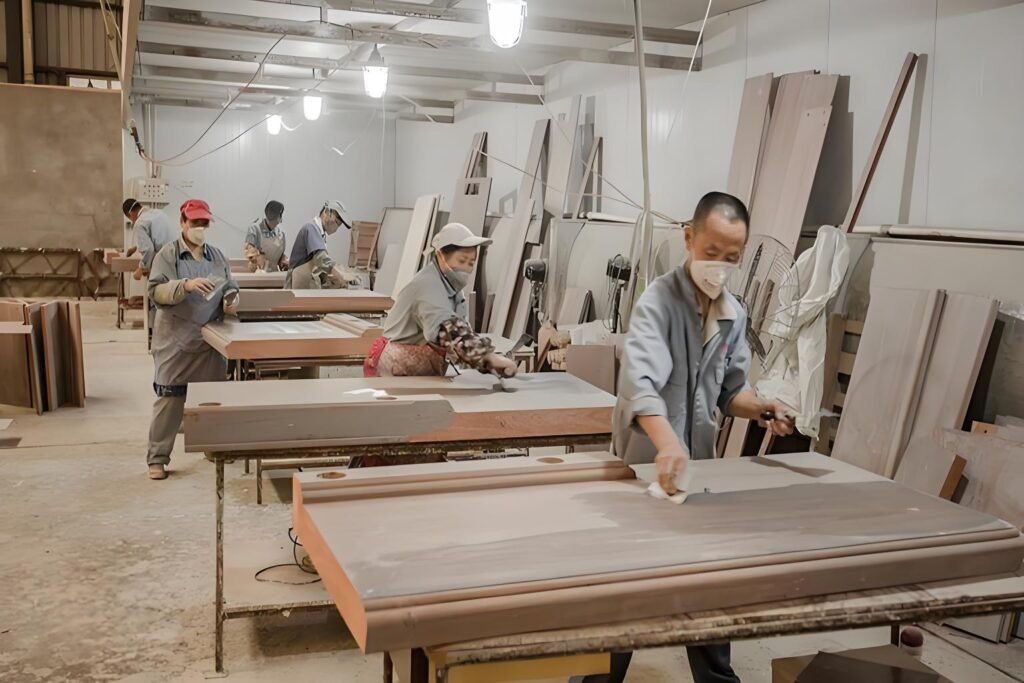
Solid wood enters the full finishing chain—assembly, putty, primer, sanding between coats, topcoat, and drying. Upholstery enters frame nailing, foam gluing, fabric/leather cutting, sewing, fitting, and final assembly. Metal enters powder coating, plating, or anodizing, then final assembly.
Finishing is weather-dependent. During the rainy season, high humidity can extend lacquer drying time by 30%–50%. Cold winter temperatures have the same effect. This is why solid-wood lead times fluctuate the most.
Upholstery 7–12 days; solid wood 15–25 days, with coating and drying consuming over 60% of that; metal 8–15 days.
Key Deliverables: First finished-goods confirmation report, finishing/upholstery process completion record, and finished-goods warehouse receipt.
Typical rework rate for upholstery at this stage is about 5%–8%, mainly from sewing alignment and upholstery smoothness issues. Solid-wood finish color variation between batches or parts is another high-frequency complaint. Metal surface-treatment adhesion failure is worse—paint flakes off after a single knock at destination.
What buyers can do at this stage: When the first finished piece comes off the line, request HD photos or video. For finished goods, ask the factory to record paint batch codes and spray dates. The window between finishing completion and packing is the best time to arrange an on-site or third-party inspection—product is fully formed, not yet sealed in boxes, problems are visible and fixable.
Stage 6: Final QC, Rework & Packing (Day 42–50)
Stage Objective: Pass AQL before shipment and survive the ocean voyage in export-grade packing.
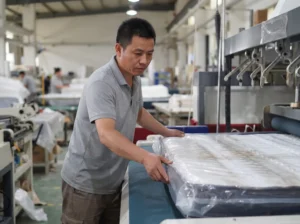
Factory QC conducts sampling inspection per AQL 2.5 or 4.0. Failed units go to rework—commonly surface touch-up, hardware re-tightening, or local upholstery re-fitting. After inspection pass, goods move to the packing line: pearl cotton, corner protectors, five-layer corrugated cartons, or export crates. Packed goods move to the finished-goods warehouse awaiting container loading.
First-pass inspection and packing take 2–5 days. Each additional rework round adds 2–3 days.
Key Deliverables: AQL inspection report, rework log, and packing completion list.
Where things most often slip: Reworked units are not properly labeled and get mixed back with qualified stock. Packing protection is insufficient, resulting in transit damage at port. Inspection standards are misaligned—the factory judges to national standard while you judge to a stricter internal standard, and neither side realizes it until the container is opened.
What buyers can do at this stage: Define AQL level and acceptable defect list at order confirmation. Do not wait until inspection day to argue standards. Ask the factory to send the inspection report and photos of sampled units. For high-value or fragile items, request a drop-test record to confirm the packing is actually robust enough.
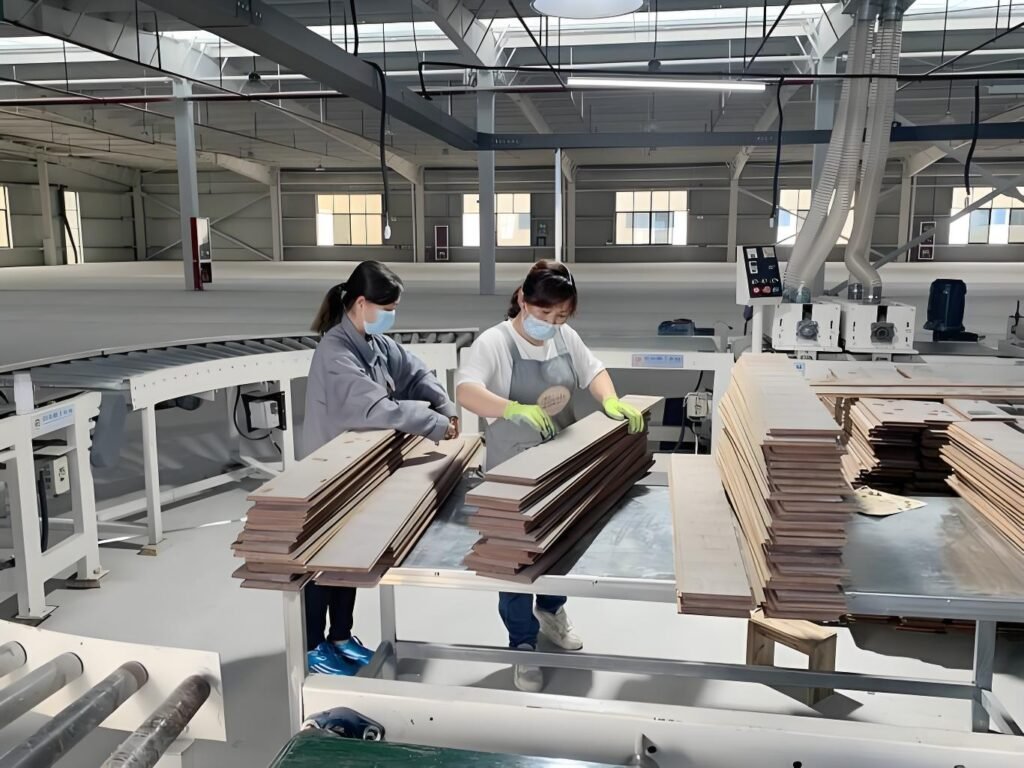
Stage 7: Export Documentation, Loading & Port Handover (Day 48–55)
Stage Objective: Paperwork correct, container loaded, port returned—factory-side loop closed.
The documentation department prepares commercial invoices, packing lists, and certificates of origin, while contacting the forwarder to arrange container pickup. Before loading, the warehouse performs a final check against the packing list to confirm SKU, quantity, and packing integrity. After loading, trucks move the container to the designated port—Nansha, Shekou, etc.—for return and customs declaration.
Document preparation 2–3 days, loading 1 day, inland transport to port 1–2 days. Customs inspection or documentation discrepancies can add 2–5 days.
Key Deliverables: Commercial invoice, packing list, draft B/L, and loading photos.
Loading-stage problems usually hide in the details: HS codes or product descriptions that do not match physical goods, causing customs delays. Poor loading sequence that creates unloading difficulties at destination. Factory loading before all QC is complete in order to catch a vessel.
What buyers can do at this stage: 48 hours before loading, ask the factory to send the final packing list and invoice draft for verification. Request loading photos confirming container number, seal number, and cargo stacking. For LCL shipments, confirm the factory has delivered goods to the designated warehouse and completed warehouse entry.
Production Differences Across Upholstery, Solid Wood & Metal
| Comparison Dimension | Upholstery | Solid Wood | Metal/Outdoor |
|---|---|---|---|
| Total Production Cycle (Baseline) | 20–30 days | 40–60 days | 25–40 days |
| Material Prep Share | 25%–35% | 35%–45% | 20%–30% |
| Core Processing Stage | Cutting + Sewing + Fitting | Machining + Finishing | Forming + Surface Treatment |
| Key Bottleneck Operation | Fitting, sewing alignment | Finish drying, moisture equilibrium | Surface adhesion, weld precision |
| Typical Rework Rate | 5%–8% | 3%–5% | 2%–4% |
| Peak Season Lead Time Increase | 30% | 25% | 20% |
| Outsourcing Dependency | High (fabric, foam, hardware) | Medium (veneer, coating) | Medium (tube, casting, powder) |
| Environment Sensitivity | Fabric color batch variance | Wood moisture, film drying | Surface treatment humidity, salt-spray test |
Three Milestone Nodes Buyers Should Actually Watch
Controlling lead time is not about sending daily emails asking “is it done yet.” It is about getting the right information at the right nodes.

Node 1: Material Kit Confirmation (end of Stage 2)
This node determines whether the line can start on time. Require the factory to send incoming inspection reports and kit-complete notice within 24 hours of material arrival. If key materials are delayed, immediately assess whether to adjust the schedule or activate an alternative. Roughly 60% of production delays root here. Time spent controlling this node pays the highest return.
Node 2: First Finished Piece Confirmation (start of Stage 5)
The first finished piece is the quality anchor for the entire run. Demand complete product photos, key dimensional measurements, and finishing/upholstery process records. If the first piece shows systematic deviation, stopping the line now costs far less than reworking completed goods. About 45% of orders experience at least one spec change during production, and each change averages 5–8 extra days. Freezing changes before first-piece confirmation is the key move to avoid that loss.
Node 3: AQL Inspection & Packing Completion (end of Stage 6)
This is the final factory-side gate. Require the factory to send the AQL report and photos of sampled units after inspection. If inspection fails, confirm rework completion date and re-inspection schedule. Also verify final packing list consistency with the actual order to avoid SKU mismatches or short shipments.
When does chasing the factory actually do nothing?
Pressuring the factory to “speed up” during Stage 2 (material prep) and Stage 4 (WIP processing) usually produces zero real effect. Progress at these stages is driven by material supply chains and process rigidity, not by factory will alone. Effective follow-up means confirming material arrival plans in Stage 2 and daily completion reports in Stage 4. Stages 5 and 6 are the windows where buyers can apply meaningful quality intervention.
Five Buyer-Side Mistakes That Most Often Slow the Line
Mistake 1: Dragging out drawing confirmation
Factories typically launch BOM breakdown upon deposit receipt, but this requires locked drawings. If the buyer keeps revising dimensions or structures after deposit, the already broken-down BOM must be rebuilt and purchased materials may be scrapped. Fix: Lock drawing revisions in writing before deposit payment, and agree on change workflow and cost allocation after version freeze.
Mistake 2: Changing color, fabric, or hardware mid-production
About 45% of orders experience at least one spec change during production, and each change averages 5–8 extra days. Changes involve not just re-procurement but also disruption of the already scheduled line. Fix: Enter a formal change freeze after PPS approval. Any change requires mutual written confirmation and a reassessed lead-time impact.
Mistake 3: Forgetting about accessories until inspection day
Zippers, foot pads, labels, and instruction booklets may seem minor, but if not defined at order confirmation, the factory will use default options. When the buyer objects during inspection, replacing accessories requires unpacking, rework, and repacking. Fix: During BOM breakdown, confirm brand, model, and color for every accessory, and request physical samples or supplier spec sheets from the factory.
Mistake 4: Approving the PPS from photos instead of a physical sample
Screen color shift, lighting conditions, and camera angles significantly distort material and color perception. Photo-only PPS approval is the leading cause of batch color disputes in mass production. Fix: For first orders or new suppliers, insist on physical PPS confirmation. For repeat orders with unchanged material batches, HD 360-degree video may be accepted, but the contract should state that video confirmation carries the same legal weight as physical sample.
Mistake 5: Treating the factory lead time as the loading date
Some buyers treat the factory-quoted lead time as the container loading date, with no buffer for inspection, rework, or documentation. Once inspection finds issues, the entire logistics plan shifts, potentially generating rush-loading fees or waiting for the next vessel. Fix: Add 5–7 days of self-managed buffer to the factory lead time for inspection, rework, and logistics coordination.
Key Takeaways
1.From order confirmation to actual assembly-line start, an average of 12–18 days of front-end preparation is required, accounting for over 40% of total lead time. Real assembly work represents only 25%–30% of the total production cycle. Controlling the front-end phase is more effective than pressuring the line phase.
2.Factory scheduling follows priority rules. Large-account recurring orders and high-margin rush jobs routinely get inserted ahead of standard queue items. Buyers should obtain a written schedule at order confirmation rather than relying solely on verbally promised total lead times.
3.The uncontrollable nature of outsourced components is the core reason factories hesitate to commit to precise dates. Understanding this helps set more realistic expectations and improves transparency by asking factories to list material sources and arrival plans.
4.About 45% of orders experience at least one spec change during production, and each change averages 5–8 extra days. Freezing changes after PPS approval is one of the most effective ways to protect lead time.

FAQ
Q: The factory says “already in production,” but keeps delaying when I ask for progress photos. What does this mean?
A: “In production” is a broad status covering Stages 3 through 6. If the factory cannot provide photos of specific operations—cutting, sanding, coating, assembly—the order may not yet be on the core line, or the factory may be unwilling to expose current true progress. At this point, demand a dated written schedule rather than continuing to accept vague status updates.
Q: Why is the factory unwilling to give me a detailed production schedule?
A: Factory internal scheduling is affected by material arrivals, equipment breakdowns, labor turnover, and inserted rush orders; schedules change weekly or even daily. Providing a detailed schedule means the factory must commit to external precision, and most factories prefer to preserve internal adjustment room. Buyers can step back and ask for 3–4 key milestone dates—material kit, line start, first article, goods ready—instead of a day-by-day process table.
Q: My order volume is not large. Will the factory downgrade my priority?
A: During capacity-tight periods, small-batch orders are indeed more likely to be bumped. Mitigation options include choosing a factory whose core business is small-to-medium orders (rather than being marginal capacity at a large plant); placing orders in off-season months; or accepting a slightly higher unit price for expedited scheduling. At order confirmation, directly asking the factory about current load and estimated line-start date is more effective than chasing afterward.
Q: What is the difference between PPS and First Article?
A: PPS is built before mass production starts to confirm materials, processes, and appearance standards, usually 1–3 pieces. First Article is the first complete unit off the mass-production line, used to verify that line setup is stable. After PPS approval, the factory may still adjust equipment parameters or worker operations, so First Article also requires buyer confirmation. Both are indispensable.
Q: What should I do if the factory tells me during Stage 2 (material prep) that a fabric is out of stock?
A: First, ask the factory to provide a physical swatch of the alternative fabric and confirm within 48 hours whether you accept it. If not, assess the time cost and economic loss of switching suppliers. At order confirmation, proactively asking the factory to list key material suppliers and stock status significantly reduces the probability of such surprises.
Q: At which stage should a Mid-Production Inspection be scheduled?
A: The optimal window is Stage 4, after core component processing and before final assembly. At this point key components are formed, making dimensional and workmanship checks feasible; because final assembly has not yet begun, rework costs are lowest. For upholstery, an inspection can also be scheduled after the fitting operation, focusing on sewing and fill quality.
Q: What happens when the factory’s AQL 2.5 standard conflicts with my internal standard?
A: At order confirmation, define mutually accepted inspection standards in an annex, including defect classification (critical/major/minor) and acceptable quantities. If your internal standard is stricter than AQL 2.5, inform the factory in advance and assess whether the factory can meet it. Misaligned standards are the single most common root cause of post-shipment quality disputes.
Recommended Resource
Interi Furniture specializes in custom furniture manufacturing for residential, hospitality, and commercial projects. Their experience in materials, craftsmanship, and project realization makes them a valuable resource for designers and buyers seeking tailored furniture solutions from China.