







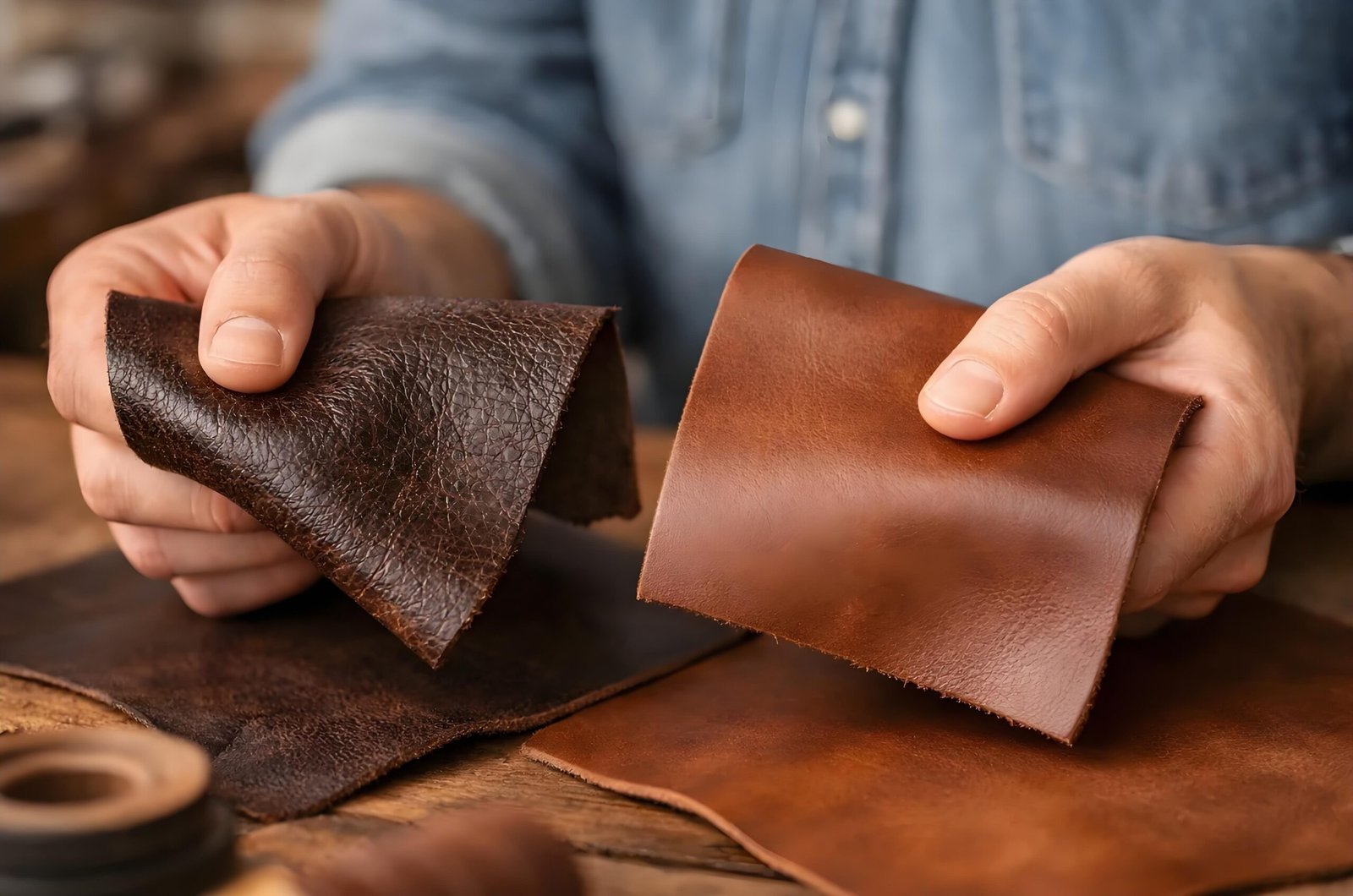
Genuine leather grades — this seemingly straightforward concept causes more procurement headaches than almost any other material issue in furniture buying. Plenty of buyers, even seasoned procurement professionals, see “Genuine Leather” stamped on a sofa tag and immediately assume they’re looking at premium hide. That assumption is wrong, and it costs money. In European and North American furniture trade circles, “Genuine Leather” carries surprisingly little weight. It merely certifies that the material contains some real leather fiber. How much, what layer, what tanning process — none of that is specified. A piece of Bonded Leather containing only 10% leather scraps can legally carry a “Genuine Leather” label.
The price of this misconception is steep. During spring 2026, Furniture Discover teams embedded at 18 upholstery factories across Foshan Longjiang and Dongguan Houjie collected data that makes uncomfortable reading: roughly 42% of sofa leather marketed as “top grain” actually consists of corrected split or finished split with PU film. Average buyers attempting visual identification? Success rate sits below 15%. This isn’t necessarily factories acting in bad faith — it’s the accumulated result of long-standing information asymmetry across the entire supply chain. Buyers enter with vague demands like “I want genuine leather,” suppliers respond with equally vague labels, and the delivered product often diverges dramatically from expectations.
This article has one purpose: lay out the raw material hierarchy, physical performance, real costs, and lifespan differences across Full Grain, Top Grain, Split, and Bonded leather using verifiable data and standards. We will dissect the three most common mislabeling schemes circulating in the industry, then provide a five-step field verification method that requires no lab equipment — just your eyes, hands, and nose. All data carries traceable sources. When you sit down to negotiate with these parameters in hand, you’ll be operating on firmer ground than listening to a sales rep describe something as “luxuriously textured.”
The Core Classification Logic of Leather Grades
The “Genuine Leather” Terminology Trap
The most common misdirection in furniture showrooms equates “Genuine Leather” with premium quality. The U.S. Federal Trade Commission (FTC) Leather Guides state it plainly: “Genuine Leather” only requires that a product contain real leather material. No mandatory constraints apply to raw material layer, surface finishing process, or actual leather content percentage. The regulatory gap here is wide enough to drive a truck through.
China’s furniture export market suffers from similar terminology ambiguity. During Furniture Discover 2026 factory visits, several factory owners candidly admitted that when clients request quotes for “genuine leather” without further specification, they default to Top Grain pricing based on industry convention. Whether the client envisions Full Grain’s natural grain or Bonded’s rock-bottom pricing never gets aligned. This terminology gap gets exploited — sometimes intentionally, sometimes through inertia — becoming one of the most convenient tools in furniture sales.
The Raw Material Hierarchy of Four Core Grades
Understanding furniture leather grades requires returning to the hide itself. A cross-section of intact bovine hide contains, from exterior to interior: the epidermis (removed during initial tanning), the corium or dermis (comprising the grain layer and reticular layer — the core raw material for leather goods), and the hypodermis (also removed).
The core differentiator in leather furniture quality boils down to how much of the original grain surface the tannery preserves, and to what degree subsequent processes like buffing, coating, or film lamination modify that surface. The ranking from highest to lowest runs: Full Grain > Top Grain > Split > Bonded. This isn’t arbitrary — it’s dictated by the natural properties of hide fiber structure. The papillary layer closer to the exterior contains denser, stronger fibers; the reticular layer deeper inside has looser fibers requiring more artificial intervention to become usable.
Deep Dive into Four Core Grades
Full Grain Leather
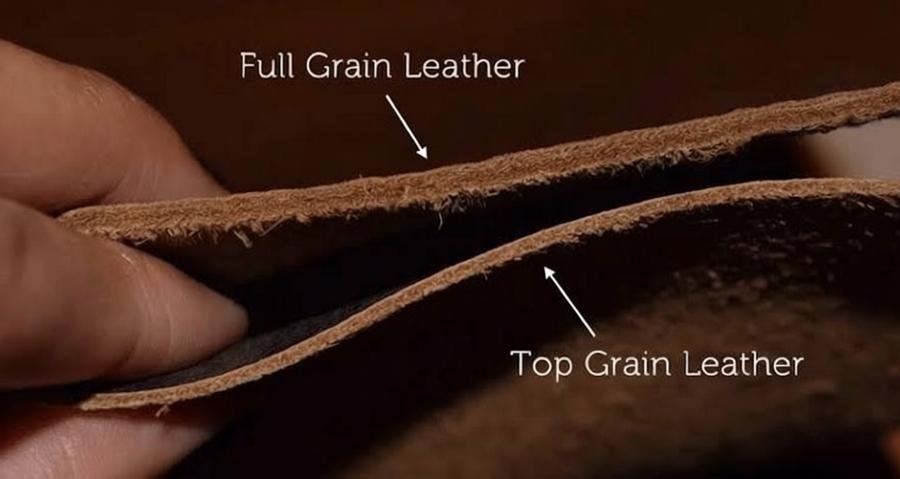
Full Grain Leather preserves the most complete natural grain surface among furniture upholstery grades. The tanning process involves only depilation, tanning, and light finishing. The original surface receives neither sanding nor cutting. Growth marks, scars, insect bites — these “imperfections” remain fully visible. Every hide possesses a unique texture; finding two identical Full Grain hides is impossible.
This “imperfection” is precisely its greatest value. Yet precisely because the natural surface is retained, raw hide utilization rates are low. During Furniture Discover research, an established high-end export factory in Foshan shared their raw hide screening data: approximately 35-45% of raw hides fail to meet Full Grain standards due to excessive surface defects, forcing downgrade to Top Grain or Split. This screening process directly pushes costs upward.
Physical Performance Parameters:
● Thickness range: 1.2-1.4mm (furniture upholstery cowhide)
● Martindale Abrasion Resistance (ISO 12947-2): ≥40,000 cycles
● Tear Strength (ISO 3377-1): ≥60N (N/5mm)
● Water Vapor Permeability (ISO 14268): ≥3.5 mg/cm²/h
● Color Fastness to Rubbing, Dry (ISO 11640): ≥Grade 4
● Average service lifespan: 12-18 years under normal use conditions
Cost & Supply: Full-grain bovine leather of equivalent thickness commands an ex-factory price of approximately USD 12.8 per square foot. Raw materials primarily comprise domestic Chinese yellow cowhide, North American steer hide, and European dairy cowhide. Pricing sits significantly above other grades for a straightforward reason: usable hide is scarce, and waste is substantial.
Application Scenarios: High-end custom sofas, designer furniture, and long-term residential upholstery. Not suitable for bulk contract projects demanding extreme surface uniformity — you cannot guarantee that every sofa in a 500-unit hotel order will share identical grain patterns. For contract clients, that inconsistency is a nightmare.
Top Grain Leather
Top Grain Leather is the most widely used grade in the furniture industry, bar none. Furniture Discover 2026 research data indicates that Top Grain accounts for approximately 58% of mid-to-high-end genuine leather sofas exported from China — the absolute mainstream. Its raw material also derives from the papillary layer (top layer), but the surface undergoes buffing to remove natural defects, followed by application of pigmented finish or semi-aniline coating. Based on post-processing extent, it subdivides into:
● Corrected Grain with Light Finish: Lightly buffed, retaining partial natural texture
● Heavy Corrected Grain: Deeply buffed, with embossed artificial patterns
Physical Performance Parameters:
● Thickness range: 1.0-1.3mm
● Martindale Abrasion Resistance: ≥25,000-35,000 cycles (heavier coatings increase abrasion resistance but reduce breathability — trade-offs exist)
● Tear Strength: ≥45-55N
● Water Vapor Permeability: ≥1.8-2.5 mg/cm²/h
● Color Fastness: ≥Grade 3-4
● Average service lifespan: 8-12 years
Cost & Supply: Top-grain bovine leather commands an ex-factory price of approximately USD 6.5-8.2 per square foot, roughly half to two-thirds of Full Grain pricing. After surface defects are artificially corrected, raw hide utilization improves to 75-85%, achieving the best balance between cost-effectiveness and appearance consistency.
Here’s the critical point: both Top Grain and Full Grain are top-layer hides. The difference isn’t “whether it’s top layer” — it’s “whether the surface has been artificially modified.” The ubiquitous “top-layer cowhide” label in the market points to Top Grain in over 90% of cases, not Full Grain. Many buyers pay Full Grain prices while receiving Top Grain — a differential that can exceed USD 1,000 for a single three-seater sofa.
Split Leather
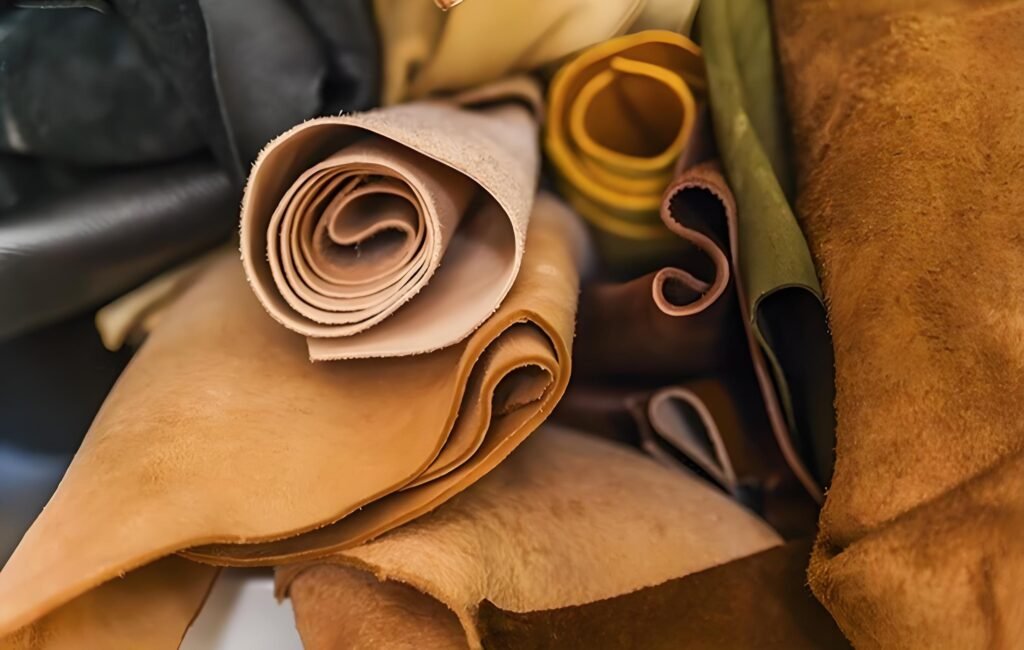
Split Leather refers to the reticular layer remaining after the grain split is separated during tanning. This layer lacks a natural grain surface, possesses a loose fiber structure, and demonstrates markedly lower physical strength than top-layer hide. To render it usable, factories typically apply surface film lamination — bonding a polyurethane transfer film to create “finished split.”
During Furniture Discover 2026 research, we observed finished split production lines at a factory in Dongguan Houjie. After film application, the surface is embossed with patterns resembling Top Grain, making visual distinction challenging at first glance. But touch reveals the discrepancy: the film layer and underlying fiber structure possess a “separation sensation” unlike natural leather’s integrated extension.
Physical Performance Parameters:
● Thickness range: 0.8-1.2mm (post-coating)
● Martindale Abrasion Resistance: ≥8,000-15,000 cycles (substrate deteriorates rapidly after film wear-through)
● Tear Strength: ≥20-35N
● Water Vapor Permeability: ≤0.8 mg/cm²/h (nearly impermeable after film lamination)
● Color Fastness: ≥Grade 2-3 (high film delamination risk)
● Average service lifespan: 3-5 years
Cost & Supply: Split leather commands an ex-factory price of approximately USD 2.8-4.2 per square foot, roughly 22-33% of Full Grain pricing. In China’s furniture supply chain, Split commonly appears in low-end sofas, office chairs, and headboard upholstery. Furniture Discover research found that approximately 18% of sofa leather marketed as “top grain” actually consists of finished Split. The primary misleading method involves embossing similar textures and employing ambiguous terms like “genuine leather.”
Application Scenarios: Short-term furniture, rental properties, and severely budget-constrained contract projects. High-frequency residential use? Not recommended. Problems typically emerge around year three, by which point replacement costs may exceed the initial savings from choosing Top Grain.
Bonded Leather
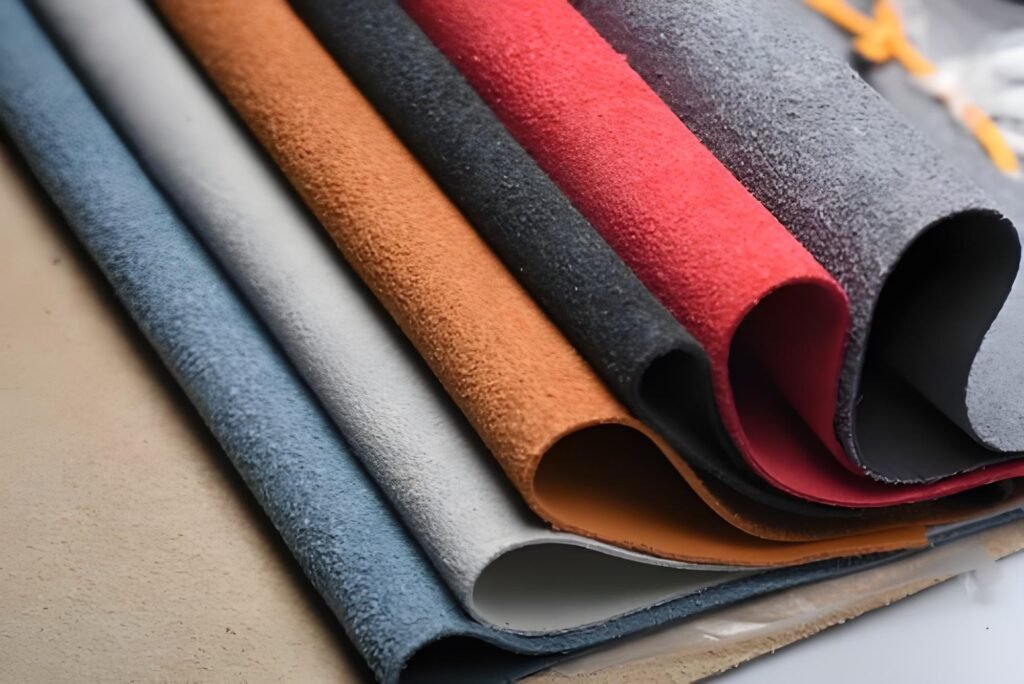
Bonded Leather is manufactured by shredding leather trimmings and scraps, mixing them with synthetic fibers, latex, or polyurethane binders, pressing into sheets, and laminating the surface with a coating film. Actual leather content typically ranges between 10-30%, with the remainder comprising chemical binders and synthetic substrates.
This material’s advantages include highly customizable surface textures, excellent color consistency, and extremely low cost. But the fatal flaw is equally clear: once the surface coating wears through, the internal scrap structure rapidly powders and cracks, becoming irreparable. In European and North American markets, Bonded Leather has been largely phased out by mid-to-high-end furniture brands, though it persists in e-commerce budget furniture and fast-fashion home sectors.
Physical Performance Parameters:
● Thickness range: 0.6-1.0mm
● Martindale Abrasion Resistance: ≥3,000-8,000 cycles
● Tear Strength: ≥10-20N
● Water Vapor Permeability: ≤0.3 mg/cm²/h
● Color Fastness: ≥Grade 1-2
● Average service lifespan: 1-3 years
Cost & Supply: Bonded Leather commands an ex-factory price of approximately USD 1.2-2.5 per square foot, merely 10-20% of Full Grain pricing.
Terminology Trap: In certain jurisdictions, Bonded Leather can legally be labeled as “Genuine Leather” or “Real Leather” because it does contain real leather material. This represents the most dangerous blind spot in furniture procurement — you believe you’re buying leather, but you’re actually purchasing synthetic substrate with a service lifespan under three years.
Full-Dimension Data Comparison
Genuine leather grades Core Parameter Comparison Table (Furniture Upholstery Cowhide, 1.0-1.3mm Thickness Baseline):
| Parameter | Full Grain | Top Grain | Split (Finished) | Bonded |
|---|---|---|---|---|
| Raw Material Layer | Top-layer, natural grain fully preserved | Top-layer, surface buffed & finished | Second-layer (reticular), surface film-coated | Leather scraps + synthetic substrate, pressed |
| Surface Characteristics | Natural texture, visible growth marks/defects | Artificially corrected texture, high consistency | Artificial embossed pattern, strong film gloss | Highly uniform, obvious plastic feel |
| Martindale Abrasion (ISO 12947-2) | ≥40,000 cycles | ≥25,000-35,000 cycles | ≥8,000-15,000 cycles | ≥3,000-8,000 cycles |
| Tear Strength (ISO 3377-1) | ≥60N | ≥45-55N | ≥20-35N | ≥10-20N |
| Permeability (ISO 14268) | ≥3.5 mg/cm²/h | ≥1.8-2.5 mg/cm²/h | ≤0.8 mg/cm²/h | ≤0.3 mg/cm²/h |
| Avg. Ex-Factory Price (USD/sq.ft) | Approx. 12.8 | Approx. 6.5-8.2 | Approx. 2.8-4.2 | Approx. 1.2-2.5 |
| Average Service Lifespan | 12-18 years | 8-12 years | 3-5 years | 1-3 years |
| Application Scenarios | High-end custom, designer furniture | Mid-to-high-end residential, commercial | Low-end contract, short-term use | E-commerce budget, temporary furniture |
| Verification Difficulty | Medium (requires natural texture comparison) | Medium (requires finish degree assessment) | High (film masks true layer) | Low (edge reveals scrap structure) |
| China Export Furniture Share | Approx. 8% | Approx. 58% | Approx. 22% | Approx. 12% |
Data Sources: Furniture Discover 2026 Field Research across 18 Upholstery Factories in Foshan & Dongguan; China Leather Industry Association 2025 Export Data; ISO Leather Testing Standards
Industry Malpractices & Verification Methods
Three Most Common Mislabeling Schemes
Scheme 1: Corrected Top Grain Misrepresented as Full Grain
Some suppliers label heavily corrected Top Grain — surface almost entirely sanded and re-embossed with artificial patterns — as “Full Grain” or “全粒面.” The verification challenge lies in the subtle visual difference between heavily corrected surfaces and natural grain. But there’s a trick: Full Grain pore distribution is irregular and penetrates deep into the corium; corrected grain pores are typically post-embossed, uniformly distributed, and shallow. Under magnification, the depth and distribution patterns differ noticeably.
Scheme 2: Finished Split Misrepresented as Top Grain
This represents the most prevalent mislabeling behavior identified in Furniture Discover 2026 research. After film lamination, finished Split closely resembles Top Grain in appearance, yet costs only 40-55% of Top Grain pricing. Suppliers exploit the ambiguous phrase “top-layer genuine leather” to blend Split into top-layer orders. The core verification point is film thickness: in Split leather, the film layer typically constitutes 30-45% of total thickness, whereas Top Grain finish layers usually measure only 5-15%. A caliper measurement combined with cross-section observation provides reliable identification.
Scheme 3: Bonded Leather Ambiguously Labeled as “Genuine Leather” or “Real Leather”
Exploiting terminology regulatory differences, suppliers package Bonded Leather as “eco-friendly recycled genuine leather” or “composite genuine leather.” Buyers mistakenly believe they’re procuring cost-effective genuine leather, when in fact they’re purchasing synthetic substrate with a service lifespan under three years. The cross-section edge of Bonded Leather reveals obvious scrap particle structures, fundamentally different from natural leather’s fibrous layered structure. This distinction requires no professional equipment — the naked eye suffices.
Five-Step Field Verification Method
Leather furniture quality field verification requires no instruments. Procurement professionals should master these five steps:
Step 1: Visual Inspection
● Full Grain: Irregular texture, natural defects, uneven pore depth. You’ll never find two identical Full Grain hides.
● Top Grain: Uniform texture, minimal defects, regular pore distribution. Consistency is its strength — and its primary distinction from Full Grain.
● Split/Bonded: Overly perfect texture, film reflection, plastic appearance. “Too perfect” is actually a warning sign.
Step 2: Tactile Test
● Full Grain: Natural texture extension when pressed, warm organic feel. The hide responds to your finger like living material.
● Top Grain: Minimal texture variation when pressed, slippery coating sensation is noticeable.
● Split: Film-substrate separation sensation when pressed, stiff rebound. The material doesn’t follow your finger like natural leather.
● Bonded: Cardboard-like feel, lacking leather extensibility. Press down, and it doesn’t bounce back properly.
Step 3: Olfactory Test
● Natural leather (Full/Top Grain): Subtle tanning odor, no pungent chemical smell. If you detect strong plastic or adhesive odors, raise your guard.
● Split/Bonded: Obvious polyurethane, latex, or chemical binder odor. This smell is particularly pronounced on Bonded Leather.
Step 4: Edge Inspection
● Examine leather cross-section edge with a magnifier:
● Full/Top Grain: Visible dense fibrous layered structure with gradual transition from grain to flesh side. No obvious discontinuity.
● Split: Obvious film-fiber layer boundary, abnormal film thickness. Resembles film laminated onto sponge.
● Bonded: Visible scrap particles mixed with binder in granular structure, lacking the directional fiber orientation of natural leather.
Step 5: Documentation Verification
● Require suppliers to provide a Leather Grade Declaration explicitly stating: material layer (Full/Top/Split/Bonded), tanning process (chrome/chrome-free/vegetable), finish type (aniline/semi-aniline/pigmented), thickness specification, supplier name, and batch number. Reject vague documentation bearing only “Genuine Leather” or “真皮” labels. This isn’t being demanding — it’s basic procurement risk management.
Furniture Discover Exclusive Insights: Industry Cognition Traps in Leather Grades
Based on Furniture Discover 2026 field visits to 18 upholstery factories across Foshan Longjiang and Dongguan Houjie, combined with laboratory testing of 86 leather samples, we identified three industry facts that circulate widely yet rarely get discussed publicly:
Fact 1: “Genuine Leather = High Quality” Constitutes Systematic Marketing Misdirection
In European and North American markets, “Genuine Leather” represents the minimum threshold for leather classification — equivalent to a food label stating “contains natural ingredients.” Yet Chinese furniture exporters frequently exploit this terminology ambiguity when targeting overseas buyers. Furniture Discover research shows that among products labeled “Genuine Leather Sofa” on Amazon, Wayfair, and similar platforms, approximately 38% actually use Bonded Leather or Split Leather. Buyer complaints citing “leather cracking, peeling” account for 62% of total grievances. The root cause often isn’t poor product quality, but a massive gap between buyer understanding of “Genuine Leather” and the actual delivered product.
Fact 2: True Grade Compliance Rates in China’s Furniture Supply Chain
Furniture Discover sampling tests across 18 factories reveal sobering numbers: among leather samples labeled Top Grain, only 73.5% actually met Top Grain standards, with 18% being Split substitutes and 8.5% Bonded adulteration. Samples labeled Full Grain fared worse at 61.2% compliance, with the remainder mostly being heavily corrected Top Grain. The core driver behind mislabeling is cost differential. For a standard three-seater sofa (requiring approximately 180 square feet of leather), substituting Split for Top Grain saves roughly USD 540-720 in material costs; substituting Top Grain for Full Grain saves approximately USD 810-1,170. In fiercely price-competitive export markets, this cost gap is the direct economic incentive for mislabeling. Factories aren’t necessarily dishonest by nature — honesty sometimes means losing the order.
Fact 3: Real Service Lifespan Differences Between Grades Are Severely Underestimated
Industry marketing commonly describes “genuine leather sofas” as uniformly “durable for over 10 years” without grade differentiation. Furniture Discover tracking data provides more specific figures: Full Grain sofas average 14.2 years under normal use, Top Grain averages 9.8 years, Split merely 3.6 years, and Bonded only 1.8 years. The premature failure of Split and Bonded leather wastes procurement costs and triggers substantial after-sales disputes and brand reputation damage. For furniture brands targeting European and North American markets, high complaint rates associated with Split and Bonded leather have become a core factor driving elevated return rates. Some brands have suffered platform ranking penalties due to after-sales issues from a single batch of Split sofas — a cost far exceeding the initial material savings.
Selection Logic Recommendations:
● Budget > USD 3,000/set, positioned as premium: Select Full Grain. Natural texture and long-term durability establish brand premium. Clients pay for the fact that “no two hides are identical.”
● Budget USD 1,500-3,000/set, positioned as mid-range: Select Top Grain (Semi-Aniline or light corrected). This is the rational sweet spot balancing cost, consistency, and service lifespan. Most export orders cluster in this range for good reason.
● Budget < USD 1,500/set or bulk contract orders: Use Split cautiously, with explicit grade labeling in contracts and minimum thresholds for abrasion and tear strength. Bonded Leather? If your product positioning includes the word “leather,” avoid it entirely. The material savings won’t cover after-salescosts.
● High-frequency usage scenarios (hotels, offices, rentals): Prioritize Heavy Pigmented Top Grain. Trade some breathability for coating protection that enhances abrasion and stain resistance. Hotel room usage intensity actually makes Full Grain less suitable than thick-coated Top Grain — the latter withstands abuse better.
Selection Recommendations & Procurement Decisions
Optimal Choices for Different Budgets
The core decision in top grain vs split isn’t “which is better” — it’s “which is more appropriate under budget constraints.”
● High-end custom line (ex-factory > USD 2,500/set): Full Grain is the only choice. Buyers pay for natural texture and uniqueness; surface defects become selling points for authenticity. Include leather care guides, as Full Grain is more sensitive to moisture and oils, requiring regular conditioning.
● Mainstream residential line (ex-factory USD 1,200-2,500/set): Top Grain (Corrected Grain with Pigmented Finish) represents the rational choice. Surface consistency satisfies mass production requirements, while abrasion and color fastness support 8-10 years of residential use. This price band also represents the most concentrated segment of China’s genuine leather sofa exports.
● Entry-level/contract line (ex-factory < USD 1,200/set): If genuine leather must be used, select Split with explicit buyer communication regarding expected service lifespan (3-5 years). A more practical recommendation: consider high-performance microfiber PU or technical fabric, which often outperform Split physically at controllable costs. Why insist on the “leather” label if the material doesn’t deliver?
Grade Matching for Different Usage Scenarios
| Usage Scenario | Recommended Grade | Core Rationale |
|---|---|---|
| High-end residential/villas | Full Grain | Natural texture, long-term value, develops patina with age |
| Standard residential living room | Top Grain (Semi-Aniline) | Balance between natural feel and practicality |
| Commercial office/hospitality | Top Grain (Heavy Pigmented) | High abrasion resistance, easy cleaning, consistency requirements |
| Rental properties/student housing | Split or alternative materials | Low cost, short cycle, replaceable |
| E-commerce budget volume | Avoid labeling Bonded as “genuine leather” | Reputation risk outweighs cost savings |

Frequently Asked Questions (FAQ)
Q1: What do “Genuine Leather” and “Real Leather” actually represent in terms of grade?
A: In European and North American markets, these terms only certify that a product contains real leather material. They represent the minimum threshold for leather classification, promising no specific raw material layer or quality standard. A piece of Bonded Leather containing merely 10% leather scraps can legally be labeled “Genuine Leather.” During procurement, you must require suppliers to explicitly state Full Grain, Top Grain, Split, or Bonded. Vague labels mean vague accountability — and vague accountability means you’re taking the risk.
Q2: What is the simplest way to distinguish Full Grain from Top Grain?
A: Examine pores and texture. Full Grain exhibits irregular pore distribution, uneven depth, visible natural growth marks, and minor defects. Top Grain shows uniform pore distribution, high texture consistency, and minimal surface defects. Under magnification, Full Grain pores penetrate deep into the corium, while Top Grain pores are typically post-embossed and relatively shallow. Here’s a field trick: press with your finger. Full Grain’s texture follows your finger; Top Grain shows minimal variation. The difference is tactile and immediate.
Q3: Is Split Leather completely unusable?
A: Not absolutely unusable, but its performance boundaries must be clearly understood. Split Leather suits low-frequency, short-term, or severely budget-constrained scenarios. If used for high-frequency residential sofas, accept its 3-5 year service lifespan and explicitly label the grade in procurement contracts to avoid being priced as Top Grain. Some contract projects use Split without issues — but transparency with the client is essential.
Q4: Why can identically labeled “top-layer cowhide” sofas vary in price by 3x?
A: “Top-layer cowhide” is ambiguous terminology encompassing two vastly different grades: Full Grain and Top Grain. Additionally, within the same grade, raw hide origin (domestic Chinese vs. North American steer), tanning process (chrome vs. vegetable), and finish thickness (aniline vs. pigmented) all create price differentials. The material cost gap between Full Grain at USD 12.8/sq.ft and Top Grain at USD 6.5/sq.ft can exceed USD 1,000 for a same-specification sofa. A 3x price differential? Completely normal. The question isn’t why prices vary — it’s whether you know what you’re actually paying for.
Q5: Does Bonded Leather offer environmental advantages?
A: Bonded Leather does utilize leather trimmings, reducing raw material waste. However, its manufacturing process consumes substantial chemical binders (polyurethane adhesives, latex), raising VOC emissions and formaldehyde release concerns. From a full lifecycle perspective, Bonded Leather requires replacement after 1-3 years, while Full Grain serves 14+ years. The latter’s long-term resource consumption is actually lower. “Eco-friendly” cannot serve as the sole justification for using lower-grade leather — you need to calculate the total account, not just the raw material line item.
Q6: What leather testing documentation should I require from suppliers during procurement?
A: Require at minimum four documents: ① Leather Grade Declaration (explicitly stating Full/Top/Split/Bonded); ② Physical performance test report (abrasion, tear, color fastness, with ISO test standard numbers); ③ Chemical composition test report (hexavalent chromium, formaldehyde, azo dyes, compliant with EU REACH or California Proposition 65); ④ Certificate of origin and tannery qualification documents. Vague documentation bearing only “Genuine Leather” or “真皮” labels lacks legal standing and won’t protect your interests if disputes arise.
Q7: Which leather grade accounts for the highest share in China’s furniture exports?
A: According to Furniture Discover 2026 research and China Leather Industry Association data, Top Grain accounts for approximately 58% of exported genuine leather furniture from China, Split approximately 22%, Bonded approximately 12%, and Full Grain approximately 8%. Top Grain is the absolute mainstream, having achieved optimal balance between cost, consistency, and performance. Full Grain’s low share doesn’t indicate lack of demand — rather, few factories can produce, are willing to produce, and can reliably supply it at scale.
Q8: What should I do if a supplier refuses to explicitly label leather grades?
A: Refuse to cooperate. Leather grade is a core basis for procurement pricing. Vague labeling indicates inherent mislabeling risk. Require suppliers to explicitly state grade, thickness, origin, and testing standards in contracts, with penalty clauses for failed incoming inspection. This isn’t being difficult — it’s the baseline of professional procurement. If a supplier won’t commit to specifics in writing, they’re telling you something important about their business practices.
Practical Toolkit
“Genuine Leather Furniture Grade Verification & Acceptance Checklist”
Usage Instructions: This checklist applies to incoming inspection of leather furniture procurement. QC personnel or third-party inspection agencies should verify each item sequentially. Any non-compliant item renders the entire batch rejected.
| No. | Inspection Item | Inspection Method | Acceptance Criteria | Remarks |
|---|---|---|---|---|
| 1 | Leather Grade Declaration | Verify supplier-provided Leather Grade Declaration | Explicitly state Full Grain/Top Grain/Split/Bonded, include tannery name and batch number | Reject vague “Genuine Leather” statements |
| 2 | Surface Texture Naturalness | Visual + magnifier, random sampling of 3 areas | Full Grain: irregular texture with natural defects; Top Grain: uniform texture without plastic film feel | Photograph for records |
| 3 | Edge Cross-Section Structure | Sample from inconspicuous area (sofa bottom/back) to examine cross-section | Visible fibrous layered structure, no scrap particles or film separation | Split/Bonded most easily exposed here |
| 4 | Odor Detection | Smell leather surface at close range | Natural leather odor, no pungent chemical smell | Bonded/Split typically show obvious PU odor |
| 5 | Press Rebound Test | Press leather surface with palm, observe texture change | Natural texture extension, rapid rebound, no film separation sensation | Test 3 different areas |
| 6 | Thickness Measurement | Use leather thickness gauge | Deviation from contract-specified thickness ≤±0.1mm | Measure at least 5 points, average |
| 7 | Physical Performance Report | Verify third-party test report | Abrasion ≥ contract value (ISO 12947-2), tear strength ≥ contract value (ISO 3377-1) | Report must bear CNAS or equivalent accreditation stamp |
| 8 | Chemical Composition Report | Verify third-party test report | Hexavalent chromium ≤3mg/kg (ISO 17075), formaldehyde ≤75mg/kg (ISO 17226) | Compliant with target market regulations (EU REACH/CA Prop 65) |
| 9 | Color Difference Comparison | Compare delivered leather with approved sample under natural light | Color difference ≤ Grey Scale Grade 4 (ISO 105-A02) | Avoid comparison under artificial lighting |
| 10 | Quantity & Size Verification | Verify delivery note against actual receipt | Area deviation ≤±3%, quantity matches contract | Leather is priced by area; size deviation directly impacts cost |
Cognitive gaps in genuine leather grades represent the most concealed yet expensive cost trap in furniture procurement. From the terminology ambiguity of “Genuine Leather” to the raw material layer differences between Full Grain and Top Grain, and onward to the performance boundaries of Split and Bonded, each grade corresponds to explicit pricing, lifespan, and application scenarios. The core of procurement decision-making is not pursuing the highest grade, but selecting truthfully labeled, performance-verifiable leather products at the intersection of budget and demand. Furniture Discover will continue tracking grade compliance rates and testing standard evolution within China’s furniture leather supply chain, providing procurement professionals with traceable industrial cognition infrastructure.
Recommended Resource
Interi Furniture specializes in custom furniture manufacturing for residential, hospitality, and commercial projects. Their experience in materials, craftsmanship, and project realization makes them a valuable resource for designers and buyers seeking tailored furniture solutions from China.