


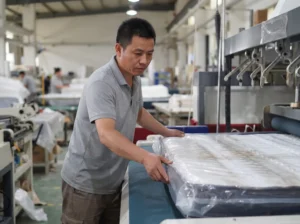





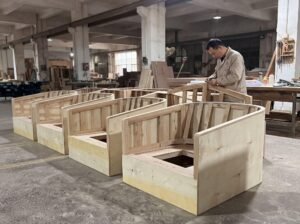
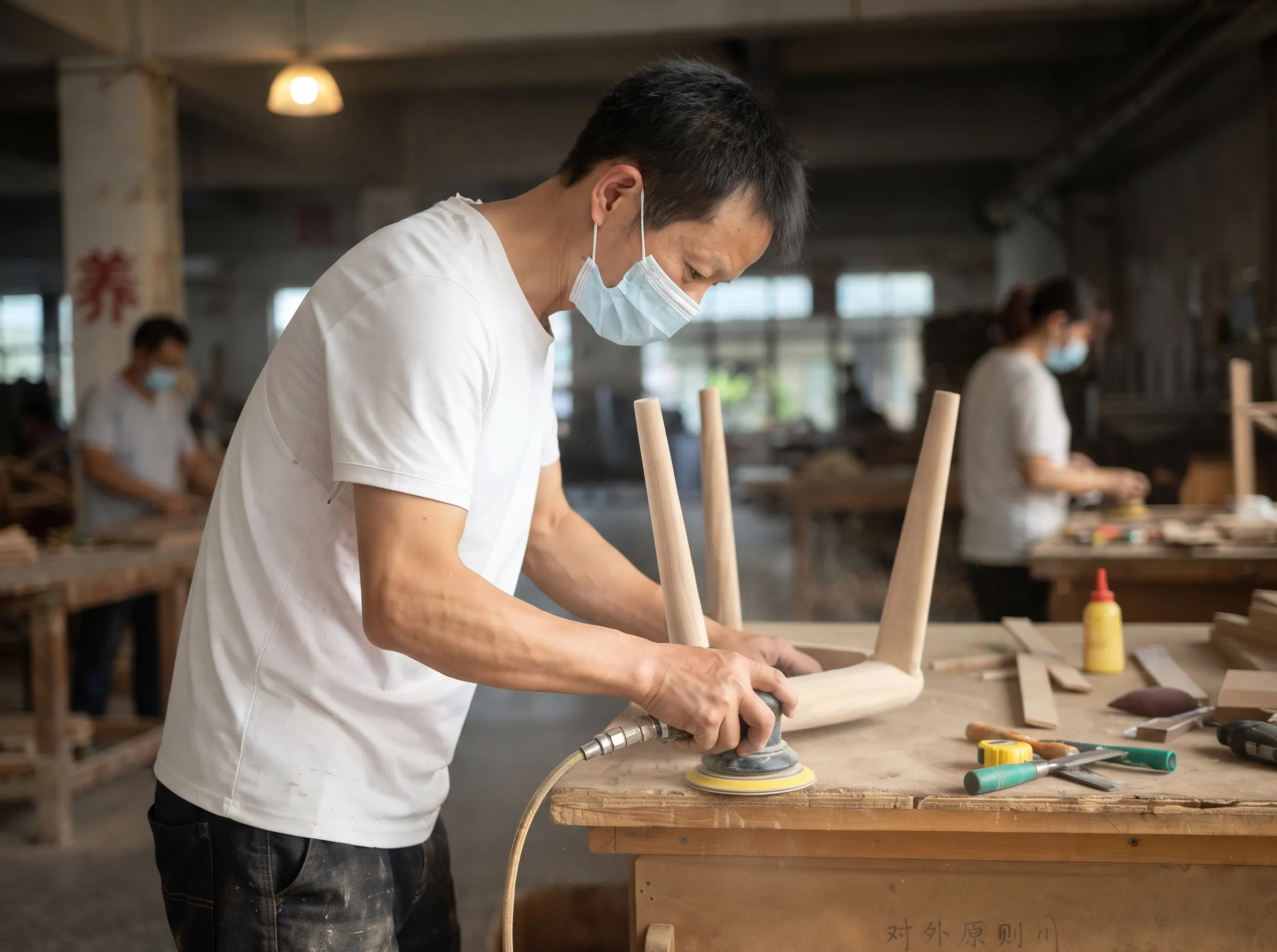
If your procurement team moved orders to Vietnam believing the supply chain had been decoupled from China, you have been sold a narrative that does not survive a single factory walkthrough. Vietnamese furniture factories remain structurally dependent on Chinese core components, raw materials, production machinery, and technical know-how. The “Made in Vietnam” label reflects final assembly labor, not supply chain independence. For buyers navigating tariff pressures and origin compliance, understanding this dependency is not optional — it is the difference between a viable sourcing strategy and a compliance time bomb.
The Buyer’s Disillusionment: When the Vietnam Pivot Hits Reality
The past three years have delivered a steady stream of frustrated inquiries to our desk. Importers who shifted substantial purchasing volume to Ho Chi Minh City now face quotes where the majority of the bill of materials still originates from Dongguan and Foshan. Outdoor furniture brands have discovered that their Vietnamese “manufacturer” was essentially performing light assembly on KD frames with Chinese aluminum tubing, hardware kits, and powder-coat chemicals shipped through Guangxi border crossings. The cost savings evaporated. The lead times stretched. And the certificate of origin they were counting on for tariff relief suddenly looked a lot shakier under scrutiny.
This is not buyer error. It is the natural outcome of a structural reality that few Vietnam sourcing consultants disclose upfront: Vietnam’s furniture ecosystem has grown rapidly, but its upstream supply base has not kept pace. The factories are in Binh Duong and Dong Nai. The screws, slides, hinges, foam blocks, PU leather rolls, edge banding, and CNC routers are overwhelmingly still made in China.
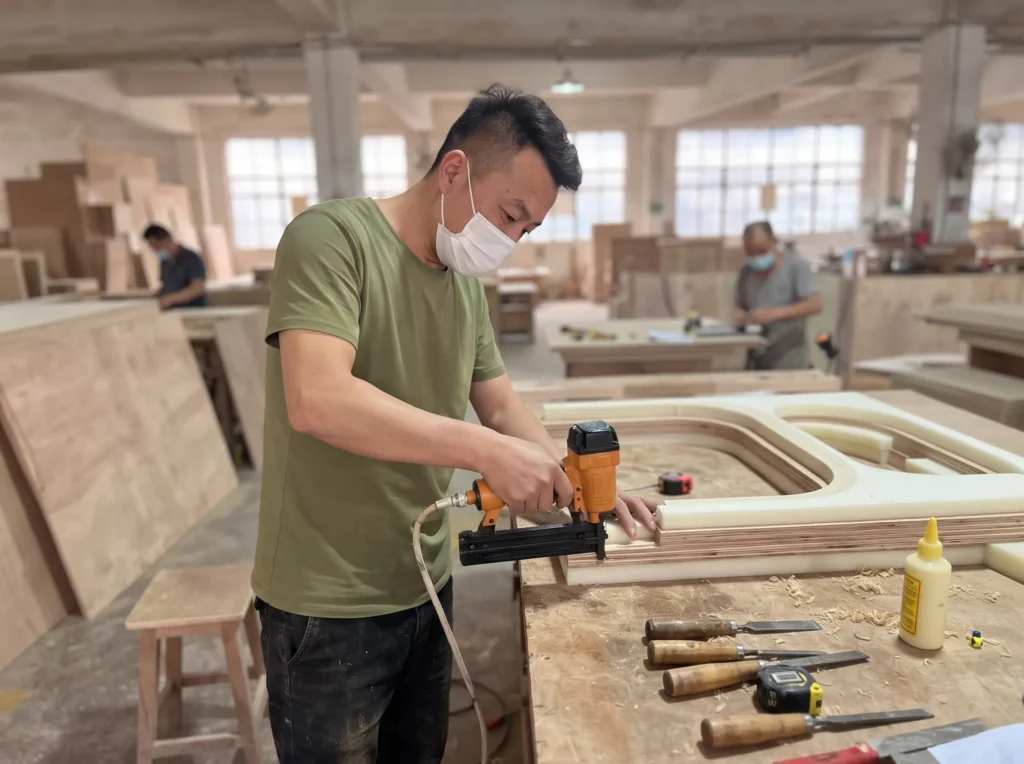
Deconstructing the “Decoupling” Delusion
The popular narrative frames Vietnam as the natural successor to China’s furniture throne. The logic is superficially compelling. Labor costs are lower. The US-China tariff regime punishes direct imports. Vietnam has free trade agreements with major Western markets. But this narrative conflates factory presence with supply chain maturity.
China’s furniture industry did not emerge overnight. It took two decades of clustered specialization — Foshan’s solid wood and upholstery ecosystem, Dongguan’s precision hardware corridor, Longjiang’s raw material markets, the Yangtze River Delta’s textile and foam chemistry base — to build the dense, responsive supplier network that global buyers now take for granted. Vietnam has factories. It does not yet have clusters. And clusters are what determine whether a screw of an unusual thread pitch can be sourced within 48 hours, or whether it must be ordered from a Guangzhou trading company with a three-week ocean freight leg.
What we have observed on the ground — across multiple sourcing trips to Binh Duong, Dong Nai, and the Lang Son / Pingxiang border corridor — is a manufacturing landscape that resembles China’s coastal zones circa 2008. There is ambition, investment, and plenty of assembly capacity. But walk the factory floor and the origin story of the components tells a different tale.
Vietnam vs. China: Component Self-Sufficiency by Category
| Component Category | Vietnam Local Sourcing Capability | Primary China Source Region | Typical China Import Share in Vietnam-Made Furniture |
|---|---|---|---|
| Hardware (slides, hinges, screws, connectors) | Limited; basic fasteners only | Dongguan, Shenzhen, Foshan | 70–85% |
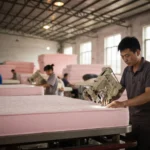
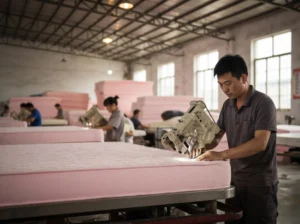
| Upholstery foam (PU, memory foam, high-resilience) | Minimal domestic chemical base; mostly cutting/trimming operations | Foshan, Nanhai, Zhejiang | 65–80% |
| Fabric, leather, synthetic upholstery covers | Some local textile mills; premium and technical fabrics largely imported | Guangzhou, Keqiao, Haining | 50–70% |
| Board materials (MDF, particleboard, plywood cores) | Growing local capacity; high-grade and specialty boards often imported | Guangxi, Shandong, Jiangsu | 40–60% |
| Edge banding, veneer, decorative laminates | Very limited; color-matching and thickness variety poor | Dongguan, Shenzhen | 75–90% |
| Packaging (corrugate, foam inserts, corner protectors) | Basic corrugate available; custom protective packaging often imported | Guangdong, Fujian | 50–65% |
| Production machinery (CNC, edge banders, sewing, spray lines) | Almost entirely imported | Shunde, Dongguan, Qingdao | 85–95% |
| Chemicals (adhesives, finishes, stains, coatings) | Limited formulation capability; raw resin and specialty coatings imported | Jiangsu, Guangdong | 60–75% |
For reference only, subject to official verification.
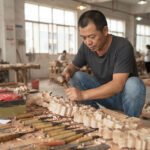
The table above is not an indictment of Vietnamese industry. It is a calibration tool for buyers. When a factory in Thu Dau Mot quotes you a “locally sourced” bedroom set, the probability that the drawer slides were forged in Dongguan, the foam poured in Nanhai, and the edge banding extruded in Shenzhen is extraordinarily high. The Vietnamese value add is cutting, sewing, assembling, and packing. That is real work. But it is not the same as supply chain sovereignty.
Vietnam-Made Furniture: True Value Add vs. China Content
| Cost Segment | Typical Vietnam Value Add | Typical China Content | Notes |
|---|---|---|---|
| Direct labor (cutting, assembly, finishing, packing) | 8–15% of ex-factory cost | — | Labor cost advantage narrowing; annual manufacturing wage growth in Vietnam runs at approximately 7–9% |
| Raw materials and components | 10–20% (local board, basic timber, simple fabric) | 35–55% (hardware, foam, coatings, machinery depreciation) | China content often understated in factory quotes |
| Logistics and cross-border transport | — | 3–8% | Guangxi border congestion, customs inspection variability |
| Factory overhead and margin | 5–10% | — | Often inflated to cover China procurement complexity |
| Effective China supply chain dependency | — | 50–70% of total landed cost | For reference only, subject to official verification. |
This is the arithmetic that procurement teams need to internalize. A dining chair with a “Made in Vietnam” hangtag may have Chinese aluminum, Chinese screws, Chinese foam, Chinese fabric backing, and Chinese packaging materials inside the carton. The Vietnamese contribution is the labor to bend, staple, and sew it together. That labor is cheaper than China’s. But it is not cheap enough to offset the cross-border logistics layer, the inventory carrying cost of dual-country procurement, and the opacity that creeps into BOM tracking when components pass through trading companies in Lang Son or Mong Cai.
The “Passive Exodus”: How Chinese Suppliers Are Reshaping, Not Severing, the Chain
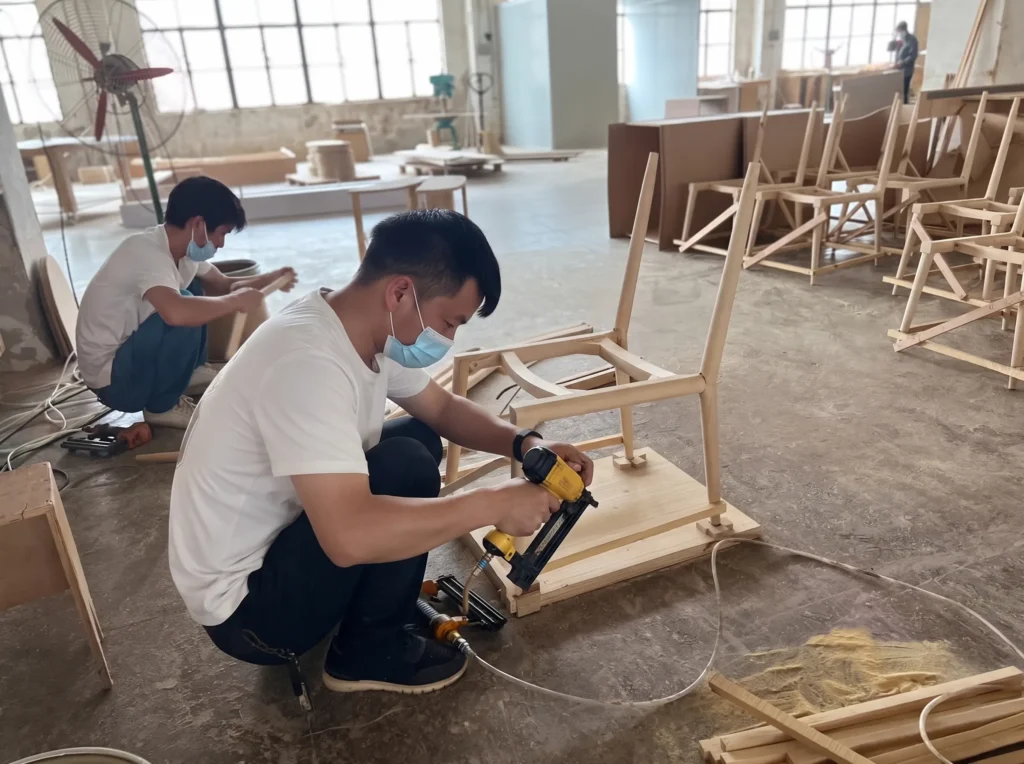
Here is where the story gets more nuanced, and more honest, than the standard “China vs. Vietnam” binary. Chinese component suppliers are not sitting idle while their downstream customers migrate south. They are following them. We have tracked dozens of mid-sized hardware, foam, and machinery trading firms that have opened satellite offices, bonded warehouses, or light assembly operations in Binh Duong and Hai Phong over the past four years.
This is not a supply chain divorce. It is a supply chain relocation of the final mile. The screws are still made on the same Dongguan forging lines. The foam is still poured in the same Foshan reactors. But instead of shipping finished goods to Yantian and sending them across the Pacific, the components now travel by truck through the Friendship Pass or Dongxing border gate, get cleared through Vietnamese customs, and feed into just-in-time assembly lines in Di An or Bien Hoa.
For buyers, this creates a peculiar illusion. Your Vietnamese factory tells you they are “sourcing locally.” Technically, the purchase order is issued to a Vietnamese-registered entity. But trace the ownership, the inventory source, and the technical support phone number, and you often land back in Guangdong province. We call these “border-hopping” supply lines. They serve a practical purpose — they keep Vietnamese factories running. But they do not represent indigenous supply chain development.
Supply Chain Lead Time Comparison: Vietnam Local vs. China Cross-Border
| Procurement Scenario | Nominal Lead Time | Realistic Lead Time with Variance | Primary Risk Factor |
|---|---|---|---|
| Vietnam factory orders standard hardware from Dongguan via sea freight | 18–22 days | 24–32 days | Port congestion at Yantian / Shekou; customs backlog at Cat Lai |
| Vietnam factory orders via Guangxi land border (Pingxiang / Dongxing) | 5–8 days | 8–14 days | Border inspection intensity spikes; informal “border trade” crackdowns |
| Vietnam factory sources from “local” supplier (Chinese-owned Vietnam warehouse) | 2–5 days | 3–7 days | Stock depth limited; emergency reorders still require China lead time |
| Comparable China factory sourcing same component domestically | 2–5 days | 3–6 days | Supplier payment terms; quality dispute resolution |
The land border route through Guangxi is the circulatory system of this dependency. During normal periods, a truckload of drawer slides can clear Pingxiang and reach Binh Duong in under a week. But “normal” is not guaranteed. We have witnessed multi-day queues at the Friendship Pass during customs enforcement campaigns. We have seen Vietnamese factories idle because a critical hardware shipment was held at Dongxing over certificate-of-origin paperwork discrepancies. These are not theoretical risks. They are weekly operational realities.
Hidden Costs of Vietnam Sourcing: What the “Vietnam Premium” Actually Covers
| Cost Category | Typical Impact | Buyer Visibility |
|---|---|---|
| Cross-border trucking and customs brokerage (China → Vietnam) | +3–7% on component cost | Often buried in factory overhead or “materials” line item |
| Dual inventory buffers (safety stock in China + Vietnam) | +5–12% working capital drag | Rarely quoted transparently |
| Quality failure and rework (inexperienced local suppliers) | +2–8% defect cost | Manifests as late delivery or chargebacks, not upfront |
| Origin compliance documentation and audit preparation | +$2,000–$8,000 per shipment for legal/consulting fees | Often underestimated until CBP inquiry arrives |
| Currency and payment friction (VND / CNY / USD triangulation) | +0.5–2% FX spread and wire fees | Absorbed by factory or passed through in vague “admin” charges |
| Supplier development and hand-holding (training local vendors) | Significant buyer personnel time | Never appears on the invoice |
For reference only, subject to official verification.
When we run total cost of ownership models for clients, the “Vietnam savings” on FOB price frequently shrinks to single digits — or reverses into a premium — once these layers are accounted for. This does not mean Vietnam is never the right answer. It means the answer depends on category, volume, and risk tolerance, not on a blanket assumption that Vietnam equals tariff avoidance plus cost reduction.
The Compliance Minefield: Origin Rules, Shell Factories, and Retrospective Risk
This is the section that makes sourcing directors reach for their legal counsel’s phone number.
The United States Customs and Border Protection (CBP) has intensified scrutiny of Vietnam-origin furniture claims, particularly for categories covered by antidumping and countervailing duty (AD/CVD) orders against China. The legal standard is substantial transformation — a genuine change in name, character, and use, with meaningful value added in the claimed country of origin. Assembly alone does not qualify. Neither does repackaging, minor finishing, or the addition of non-substantial components.
Industry observers and legal reports have noted that some Vietnamese facilities appear to operate with Chinese capital, management, or technical control structured through local nominee arrangements. CTPAT alerts and trade law analyses have explicitly cited furniture as a sector where goods may be shipped to Vietnam for light processing or relabeling before export to the United States . The “Vietnamese” factory purchases nearly all inputs from entities in China, adds minimal local labor, and ships finished goods with a Vietnam origin declaration. These arrangements exist in a gray zone that is legally perilous for the ultimate importer.
CBP’s penalty framework is unforgiving. Retroactive duty assessments, loss of preferential tariff treatment, and suspension of importer privileges are all on the table. The cost of a failed origin audit does not stop at the tariff differential. It includes legal fees, supply chain disruption, brand reputation damage, and the operational chaos of redirecting production while under investigation. CBP announced over $400 million in uncovered unpaid duties year-to-date in 2025, underscoring the real risk of penalty rates if origin is misstated .
Beyond the shell-factory risk, there is the simpler problem of component origin aggregation. Even a genuinely independent Vietnamese factory, sourcing openly from Chinese suppliers, must navigate the complex arithmetic of regional value content rules under trade agreements like the EVFTA or CPTPP. If the China-sourced content exceeds thresholds, the finished goods may not qualify for preferential duty rates. Buyers who assumed their Vietnam pivot locked in zero-duty access to Europe or Comprehensive and Progressive Agreement for Trans-Pacific Partnership markets can face nasty surprises at the port of entry.
Vietnam’s Real Trajectory: Growth Without Maturation
We want to be clear-eyed, not dismissive. Vietnam’s furniture export sector is growing. According to VIFOREST and Vietnam Customs, wood and wood product exports reached US$17.2 billion in 2025, an increase of almost 6 percent compared to 2024 . The workforce is young and trainable. The government has welcomed foreign direct investment with tax holidays and industrial zone development. Major retailers are increasing their Vietnam SKU counts. These are real trends.
But growth is not the same as maturation. China’s furniture supply chain advantage rests on decades of accumulated tacit knowledge: the technician in Longjiang who knows why a particular humidity level warps rubberwood during monsoon season; the trading company in Lecong that can source a discontinued hinge pattern from a defunct factory’s remaining tooling; the freight forwarder in Shenzhen who knows which customs broker at Shekou will clear a mixed container of hardware and chemicals without unpacking it. This knowledge is not transferrable via capital investment. It accrues through failure, iteration, and the brutal density of competition.
Vietnam is on that path. It is not there yet. Our assessment, based on repeated site visits and conversations with factory owners on both sides of the border, is that Vietnam’s furniture component ecosystem trails China’s in depth, breadth, and responsiveness. The gap is narrowing in simple categories like basic timber cutting and standard textile sewing. It remains wide in precision metalwork, chemical formulation, automated machinery integration, and the intangible ecosystem of rapid prototyping and design-for-manufacturing feedback loops.
Moreover, some of Vietnam’s headline advantages are eroding. Industrial land in Binh Duong and Dong Nai has risen sharply — market data indicates southern Vietnam industrial land prices have more than doubled since 2019, climbing from roughly USD 100 per square meter to approximately USD 183 per square meter by early 2026 . CBRE Vietnam forecasts continued annual rises of 3–7 percent in the south over the coming three years . Wage inflation in the furniture corridor is running at approximately 7–9 percent annually , with manufacturing workers earning an average of VND 8.4 million monthly as of early 2025 . The government’s enthusiasm for tax-break-driven FDI is cooling as fiscal pressures mount. The “Vietnam discount” is not disappearing, but it is shrinking. Buyers who made location decisions based on early-2020s cost structures may find the 2026 math less compelling.
Actionable Playbooks by Buyer Type
For B2B Bulk Importers and Contract Furniture Specifiers
Your priority is origin defensibility and total cost transparency. Before placing substantial Vietnam volume, conduct a supply chain audit that traces the BOM two tiers deep. Do not accept the factory’s “local sourcing” assertion at face value. Request component-level origin declarations. Build a contingency plan that assumes China-border logistics delays of two to three weeks. And engage a trade compliance attorney to stress-test your origin documentation against CBP’s current enforcement posture. If your annual exposure exceeds seven figures, the audit cost is trivial compared to a retroactive duty bill.
For Brand Owners and Retail Chains
You face the dual pressure of consumer-facing “Vietnam” marketing and backend supply chain reality. Our recommendation: be honest in your internal cost models. Do not let merchandising teams assume Vietnam sourcing delivers a 20% cost reduction without verifying the China-component layer. Consider hybrid strategies — core collections from established Chinese suppliers with transparent pricing, and Vietnam-only SKUs in categories where local content thresholds are genuinely achievable (certain solid wood frames, rattan, and basic upholstery). Avoid the temptation to label everything “Made in Vietnam” when the supply chain story is more complicated.
For E-Commerce and DTC Sellers
Your volumes are smaller, but your agility is higher. Use this to test Vietnam factories with limited SKU pilots before committing to container-load programs. Demand detailed packing lists that itemize component origins. Be especially wary of Vietnam factories quoting prices that seem too close to Chinese FOB levels — this often signals heavy China-component dependency with minimal labor savings. And remember: your end consumer may not care about origin, but customs authorities absolutely do. A CBP hold on your inbound container will hurt your inventory turns regardless of your marketing story.

Frequently Asked Questions
Does “Made in Vietnam” furniture avoid US tariffs on Chinese products?
No. The “Made in Vietnam” label only determines the country of origin for the finished product. If the furniture qualifies as Vietnamese-origin under substantial transformation rules, it may enter the US under standard MFN rates rather than Section 301 punitive tariffs. However, the Chinese components inside it have already been imported into Vietnam — a step that does not trigger US tariffs at the component level. The risk lies in origin compliance: if CBP determines the goods were not substantially transformed in Vietnam, or if the factory is a shell operation masking Chinese production, the shipment can be reclassified as Chinese origin and assessed the full tariff rate retroactively.
How much of a typical Vietnam-made sofa or dining set actually comes from China?
Based on our factory floor observations and BOM reviews across multiple Vietnamese upholstery and case goods facilities, the China content in finished Vietnam furniture typically ranges from 50% to 70% of total ex-factory cost. Hardware, foam, synthetic leather, coatings, and machinery depreciation overwhelmingly trace back to Chinese suppliers. The Vietnamese contribution is concentrated in labor, local timber (where applicable), and basic assembly operations. For reference only, subject to official verification.
Are Vietnamese furniture factories just Chinese factories with a different address?
Not all of them, but industry reports and CBP enforcement alerts indicate that some facilities — particularly in metal furniture, upholstered seating, and ready-to-assemble categories — involve Chinese capital, management, or technical control operating through local nominee structures. These are not inherently illegal if properly structured and disclosed. They become dangerous when they are used to obscure origin, manipulate transfer pricing, or evade AD/CVD duties. A thorough ownership and management background check is standard practice for any serious importer. For reference only, subject to official verification.
Can Vietnam develop its own component supply chain to replace Chinese imports?
In the long term, possibly. In the medium term — the next five to seven years — it is highly unlikely for most categories. Vietnam lacks the petrochemical base for foam and coatings, the precision metalworking cluster for hardware, and the machinery manufacturing ecosystem for production equipment. Some assembly and light processing of these materials will localize. But the core manufacturing of high-value components will remain concentrated in China. The more probable trajectory is continued “passive” Chinese supplier presence in Vietnam — warehouses, trading offices, and light finishing — rather than genuine Vietnamese-owned replacement capacity.
Is it safer to source from Vietnam to avoid antidumping duties on Chinese furniture?
Only if the origin claim is genuine and defensible. Vietnam is itself subject to AD/CVD investigations in several furniture categories, and CBP has explicitly targeted transshipment schemes where Chinese goods are minimally processed in Vietnam to evade duties. The “safety” of Vietnam sourcing depends entirely on the substance of the manufacturing operation, not the geography of the shipping container. Importers who treat Vietnam as a tariff loophole rather than a sourcing strategy are taking on legal risk that can far exceed the duty savings.
What has your Vietnam sourcing experience looked like?
Are you seeing different China-dependency ratios on your factory floor, or have you found component suppliers in Vietnam that buck the trends we have described? Drop your observations or questions below — we read every comment, and the sharpest insights often come from buyers in the field.
Recommended Resource
Interi Furniture specializes in custom furniture manufacturing for residential, hospitality, and commercial projects. Their experience in materials, craftsmanship, and project realization makes them a valuable resource for designers and buyers seeking tailored furniture solutions from China.