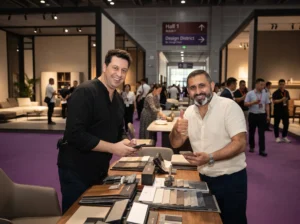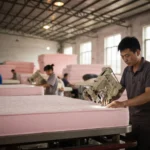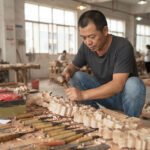


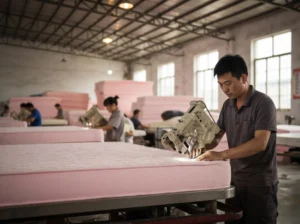

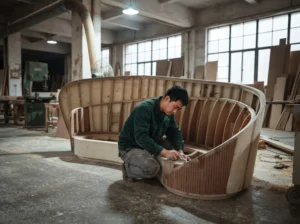
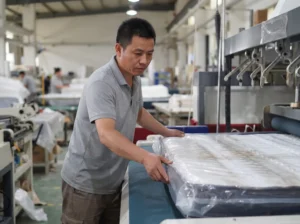


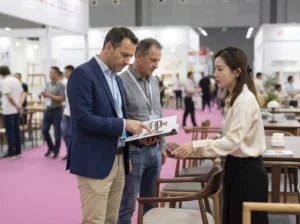

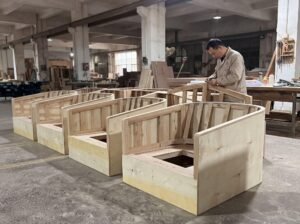

Most buyers walking into CIFF assume the person across the table works for the factory. Often, they do not. Trading companies have refined the art of disguising themselves as manufacturers — with better English, larger booths, and slicker presentations than the real factories they represent. This article delivers seven field-tested red flags that expose a spot trading company CIFF booth before you waste time negotiating prices that already include a hidden middleman markup.
We have walked the halls of CIFF Guangzhou and Shanghai for over a decade. The booths that look the most “professional” are frequently the ones least connected to actual production. Real factories rarely invest in Broadway-level stagecraft. They invest in CNC routers, upholstery workshops, and dust-collection systems. If you know what to look for, the disguise falls apart in under five minutes. The goal is not to villainize trading companies. It is to make sure you know who you are actually talking to before you commit your deposit.
The Real Cost of Mistaking a Middleman for a Manufacturer
The pain point is universal and expensive. You shake hands with a sales rep whose English is flawless. The booth spans sixty square meters with mood lighting, catalogues thick as bricks, and espresso on demand. You sign a purchase order feeling like you have secured factory-direct pricing. Three months later, quality issues surface. The “factory” cannot explain why the joinery failed because they never saw the workshop floor. They are forwarding your angry emails to a third-party producer in Foshan who speaks zero English and cares even less about your brand reputation. Your margin evaporated the moment you mistook a middleman for a manufacturer. Worse, you have lost the ability to fix the problem at its source. Every email now passes through a filter that has a financial incentive to delay bad news.

Why the Flashiest Booths Often Hide the Weakest Supply Chains
Here is the counterintuitive reality that trips up even experienced buyers. Booth size correlates with marketing budget, not production capacity. The most polished fake factory booth presentations at CIFF often belong to trading companies because their entire business model depends on perception management. They rent the premium space, hire bilingual sales teams, and script origin stories about “our 50,000-square-meter facility in Dongguan.” The actual factory owner is back at the plant wondering why his WeChat is blowing up with complaints he never authorized.
Why do they do it? Direct factory relationships threaten trading company margins. When buyers believe they are talking to the source, they accept pricing without questioning the markup layer. The trading company captures the spread while the factory absorbs the QC risk. It is not illegal in most cases. It is simply opaque. And opacity costs you control, traceability, and long-term pricing power.
What Is a “Showroom Company” in the China Furniture Supply Chain?
In the domestic industry lexicon, a showroom company — also called a “马甲工厂” (shell factory) or “展厅公司” — refers to a trading entity that leases exhibition space, builds a branded facade, and poses as a manufacturer. These operators typically do not own production equipment, employ assembly workers, or hold raw material inventory. They source finished goods from multiple actual factories — often through “炒货” (speculative purchasing) or “串馆” (booth-hopping to photograph competitor products) — and consolidate shipments under their own documentation. Their value proposition is not manufacturing expertise. It is packaging and language access. Understanding this distinction is the foundation of every red flag that follows.
What Does “Ex-Factory” Actually Mean at CIFF?
In international trade parlance, “ex-factory” or EXW (Ex Works) pricing means the seller makes goods available at their premises. At CIFF, however, the term gets stretched. Trading companies often quote “factory prices” that are actually their own resale prices. True ex-factory pricing comes from an entity whose business license authorizes manufacturing, whose registered address sits in an industrial zone, and whose staff can walk you through the production process without calling a third party. Anything less is a quotation, not an ex-factory price.

The Seven Red Flags: Trading Company Booth vs. Real Factory Booth
The following signals do not require factory audits or background checks. They are observable in the booth itself, during the first conversation, or through a five-minute smartphone verification. We have used these checks across hundreds of CIFF visits. None are foolproof alone. Together, they form a reliable pattern.
| Red Flag | Trading Company Booth Behavior | Real Factory Booth Behavior |
|---|---|---|
| Product Category Spread | Displays sofas, solid wood dining sets, metal outdoor furniture, and mattresses simultaneously — a supply chain impossibility for a single plant | Focuses on one material family or product vertical; may show limited SKUs but deep customization options |
| Production Knowledge Gap | Sales rep cannot answer workshop-specific questions: CNC cycle times, veneer drying periods, or custom mold development lead times | Staff can walk you through grain patterns, explain kiln schedules, or call the workshop foreman on the spot |
| Pricing Elasticity | Quotes drop significantly under pressure; admits to “negotiating with the workshop” when pushed | Pricing reflects cost rigidity; minor discounts possible but no hidden 15–30% compression room |
| Registration Address | Business card or license shows “Trade,” “Industry,” or “Import/Export” in the name; registered at a commercial office building rather than an industrial zone | License lists manufacturing in the business scope; registered address sits in a recognized furniture industrial cluster |
| Visual Proof | Shows generic factory videos downloaded from the internet, recycled footage from affiliated companies, or showroom-only photography | Offers real-time video calls to the workshop floor or invites immediate on-site verification |
| Factory Visit Evasion | Invites you to a “nearby office” or decorated showroom; deflects immediate workshop tours with excuses about “safety protocols” or “renovation” | Readily coordinates shuttle buses to the actual plant; workshop is often within one-hour drive of the exhibition hall |
| Packaging Traces | Product labels show multiple brand names, inconsistent origin markings, or packaging from unrelated manufacturers | Uniform labeling, consistent inner-carton branding, and traceable batch codes tied to single production lines |
Why Trading Companies Pretend to Be Factories: The Incentive Structure
The incentive structure is not mysterious. It is arithmetic. Trading companies hide their identity because transparency would compress their margins and expose their replaceability. The following breakdown shows how the deception pays.
| Incentive Driver | How It Works | Buyer Impact |
|---|---|---|
| Margin Capture | Trading companies add 15–35% markup (For reference only, subject to official verification) while presenting prices as “factory direct” | You pay above true ex-factory cost without realizing negotiation leverage exists at the source |
| QC Shielding | The factory handles defects; the trading company filters communication, often delaying or diluting accountability | Quality failures get lost in translation; you cannot pressure the actual producer directly |
| Volume Consolidation | One trading company aggregates small orders across multiple factories to hit container-minimum thresholds | You lose visibility into which plant made which batch, complicating traceability |
| Relationship Lock-In | By positioning as the sole contact, the trading company becomes indispensable, making supplier switching costly | Your supply chain flexibility erodes; you are tethered to an intermediary with no production assets |
Cost Impact: What the Middleman Layer Actually Costs You
The middleman layer is not a rounding error. Over a multi-container annual program, the cumulative cost of unidentified trading company markups can reshape your P&L. The table below compares direct factory economics against typical layered pricing.
| Cost Category | Direct Factory Pricing | Trading Company Layered Pricing | Typical Delta |
|---|---|---|---|
| Ex-Works Unit Price | Base material + labor + overhead + thin factory margin | Base cost + trading company markup + consolidation fee | 15–30% higher (For reference only, subject to official verification) |
| Customization Surcharges | Mold fees, color-matching costs, and engineering time passed through at cost | Markups applied to every custom request; “development fees” inflated | 20–50% higher on NRE (For reference only, subject to official verification) |
| QC and Rework | Direct negotiation with factory; rework absorbed or split based on contract | Trading company adds coordination fees; disputes drag across three parties | Time cost + 5–10% administrative overhead (For reference only, subject to official verification) |
| Long-Term Price Trends | Factory pricing tracks raw material indexes and wage inflation transparently | Trading company pricing is opaque; adjustments lag or overshoot market reality | Unpredictable; harder to forecast COGS |
Verification Tactics: On-the-Spot Checks That Work
Theory means nothing without execution. These are the exact questions we ask, the exact stalling tactics we listen for, and the exact responses that separate real factories from polished intermediaries.
| On-the-Spot Check | What to Ask | What a Real Factory Will Do | What a Trading Company Will Do |
|---|---|---|---|
| Real-Time Video Verification | “Can we WeChat video your workshop right now?” | Foreman answers within minutes; shows active production lines, raw material stacks, or current orders | Stalls; claims “the boss is not there” or sends a pre-recorded video from six months ago |
| Custom MOQ Probe | “What is your true MOQ for a completely new frame design with custom fabric?” | Gives specific numbers tied to cutting tables, foam-block sizes, or minimum veneer lot requirements | Gives vague ranges or promises “we can check with the factory” — admission they do not control production |
| License Inspection | “May I photograph your business license?” | Produces the original document; scope includes “manufacturing” or “production” | Shows a copy; scope emphasizes “trading,” “sales,” or “import/export”; may resist photography |
| Workshop Address Cross-Check | “Type the factory address into Baidu Maps and show me the satellite view” | Confirms industrial zone location with large roof footprints, loading bays, and adjacent supplier clusters | Address resolves to a commercial high-rise, residential complex, or shared office suite |
| Spontaneous Visit Request | “I have a car tomorrow morning. Can we drive to the plant?” | Coordinates immediately; offers factory shuttle or clear directions | Creates friction: “The factory is far,” “They are renovating,” or pushes a showroom tour instead |
High-Risk Warning Signs That Should Kill the Deal
The most expensive mistake is not recognizing a trading company. It is signing with one while believing you have factory-direct control. When a sales rep drops phrases like “自有工厂” (own factory), “一手货源” (first-hand supply), or “工厂直供” (factory direct supply) without verifiable proof, your alarm bells should ring. These terms are standard script elements in the trading company playbook. They cost nothing to say and mean nothing without documentation.

Another trap is accepting a factory address you cannot independently verify. A real manufacturer in Foshan Shunde or Dongguan Houjie sits in a district where every other building is a furniture plant. If the address traces to a downtown office tower, you are not dealing with the source. Similarly, refusing to demand real-time video or on-site verification before placing a deposit leaves you exposed. The cross-category display is equally telling. No single factory runs upholstery lines, solid wood milling, metal powder-coating, and mattress foam-pouring under one roof. When you see that breadth, you are looking at a curator, not a creator.
The final red line is accepting “cooperative factory” language as equivalent to ownership. Cooperation means sourcing. Ownership means control. Do not confuse the two.
Audience-Specific Playbooks
For High-Volume B2B Importers
Your leverage is order size. Demand the ex-factory address before the second meeting. Cross-reference it with satellite imagery and our Foshan furniture market guide to confirm industrial zone authenticity. Insist on WeChat video verification during production hours — not staged footage, but a live walkthrough where you choose which workshop section to view. Build your negotiation around the assumption that a middleman layer exists until proven otherwise. If the booth representative cannot produce original manufacturing licenses or deflects custom engineering questions, treat their pricing as negotiable downward by at least twenty percent. That gap is your margin. You should also request the export declaration copy from the last shipment and cross-check it against our China furniture export compliance guide for documentation standards. The exporting entity name on that document reveals who actually holds the factory registration.
For Mid-Size Retailers and E-Commerce Sellers
You are the sweet spot trading companies target — big enough to place recurring orders, small enough to lack onsite China presence. Your defense is documentation discipline. Photograph every product label in the booth. Check for inconsistent branding or multiple origin stickers. Ask for the factory name that will appear on the export declaration, then search that exact name on Chinese corporate registry platforms using our supplier verification checklist as a reference framework. If it differs from the booth company, you have uncovered a China fair middleman structure. Never accept “we have cooperative factories” as a substitute for “we own the production line.” For Amazon and Wayfair sellers, this distinction matters even more. A trading company switching sources between orders can create listing violations if dimensions, materials, or certification documents shift without warning.
For Individual Buyers and Independent Interior Designers
Your vulnerability is lower order volume and limited sourcing experience. Trading companies know you cannot justify a dedicated China trip. Counter this by joining buyer groups or hiring local sourcing agents with manufacturing backgrounds — not translators, but former factory QC managers who can read workshop conditions. If you must buy direct at CIFF, focus on single-category booths with modest presentations. The factory with twenty chairs and a stack of fabric swatches is often more authentic than the palace showing everything under the sun. Avoid the glamour. Look for the grime. Real production leaves sawdust on the floor samples.

Frequently Asked Questions
How Common Are Trading Companies Disguised as Factories at CIFF?
The practice is widespread. For reference only, subject to official verification, industry observers estimate that a significant portion of booths presenting as manufacturers at CIFF are operated by trading entities, particularly in composite furniture halls where product breadth attracts generalist buyers. The disguise has matured into an ecosystem: booth designers, English sales trainers, and scripted origin stories are available as turnkey services. We have seen business card templates sold specifically for “factory impersonation” at peripheral trade shows. This is not fringe behavior. It is mainstream.
Is Every Trading Company at CIFF a Scam?
No. Trading companies perform legitimate functions — consolidation, language bridging, and small-order aggregation. The problem is misrepresentation. When a buyer believes they are negotiating with the factory owner, they accept pricing and terms that assume zero intermediary markup. That information asymmetry erodes margin and control. We do not condemn the trading model. We condemn the costume. A trading company that discloses its role and charges a transparent service fee can be a valuable partner. One that hides inside a manufacturer’s skin is extracting rent from your ignorance.
Can I Still Get Good Prices from a Trading Company?
Sometimes. If your order volume is below a factory’s minimum threshold, a trading company may secure better unit economics through batch consolidation. However, you should know what you are buying. Transparent trading companies exist — they openly state their role and charge a disclosed service fee. The danger lies in the ones that hide inside a fake factory narrative. If you choose to work with a disclosed intermediary, negotiate the service fee separately from the product cost. That way you know exactly what you are paying for logistics and language support versus manufacturing.
What Should I Do If I Discover the Booth Is a Trading Company Mid-Negotiation?
Do not walk away in anger. Use the discovery as leverage. Their pricing now has visible compression room. Ask directly: “Which factory actually makes this? What is the ex-factory price before your layer?” If they refuse transparency, you have your answer. If they disclose the source factory, you now have a direct lead to verify independently. Either way, you have improved your position. Remember: in China furniture sourcing, information is currency. The moment you know who really owns the production line, you hold the stronger hand.

Share Your CIFF War Stories
Have you ever sat across from a CIFF booth rep and realized, mid-conversation, that you were talking to a middleman? Or pulled off a last-minute workshop visit that exposed the truth? Drop your story in the comments — we read every one. If you are heading to CIFF next season and want us to look at a specific booth setup or verify a supplier license, tell us what you are seeing. We will give you the honest read.
Recommended Resource
Interi Furniture specializes in custom furniture manufacturing for residential, hospitality, and commercial projects. Their experience in materials, craftsmanship, and project realization makes them a valuable resource for designers and buyers seeking tailored furniture solutions from China.