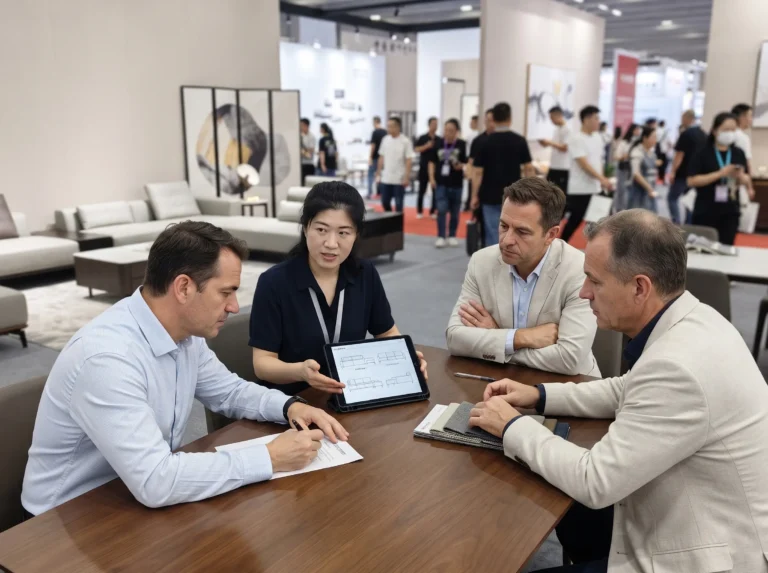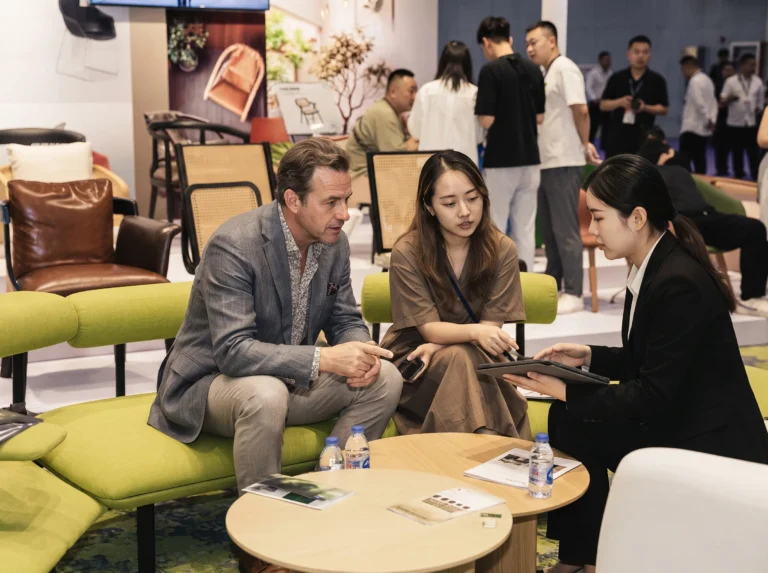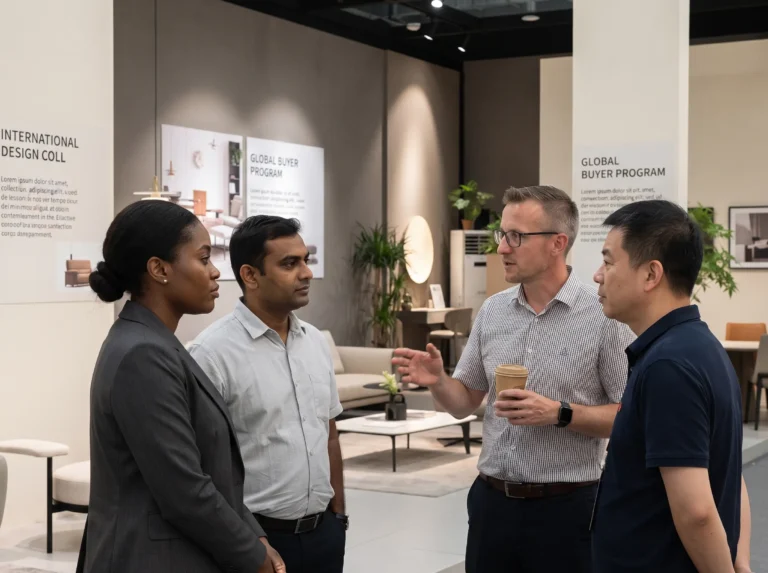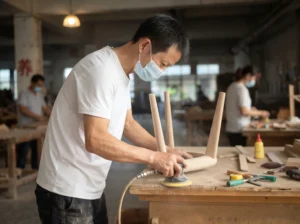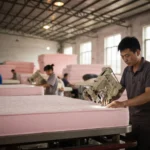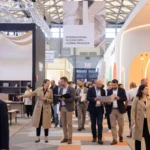
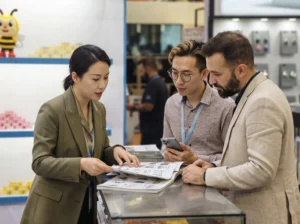



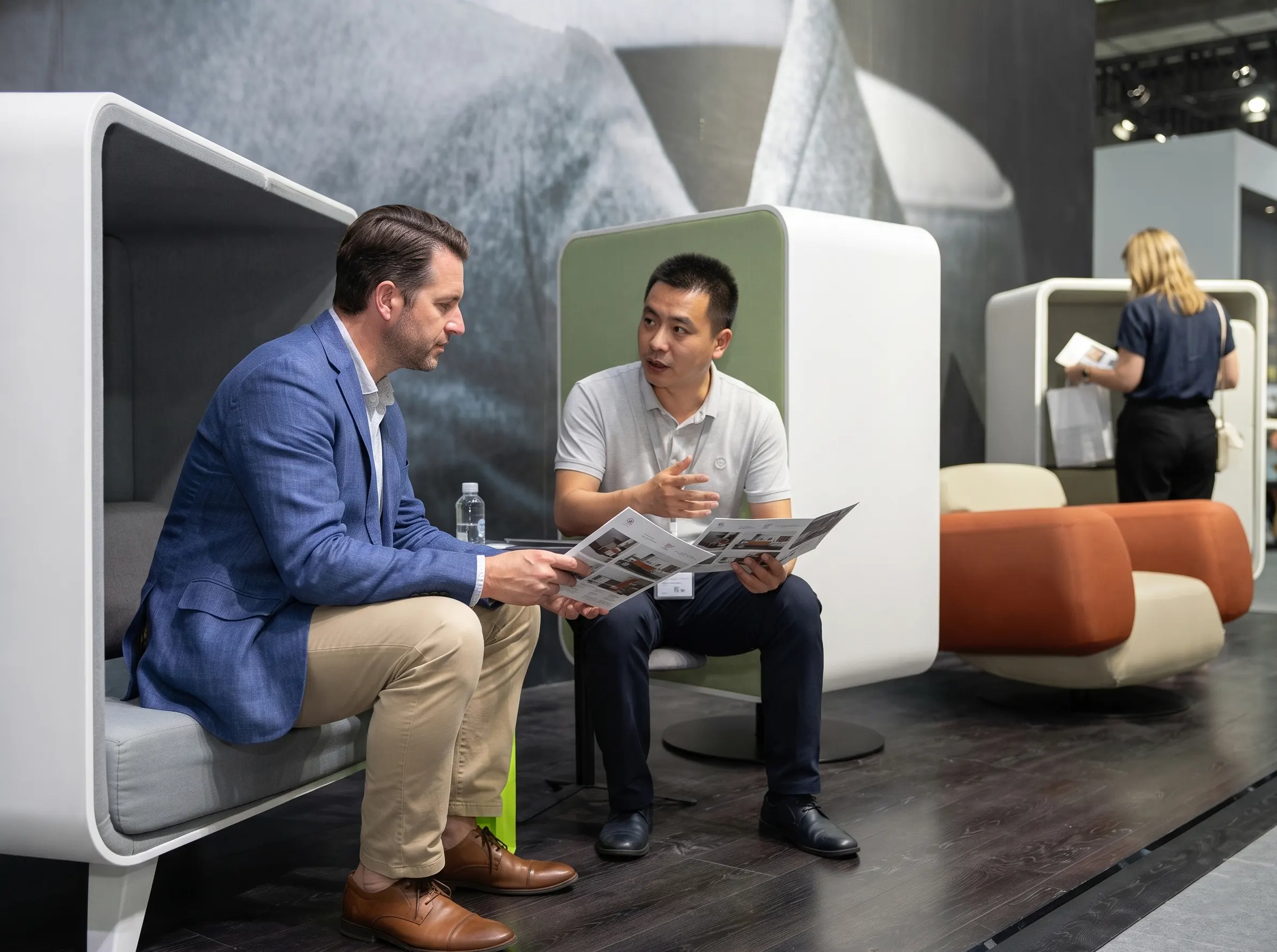
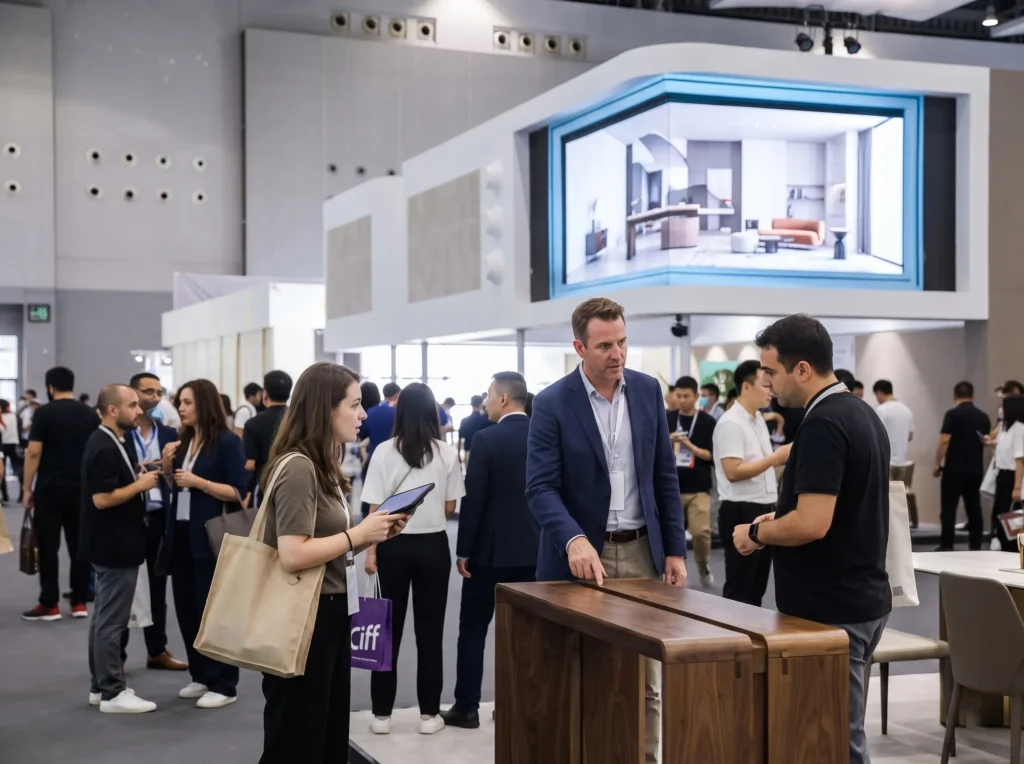
That polished CIFF booth with the smiling sales team and the “Factory Direct” banner might be a rental. Showroom borrowing — where traders, middlemen, or shell companies lease or share factory exhibition space to pose as direct manufacturers — is a persistent gray-zone practice at China’s largest furniture fair. It is not a fringe scam. It is structural. And it costs buyers anywhere from fifteen to forty percent in hidden markup while eroding quality control and voiding warranty claims. This guide gives you a thirty-second field protocol to spot a borrowed booth before you hand over a deposit.
We have walked the halls of CIFF Guangzhou and CIFF Shanghai for over a decade. We have sat in factory break rooms in the Foshan Lecong furniture market and Dongguan Houjie and heard owners admit, off the record, that they quietly lease booth space to traders to absorb excess capacity without diluting their own brand. If you are attending CIFF for the first time, our first time CIFF guide maps the seventeen mistakes that mark you as a tourist. For a deeper look at supplier verification beyond the exhibition hall, see our guide to spotting fake factory certificates. What follows is not theoretical. It is what we have seen, what buyers have reported, and what the data — where it exists — supports.
The Showroom Borrowing Ecosystem: What Most Buyers Miss
Most buyers assume that a CIFF exhibitor badge equals factory ownership. That assumption is expensive. Understanding how CIFF showroom borrowing scam networks operate is the first step toward protecting your procurement budget.
What Is Showroom Borrowing?
Showroom borrowing is the practice of a non-manufacturing entity — typically a trading company, export agent, or shell firm — obtaining the right to use a factory’s CIFF booth, product samples, and branding materials during the fair. The arrangement can be formal, with revenue sharing between the factory and the borrower, or informal, with a simple cash payment for booth access. The borrower then presents themselves as the factory’s direct sales arm, overseas branch, or “strategic partner.” In reality, they are a middleman inserting themselves into your supply chain with zero production capability.
This differs from a fully fabricated scam. The products on display are often real. The factory exists. The deception lies in who is standing across from you at the negotiation table.
How Showroom Borrowing Works: The Full Scam Chain
| Stage | Actor | Action | Buyer Risk |
|---|---|---|---|
| Booth Acquisition | Trading company or shell firm | Pays factory for booth rights, or uses a shared subsidiary license | Buyer assumes they are talking to the manufacturer |
| Brand Packaging | Borrower | Prints new business cards, creates a matching website, adopts factory product photos | Identity verification fails because materials look authentic |
| Floor Performance | Hired sales team | Recites factory specs, offers “exhibition pricing,” pushes for same-day deposit | Emotional pressure overrides due diligence |
| Order Capture | Borrower | Collects deposit, issues invoice under borrower name, not factory name | Contractual recourse points to a shell company |
| Production Handoff | Factory (unaware or complicit) | Receives order from borrower at wholesale price, produces goods | Buyer loses QC oversight and direct communication |
| Delivery & Margin | Borrower | Marks up factory price by 15%–40%, ships goods, pockets spread | Buyer overpays without knowing true factory cost |
For reference only, subject to official verification: Our industry contacts in the Foshan Lecong furniture market estimate that roughly eight to fifteen percent of CIFF booths in the mid-tier furniture halls involve some form of shared or borrowed representation. CIFF’s official exhibitor list does not publicly distinguish between direct factory exhibitors and authorized agents, and the association-company loophole — where a trading firm and a factory share the same registered address or legal representative — renders standard business-registry checks inconclusive.
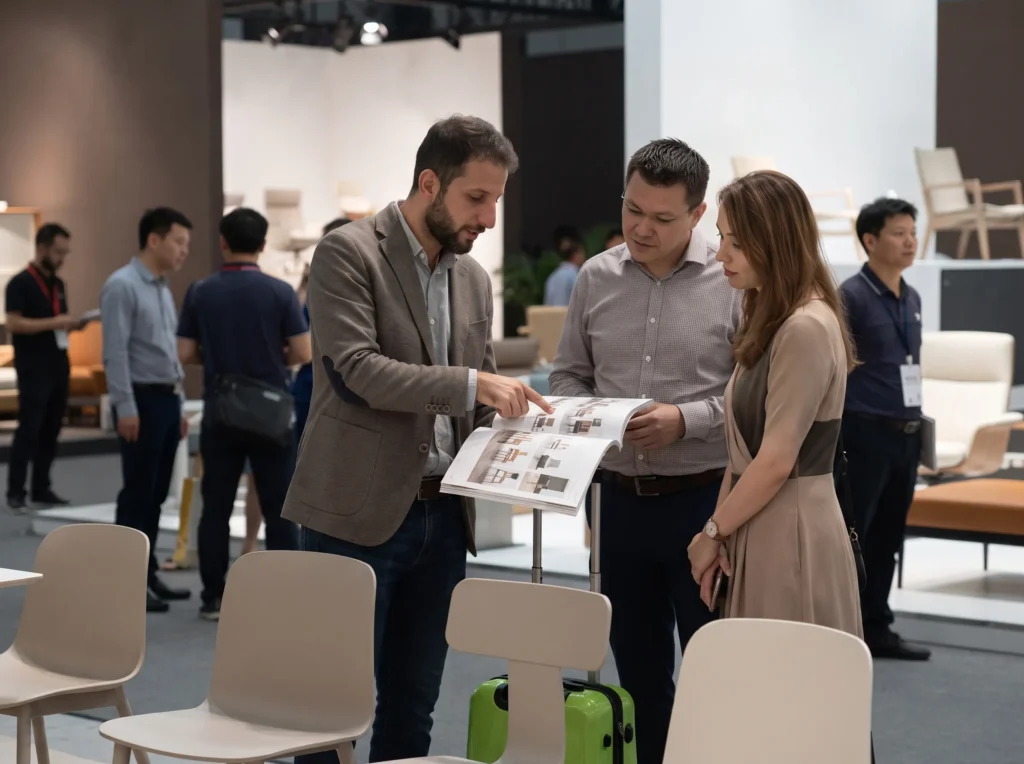
The 30-Second Spotter: Field Clues That Expose a Borrowed Booth
You do not need Mandarin fluency or a private investigator to spot a borrowed booth. You need thirty seconds of disciplined observation.
The 30-Second Spotter: Visual, Verbal, and Document Clues
| Category | Red Flag | What to Look For |
|---|---|---|
| Visual | Name mismatch | Booth header displays one company name; business cards show another, or a vague “Group” umbrella |
| Visual | Product overreach | Single booth claims to manufacture solid wood, upholstery, metal, and glass — a real factory specializes |
| Visual | Staff detachment | Salespeople cannot describe the factory layout, machinery type, or production flow |
| Verbal | Evasive answers | “We have several factories” or “Our partner handles production” without named addresses |
| Verbal | Pricing opacity | Refusal to break down FOB pricing into material, labor, and overhead components |
| Verbal | Rush tactics | “This price is only valid if you sign today” — a classic pressure move to prevent verification |
| Document | License gap | Business license shows a trading company registration, not a manufacturing license |
| Document | Name game | Invoice preview shows a payee name different from the booth name or the factory name |
| Document | Missing media | No factory video, no production floor photos, or only generic stock imagery |
We always tell buyers to trust their gut when the story feels too smooth. A real factory owner or factory-employed sales manager will talk about kiln-drying schedules, veneer matching, and CNC tolerances with granular pride. A borrowed-booth salesperson will pivot to MOQ flexibility and payment terms because that is what they actually control.
Real Factory Booth vs. Borrowed Booth: A Side-by-Side Breakdown
The differences are subtle but consistent once you know where to look.
| Checkpoint | Real Factory Booth | Borrowed Booth |
|---|---|---|
| Booth branding | Company name matches factory registration exactly; often includes factory photos or QR codes to production video | Generic “Group” or “International” suffix; logo looks freshly designed for the fair |
| Product range | Narrow and deep — maybe three to five closely related categories with visible engineering consistency | Broad and shallow — ten categories with no design DNA connecting them |
| Staff knowledge | Can name machinery brands, describe finishing processes, explain raw material sourcing regions | Speaks in generalities; defers technical questions to “our engineer” who is never present |
| Sample quality | Consistent joinery, hardware, and finish across all pieces; minor imperfections suggest real production, not showroom perfection | Flawless samples that look hand-selected or even sourced from multiple suppliers |
| Pricing structure | Willing to itemize material, labor, overhead, and margin; negotiates on volume, not on mystery | Flat “package pricing” with limited transparency; heavy emphasis on deposit timing |
| Documentation | Readily shows manufacturing license, environmental compliance cert, and factory audit reports | Produces trading licenses, vague “partnership agreements,” or promises to send documents later |
| Follow-up offer | Invites you to visit the actual factory, often within driving distance of the fair venue | Resists factory visits, suggests hotel meetings, or offers to “arrange a tour next time” |
The Financial Hit: What Showroom Borrowing Actually Costs You
The markup is only the beginning. The real damage is structural.
Financial Impact: What Borrowed Booths Cost You
| Cost Category | Typical Impact | Mechanism |
|---|---|---|
| Hidden markup | 15%–40% above true factory price | Borrower acts as silent intermediary, adding margin without adding value |
| QC failure | 10%–25% defect rate increase | Borrower lacks technical staff to supervise production; factory prioritizes direct clients |
| Warranty void | Near-total loss of after-sale support | Borrower disappears post-shipment; factory denies responsibility for terms promised by middleman |
| Timeline slippage | 2–6 week delays | Borrower has no production scheduling authority; factory bumps borrowed orders during peak season |
| Legal recourse | Minimal | Contract is with a trading shell, not the asset-backed manufacturer; cross-border enforcement is costly |
For reference only, subject to official verification: Buyers who discover they have signed with a borrowed-booth middleman rather than the factory itself report average recovery rates of less than twenty percent on disputed deposits, based on feedback we have collected from independent sourcing consultants and trade-law practitioners in the Pearl River Delta.
Red Flags and Hard Lines: When to Walk Away
Recognizing a fake factory booth CIFF setup requires looking past the surface polish. Some signals are not just suspicious. They are disqualifying.
If the salesperson cannot produce a business license that lists “manufacturing” as the primary business scope, stop. If the name on the invoice preview differs from the name on the booth header, stop. If you are pressured to pay a deposit in a hotel lobby, a restaurant, or via a mobile payment QR code instead of through a verified corporate account, stop. If the “factory” claims to produce everything from solid oak dining sets to Italian leather sofas to outdoor aluminum furniture under one roof, stop. Real factories have real constraints. Borrowed booths sell fantasies.
We also advise buyers to avoid any booth where the staff changeover is abrupt — where the person you spoke with on day one is replaced on day two by someone who has never heard of your conversation. That is often a sign of rotating freelance sales crews hired specifically for the fair, a hallmark of borrowed-booth operations.
While not every borrowed booth qualifies as a CIFF trade show scam, the financial damage to buyers is functionally identical.
Verification Playbook by Buyer Type
Not every buyer has the same risk profile or the same verification bandwidth. Here is how we break it down.
For Individual Buyers and First-Time Attendees
Your priority is speed and simplicity. Snap a photo of the booth header and the salesperson’s business card. Ask for the factory’s full Chinese legal name and its city of registration. Cross-check that name against the booth number on the CIFF official exhibitor list before you leave the hall. If the names do not align exactly, treat it as a borrowed booth until proven otherwise. Do not pay any deposit at the fair. Take the quote, sleep on it, and verify through a factory audit service or a trusted local contact before wiring funds.
For Small-to-Medium Importers and Retailers
You have volume leverage. Use it. Demand a factory visit as a non-negotiable precondition to any order above your minimum threshold. Ask to see the production line for the specific SKU you are considering. Request a video call from the factory floor, not from a showroom. Insist that the contract and the invoice name the manufacturing entity, not a trading intermediary, and that the factory chops the contract with its official seal. If the other party hesitates on any of these points, you are almost certainly dealing with a borrower.
For Interior Designers and Project Procurement Managers
Traceability is your currency. You need to certify the supply chain for client liability and BIFMA compliance standards. A borrowed booth breaks that chain. Require a signed letter from the factory — not the booth operator — confirming that the products meet your specified material standards and that the factory assumes direct warranty responsibility. If the booth representative cannot produce that letter on the spot, the booth is borrowed. Full stop.

Frequently Asked Questions
Can CIFF itself prevent showroom borrowing?
CIFF requires exhibitors to submit business licenses and product scope documentation during registration. However, the system does not reliably catch affiliated companies, newly registered shell firms with valid licenses, or last-minute personnel substitutions during the fair. The review mechanism has improved in recent years, but the gray zone persists. For reference only, subject to official verification: Our conversations with long-time exhibitors suggest that booth transfers and shared representations remain common in the secondary halls and during the final days of booth allocation.
Is showroom borrowing illegal?
Not necessarily. If the factory consents to the arrangement and the borrower holds a valid business license, the practice sits in a legal gray area rather than outright fraud. The scam element arises from the deliberate misrepresentation to buyers — presenting a trading company as a direct manufacturer. That misrepresentation can constitute contractual fraud under Chinese law, but enforcement across borders is difficult and expensive.
How can I verify a factory’s booth ownership before the fair?
Contact the factory directly through its official website or Alibaba/TMIC storefront — not through the contact on the CIFF exhibitor list — and ask for its booth numbers. A real factory will know. A borrowed-booth operator will either evade the question or give you a number that does not match. You can also search the factory’s Chinese legal name on Tianyancha or Qichacha to see if the registered address matches the booth operator’s address.
What should I do if I already paid a deposit to a borrowed booth?
Document everything. Screenshot the booth, save the business card, and preserve all chat records and payment receipts. If the invoice was issued by a trading company, you may have a misrepresentation claim. Engage a Chinese trade lawyer or a sourcing agent with legal backup in the factory’s home city. Speed matters. The longer you wait, the higher the chance the shell company dissolves or the borrower simply stops responding.
Are all multi-category booths at CIFF fake factories?
No. Some large furniture groups operate multiple specialized factories under one holding company and legitimately display across categories. The difference is transparency. A legitimate group will name each factory, show you separate production facilities, and issue contracts from the specific manufacturing entity responsible for your product line. A borrowed booth will hide those distinctions behind vague “Group” language.
We have shared what we know. Now we want to hear from you. Have you walked into a CIFF booth and sensed something was off? Did you spot a name mismatch, dodge a pressure deposit, or recover from a borrowed-booth nightmare? Drop your story or your specific booth verification question below. We read every comment, and we use them to keep this guide honest, sharp, and actually useful.
Recommended Resource
Interi Furniture specializes in custom furniture manufacturing for residential, hospitality, and commercial projects. Their experience in materials, craftsmanship, and project realization makes them a valuable resource for designers and buyers seeking tailored furniture solutions from China.