




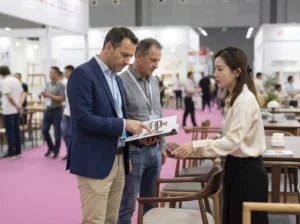

If you are reading this before noon on your first day at CIFF, put your wallet away. The window between 9:30 AM and 12:30 PM on opening day is statistically the most dangerous three hours for your procurement budget. Sales teams train for this slot. Buyers arrive jet-lagged, overstimulated, and without market baseline pricing. That cocktail produces more non-refundable deposits than any other period in the furniture fair calendar. We have walked the Pazhou and Hongqiao halls for over a decade, and the pattern never changes. The buyers who pay before lunch on day one are the buyers who email us three months later asking how to get their money back.
The Anxiety You Are Feeling Right Now Is Manufactured
You have been in Guangzhou for maybe fourteen hours. The humidity hit you at the airport. You slept four hours, drank hotel coffee that tastes like cardboard, and stepped into a hall with ten thousand booths screaming for your attention. Every second salesperson has already told you this is the “best price of the fair.” Another one showed you a WeChat screenshot of a “competitor from Miami” who supposedly wired a deposit an hour ago. Your heart rate is up. You are worried that if you walk away, the SKU you want will be gone by tomorrow.
That feeling is not accidental. It is the product of a carefully orchestrated sales rhythm designed specifically for the first morning. The CIFF payment traps we are about to break down do not rely on obvious fraud. They rely on your own enthusiasm, your fear of missing out, and your assumption that a booth badge equals a guarantee.
The “Day One Special” Is Usually a Mirage
Here is the industry truth that booth staff will never tell you. The “first-day exhibition price” is, in the majority of cases we have observed across Foshan and Dongguan supply chains, not a special price at all. It is the standard Alibaba MOQ quote with a red sticker slapped on it. In some cases, it is higher than the factory’s online listing because the booth cost — easily six figures RMB for a modest space at Pazhou — needs to be amortized across fewer orders.
Buyers assume that day one unlocks some secret tier of pricing. It does not. What it unlocks is a sales script honed through pre-fair training sessions where teams rehearse urgency lines, practice fake phone calls to create social proof, and coordinate “last piece” theatrics with neighboring booths. For reference only, subject to official verification: our conversations with multiple factory owners in Shunde and Houjie suggest that the actual “best price” of the year is typically negotiated in the factory showroom, three weeks after the fair ends, when order books are thin and rent is due.
The Day One Trap: How It Works Minute by Minute
The first morning operates on a precise timeline. Understanding the choreography is the first step to resisting it.
| Time Window | Sales Team Action | Buyer Mental State | Risk Level |
|---|---|---|---|
| 8:30–9:30 AM | Pre-shift huddle. Scripts distributed. “Early bird” badges pinned. Energy drinks consumed. | Still navigating the hall. Caffeine not yet absorbed. Low alertness. | Medium |
| 9:30–10:30 AM | First wave engagement. Aggressive greeting. Immediate catalog thrust. “We already sold two containers this morning.” | Fresh optimism. First impressions forming. Still comparing aesthetics, not terms. | High |
| 10:30–11:30 AM | Social proof escalation. Fake phone calls. Fake WeChat voice messages played on speaker. “Your market competitor just left.” | Anxiety builds. Fear of missing out peaks. Cognitive load maxes out from hall noise and visual overload. | Critical |
| 11:30 AM–12:30 PM | Lunch deadline pressure. “My manager leaves at 12:30.” “The price dies when I eat.” Physical blocking of exit path. | Decision fatigue sets in. Blood sugar drops. Flight response competes with sunk-cost feeling of time already invested. | Extreme |
| 12:30–2:00 PM | Shift change. Afternoon team takes over with softer scripts. Morning “special” miraculously extended. | Relief mixed with confusion. Some buyers return to pay, believing they “got away with something.” | High |
This schedule is not speculation. We have sat in the aisles with coffee and watched it repeat across dozens of booths in Hall 9.2 and the modern furniture zones. The 11:30 AM lunch deadline is the kill shot. Sales staff know that a buyer who has invested ninety minutes in negotiation feels psychologically committed. Walking away feels like wasting the morning. Paying feels like closure.
Psychological Triggers: Why Buyers Fold Before Lunch
The mechanics are not magic. They are applied behavioral economics, executed by people who have never read Kahneman but intuitively understand loss aversion.
| Trigger | How It Is Deployed at CIFF | Why It Works on Day One Specifically |
|---|---|---|
| Scarcity | “Only two production slots left for October.” “This fabric discontinues next week.” | Buyers have no way to verify inventory depth. They have not yet visited enough booths to know the fabric is standard across twenty suppliers. |
| Social Proof | WeChat screenshots of “orders from your country.” Colleagues pretending to be busy with paperwork. | Jet lag and unfamiliarity reduce skepticism. The hall feels like proof that everyone is buying, so you should too. |
| Loss Aversion | “Tomorrow the price goes back up 20%.” “You will pay the booth price, not the factory price.” | Buyers mentally anchor to the quoted number and treat walking away as an active loss, not a neutral non-event. |
| Authority | “I am the boss. I can decide now.” “My brother owns the factory.” | First-time buyers cannot distinguish between a sales rep and an owner. The title “boss” is used loosely in booth culture. |
| Cognitive Fatigue | Rapid-fire SKU switching. Math done on scrap paper. Multiple “options” presented simultaneously. | Long-haul flight residue plus hall noise plus heat equals depleted executive function. Impulse replaces analysis. |
The combination of these triggers before lunch is lethal because your brain has not yet calibrated to the fair. You do not know what a fair price is. You do not know which factories are real and which are trading companies renting a booth. You do not know that the “brother” who owns the factory is actually a cousin who sublets workshop space. You are flying blind, and the sales team knows it.

Payment Methods and Their Risk Levels at CIFF
Not all payment routes carry the same danger. The problem is that the riskiest methods are also the fastest, and speed is exactly what day-one sales scripts demand.
| Method | Typical Day-One Context | Risk Level | Why |
|---|---|---|---|
| Cash (RMB or USD) | “We give extra 5% off for cash.” “No receipt needed, save tax.” | Extreme | No paper trail. No contract. Often goes into personal pocket. Recovery is functionally impossible. |
| Personal WeChat / Alipay QR | Scan code at booth. Payment clears instantly. | Extreme | Account holder is often not the booth-registered company. We have seen QRs belonging to sales reps’ personal accounts, “friend’s” accounts, or unrelated shell companies. |
| Company Bank Transfer (TT) | Sales provides PI with company chop. Buyer initiates wire from hotel. | High-Medium | At least there is a company name. But the PI may lack English terms, delivery clauses, or refund conditions. The account name should match the booth license exactly. |
| Western Union / MoneyGram | “Fast and no bank fees.” | High | Irreversible. Favored by fly-by-night operators who disappear after the fair. |
| Credit Card | Rare at CIFF. Some large exhibitors accept it. | Medium-Low | Chargeback protection exists, but many Chinese furniture vendors resist card payments due to fees and documentation requirements. |
| Letter of Credit | Almost never offered for day-one “deposits.” | Low | Not practical for spot orders, but the safest structure for confirmed container loads negotiated post-fair. |
The pattern is clear. The methods that feel most convenient in the moment — scan a QR code, hand over a stack of hundreds — are the ones that leave you with the least recourse. We have inspected booth receipts that lack company stamps, legal addresses, or even product descriptions. A scrap of thermal paper with a number on it is not a contract. It is a souvenir.
Safe vs. Unsafe Commitments: What You Can and Cannot Do on Day One
You do not need to be paranoid. You need to be protocol-driven. There are things you can safely do on day one. Paying a deposit is not one of them.
| Unsafe on Day One | Safe on Day One |
|---|---|
| Paying any form of deposit, “intent fee,” or “lock-price fee” before 12:30 PM | Collecting business cards and verifying booth license numbers against the CIFF exhibitor directory |
| Accepting “cash only” or “personal account” collection methods | Photographing product labels, catalog pages, and booth numbers for later cross-referencing |
| Signing a Memorandum of Understanding (MOU) or “intent letter” that lacks English text, legal entity details, or dispute resolution clauses | Ordering physical samples with clear written sample terms (cost, refundability, shipping timeline) |
| Agreeing to “verbal price locks” or handshake deals | Scheduling factory visits for later in the week to verify production capacity and showroom inventory |
| Reacting to “booth is closing / sample is last piece” pressure without verification | Building a comparison matrix of SKUs, MOQs, and quoted prices across at least five competing booths |
| Wiring money to a bank account whose name does not exactly match the exhibitor’s registered company | Requesting a formal Proforma Invoice (PI) with full company chop, HS codes, and Incoterms — to be reviewed overnight, not signed on the spot |
The hard rule is this. Day one is for data collection. Day two is for calibration. Day three is for negotiation. Payment happens after you have left the hall, checked account names, compared quotes, and ideally visited the factory. If a salesperson tells you the price expires at noon, smile and walk away. Real factories with real capacity do not evaporate because you wanted lunch.
Industry Red Lines: Four Things That Should Trigger Immediate Walk-Away
Some signals are not just risky. They are neon warnings that you are being herded into a furniture fair scams structure. If any of the following happen before lunch on day one, leave the booth.
First, any request for payment to a personal bank account, personal WeChat, or third-party “friend’s” account. This is the single most common thread in the dispute emails we receive. The booth displays Company A. The QR code belongs to Individual B. After the fair, Company A claims they never received the money. Individual B stops responding. You have no contract with either.
Second, any “contract” or receipt that lacks the company’s full legal name in English, registered address, and Unified Social Credit Code (or equivalent registration number). If the document only has a stamp with Chinese characters you cannot read, you do not have a contract. You have decoration.
Third, any pressure tactic tied to a false time horizon. “The sample sofa is being moved to another buyer’s hotel at 1 PM.” “My manager flies back to Foshan tonight.” These are theatrical devices. Real logistics do not work on ninety-minute deadlines.
Fourth, any refusal to provide a factory address that can be independently verified on Baidu Maps or through a scheduled visit. Trading companies sometimes rent impressive booths but have no production floor. If they dodge the factory tour question, they are not manufacturers. They are middlemen with a nice carpet.
What Different Buyers Should Do on Day One
Your strategy depends on your scale. A container-load importer faces different temptations than a solo interior designer buying one custom dining set.
For B2B Importers and Wholesalers
Your danger is volume optimism. A salesperson tells you that forty units at “day one price” saves you eight thousand dollars. You imagine your warehouse full of stock. You pay. Then you discover the same SKU in Hall 11.3 with better hardware and a lower MOQ. On day one, your job is MOQ reconnaissance, not commitment. Collect FOB quotes. Ask about container loading plans. Note which factories have in-house CNC workshops versus outsourced cutting. Do not discuss deposits. If a factory is legitimate, they will still want your container on day three.
For SMB Retailers and E-Commerce Sellers
You are the most vulnerable category. You do not have the leverage of a forty-foot container, so sales teams compensate with “small order friendliness.” They offer mixed-SKU samples, low MOQs, and “exclusive online pricing.” The trap is that your order size makes a quick WeChat payment feel low-risk. It is not. For small buyers, China sourcing payment safety means never paying at the booth. Use day one to photograph packaging details, ask about carton dimensions, and confirm whether product photos are CGI or actual production shots. These details determine your Amazon listing success more than a ten-percent discount ever will.
For Individual Buyers and Interior Designers
You are often shopping for a single project or a handful of custom pieces. Sales teams sense this and switch to “designer special” scripts. They flatter your taste. They offer to “hold” the custom fabric if you pay a “designer lock fee.” Do not pay it. Custom furniture requires factory verification, material swatch approval, and dimensional confirmation. None of that can happen in a noisy hall before lunch. Use day one to collect material samples. Schedule a Tuesday or Wednesday visit to the factory showroom in Longjiang or Houjie, where you can see the actual leather grades and wood finishes under natural light. The booth lighting lies.

Frequently Asked Questions
Is a deposit paid at CIFF legally binding?
A deposit handed over in a convention center is only as binding as the document you signed. Most day-one “receipts” we have reviewed lack essential contract elements: product specifications, delivery terms, refund conditions, and governing law. In cross-border disputes, Chinese courts generally require a formal contract with clear terms and a company chop. A thermal receipt with a handwritten total rarely meets that standard. For reference only, subject to official verification: the majority of post-CIFF payment disputes that reach mediation involve buyers who paid without a bilingual contract reviewed by both parties.
Can I get a refund if I already paid on day one?
It depends on who received the money and what you signed. If the payment went to the registered exhibitor’s corporate account and you have a PI with refund clauses, you have a negotiating position. If you paid cash or sent money to a personal WeChat account, recovery is extremely difficult. We have seen cases where buyers successfully retrieved funds by threatening to report the booth to CIFF organizers and local commerce authorities, but this requires documentation that most impulse payers never collected. Prevention is vastly cheaper than recovery.
Why do prices sometimes seem higher on day one than online?
Booth costs, sample shipping, and sales team commissions all inflate the quoted price. Additionally, some exhibitors use the fair to filter for uninformed buyers who will pay premium rates. The same factory may list a lower price on Alibaba because that platform’s competition is transparent and global. At CIFF, the competition is hidden behind hall doors, and sales teams exploit the information gap. Always cross-reference booth quotes with the factory’s online storefront before considering any payment.
How do I verify that the booth company matches the Receiving account?
Ask to see the exhibitor’s business license (营业执照). The legal name on that document must match the name on the bank account or merchant QR code exactly. If the salesperson shows you a license for “Foshan XYZ Furniture Co., Ltd.” but the QR code belongs to “ABC Trading Individual Business,” do not pay. We also recommend photographing the booth number and the license side-by-side, then emailing the factory through their official website (not the salesperson’s WeChat) to confirm account details. Any legitimate factory will appreciate the diligence.
What should I do if a salesperson becomes aggressive when I refuse to pay?
Leave. Immediately. Aggressive blocking of exit paths, raised voices, or personal insults are not normal sales pressure. They are intimidation tactics. CIFF is a professional trade fair, and reputable exhibitors do not behave this way. If you feel unsafe, note the booth number and report the behavior to hall security or the CIFF service desk. Do not let embarrassment keep you in a chair. The money you save by walking away is worth any temporary awkwardness.
What Happened on Your First Morning?
We have shared the trap. Now we want your story. Did a sales team try the “lunch deadline” on you? Did you pay before noon and regret it later? Or did you stick to the protocol and find a better deal on day three? Drop your experience in the comments — city, booth zone, and year optional — so the next buyer walking into Pazhou at 9:30 AM knows exactly what they are walking into.
Recommended Resource
Interi Furniture specializes in custom furniture manufacturing for residential, hospitality, and commercial projects. Their experience in materials, craftsmanship, and project realization makes them a valuable resource for designers and buyers seeking tailored furniture solutions from China.