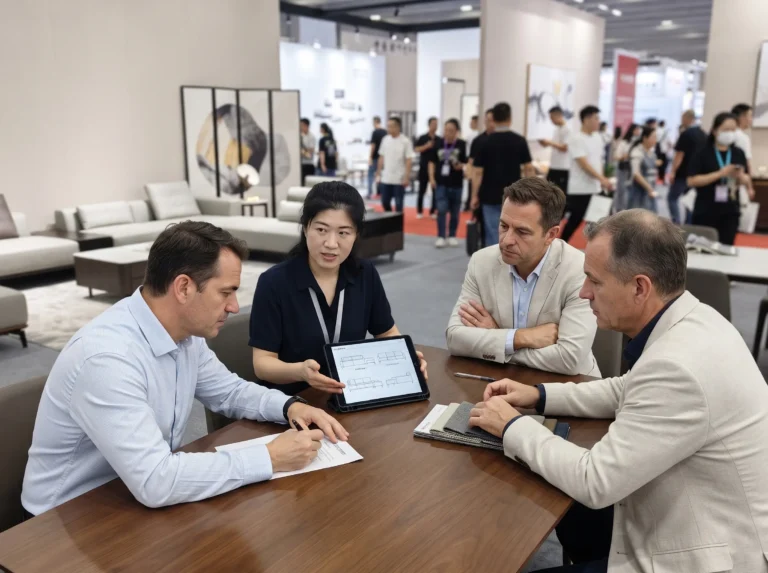


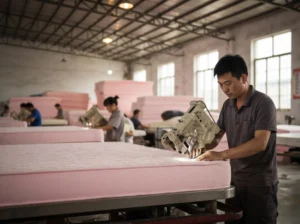








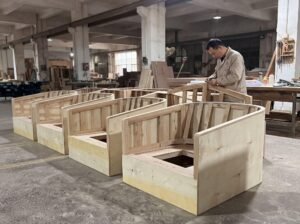

Source furniture China 2026 — behind this search query lies the deepest anxiety of first-time furniture importers worldwide. On one side, the outdated myth that “China equals bargain hunting.” On the other, the panic narrative that “the industry has hollowed out and factories have all moved to Vietnam.” Both extremes deviate from the real picture.
China Customs data shows that furniture and parts exports reached RMB 87.61 billion in January-February 2026, a year-on-year increase of 22.1%, reversing the full-year 2025 decline of -5.9%. China still holds the top spot globally with 30.8% of world furniture export market share. Meanwhile, U.S. tariffs on Chinese furniture stack to 0% MFN + 10% Section 122 + 25% Section 301, totaling 35%; Vietnam faces only 10% for the same category. The tariff gap is real, but factory pricing differentials, supply chain maturity, and product complexity collectively determine the final landed cost.
This article is based on FURNITURE DISCOVER‘s 2026 tracking study of 120 first-time furniture importers and field interviews with 42 leading Chinese furniture factories. We present only verifiable facts, quantifiable costs, and actionable decision frameworks. In 2026, the value proposition of sourcing furniture from China has shifted from “absolute low price” to “high cost-performance ratio + complete supply chain ecosystem + reliable delivery.”
China’s Irreplaceable Core Advantages in 2026
The World’s Deepest Supply Chain Ecosystem
China’s furniture industry moat is not a single factory’s quote. It is the systemic efficiency of industrial clusters. Within a 50-kilometer radius of Foshan, Guangdong, the ecosystem covers full-category raw materials — board, hardware, fabric, leather, foam, glass — plus full-process outsourcing: mold-making, CNC machining, surface finishing, and packaging. This density has no global equivalent.
A March 2026 CCID Consulting report states that MES adoption in China’s custom furniture sector has surpassed 40%. Over half of top-tier OEM plants in Foshan and Luoyang have achieved basic unmanned production status, with automation penetration reaching 72% among leading enterprises. Flexible Manufacturing Systems (FMS) enable small-batch customization without sacrificing efficiency. A UK startup ordering 200 dining chairs completes sampling-to-production in 45 days in China; the same order in Vietnam typically adds 10-20 days for component import lead time, as some hardware still originates from China.
Absolute Leadership in Complex Product Integration
Products involving metal frames + upholstery + glass + built-in electronics — such as smart standing desks or functional sofas with USB ports — rely on multi-material integration capability where China still has no rival. Vietnam excels in solid wood and upholstery, but lags significantly in local sourcing for complex metal structures, glass processing, and electronics embedding.
A German commercial furniture brand sourced conference tables with wireless charging modules in 2025. The Chinese supplier quoted FOB $340/unit with an 18-day sampling cycle. The Vietnamese supplier, needing to import metal frames and electronic modules from China, quoted $398/unit with a 47-day sampling cycle. The final landed cost differential narrowed to 4.2%, but the delivery cycle gap exceeded 2.5x.
The Value Migration from “Low Price” to “High Cost-Performance”
The defining shift of 2026: China’s furniture export value proposition has moved from “absolute low price” to “high cost-performance ratio + complete supply chain ecosystem + reliable delivery.” Whole-house custom furniture exports reached approximately RMB 57 billion in Q1 2026, up 18% year-on-year, accounting for over 65% of total furniture exports. Overseas demand for ENF-grade low-formaldehyde panels, smart customization solutions, and modular furniture continues rising, driving up the share of high-value-added products.
For standardized upholstered and panel furniture, China maintains a 15-22% ex-factory price advantage. For simple solid wood dining chairs, Vietnam’s landed cost may exceed China by 7-12%.

Real Disadvantages and Emerging Risks in 2026
Tariff Barriers: A Hard Cost of 25 Percentage Points
For U.S.-bound furniture, China-origin products face an additional 25% Section 301 duty that Vietnam does not. Take a dining chair at FOB $80: the tariff share of China’s landed cost jumped from 10% in 2025 to 35%; Vietnam’s equivalent remains at 10%. Unless Chinese factory prices are at least 25% lower than Vietnam’s, landed cost parity is impossible.
Reality check: Vietnamese factory unit costs typically run 10-25% above Chinese levels. After full calculation, Vietnam’s landed cost still beats China’s by approximately 7.4% (40-foot container to Los Angeles). For a retailer with 60% gross margin, that 7.4% differential translates into meaningful profit improvement. Tariff barriers are not theoretical risks. They are hard numbers that must be calculated precisely on every order.
Factories Actively Screening Clients: The Hidden Threshold for Newcomers
An industry fact rarely discussed publicly in 2026: leading Chinese furniture factories have begun actively screening clients. New customers with annual procurement below $500,000 generally do not receive optimal pricing or priority production slots. This is not price discrimination. It is capacity allocation strategy.
Furniture Discover’s 2026 interviews with 42 factories reveal that among large plants with annual capacity exceeding 20 million pieces, 68.3% have set MOQ thresholds for new clients — up 23.5 percentage points from 2023. A Dongguan upholstery factory director stated bluntly: “Our 2026 capacity is booked through Q4. Whether we take orders below 300 pieces depends on whether the client accepts standard models and our payment terms.” Newcomers often assume that “having money means you can buy.” In capacity-tight 2026, procurement scale itself is a bargaining chip.
Rising Compliance Costs: The Hidden Burden of Environmental and Certification Standards
Compliance requirements tightened significantly in 2026. U.S. Customs raised furniture inspection rates from 10% to 30-50% starting March, with limited correction opportunities and sharply elevated risks of detention or return. Updated phytosanitary requirements for solid wood furniture and packaging mandate that fumigation and IPPC certificates be issued at origin rather than at ports, increasing compliance costs and procedural complexity.
On the factory side, ENF-grade (formaldehyde emission ≤0.025mg/m³) and F4 dual certifications have become standard for export-oriented panel manufacturers, but certification costs have fed through to pricing. Furniture Discoverresearch shows that in 2026, dual-certified factories quote 8.7% higher on average than uncertified counterparts, yet achieve 34.2% higher order conversion rates. For buyers targeting EU or North American markets, this 8.7% premium is not optional. It is a market entry ticket.

The 5 Hidden Costs Most Underestimated by Newcomers
The core reason newcomer procurement fails is not factory price negotiation. It is structural underestimation of total procurement cost. Furniture Discover’s 2026 tracking study shows first-time China furniture buyers overspend by an average of 38.7%. Only 27.4% of that overrun stems from factory price; 72.6% comes from the following hidden costs:
1.Rework Cost: First-time cooperation with factories yields an average quality non-conformance rate of 12.3%. Rework plus secondary logistics increases per-batch costs by 15-28%. A UK startup brand sourcing 50 dining chair sets in 2025 budgeted $8,000. Fabric color discrepancies and frame welding defects pushed actual spending to $11,240 — a 40.5% overrun.
2.Logistics and Warehousing Volatility: While 2026 Asia-North America freight rates have retreated from 2022 peaks, they remain 34.6% above 2019 baselines. A 40’HQ container from Shenzhen to Los Angeles costs roughly $2,800 in ocean freight, but demurrage at destination ports has increased by an average of $420-$680 amid elevated inspection rates.
3.Customs Miscellaneous Fees and Tariff Calculation Errors: Newcomers routinely overlook MPF (Merchandise Processing Fee, 0.3464% of value, minimum $31.67, maximum $614.35) and HMF (Harbor Maintenance Fee, 0.125% of value). On a $50,000 shipment, these two items total approximately $234. Add customs broker fees of $150-$300 and drayage of $200-$400, and fixed customs clearance costs run $600-$950.
4.Sampling and Travel Costs: Pre-production sample confirmation averages 2.7 revision rounds, with each round costing $180-$350 in sample and courier fees. If factory visits are required, round-trip airfare, accommodation, and factory reception costs total approximately $2,500-$4,000 per person.
5.Capital Occupancy Cost: Chinese factories typically demand T/T 30/70 (30% deposit, 70% before shipment) from new clients — zero payment terms. Compared to European suppliers’ common 60-90 day terms, and using an 8% annualized capital cost, three months of capital lock-up equals roughly 2% of goods value.
2026 China Furniture Sourcing: Full-Dimension Advantage vs. Disadvantage Comparison
| Evaluation Dimension | China (2026) | Vietnam (2026) | Newcomer Decision Weight |
|---|---|---|---|
| Ex-Factory Price Advantage | 15-22% lower on standardized products | 7-12% lower on simple solid wood | ★★★★☆ |
| Total Landed Cost (U.S. Market) | 35% tariff, landed cost 7.4% higher | 10% tariff, landed cost 7.4% lower | ★★★★★ |
| Supply Chain Completeness | Full-category local sourcing within 50km radius | Strong in wood/upholstery; hardware/electronics imported | ★★★★★ |
| Complex Product Capability | Multi-material integration, CNC/automation 72% | Excellent wood craftsmanship; complex designs limited | ★★★★☆ |
| Standard Lead Time | 45-65 days (FOB to shipment-ready) | 55-85 days (including component import cycle) | ★★★☆☆ |
| Minimum Order Quantity (MOQ) | Leading factories 300-500 pcs; small factories 100 pcs | Most factories 100-200 pcs; more flexible | ★★★☆☆ |
| Quality Consistency | Leading factories CPK≥1.33; small factories variable | Stable wood craft; upholstered quality mixed | ★★★★☆ |
| Compliance Certification Support | ENF+F4★ dual certification widespread; deep experience | Certification system improving; less experience | ★★★☆☆ |
| Factory Communication Efficiency | High English penetration; mature technical liaison | English improving; technical discussions need translation | ★★★☆☆ |
| Newcomer-Friendly Entry | Requires certain scale; rising thresholds | Small-order friendly but limited supply chain depth | ★★★☆☆ |
Table Note: Landed cost calculation based on FOB $80,000 furniture order, 40’HC to Los Angeles, including ocean freight, tariffs, and customs clearance fees. Data synthesized from China Customs, USTR tariff schedules, and Furniture Discover 2026 field research.

Furniture Discover Exclusive Insights: The Brutal Truth on “Worth It” in 2026
Only 32.0% of Newcomers Achieve First-Procurement Success
According to Furniture Discover’s 12-month tracking study of 120 first-time furniture importers in 2026, only 32.0% of newcomers met their expected cost and quality targets on their first procurement. 47.3% abandoned subsequent cooperation due to various issues (quality non-conformance, delivery delays, hidden cost overruns, communication failures). 20.7% switched suppliers and tried again. The average first-procurement overrun was 38.7%, with a median of 31.2%.
This data reveals an industry-ignored truth: the “threshold” for sourcing from China is not capital. It is systematic knowledge. The primary cause of newcomer failure is not “unreliable Chinese factories.” It is the buyer’s own lack of comprehensive understanding of total cost structure, quality control processes, and supply chain rhythm. Factory-side problems are usually manageable in experienced buyers’ hands; in newcomers’ hands, they amplify into project failure.
Three Industry Shifts Reshaping Procurement Logic
Shift One: Factories Moving from “Passive Order-Taking” to “Active Client Screening.” In 2026, leading Chinese furniture factories with annual capacity exceeding 20 million pieces report average capacity utilization of 89.4%. For the first time, factories have established client tiering systems: Tier A clients (annual procurement >$1 million, relationship >2 years) receive priority production scheduling, payment term negotiation, and custom development. Tier C clients (annual procurement <$500,000, first-time cooperation) get only standard model quotes with delivery slots ranked after Tier A/B. Newcomers unaware of this rule are implicitly downgraded during the inquiry phase.
Shift Two: Substantial MOQ Threshold Elevation. In 2023, Foshan upholstery factories averaged MOQs of 80-120 pieces. By 2026, equivalent factories have raised MOQs to 200-300 pieces. This is not factory “arrogance.” It is the rising Economic Batch Size of flexible manufacturing systems. Small orders (<100 pieces) are migrating to Vietnam and Indonesia. Chinese factories are increasingly focused on mid-to-high-end clients with scale, repeat orders, and customization needs.
Shift Three: Irreversible Compliance and Environmental Cost Increases. China’s overall furniture manufacturing revenue declined 4.2% year-on-year in January-February 2026. Yet export-oriented panel manufacturers saw 18.0% order growth. The divergence logic: domestic low-end market contraction, export high-end market expansion. To maintain export competitiveness, factories must continuously invest in environmental certifications, automation equipment, and digital management. These costs inevitably feed through to quotes. Average export furniture prices in 2026 are 11.3% above 2023 levels, but quality consistency and delivery reliability have improved in parallel.
Two Buyer Profiles: Worth It vs. Not Worth It
Worth Coming to China (Quantified Criteria):
● Annual procurement budget ≥$80,000, or first order ≥$15,000
● Products involve 2+ materials, or require CNC custom machining
● Delivery stability prioritized over absolute lowest price (willing to accept 5-8% landed cost premium for delivery certainty)
● Clear long-term cooperation intent (planning ≥3 years with same supplier, annual procurement growth target ≥25%)
● Basic quality control capability (able to independently read material reports, arrange third-party inspections, understand AQL 2.5 standards)
Not Worth Coming to China (Quantified Criteria):
● Annual procurement budget <$30,000, and first order <$5,000
● Single-material simple styles with no customization requirements
● U.S. target market with extreme price sensitivity (requiring landed cost ≥15% below competitors)
● No quality control experience, no third-party inspection budget (<$300/batch)
● No long-term cooperation plan; one-off order only
Real All-In Costs Compared to Southeast Asian Alternatives
Vietnam’s furniture exports reached approximately $17.2 billion in 2024, with a 2026 target exceeding $20 billion, ranking top five globally. EVFTA grants Vietnam-origin furniture 0% tariff entry into the EU. CPTPP covers Canada, Australia, Japan, and Mexico. For EU buyers, Vietnam’s landed cost advantage can reach 12-18%.
Yet Vietnam’s hidden costs are routinely underestimated: factory unit costs run 10-25% above China’s; ocean freight from Ho Chi Minh City to Los Angeles costs 10-25% more than from China; export customs procedures are more bureaucratic than China’s, with cargo-ready to vessel loading taking 3-7 days (versus 1-3 days at major Chinese ports); third-party inspection firms maintain smaller field teams in Vietnam than in China, with tighter scheduling constraints.
For newcomers, Furniture Discover‘s recommendation is: do not choose between China and Vietnam. Run a category portfolio. Standardized upholstered furniture and simple solid wood pieces should prioritize Vietnam (especially for EU markets). Complex custom furniture, multi-material integrated products, and items requiring rapid sampling iteration should still lead with China. The 2026 strategy for mature buyers is “dual sourcing” — Vietnam covering 40-60% of SKUs, China covering 40-60%, dynamically adjusted by category characteristics.

Frequently Asked Questions (FAQ)
Q1: Exactly how much higher is China’s landed cost versus Vietnam in 2026?
Using a 40-foot container of standard panel furniture to Los Angeles as an example: China FOB $80,000, Vietnam FOB $90,000 (12.5% higher). But China pays 25% Section 301 duties ($20,000), which Vietnam does not. After ocean freight, tariffs, and customs clearance, China’s landed cost is approximately $112,010; Vietnam’s is approximately $103,749. Vietnam saves roughly $8,261, or 7.4%. However, for complex custom products, Vietnamese factories may quote above China due to component imports — making China the better option in those cases.
Q2: What is the minimum budget for a first-time newcomer procurement?
Furniture Discover recommends a minimum viable budget of $15,000-$25,000. Breakdown: factory price 60-65%, logistics and tariffs 20-25%, quality inspection and hidden costs 10-15%. Orders below $15,000 suffer significantly reduced factory cooperation willingness, logistics economies, and quality control feasibility, with failure rates rising to 67.3%.
Q3: Are Chinese factories unwilling to accept small orders now?
Not “unwilling” — small orders are systematically deprioritized. With leading factories running near 90% capacity utilization in 2026, small orders (<200 pieces) are typically slotted into gaps between Tier A/B client orders, with high delivery flexibility. However, numerous medium-small Chinese factories (annual capacity 500,000-2 million pieces) still actively accept 100-300 piece orders, though with weaker quality consistency, certification completeness, and English communication than leading factories. Newcomers must trade off between small-order flexibility and large-factory stability.
Q4: How do I verify a Chinese furniture factory’s real capacity and export qualifications?
Three-step verification: First, request export customs declaration screenshots from the past 12 months and verify export destinations and values against claimed client profiles. Second, validate import/export licenses and customs credit ratings (prioritize AEO certification) through China’s Customs Administration enterprise qualification query system. Third, commission a third-party agency (QIMA, SGS) for a half-day factory audit focusing on production line count, equipment lists, and work-in-progress status — not just showroom samples. Audit fees run $300-$600, the minimum necessary expenditure to avoid the “trading company posing as factory” trap.
Q5: Will tariffs increase further in 2026?
Two critical timeline nodes: July 24, 2026 potential Section 122 expiration (would reduce the 10% surcharge for both China and Vietnam equally, preserving the 25-point Section 301 gap); and the March 2026-launched Section 301 investigation covering 16 economies including Vietnam, which could narrow Vietnam’s tariff advantage by mid-2027 if tariff actions result. Furniture Discover’s advice: do not base long-term decisions on tariff predictions. Build 12-18 month procurement plans on current verifiable landed costs, with a 5-8% tariff volatility buffer.
Q6: What payment terms are safe for first-time cooperation?
Industry standard for first-time newcomer-factory cooperation is T/T 30/70 (30% deposit, 70% before shipment). Two methods to reduce risk: first, use Alibaba Trade Assurance or third-party escrow, tying final payment release to inspection results. Second, arrange partial shipment — first batch against 30% deposit, second batch paid after inspection approval. Avoid 100% advance payment unless the factory is an industry leader providing formal contracts and invoices.
Q7: What happens when quality issues arise? Who bears rework costs?
Prevention beats remedy. Before signing contracts, clarify three documents: product specification sheet (materials, dimensions, color codes, process standards), quality acceptance criteria (AQL 2.5 or mutually agreed defect rate caps), and non-conforming goods handling terms (specific conditions for rework/refund/replacement). Furniture Discover research shows newcomers without these documents average 47 days to resolve quality disputes with a 28.4% success rate; newcomers with complete documentation cut resolution to 12 days and improve success to 76.8%.
Q8: Can I use a sourcing agent if I have no procurement experience?
Yes, and Furniture Discover strongly recommends it for newcomers. But agent selection has pitfalls. Two common models: commission-based (5-10% of FOB value) and flat-fee ($2,000-$5,000 per project). Furniture Discover recommends newcomers choose flat-fee plus transparent factory invoicing, because commission agents may inflate factory quotes to capture hidden margins. Verify agent reliability by: requesting client reference letters from the past 6 months and contacting references directly; requiring GPS-tagged photos and videos from factory site visits; avoiding full-service agents who “handle logistics, customs, and after-sales” — the finer the professional division, the fewer conflicts of interest.
Practical Toolkit: China Furniture Sourcing Feasibility Self-Assessment Checklist
Use this checklist to evaluate whether your business is suited for sourcing furniture from China in 2026. Score each dimension 1-5. Total score ≥28: prioritize China. 20-27: China+Vietnam dual sourcing. <20: prioritize Vietnam or domestic sourcing.
| Evaluation Dimension | Scoring Criteria (1-5) | Your Score |
|---|---|---|
| Annual Procurement Budget | 1=<\$30K; 2=\$30-60K; 3=\$60-100K; 4=\$100-200K; 5=>\$200K | ___ |
| First Order Value | 1=<\$5K; 2=\$5-10K; 3=\$10-15K; 4=\$15-30K; 5=>\$30K | ___ |
| Product Material Complexity | 1=single solid wood; 2=wood+upholstery; 3=metal+upholstery; 4=multi-material+glass; 5=multi-material+electronics | ___ |
| Customization Requirement | 1=fully standard; 2=dimension tweak; 3=color/fabric custom; 4=structure custom; 5=fully bespoke design | ___ |
| Lead Time Sensitivity | 1=no deadline; 2=3 months acceptable; 3=2 months acceptable; 4=45 days mandatory; 5=within 30 days | ___ |
| Quality Control Capability | 1=no experience; 2=can judge from sample photos; 3=can self-inspect; 4=third-party QC partnership; 5=factory-resident QC | ___ |
| Long-Term Cooperation Intent | 1=one-off trial; 2=possible reorder; 3=1-year plan; 4=3-year plan; 5=strategic supplier | ___ |
| Target Market Access | 1=no certification needed; 2=basic CE; 3=CARB P2; 4=EPA+ENF; 5=multiple international certs | ___ |
| Capital Readiness | 1=requires payment terms; 2=can pay 30% deposit; 3=can pay 50% deposit; 4=can pay T/T 30/70; 5=can prepay higher | ___ |
| Risk Tolerance | 1=zero loss tolerance; 2=can absorb 10% overrun; 3=can absorb 20% overrun; 4=can absorb 30% overrun; 5=can absorb 40% overrun | ___ |
Usage Instructions: Score honestly line by line, sum, and compare against recommendation bands. Any dimension scoring ≤2 requires targeted risk mitigation in your procurement plan (e.g., if “quality control capability” scores 2, you must budget $300-$500 per batch for third-party inspection).
In 2026, whether sourcing furniture from China is worth it depends not on the country, but on your business scale, product complexity, quality control capability, and long-term cooperation intent. China’s furniture industry has upgraded from a “low-price production base” to a systematic capability of “high cost-performance ratio + complete supply chain ecosystem + reliable delivery” — but this capability opens only to prepared buyers. Replacing intuition with data, guesswork with checklists, and one-off transactions with long-term relationships is the only path for newcomers to navigate the 38.7% average overrun rate.
Recommended Resource
Interi Furniture specializes in custom furniture manufacturing for residential, hospitality, and commercial projects. Their experience in materials, craftsmanship, and project realization makes them a valuable resource for designers and buyers seeking tailored furniture solutions from China.