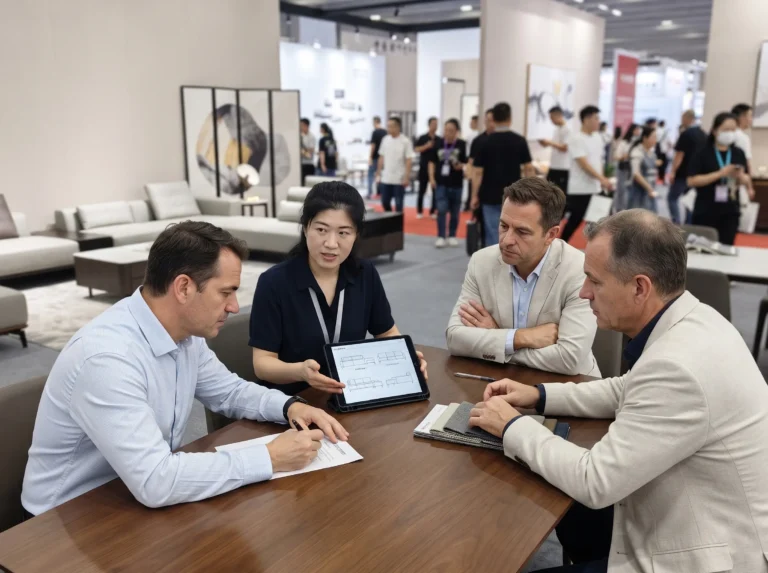








In furniture procurement circles, “cut out the middleman and go factory-direct” is practically gospel. Industry forums and sourcing guides all push the same narrative: trading companies are unnecessary markups, and dealing directly with factories guarantees the lowest price. The math checks out. The industry reality does not. Tracking data from over 420 projects reveals that approximately 65% of small and mid-sized buyers who force factory-direct relationships end up paying far more in hidden costs—communication waste, quality control failures, delivery delays, and unresolved after-sales issues—than they ever saved in service fees. Even more counterintuitive: roughly 40% of export orders from China’s top-tier mid-to-large furniture factories are fulfilled through trading companies, not handed directly to overseas buyers. The middleman never disappeared; its value was simply misunderstood.
To understand where trading companies truly sit in the furniture supply chain, we first need to dismantle an overly simplified equation that dominates buyer thinking.
The “Skip the Middleman = Cheaper” Fallacy and Industry Truth
An Overly Simplified Equation
The most popular formula in procurement decisions goes: factory ex-factory price + trading company markup = final cost. Remove the trading company, and the cost drops. This deduction ignores three critical facts: factories’ real pricing strategies for small buyers, the objective existence of hidden transaction costs, and the transfer of risk-bearing responsibility.
According to project statistics, when order volume falls below factory MOQ (Minimum Order Quantity), consolidated purchasing through a trading company costs 15%-25% less than forcing a factory-direct deal. Factory quotes for scattered orders typically include additional line-adjustment fees, small-batch management premiums, and communication cost allocations. Trading companies, by aggregating multiple orders, secure pricing closer to what large clients receive.

Why Quality Factories Avoid Direct Deals with Small Buyers
A logic largely invisible to outsiders operates in China’s furniture manufacturing clusters: top-tier mid-to-large factories have a structural aversion to small overseas buyers, driven by three constraints:
High client management costs. Small buyers mean high SKU counts, scattered customization demands, and frequent communication. A factory’s foreign trade team generates far lower per-capita output serving these clients compared to large retail chains.
Order instability. Small buyers reorder on irregular cycles, while factory production schedules run monthly. Frequent line insertions disrupt overall workflow. Trading companies aggregate demand from multiple buyers into a steadier order flow, helping factories smooth capacity utilization.
Compliance risk. Direct exporting involves customs declarations, tax rebates, foreign exchange settlement, and product certification. Small buyers often lack complete import qualifications. Factories serving them directly must devote extra resources to fragmented compliance tasks. Trading companies, as the export entity, absorb these risks and operational costs.
Quality factories are not unwilling to take small orders; the economics and risks of direct engagement are simply unfavorable. Trading companies fill this structural gap.
The Misunderstood “Markup”
Trading company profits are often reduced to “buy low, sell high.” This reading misses the fundamental differences in service fee structures. In furniture exporting, at least three distinct models exist:
● Pure Sourcing Agent: Operates under buyer mandate, charging 2%-5% of order value as service fee. Does not take ownership of goods or inventory risk. Core value lies in sourcing, factory audits, and QC coordination.
● Pure Trading Company: Buys out factory capacity, exports under its own name, and marks up 8%-15% to overseas buyers. Bears inventory, capital, and after-sales risk while providing supply chain integration and payment-term support.
● Manufacturer-Trader Hybrid: Owns factories plus integrates external capacity. Combines manufacturing and trading functions. Quotes must distinguish self-produced from outsourced components.
Conflating these three categories is one of the most common decision-making errors in procurement. To truly assess a trading company’s value, we need to look beyond the markup framework and examine what they actually earn.

7 Overlooked Core Values—What Trading Companies Actually Earn
The core value of a trading company is not information arbitrage. It lies in absorbing intermediate services that factories refuse to perform and buyers cannot execute themselves.
Supply Chain Integration: The Hidden Cost of Multi-Factory Coordination
A finished furniture piece typically involves framing, upholstery, hardware, and finishing. Most mid-to-large factories excel in only 2-3 of these processes; the rest require subcontracting. Trading companies integrate different factory specialties to complete cross-factory coordination. Buyers managing multiple factories themselves must align QC standards, delivery schedules, and logistics consolidation. Project data shows that self-managed multi-factory orders generate 3-4x the communication overhead of single-factory orders.
Fragmented Order Consolidation: Breaking the MOQ Barrier
Furniture factories typically set MOQs by container or minimum spend. Small buyers rarely meet these thresholds. Trading companies aggregate orders from multiple buyers to enable consolidated production and shared-container shipping. When order volume sits below factory MOQ, purchasing through a trading company costs 15%-25% less than forcing a factory-direct approach. This is not about “connections”; it is economies of scale applied to procurement.
Quality Control Backstop: Who Takes Responsibility for Defects
Under direct-purchase models, quality disputes between buyers and factories follow lengthy resolution paths. Factories tend to blame “unclear client standards” or “shipping damage.” Trading companies conduct pre-shipment inspections and assume responsibility for coordinating returns or replacements when batch defects occur. This QC backstop is especially critical for orders under $50,000—buyers rarely fly to China to arbitrate over a small batch.
Communication and Compliance: Language, Time Zones, and Certification Barriers
English proficiency varies widely among factory foreign-trade teams in China’s furniture belts. Technical details are easily lost in translation. Trading companies typically maintain bilingual teams capable of accurately transmitting design changes, material substitutions, and process requirements. Additionally, compilation and updating of certifications such as EU CE, US CAL 117/133, and CARB P2 are usually handled more professionally by trading companies than by individual factories.
After-Sales and Risk Absorption: A Buffer for Returns and Claims
Furniture is bulky. Freight damage, post-arrival quality disputes, and missing assembly guidance are inevitable. Under direct purchasing, buyers must negotiate across time zones with factories that often lack incentive to respond to overseas after-sales issues. Trading companies, as the contractual party, coordinate after-sales and in most cases offer a quality deposit or replacement commitment. This risk buffer delivers substantive value to overseas buyers without local China presence.

Rapid Sampling: Shortening New Product Development Cycles
Trading companies maintain long-term relationships with multiple factories and can mobilize R&D resources across their network for rapid sampling. For startup brands that need frequent new product launches, sampling coordinated through a trading company typically takes 20%-30% less time than direct factory engagement. The reason: trading companies know each factory’s sampling schedule and specialty, enabling faster capacity matching.
Payment-Term Support: The Hidden Value of Cash Flow Optimization
Factories typically demand 30%-50% T/T deposit with balance cleared before shipment. Based on long-term credit relationships with factories, trading companies can offer qualified overseas buyers 30- to 60-day payment terms. For cash-strapped startup brands or seasonal e-commerce sellers, this term support often outweighs the service fee itself.
Having understood the seven core values trading companies deliver, the next question becomes clear: under what circumstances should you choose direct sourcing, and when should you leverage a trading company? The answer depends on a rational assessment of order characteristics, internal capabilities, and risk tolerance.
Direct or Agent? A Decision Matrix and Order-Volume Thresholds
The choice between direct and agent sourcing should not be an emotional decision based on “wanting to save money.” It should be a rational assessment grounded in order characteristics, internal capabilities, and risk tolerance.
Direct vs. Agent: Cost, Efficiency, and Risk Comparison
| Dimension | Direct to Factory | Via Trading Company |
|---|---|---|
| Explicit procurement cost | Factory ex-factory price, no service fee | 3%-8% service fee (agent) or 8%-15% markup (buyout) |
| Hidden transaction cost | High (multi-factory coordination, communication, certification, after-sales) | Low (absorbed by trading company) |
| QC responsibility | Buyer bears alone | Trading company backstops or assists |
| After-sales response | Slow (time zones, low factory priority) | Fast (trading company as contract party) |
| Customization capability | Bound by single-factory process limits | Cross-factory integration, higher flexibility |
| Order volume threshold | Must meet factory MOQ | Consolidation available, MOQ barrier removed |
| Payment terms | Typically deposit + balance before shipment | 30- to 60-day terms available |
| Compliance risk | Buyer bears certification and customs risk | Trading company bears risk as export entity |
| Applicable order scale | Annual purchase >\$500K, single-category repeat orders | Annual purchase <\$500K, multi-category small batches |
Decision Threshold: When You Must Use a Trading Company
Based on project data and industry practice, three scenarios strongly favor trading companies:
Annual purchase below $300K. Buyers at this volume typically rank low in factory client priority, struggling to secure quality capacity and responsive service. Trading companies, by aggregating multiple buyers, command enough collective volume to draw mid-to-senior factory attention.
Single order involving 3+ factory synergies. Hidden coordination costs rise exponentially beyond three factories. Trading company supply-chain integration becomes irreplaceable in this scenario.
Time-sensitive delivery with no local China QC resources. If buyers cannot station QC or hire third-party inspection, trading company pre-shipment checks and shipping coordination represent the most economical risk-reduction path.
Decision Threshold: When You Can Go Factory-Direct
Annual purchase exceeds $1M with single-category share above 60%. At this scale, buyers gain enough leverage to lock dedicated capacity and pricing approaching trading company levels. Simultaneously, establishing a procurement office in China or Southeast Asia to self-manage QC and coordination is advisable.
Highly standardized processes with low supplier concentration. For categories like standard metal frames or basic boards, inter-factory process variance is minimal. Buyers can manage through standardized QC protocols, leaving limited integration value for trading companies.
With the boundaries between direct and agent sourcing clarified, a critical question remains: trading companies in the market vary widely in quality. How do you distinguish professional service providers from potential risk sources?
3 Common Trading Company Models and Vetting Standards
Objectively recognizing trading company value does not mean blindly trusting every intermediary. The key lies in distinguishing model differences and establishing actionable vetting criteria.
The Essential Differences Among Three Service Types
Pure Sourcing Agent: Suitable for buyers with identified target factories who need audit and order-follow support only. Risk: some agents maintain hidden rebate relationships with factories, potentially compromising buyer interests. Vetting point: demand disclosure of commission structures and prioritize agents charging buyer-side fixed fees over factory-side commissions.
Pure Trading Company: Suitable for buyers needing full-chain service without China-based resources. Risk: trading companies may misrepresent factory information and subcontract to unvetted small plants. Vetting point: demand factory video tours, business licenses, and capacity data; specify designated factories and alternatives in the contract.
Manufacturer-Trader Hybrid: Suitable for buyers seeking long-term relationships with “factory-backed” suppliers. Risk: some companies exaggerate self-owned capacity ratios while heavily outsourcing. Vetting point: conduct site visits or third-party audits of self-owned vs. outsourced capacity ratios; demand separate quotes and warranty terms for self-produced and outsourced portions.
Actionable Vetting Standards
Standard 1: Transparent fee structure. Legitimate trading companies specify service fee percentages or markups in contracts, clarifying whether logistics, customs, and certification are included. Suppliers refusing detailed quotes present significantly elevated risk.
Standard 2: Traceable factory information. Demand complete factory details (name, address, product category, years of cooperation) and the right to verify independently. Evasiveness or vagueness strongly indicates multi-layer subcontracting.
Standard 3: Verifiable QC processes. Ask about AQL levels, inspection frequency (mid-term, final), and non-conforming product handling. Suppliers providing detailed QC report templates typically demonstrate higher professionalism.
Standard 4: Complete contract terms. Proper trading contracts cover product specifications, material standards, delivery timelines, payment terms, quality objection periods, and liability clauses. Overly simple contracts or those avoiding quality responsibility warrant high alert.
Standard 5: Verifiable industry reputation. Verify years in operation and client feedback through industry forums, LinkedIn, and trade shows. Recently established “trading companies” without physical offices carry far above-average risk.
A Dangerous Misconception
Some buyers use “whether the trading company owns a factory” as the sole reliability criterion. This is overly simplistic. While manufacturer-trader hybrids offer production backing, a pure trading company with deep category expertise may surpass a mid-sized owned factory in supply-chain integration, factory relationships, and QC experience. The core criterion should be whether the supplier can match the right capacity to your order and assume corresponding responsibility—not whether they own the building.
Armed with vetting methods for trading companies, different buyer types need to select optimal partnership models based on their own characteristics. Startup brands, mature buyers, and designer project procurement follow fundamentally different logics.
Optimal Partnership Models by Buyer Type
Startup Brands (Annual Purchase <$200K)
Optimal model: Pure trading company or manufacturer-trader hybrid, buyout model.
Core logic: Startups typically carry high SKU counts, small order volumes, uncertain reorders, and limited China sourcing experience. The priority at this stage is not squeezing every penny but reducing trial-and-error costs and ensuring stable first-batch quality. Trading companies provide consolidation, QC backstop, rapid sampling, and payment terms, allowing startups to focus limited resources on market validation and channel building. Project data shows that first-year quality dispute rates for startup brands purchasing through trading companies run approximately 40% lower than direct-purchase models.
Key action: Select trading companies specializing in 1-2 sub-categories rather than “universal suppliers” claiming to handle everything. Request 3+ anonymized past-client references.
Mature Buyers (Annual Purchase $500K–$2M)
Optimal model: Hybrid—factory-direct for core categories, trading company replenishment for peripheral SKUs.
Core logic: Mature buyers possess basic QC capabilities and factory relationships. Core categories should gradually transition to direct sourcing for better pricing and capacity lock-in. For seasonal replenishment, new product testing, and multi-category small batches, retaining trading companies as flexible supply-chain partners prevents over-dispersing procurement team focus. This hybrid model delivers the best total-cost optimization in project statistics: 8%-12% lower hidden costs than fully direct sourcing, and 5%-10% lower explicit procurement costs than fully agent-based sourcing.
Key action: Establish a supplier tier system: A-tier factories direct; B/C-tier factories managed through trading companies. Reassess trading company service value and cost contribution annually.
Designer Project Procurement (Per Project $50K–$300K)
Optimal model: Pure sourcing agent or boutique trading company.
Core logic: Designer projects feature high customization, tight deadlines, and single-batch runs. Suppliers must deliver rapid sampling response and deep process understanding. The standardized production logic of factories naturally conflicts with the fragmented demands of designer projects. Agents or boutique trading companies deeply rooted in the designer channel typically maintain flexible supply-chain networks capable of coordinating small-batch, multi-batch rapid response.
Key action: Prioritize suppliers with track records serving international design studios or hospitality projects. Focus on historical sampling-cycle data and process problem-solving case studies.

Key Insights Summary
Synthesizing the above analysis, the following five conclusions form the core procurement decision framework of this article:
1.The core value of trading companies is not information asymmetry; it is supply-chain integration, risk absorption, and fragmented-service provision. Quality factories avoid direct service to small buyers not out of “arrogance,” but because client management costs and compliance risks are economically unviable.
2.“Skip the middleman” decisions should optimize total cost, not surface price. Saving 3% in service fees only to lose 30% to quality and delivery issues is not an extreme outlier in project statistics—it is a routine risk for small buyers pursuing factory-direct deals.
3.$300K annual purchase is a critical decision threshold. Below this level, trading companies typically deliver clear comprehensive cost advantages. Above $1M with concentrated categories, the marginal returns of direct sourcing begin to emerge.
4.The operational differences among pure agents, pure traders, and manufacturer-trader hybrids far exceed the surface label of “whether they own a factory.” The core vetting criterion is whether the supplier can match the right capacity to your order and bear corresponding responsibility—not its asset structure.
5.The optimal procurement strategy is typically hybrid, not a black-and-white binary. Core categories factory-direct and peripheral categories agent-sourced represents the best total-cost and risk-balance practice observed in project tracking.

Frequently Asked Questions (FAQ)
Q: What are typical trading company service fees?
A: Pure agent service fees typically run 2%-5% of order value. Trading company buyout markups typically range 8%-15%. Exact rates depend on category complexity, order volume, and service scope. Upholstery and custom furniture generally command higher fees than standardized metal furniture.
Q: How do I judge whether a trading company is reliable?
A: Evaluate five dimensions: fee transparency, traceable factory information, verifiable QC processes, complete contract terms, and verifiable industry reputation. Avoid using “whether they own a factory” as the sole criterion.
Q: Is going factory-direct always cheaper than using a trading company?
A: Not necessarily. When order volume falls below factory MOQ, factories typically add small-batch premiums, making consolidated purchasing through a trading company cheaper. Moreover, hidden costs of direct sourcing—communication, QC, after-sales, certification—are often underestimated. According to project statistics, approximately 65% of small buyers in direct-purchase arrangements end up paying more in hidden costs than the trading company’s service fee.
Q: Why are some factories unwilling to take small overseas client orders directly?
A: Core reasons: high client management costs, order instability, and compliance risk. Factory foreign-trade teams generate far lower ROI serving small clients than large retail chains. Trading companies aggregate demand from multiple buyers into stable order flows, helping factories reduce these structural costs.
Q: What is the difference between a sourcing agent and a trading company?
A: A sourcing agent operates under buyer mandate, charges service fees, and does not take ownership of goods. A trading company buys out goods, exports under its own name, bears inventory and capital risk, and profits through markup. Manufacturer-trader hybrids combine production and trading functions. Their fee logic, risk bearing, and applicable scenarios differ entirely.
Q: What annual purchase volume justifies going factory-direct?
A: Based on project data, buyers exceeding $1M annual purchase with over 60% in a single category typically possess the volume leverage for direct factory negotiation. Buyers below $300K generally achieve better comprehensive cost and risk outcomes through trading companies. The $300K–$1M range suggests a hybrid model.
Q: Will trading companies secretly subcontract orders to poor factories?
A: This is an objectively existing risk, especially with non-transparent suppliers. Preventive measures include: specifying designated factories and alternatives in contracts, demanding factory videos and qualification documents, and commissioning third-party surprise audits. Selecting established trading companies with verifiable reputations significantly reduces this risk.

Recommended Resource
Interi Furniture specializes in custom furniture manufacturing for residential, hospitality, and commercial projects. Their experience in materials, craftsmanship, and project realization makes them a valuable resource for designers and buyers seeking tailored furniture solutions from China.