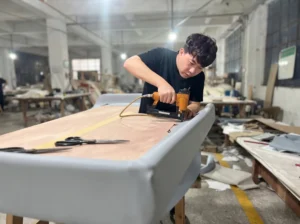


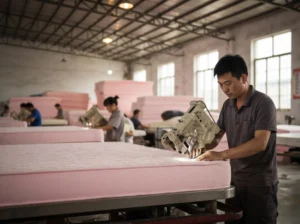








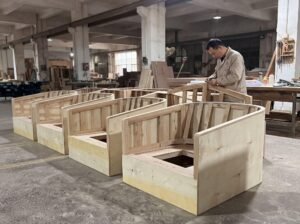

Most furniture displayed at Chinese trade fairs does not legally require CE marking. The certificates factory salespeople wave around are often misapplied, expired, or flat-out fake. EUTR due diligence is your responsibility as the EU operator, not the factory’s, yet the majority of Chinese suppliers we have audited in Dongguan and Foshan cannot produce complete timber traceability files. If you trust surface-level compliance claims without independent verification, you are gambling with port seizures, destroyed inventory, and six-figure losses. This guide maps what actually matters for EU-bound furniture buyers walking the floors of CIFF 2026.
The Compliance Anxiety on the Fair Floor
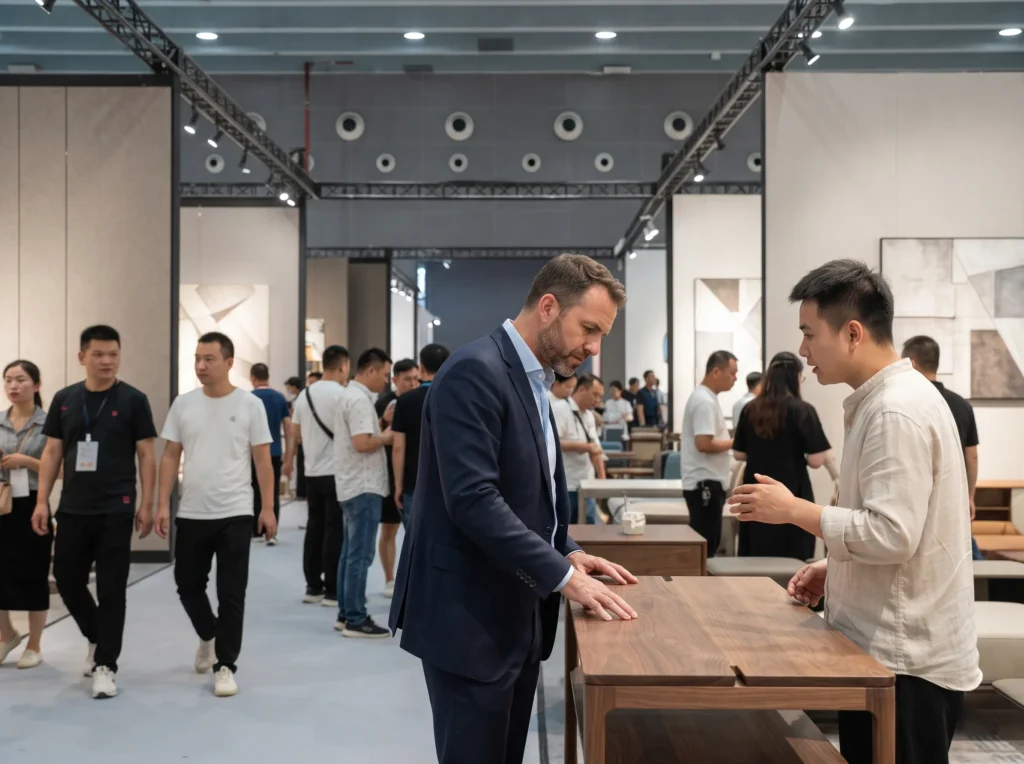
Walk into any hall at CIFF Guangzhou or the Dongguan furniture expos and you will hear the same refrain within minutes: “We have CE.” It is the factory salesperson’s default shield against every European buyer’s hesitation. But here is what we have learned after a decade of walking these halls — that statement usually means nothing. It could mean the factory once paid a third-party lab to test a completely different product. It could mean they downloaded a template Declaration of Conformity and filled in their own company name. It could mean they are confusing CE with a generic quality certificate issued by a local Chinese testing bureau with zero EU recognition.
The anxiety is real. European importers know that a single customs hold at Rotterdam or Hamburg can wipe out an entire quarter’s margin. They know that EUTR enforcement has tightened since 2023, with national market surveillance authorities in Germany, France, and the Netherlands ramping up border checks on wood-based furniture. Yet when they stand at a booth in China, they have no practical way to distinguish a legitimate compliance file from a piece of paper printed the night before the fair opened. That gap between fear and verification is exactly what this guide closes.

The CE Marking Reality Nobody Talks About
Here is the single most misunderstood fact in the China-to-EU furniture trade: CE marking furniture China is mandatory only for specific sub-categories, not for general household furniture. The Construction Products Regulation (EU 305/2011) mandates CE marking for structural building elements, but your average dining chair, sofa, or bedside table falls outside its scope. CE becomes relevant when furniture incorporates electrical components (triggering the Low Voltage Directive 2014/35/EU or EMC Directive 2014/30/EU), when it is designed for children (toy safety under EN 71 series), or when it involves specific safety-critical mechanisms like folding beds (EN 1129) or wall-mounted storage units with tip-over risks.
The “CE=EU passport” myth persists because Chinese factories have built an entire side industry around selling certificates that look official but carry no legal weight. We have seen factories present CE documents based on withdrawn standards, issued by accreditation bodies not listed in the EU NANDO database, or simply self-declared without any underlying test reports. The presumption of conformity under EU law requires a legitimate technical file, a proper risk assessment, and a signed Declaration of Conformity — not a laminated certificate with a gold seal.
| CE Marking Reality for Furniture | Mandatory | Voluntary / Misapplied | Fake / Invalid |
|---|---|---|---|
| General dining, bedroom, living room furniture (no electrical/special safety features) | No CE required | Often falsely claimed | Common |
| Furniture with integrated lighting, charging ports, motors | Yes, under LVD 2014/35/EU or EMC 2014/30/EU | Sometimes claimed under wrong directive | Moderate |
| Children’s furniture with play/entertainment function | Yes, under Toy Safety Directive 2009/48/EC | Frequently misapplied to all kids’ furniture | High |
| Folding beds, bunk beds with specific safety mechanisms | Yes, under EN 1129 or EN 747 | Occasionally claimed without testing | Moderate |
| Building-integrated fixed furniture (fitted kitchens, wall systems) | Yes, under CPR EU 305/2011 | Rarely correctly documented | High |
| Certificates based on withdrawn EN standards | N/A — legally invalid | Widespread | Very common |
| Self-declared DoC with no technical file or test report | N/A — legally insufficient | The norm at mid-tier factories | Extremely common |
For reference only, subject to official verification: Our field estimates suggest that roughly 60–70% of CE certificates shown to European buyers at Chinese furniture fairs are either misapplied to non-regulated products or lack supporting technical documentation. This figure is based on our independent supplier audits across Guangdong and Zhejiang between 2022 and 2025.
EUTR: Your Problem, Not Theirs
The EU Timber Regulation (EU 995/2010) creates a legal obligation that most European buyers misunderstand from the start. The due diligence system, or DDS, is not the Chinese factory’s responsibility. It is yours. Under EUTR, the “operator” is defined as the natural or legal person who first places timber or timber products on the EU market. If you are the importer of record in Rotterdam, you are the operator. The Chinese factory is merely the supplier. They have no direct legal liability under EUTR, which explains why their willingness to prepare traceability files ranges from reluctant to nonexistent.
We have sat across from factory owners in Shunde who openly admit they cannot trace the origin of the rubberwood in their dining sets beyond “we bought it from the lumber market.” That is not a crime in China, but it is a catastrophic compliance gap for you. EUTR requires you to maintain a DDS that includes information on the timber species, the country of harvest, the supplier’s name and address, and documentation demonstrating legality of harvest. Most Chinese furniture factories operate on a mixed-supply model — they buy timber from multiple traders, blend FSC-certified and non-certified material without segregation (FSC Mix in theory, “whatever is cheaper today” in practice), and keep minimal purchase records beyond standard VAT invoices.
| EUTR Due Diligence | What EU Law Requires | What Chinese Factories Actually Provide |
|---|---|---|
| Complete timber species identification and CITES checks if applicable | Mandatory for operator | Often vague; “mixed hardwood” is common |
| Geographic origin documentation to sub-national level where required | Mandatory for operator | Usually country-level only; province/mill details rare |
| Chain of custody documentation back to forest or first processor | Mandatory for operator | Typically ends at the Chinese trading company, not the forest |
| Risk assessment and risk mitigation measures documented | Mandatory for operator | Almost never provided; factories assume “not our job” |
| FSC or PEFC chain of custody certificates | Acceptable as part of DDS, not automatic EUTR compliance | Often shown but may cover only specific product lines, not your batch |
| Legality documentation from harvest country | Mandatory for high-risk sources | Rarely available; factories rely on trader assurances |
For reference only, subject to official verification: Based on our supplier audits in the Pearl River Delta, fewer than 15% of mid-sized furniture exporters to the EU can produce EUTR-compliant traceability files without significant buyer intervention. This does not imply malice — it reflects a structural disconnect between Chinese commercial practices and EU regulatory expectations.
UKCA vs. CE Post-Brexit: What UK Buyers Need
Brexit created a parallel compliance track that catches buyers off guard. The UKCA marking replaced CE for products placed on the Great Britain market, though the UK government has repeatedly extended recognition of CE marking for certain product categories. As of mid-2026, furniture with mandatory CE requirements generally still accepts CE marking in Great Britain under current transitional arrangements, but UK-bound importers should verify the latest UK government guidance because these deadlines shift. Northern Ireland operates under a dual system — the UKNI marking plus CE under the Windsor Framework.

The real trap for buyers is assuming that a factory’s CE documentation automatically works for the UK. UKCA requires UK-recognized conformity assessment bodies, not EU Notified Bodies. We have seen buyers ship container loads to Felixstowe based on CE files, only to discover their conformity assessment body has no UK recognition. The paperwork looks identical. The legal validity is not.
| UKCA vs. CE for Furniture | Great Britain (England, Scotland, Wales) | Northern Ireland |
|---|---|---|
| Mandatory marking for general furniture | Same as CE — limited categories only | CE marking required; UKNI optional |
| Conformity assessment body | Must be UK-recognized | EU Notified Body or UK body under specific arrangements |
| Acceptance of CE marking | Transitional arrangements apply as of 2026; check current UK gov guidance | Accepted under Windsor Framework |
| EUTR equivalent | UK Timber Regulation (UKTR) applies; operator is UK-based importer | EU EUTR applies |
| Practical risk for buyers | Assuming CE = UKCA valid; using EU Notified Body for UK market | Confusion over dual marking requirements |
The Fair Floor Verification Playbook
You have forty minutes at a booth before the next appointment. Use them to stress-test compliance claims. Do not ask “Do you have CE?” Ask “Which directive and which EN standard is this CE declaration based on?” If the salesperson cannot answer within ten seconds, you are looking at a self-declaration with no technical backbone.
For EUTR, ask for the timber species list for the specific SKU you are considering, not a generic mill certificate. Ask for the supplier’s name and address two steps upstream — the direct timber trader is not enough. If they hand you an FSC certificate, check the certificate code on the FSC database in real time on your phone. Verify that the product group code on the certificate actually covers furniture manufacturing, not just paper trading.
| Compliance Verification Checklist for Fair Floor Use | What to Ask | Red Flag Response |
|---|---|---|
| CE validity | “Show me the DoC and the test report number” | “We only have the certificate” / “The lab is updating the report” |
| Standard applicability | “Which EN standard and EU directive covers this product?” | Vague answers; mentions “general quality standard” |
| EUTR timber traceability | “What is the species and country of harvest for this exact chair?” | “Mixed wood from Southeast Asia” / “We buy from the market” |
| Upstream supplier data | “Who is your direct timber supplier, and who supplied them?” | Refusal to disclose; “trade secret” |
| FSC verification | “What is the FSC certificate number? I will check it now” | Certificate not found online; expired; wrong scope |
| Electrical component safety | “Show me the LVD or EMC test report for the LED driver” | “The lighting factory gave us a certificate” / no report |
Red Flags and High-Risk Traps
Accepting a factory-provided CE certificate without checking whether the product category actually falls under a CE directive is the most expensive mistake we see repeated every fair season. The certificate might be real. It might even be issued by a legitimate Notified Body. But if it covers stainless steel kitchen sinks and you are buying oak dining tables, it is legally worthless for your shipment.
EUTR file gaps are harder to spot but more dangerous at the border. German customs and the Bundesamt für Naturschutz have intensified checks on furniture imports from high-risk timber sources. A missing species declaration or an unverifiable legality document can trigger a hold that lasts weeks. Storage fees at port compound fast. In severe cases, goods face seizure and destruction. We have spoken with Dutch importers who absorbed over €80,000 in combined demurrage, testing, and legal costs because their Chinese supplier’s “FSC certificate” turned out to cover a different product line.
Outsourcing compliance responsibility to the factory through a vaguely worded contract is another trap. Chinese factory contracts often include a clause like “Supplier guarantees product meets EU standards.” That language means almost nothing in a dispute. EUTR operator liability cannot be contractually transferred to a non-EU entity. You need explicit contract terms requiring documentary evidence — species lists, supplier declarations, due diligence records — with penalty clauses for non-delivery of documents, not just for product defects.
Audience-Specific Playbooks
EU Bulk Importers and Distributors
You move containers, not cartons. Your EUTR exposure is systemic. Build a pre-qualified supplier list that requires independent third-party EUTR audits before any purchase order is issued. Do not rely on fair-floor promises. Send your compliance team or hire local auditors to verify mill records, warehouse segregation practices, and upstream supplier contracts. For CE-regulated product lines, require EU-type examination certificates from Notified Bodies listed in NANDO, not just test reports from Chinese labs. Build a 90-day documentation buffer into your lead times — EUTR files from Chinese factories rarely arrive complete on the first request.
Small Retailers and E-Commerce Sellers
Your volumes do not justify container-level risk. You are likely buying through trading companies or dropship arrangements. Your vulnerability is hidden in the supply chain you cannot see. Demand that your Chinese trading partner provides the EUTR due diligence documentation they are supposed to maintain as your supplier. If they push back, that is your signal to walk. For CE-related products like children’s furniture or items with USB charging ports, verify that the DoC lists your EU importing entity as the responsible party, not the Chinese factory. Amazon and other marketplaces are increasingly requiring uploadable compliance files; a factory selfie-holding-a-certificate will not pass.
UK Buyers
Treat UKCA as a separate workstream, not a CE add-on. Verify that any conformity assessment referenced in your files is performed by a UK-recognized body. If you are importing into Northern Ireland, understand whether your goods move under the Windsor Framework’s CE-acceptance rules or require UKNI. The UK Timber Regulation mirrors EUTR in structure but is enforced by UK authorities — your DDS must be UK-facing, not a repurposed EU file.
Interior Designers and Project Procurement Managers
Your FF&E packages often include custom or semi-custom pieces where factory-standard compliance files do not exist. For fixed installation furniture — fitted wardrobes, built-in kitchen systems, wall-mounted shelving with structural load — CE under the Construction Products Regulation may genuinely apply. Engage a European technical assessment body early in the specification phase. For wood sourcing on high-profile projects, clients increasingly demand FSC 100%, not FSC Mix. Verify chain of custody at the factory level, not just at the certificate level. A certificate does not guarantee that the wood in your specific hotel room set came from certified sources.

Frequently Asked Questions
Does all furniture need CE marking to enter the EU?
No. The vast majority of general household furniture — dining tables, sofas, beds without special mechanisms, storage cabinets — does not fall under any CE directive. CE marking becomes mandatory only when furniture incorporates electrical components, is designed for children under toy safety rules, or functions as a building product under the Construction Products Regulation. The CE marking furniture china landscape is cluttered with voluntary or fake claims because factories know European buyers expect to see it.
What is EUTR and who is responsible for compliance?
The EU Timber Regulation (EU 995/2010) requires that timber and timber products placed on the EU market come from legally harvested sources. The legal responsibility for maintaining a due diligence system lies with the “operator,” defined as the person or company that first places the product on the EU market. If you are the importer of record, that is you. The Chinese factory is not the operator and has no direct EUTR liability, which is why many factories are unprepared to provide the documentation you need.
Can I trust CE certificates shown at Chinese trade fairs?
Trust but verify — heavily. We recommend treating every certificate shown at a fair as unverified until you cross-check the Notified Body in the EU NANDO database, confirm the EN standard is current and applicable to the specific product, and request the underlying technical file and test reports. A shocking number of certificates we encounter are based on withdrawn standards, issued by non-recognized bodies, or simply self-declared without testing.
What happens if my shipment lacks EUTR documentation at the EU border?
National market surveillance authorities can detain, test, or seize shipments. You may be required to provide additional documentation within a specified timeframe. If you cannot demonstrate compliance, goods can be prohibited from entering the market, and in serious cases, destroyed. Port storage fees accrue daily during holds. Criminal penalties apply in some member states for systematic violations. The factory in China will not pay these costs — you will.
Do I need UKCA marking if I also sell in the UK?
For furniture categories that require mandatory conformity assessment, Great Britain currently recognizes CE marking under transitional arrangements as of 2026, but you should verify the latest UK government guidance because deadlines change. UKCA marking requires UK-recognized conformity assessment bodies. Northern Ireland maintains different rules under the Windsor Framework. Do not assume your CE documentation automatically satisfies UK requirements.
How do I verify wood sourcing claims at the factory level?
Ask for the specific timber species and country of harvest for your exact order, not generic mill statements. Request supplier names and addresses at least one tier upstream from the factory. Check FSC certificate numbers live on the FSC database during your factory visit. Look for physical segregation of certified and non-certified wood in the factory’s warehouse and cutting areas. If the factory cannot or will not show you this, their sourcing claims are unreliable.
What Is Your Experience?
We have laid out the compliance landscape as we see it from the fair floors of Guangzhou and the loading docks of Rotterdam. But every buyer’s path is different. Have you been caught out by a CE certificate that turned out to be misapplied? Did you ever face a port hold because EUTR files were missing or incomplete? What verification tactics have worked for you when auditing Chinese suppliers? Drop your experience or your specific CE and EUTR scenario questions in the comments — we read every one, and the community learns from real war stories, not theory.
Recommended Resource
Interi Furniture specializes in custom furniture manufacturing for residential, hospitality, and commercial projects. Their experience in materials, craftsmanship, and project realization makes them a valuable resource for designers and buyers seeking tailored furniture solutions from China.