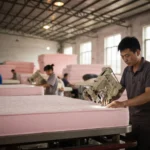


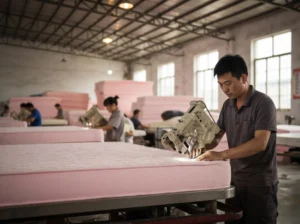

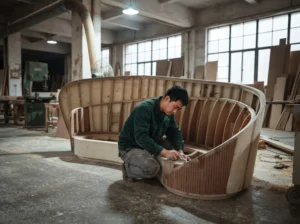
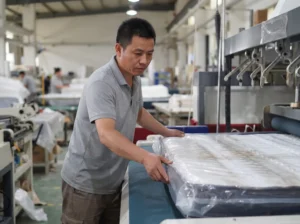





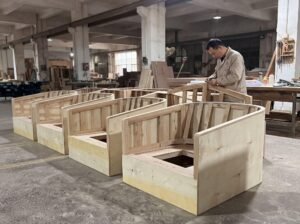
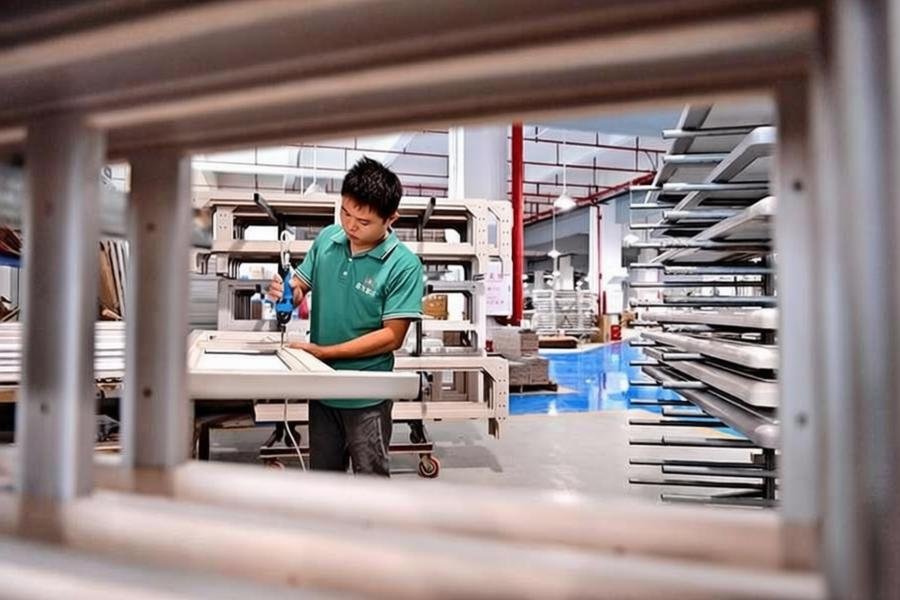
China’s hospitality furniture lead time runs roughly 40% shorter than European counterparts. Not because one machine spins faster, but because the underlying industrial structure is entirely different. Within a 50-kilometer radius in the Pearl River Delta, raw timber, hardware, upholstery fabrics, and finished casegoods complete a closed loop. In Europe? A Polish factory might wait for fabric from Como, Italy; hinges from Solingen, Germany; timber from Sweden. Cross-border logistics alone eats up more than a week of buffer. For hotel developers and interior design firms, understanding the industrial logic behind this 40% gap matters far more than price comparisons when it comes to protecting project timelines.
Who Actually Bears the Cost of Delay?
Procurement directors at large hotel groups don’t fear high prices—they fear uncertainty. A 200-room standardized project delayed by thirty days means a postponed opening. At an average daily rate of RMB 800, vacancy losses head straight into the millions. European suppliers typically lock production schedules by fiscal year. Last-minute add-ons? Basically impossible. This becomes a fatal weakness during pre-season rushes when hotels stock up before peak occupancy.
Small B&B owners face a more counterintuitive problem. Most assume “I only have twenty rooms, so it should be faster.” Wrong. European factories routinely reject orders below fifty room sets or push lead times to 14–16 weeks. Flexible lines in Foshan and Dongguan, China? Twenty-piece minimums, six to eight weeks. The real blind spot for small buyers isn’t finding a factory—it’s failing to grasp the fundamental production-logic gap between China vs Europe hotel furniture. European plants run on annual plans; Chinese factories run on rolling monthly schedules.

Where Exactly Does the 40% Gap Show Up in the Numbers?
Let’s look at China first. Foshan industry belt’s 2025 export report, combined with our conversations with a dozen hotel furniture suppliers at CIFF Guangzhou this March, puts standard guest room sets (bed, nightstand, wardrobe, desk) at roughly 45–55 days. Complex executive-suite customization? 65–80 days.
Europe? FederlegnoArredo’s 2024 capacity report, plus our field visits to Dębowa Góra (Poland) and Brianza (Italy) in Q4 last year—standard guest room sets need 75–90 days. Executive suite level? 105–130 days. The gap is concrete.
| Comparison Dimension | China Manufacturing (PRD/YRD) | Europe Manufacturing (Poland/Italy/Spain) | Gap Range |
|---|---|---|---|
| Standard guest room full set | 45–55 days | 75–90 days | ~38–42% |
| Executive suite custom furniture | 65–80 days | 105–130 days | ~38–40% |
| Lobby fixed-installation furniture | 55–70 days | 90–115 days | ~39–44% |
| Restaurant / meeting movable furniture | 35–45 days | 60–75 days | ~40–42% |
| Emergency reorder (same model) | 15–20 days | 35–50 days | ~57–60% |
Note: Sea/land freight excluded. Emergency reorder gaps are widest because Chinese factories reactivate existing tooling immediately; European plants often wait for the next quarterly slot.
Why China Delivers Faster: Six Structural Reasons
Cluster density determines reaction speed.
Within 50 kilometers of Lecong and Longjiang in Foshan, over 3,000 furniture and ancillary enterprises cluster. A hotel furniture factory’s purchasing manager discovers a wardrobe hinge spec needs changing in the morning, drives to the hardware market, and has alternative samples by afternoon. This density wasn’t planned—it grew organically over decades. Europe runs entirely opposite. A Polish factory’s upholstery fabric comes from Como, Italy; hardware from Solingen, Germany; timber from Sweden or Romania. Cross-border logistics alone consumes 5–10 days.
Flexible production lines make changeovers trivial.
Between 2023 and 2025, leading Chinese hotel furniture factories completed large-scale CNC upgrades. One Longjiang-based manufacturer focused on five-star projects runs machining centers with 15-minute changeover times. Standard double-room headboards in the morning, executive suite models in the afternoon—no line stoppage. Many traditional European plants still switch product lines by week or month, with equipment sitting idle waiting for schedule slots. That’s the hidden waste in hospitality furniture lead time that most analyses miss.
Concurrent engineering—Chinese factories are willing to “bet early.”
Before drawings are 100% frozen, woodworking shops already procure standard panels and universal hardware; upholstery workshops prepare fabric swatches in parallel. The factory absorbs the risk internally—if design changes occur, losses from already-cut panels are eaten in-house. European factories strictly enforce serial workflows: “drawing freeze triggers production start.” Any tweak triggers a full schedule reset. Hotel projects change designs frequently; this difference gets magnified.
Zero-wait local raw materials.
Over 200 Foshan-based fire-rated fabric suppliers hold BS 5852 and CAL 117 certifications, with 48-hour delivery to factory doors. A special-grain wood veneer? Local suppliers custom-produce it in 5–7 days. European manufacturers can source equivalent materials, but suppliers scatter across Portugal, Turkey, even China. More critically, Chinese factories’ response to non-standard requests—a special hardware piece, local mold shops deliver samples in three days. In Europe, the same request might spend a week on quotation and spec confirmation alone.
Elastic workforce—peak season means “surge capacity.”
During the March–May hotel furniture export rush, Chinese factories boost output 30–40% through temporary workers, piece-rate teams, and cross-factory labor sharing—without carrying fixed long-term headcount. European factories, bound by labor law and union agreements, lock schedules six months ahead. Temporary staffing is prohibitively expensive. This elasticity gap becomes decisive during fast hotel manufacturing peak-season sprints.
Modular decomposition—chopping big orders into parallel streams.
Chinese factories break room furniture into modules: headboard panels, bed boxes, wardrobe carcasses, doors, drawer boxes. Different teams work in parallel, then integrate on final assembly lines. A 200-room order splits into twenty parallel sub-batches of ten rooms each. Traditional European factories favor “whole-piece flow”—one craftsman completes a wardrobe from start to finish. One bottleneck stage chokes the entire line.
Why Europe Slows Down: Five Structural Constraints
Fragmented supply chains hurt the most.
One mid-sized Polish manufacturer sources oak from Sweden, fire-rated fabrics from the UK, hinge hardware from Germany, marble tops from Carrara, Italy. Four countries, four lead times, four quality standards. One node fails, the chain reacts. FederlegnoArredo research shows European furniture manufacturers coordinate upstream suppliers from an average of 4.2 countries. The Pearl River Delta equivalent? 1.3—essentially intra-provincial.
Hand-craft texture carries a time premium.
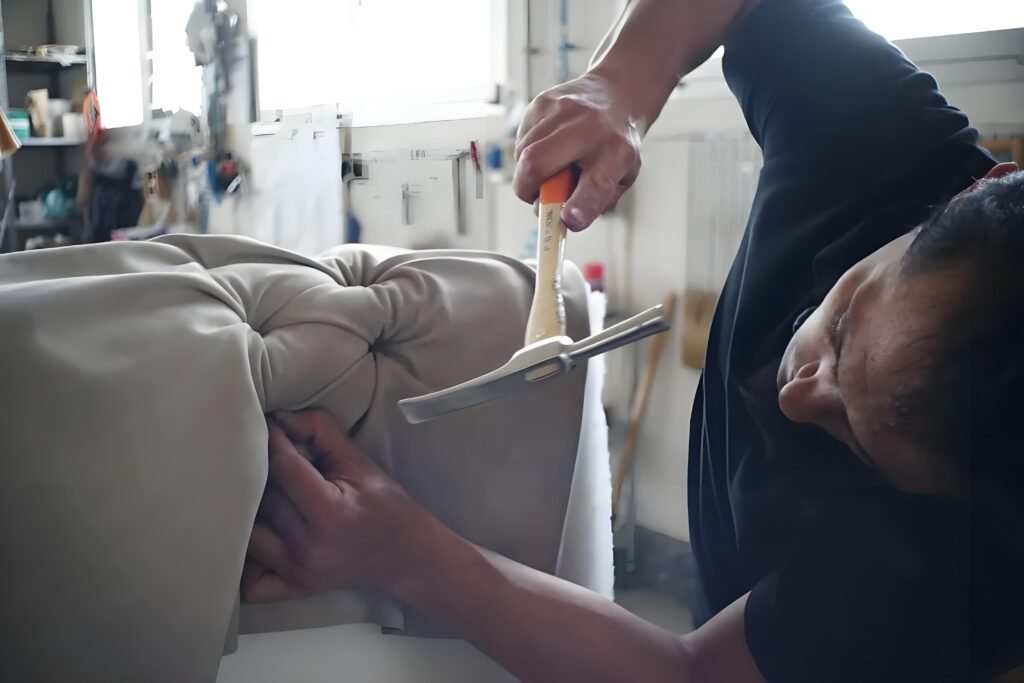
Artisans in Brianza, Italy, still use traditional mortise-and-tenon joinery and hand sanding. A single executive-suite wardrobe may require 2.5–3 times the woodworking labor hours of a Chinese counterpart. The texture is undeniable, but hospitality furniture lead time gets stretched proportionally. Chain hotel projects need delivery certainty; this trade-off is hard to reconcile.
Moisture content control—not the “6–12 month air-drying” myth.
Let’s clear up a common misconception here. European factories widely use kiln-drying; they don’t rely purely on natural air-drying. The longer cycle stems from a 2–4 week post-kiln conditioning and stress-release phase, plus moisture-content fine-tuning for the project’s destination climate (higher humidity for Nordic projects, drier specs for Southern Europe). Total raw-material pre-processing runs roughly 4–6 weeks. Chinese factories also use kiln-drying but compress conditioning to 1–2 weeks. The technical gap is not generational. The difference lies in process conservatism and risk-tolerance standards—European manufacturers invest longer lead times to minimize cracking and warping risks across hotel climate zones.
Annual planning locks in flexibility.
Northern Italian factories build production plans around fiscal years, locking next-year schedules during Q3–Q4. Finalize your furniture scheme in May 2026? You’ll likely secure only Q1 2027 capacity. Chinese factories operate on rolling monthly schedules; order this month, produce next month. This planning-system difference explains more of the China vs Europe hotel furniture lead-time gap than any single efficiency metric.
Ancillary industry atrophy forces longer subcontracting cycles.
Valencia, Spain, once had a thriving furniture hardware sector. Over two decades, much production shifted to Asia. Local hotel furniture manufacturers now source hardware from Germany or Asia, extending subcontracting cycles. Compounding this, European factories enforce near-zero-defect tolerance on subcontracted parts. One batch of non-conforming hardware can halt an entire line awaiting replacement. Quality guaranteed; speed sacrificed.
Matching Lead Time to Hotel Size
Large chain hotels (200+ rooms)—China maximizes fast hotel manufacturing advantages. Standardized design + modular production + elastic capacity delivers a full hotel’s guest room furniture in 60–75 days. European manufacturers typically need 100–120 days, with minimal tolerance for design changes. Recommended: “China primary + Europe selective premium”—send 90% of standard guest room furniture to China, reserve 10% of presidential suites and lobby art-grade pieces for European artisans.
Mid-size boutique hotels (50–150 rooms)—the most competitive bracket. Chinese factories maintain 45–60-day lead times, supporting moderate customization (special fabrics, non-standard dimensions). European manufacturers may stretch to 90–110 days here—mid-size orders lack “major-client fast-track” priority, yet don’t generate enough volume to amortize fixed hand-craft costs. Mid-size buyers should evaluate “delivery certainty” over pure price.
Small B&Bs (under 20 rooms)—European factories treat these orders as “optional.” Reject outright, or schedule to 16–20 weeks. Foshan and Dongguan maintain dedicated small-batch lines: 20-piece minimums, 6–8-week lead times. For small owners, hospitality furniture lead time sensitivity isn’t vacancy cost (B&Bs rarely face rigid chain deadlines)—it’s cash flow lockup. Capital tied in deposits for 3–4 months creates real pressure.
The Hidden Cost of Delay
A 200-room, mid-scale hotel at RMB 800 average daily rate:
| Delay Duration | Direct Vacancy Revenue Loss | Project Delay Penalty | Design Team On-Site Costs | Total Estimated Loss |
|---|---|---|---|---|
| 15 days | RMB 2.4M | RMB 300K–500K | RMB 50K–80K | RMB 2.75M–2.98M |
| 30 days | RMB 4.8M | RMB 600K–1M | RMB 100K–150K | RMB 5.5M–5.95M |
| 45 days | RMB 7.2M | RMB 900K–1.5M | RMB 150K–220K | RMB 8.25M–8.92M |
Based on China hotel industry averages. European projects typically carry higher penalties due to stricter building-code opening-permit requirements.
The more insidious cost is “design team idle time”—interior designers, soft-furnishing consultants, and pre-opening teams keep burning labor while furniture stalls. Overseas projects add project managers’ international travel and factory-monitoring expenses, accumulating linearly.
Risk Mitigation for Procurement Teams
Before signing any contract, run this self-check:
Design freeze—at least 45 days ahead for China factories; 90 days for European. Sample confirmation: reserve two rounds of revisions, 7–10 days each. Freight stacking: add 25–35 days sea freight for China-to-Europe/North America; 5–10 days land freight for intra-EU from European factories; 20–25 days sea freight for Europe-to-North America. Peak-season avoidance: skip the month before Chinese New Year (worker migration) and July–August (Italy’s shutdown). Reorder contingency: reserve 5–10% replacement capacity—Chinese factories need 15–20 days; European factories need 35–50 days.
Contract recommendations: milestone-bound phased payments (30% deposit, 40% progress, 30% balance tied to “drawing confirmation,” “first-piece sample approval,” “pre-shipment QC pass”). Delay penalties at 0.05%–0.1% of contract value per day, capped at 5–8% total, preventing suppliers from padding quotes out of fear. Add an alternative-supplier clause: if the primary factory delays beyond X days, the buyer activates a backup at the primary’s cost for the transfer premium.
Small-B&B Buyer’s Guide to Compressing Lead Time
Pick “hotel-furniture-specialist” factories, not generalists. Foshan has factories specializing exclusively in B&B guest room furniture—mold libraries, fabric inventories, hardware stocks already optimized for small batches. Minimums as low as 15–20 pieces, lead times of 6–7 weeks.
Group-buy consolidation works. Multiple B&B owners combine orders, sharing fabric batches and hardware specs. The factory merges into one production line, compressing lead times by another 10–15%.
Video-based sample confirmation. Request HD video walkthroughs of sample details instead of waiting for international courier (saves 7–10 days). For colors and fabric textures, ask for shots under both natural and indoor lighting.
“Semi-custom” beats full custom. Select the factory’s existing standard bed frames and wardrobe carcasses; customize only fabric colors and headboard shapes. Compresses lead time from eight weeks to five.
Lock in a “fast reorder” clause contractually: post-opening damage replacement, factory commits to 15-day turnaround. Write it in the contract. Not a verbal promise.

FAQ
Q1: Does China’s 40% lead-time advantage mean lower quality
A: Not necessarily. The gap comes from industrial cluster density and production organization, not craftsmanship standards. Leading Chinese factories hold FSC, ISO 9001, and BIFMA certifications, producing for international five-star brands as OEM partners. Quality depends on the individual factory’s QC system, not nationality.
Q2: Is European hand-craft texture worth the extra 40% wait?
A: Depends on positioning. Single luxury hotels pursuing ultimate hand-craft detail may justify the European premium. For chain-standardized projects, time costs (vacancy losses, penalties) typically exceed texture premiums. Hybrid China-Europe procurement is recommended.
Q3: Can Chinese factories handle complex custom designs—curved lobby reception desks, non-standard suite layouts?
A: Yes. Leading Pearl River Delta factories operate five-axis CNC and 3D modeling, achieving European-equivalent precision on irregular pieces. But complex customization extends prototyping to 12–18 days; reserve enough time at project inception.
Q4: How do I verify a Chinese factory’s claimed lead time?
A: Request actual production schedules from the last three similar-volume projects (anonymized), and cross-check upstream fabric and hardware suppliers’ typical delivery cycles. More direct: include a “milestone progress reporting” clause requiring weekly production photos and videos.
Q5: Do European factories have zero speed advantages?
A: Not entirely. For EU-internal projects, European factories hold natural advantages in last-mile logistics and local compliance (CE marking, fire standards), saving 2–3 weeks of customs clearance. If the project sits in Europe and lead-time requirements aren’t extreme, the “local closed loop” remains competitive.
Q6: Can I find a European factory for a small B&B order (under 20 rooms) ?
A: Extremely difficult. European manufacturers typically set MOQs at 50–100 room sets. Below that, factories reject the order or raise unit prices 80–120%. Factories in Foshan and Dongguan are far more accommodating.
Q7: How do Chinese New Year and Italy’s August shutdown affect lead times?
A: Chinese factories gradually reduce output 15–20 days before Spring Festival; post-holiday recovery takes 2–3 weeks, totaling roughly 5–6 weeks. Italian factories essentially shut down in August, impacting roughly 4–5 weeks. Bake these windows into your schedule.
Q8: If a project needs mid-course add-ons, how responsive are Chinese factories?
A: Significantly faster. Chinese factories reactivate existing tooling and process files directly—add-on lead times of 15–20 days. European factories must re-enter quarterly plans, typically 35–50 days.
Q9: Does sea freight erase China’s lead-time advantage?
A: For distant markets (Europe, North America), sea freight adds 25–35 days. Even so, China’s production-cycle advantage (40–50 days vs. 75–90 days) plus freight still yields total delivery roughly 15–20% faster. For Asian, Middle Eastern, and African markets, the advantage is far more pronounced.
Q10: How to compress lead time further without sacrificing quality?
A: Three moves: ① Engage factory process engineers during design to avoid “designed but unmanufacturable” rework; ② Adopt existing standard modules, customizing only fabrics and colors; ③ Confirm fabric and hardware samples early to prevent material disputes from halting mass production.
Q11: Does European solid wood require 6–12 months of natural air-drying?
A: No. European factories widely use kiln-drying, not pure natural air-drying. The longer cycle comes from a 2–4 week post-kiln conditioning and stress-release phase, plus moisture-content fine-tuning for destination climate. Total raw-material pre-processing is roughly 4–6 weeks, not months. Chinese factories also use kiln-drying but compress conditioning to 1–2 weeks. No generational technical gap; the difference is process conservatism and risk-tolerance standards.
Recommended Resource
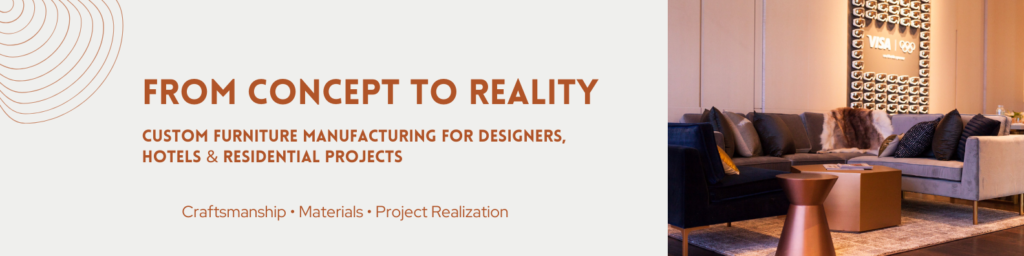
Interi Furniture specializes in custom furniture manufacturing for residential, hospitality, and commercial projects. Their experience in materials, craftsmanship, and project realization makes them a valuable resource for designers and buyers seeking tailored furniture solutions from China.