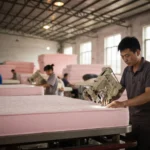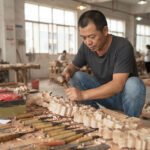


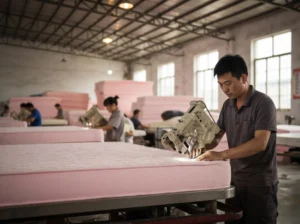

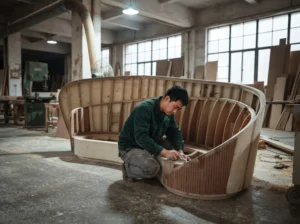
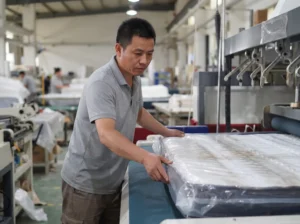





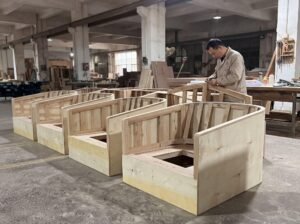

Here’s the thing most buyers don’t realize until it’s too late. Walk into any workshop in Dongguan’s Houjie corridor on a random Tuesday morning. Look left—you’ll see technicians rushing a 500-piece hotel order through spray booths, masks half-on, timers running. Look right—a single senior craftsman is hand-sanding the fifteenth coat of hardwax oil on one dining table, taking his time, no supervisor hovering. Same building. Same company name on the business card. Completely different operations. Understanding which side your project lands on? That’s what separates a successful $50,000 bespoke furniture workflow from an expensive lesson in misplaced trust.
China’s elite manufacturing belts have spent decades quietly producing for European heritage brands, Middle Eastern royal residences, and boutique hotel groups that would never admit their sourcing in public. The luxury custom furniture China ecosystem in 2026 is mature, sophisticated, and—honestly—deliberately opaque. This article unpacks what actually happens between your deposit and delivery. No factory commissions. No product sales. No affiliate links. Just the mechanics the industry prefers to keep invisible.
What “Custom” Actually Means: Three Tiers Hiding in Plain Sight
When a factory says “we do custom,” they usually mean one of three entirely separate operations. And here’s where most buyers trip up—they assume all three are the same thing.
The bottom tier? Configuration custom. Pick your leather color from a swatch book, choose between three leg profiles, maybe adjust the depth by five centimeters. This is retail furniture with a longer lead time. Nothing wrong with it. But it has nothing to do with bespoke furniture manufacturing China as professional buyers understand it.
The middle tier is competent made-to-order. Solid engineering team, decent material stocks, reasonable fidelity to your drawings. You’ll get a good product. What you won’t get? The workshop’s best technician. Their prime material allocation. The QC attention that European luxury brands receive. Your project enters the standard queue—alongside everyone else’s.
The top tier—the one we’re actually dissecting here—is where a premium furniture factory China operation assigns dedicated senior staff, reserves specific kiln-dried timber batches, and schedules finishing time that isn’t squeezed between rush orders. This tier doesn’t advertise. You won’t find it on Alibaba. Access comes through established design professionals, trade references, or project values crossing the factory’s internal threshold. Across Dongguan, Suzhou, and Foshan, that threshold generally sits around $50,000 for a single commission. Below that? Even well-intentioned factories quietly slide your order to their secondary line. They won’t tell you. You’ll only find out when the finish doesn’t match the sample.
Suzhou’s Xiangcheng district has carved out a niche in solid hardwood and hand-carved work that Dongguan shops rarely attempt. Foshan’s Shunde district—historically known for volume—now hosts segmented workshops where master craftspeople handle small-batch luxury orders away from the main production floor. Each belt developed supply chain biases through decades of specialization. Dongguan dominates upholstery and mixed-material complexity. Suzhou owns timber-heavy commissions. Foshan handles stone-and-metal integration that would confuse a timber-focused workshop.
The engineering layer is what truly separates tiers. A legitimate high-end workshop maintains furniture engineers with fifteen-plus years interpreting Italian, French, and Scandinavian technical packs. These aren’t CAD operators clicking through software. They’re problem-solvers who can reverse-engineer a mortise-and-tenon joint from a photograph, calculate load tolerances when you widen a cabinet by forty centimeters, and advise on material substitutions when your specified European veneer becomes unobtainable mid-project. That human database is the invisible infrastructure behind a $50,000 project. You don’t see it on the quote sheet. You notice it when your piece arrives with joints that don’t squeak after six months and veneers that don’t telegraph through the finish after the first winter.
Stage 1: Design Alignment (Weeks 1–3) — The Conversation Most Buyers Get Wrong
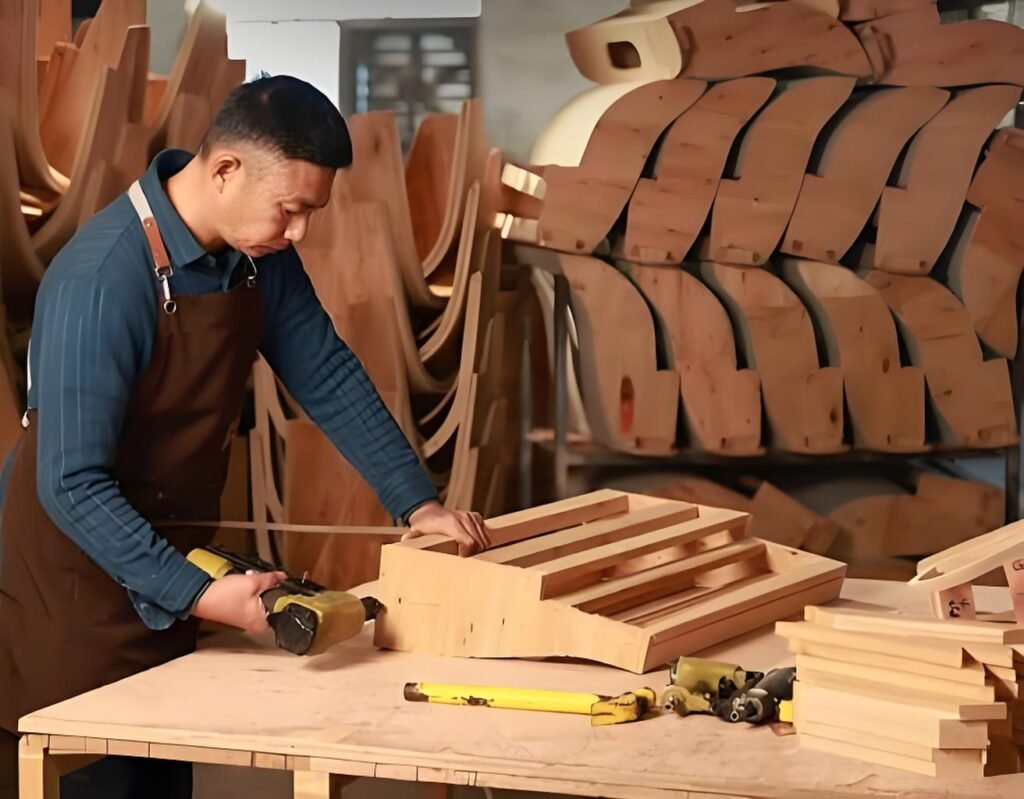
The first mistake? Treating this like ordering from a catalog. (It isn’t.) A serious bespoke furniture workflow doesn’t begin with a sketch. It begins with an interrogation—and if the factory isn’t interrogating you, that’s a red flag, not a green light.
A legitimate partner will push back on your drawings. Hard. They’ll ask about humidity range in your installation environment. Whether the piece sits over underfloor heating. How many centimeters of compression clearance the upholstery needs across a ten-year lifespan. These questions aren’t bureaucratic box-checking—they’re survival mechanisms. A leather sofa built for Dubai’s dry climate will crack within two winters in a heated London apartment if frame expansion and hide conditioning aren’t calculated differently. The factory knows this. The question is: do you?
What emerges from this phase is three documents that most buyers don’t know to demand. First, a confirmed 3D render with exploded joinery views—not for your Instagram, but as the shop floor’s primary reference. Second, a material specification sheet with explicit substitution hierarchies. (When your first-choice Italian marble quarry shuts down for maintenance, what’s the fallback? The factory has an answer. Make sure you know it before production starts.) Third, a production timeline with critical path milestones that actually account for material lead times, not fantasy dates that look good on a proposal.
Here’s an observation from years of watching projects derail. The factory’s engineering team is quietly auditioning you while you audition them. They assess whether your design aligns with their existing competence. Request a continuous waterfall grain match across a six-meter wall panel—a technique they’ve never executed at scale—and they’ll either decline or subcontract that element without necessarily telling you. The coordination risk? Entirely yours to bear. Smart buyers leverage the factory’s proven capabilities and push incrementally. Reckless buyers demand novelty without understanding production physics, then blame the factory when it doesn’t work.
For Personal Home Buyers: Pinterest images alone are worthless. Extract dimensions. Note which materials you’re flexible on. Specify doorway widths, elevator dimensions, and stairwell clearances. The factory won’t assume you understand the difference between semi-aniline and full-grain leather. State your preference explicitly, or accept their default—which, honestly, may be selected for production convenience, not your living room’s aesthetic.
Stage 2: Prototyping (Weeks 4–8) — Why Three Samples Are Non-Negotiable
High-end Chinese custom work follows a disciplined three-sample protocol that factory managers candidly admit is as much about legal protection as quality assurance. (They’ve been burned too. Arbitration isn’t fun for anyone.)
Sample One is the engineering prototype. Built fast, often with substitute materials, intended purely to verify proportions, joinery integrity, and ergonomics. It looks rough. It’s supposed to. Sample Two introduces your specified materials and surface treatments, allowing evaluation of color, texture, and tactile response under realistic conditions. Sample Three is the pre-production master—built from the exact material batch entering the final run. It serves as the immutable quality benchmark. When a dispute arises six months later (and they do), Sample Three is the only document that matters in arbitration. Not your emails. Not your memories. Sample Three.
Budget reality: prototyping consumes 8% to 12% of a $50,000 project. Factories skipping Sample One to “save time” are cutting structural corners. Factories refusing Sample Three? They’re signaling—loudly—that they don’t intend to match the approved standard in production. The three-sample rule isn’t a luxury indulgence. It’s a risk allocation mechanism protecting both parties. Ignore it at your own expense.
Material behavior during prototyping routinely exposes surprises that would be catastrophic at final delivery. We’ve seen walnut veneers from reputable North American suppliers exhibit unexpected color variation when book-matched across large surfaces—something the tannery’s sample card never revealed. Full-grain leather selected from a small swatch can stretch differently during upholstery than anticipated, shifting seam alignment on curved sections by several millimeters. These discoveries at Sample Two are inconvenient. They’re also cheap. Fixing them after a full production run? That’s where projects become litigation.
For Personal Home Buyers: Demand to evaluate Sample Two in your actual space lighting, not under the factory’s fluorescent tubes. Leather and wood shift dramatically under 3000K versus 4000K versus daylight. If travel isn’t feasible, request detailed photographs under all three conditions plus a physical material swatch mail-out. The $200 shipping cost is negligible insurance against a $50,000 aesthetic disaster.
Stage 3: Material Procurement (Weeks 6–10) — The Grading Game Nobody Explains
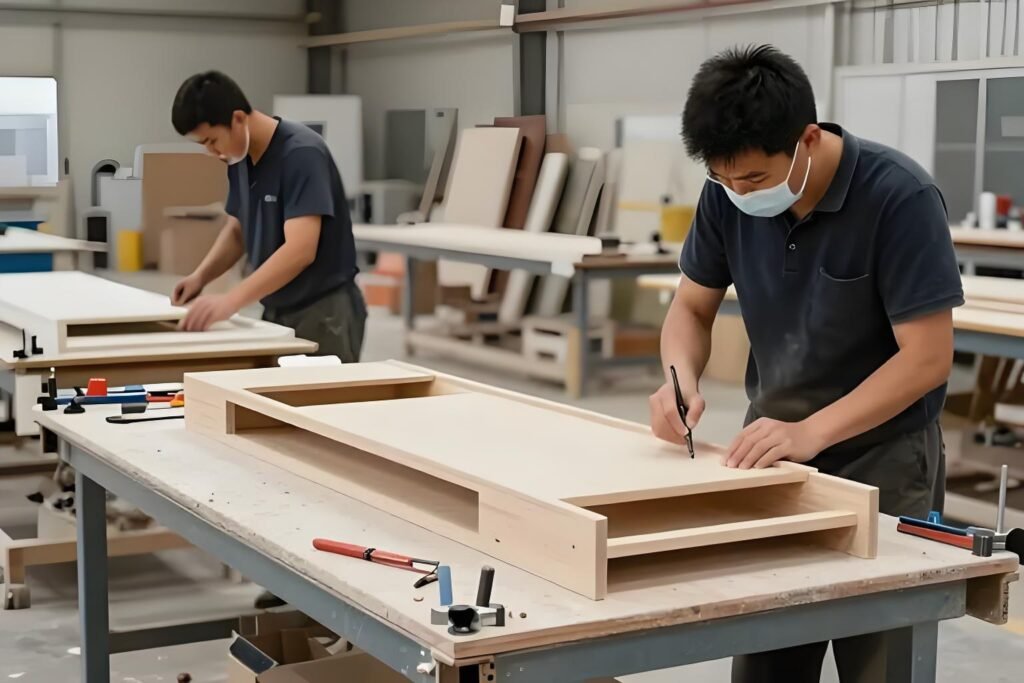
Let’s talk about what “full-grain leather” actually means in a high-end custom furniture cost context. Because here’s what most buyers don’t know: within full-grain classifications, tanneries grade hides by surface defect density, tensile strength consistency, and dye lot uniformity. A Grade I hide suitable for luxury automotive interiors commands a 40% to 60% premium over a Grade III hide from the exact same tannery. Both are “full-grain.” Both meet the specification sheet. They are not the same material. Not even close.
The factory’s procurement team makes these micro-decisions daily. Their default choice depends on your project’s stated budget tier and your demonstrated sophistication—not on an abstract quality standard. When two buyers present similar specifications, the one who explicitly demands Grade I and accepts no substitutions receives prime allocation. The less informed buyer receives the same specification sheet and a lower grade within that specification. This isn’t fraud. It’s standard commercial practice across every manufacturing sector globally. The $50,000 budget, combined with explicit grade requirements, places you in the prime allocation tier. Without that explicit requirement? You’re rolling dice. And the house usually wins.
Wood follows identical logic. “Walnut” is meaningless without origin context. American black walnut behaves differently from European walnut. FAS grade carries different defect tolerances than Select grade. Moisture content at delivery determines whether your piece survives its first heating season. Premium Suzhou workshops maintain direct relationships with specific Pennsylvania sawmills, importing kiln-dried stock at 6% to 8% moisture content—critical for furniture destined for heated European interiors. Substitute air-dried local stock at 12% moisture content, and you’ll see surface checking and joint failure within eighteen months. The specification sheet says “walnut.” The physics don’t care what the sheet says.
Metal hardware is another silent variable. Brass components may be specified as solid cast brass. The factory’s procurement default—if you don’t explicitly challenge it—may be brass-plated zinc alloy. Visually identical at delivery. Structurally divergent after five years of oxidation and load stress. Specify solid brass. Request mill certificates. Budget for the difference. Or don’t, and wonder why your handles are green in 2028.
For Personal Home Buyers: Ask for material origin documentation. Not printed certificates of authenticity—those are trivial to produce—but supplier names and batch numbers that you can cross-reference against the supplier’s known product ranges. If the factory cannot provide this transparency, you are not on their high-end line regardless of what their marketing materials claim.
Stage 4: Production Execution (Weeks 10–16) — The Human Factor
CNC machines handle rough cutting and basic joinery. The rest—veneer matching, hand-rubbed finish application, leather stitching tension, final assembly—is manual work dependent on individual craftspeople whose daily condition, mood, and sleep quality affect output. That isn’t romanticism. It’s production reality. (Anyone who tells you otherwise hasn’t spent time on a factory floor.)
A Dongguan workshop producing luxury custom furniture China for European clients typically assigns one senior technician to a single project from cutting through final inspection. That individual is responsible for grain continuity across matched panels, the consistency of hand-applied oil finishes (twelve to fifteen coats with sanding between each), and the final upholstery tension that determines whether a sofa looks bespoke or merely expensive. If that technician falls ill, takes emergency leave, or departs mid-project, the workshop faces a genuine crisis. There is no digital file, no training manual, that replaces twenty years of hand-eye calibration. We’ve seen factories delay delivery by three weeks because their senior finisher had a family emergency. The delay was expensive. The alternative—rushing the work with a junior replacement—would have been catastrophic.
Finish quality deserves particular attention because buyer preferences often conflict with durability. A factory-grade lacquer finish, sprayed and cured in a single day, produces a surface that photographs beautifully and feels like plastic. The high-end alternative—multiple hand-applied coats of hardwax oil or shellac, cured slowly between applications, finally buffed with steel wool and paste wax—requires three to four weeks of dedicated time. The tactile difference is immediate. The durability difference is measured in decades. Yet many buyers, conditioned by retail furniture aesthetics, actually prefer the sprayed lacquer because it looks more “perfect.” We’ve had clients reject a $50,000 commission because the hand-rubbed oil finish contained subtle grain variations that the client interpreted as defects. Know your own preference before production begins. The factory cannot read your mind.
Joinery methods are the structural signature of genuine bespoke work. Dowel and screw construction is standard for production furniture. Mortise-and-tenon with floating panels, hand-cut dovetails on drawer boxes, breadboard ends on tabletops—these are the markers that separate a bespoke furniture workflow from expensive assembly. They take longer. They require seasoned hardwood that won’t split under hand-tool pressure. They cannot be executed by workers with two years of experience. When evaluating a factory, ask to see joinery samples from a recently completed production project, not from their showroom. Showroom pieces are always built to a higher standard than production goods. This is universal factory practice, not a Chinese quirk.
For Personal Home Buyers: Request a mid-production visit or video walkthrough at approximately 60% completion. Joinery is visible. Finishes haven’t yet concealed construction methods. Legitimate high-end workshops generally welcome this transparency—it demonstrates you’re a serious buyer. Evasive responses suggest you’re not on the premium line they promised.
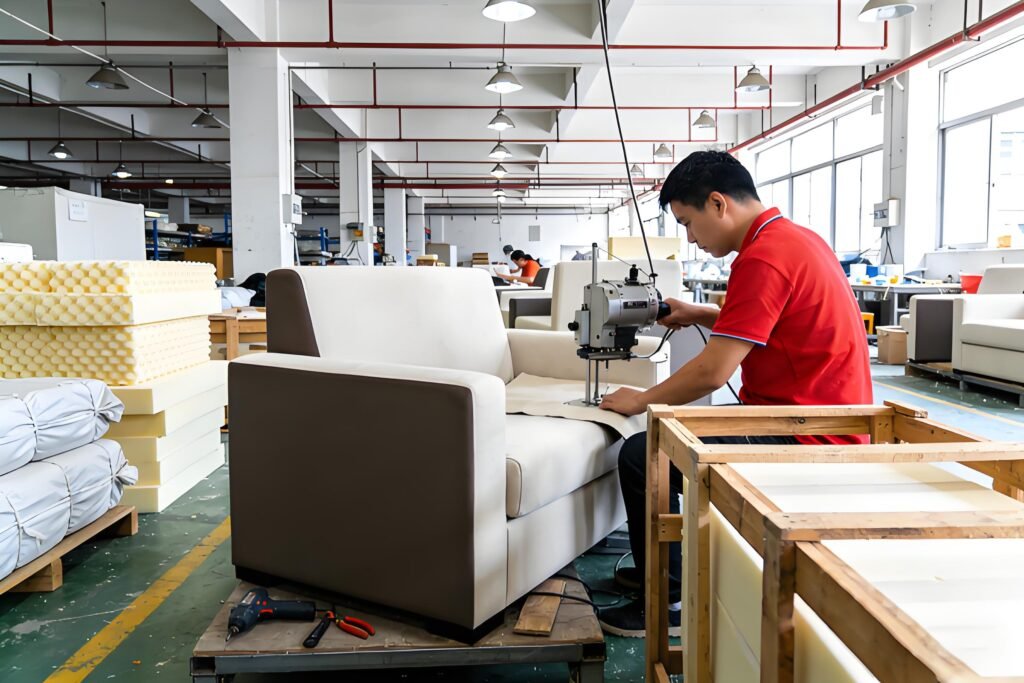
Stage 5: Quality Control (Weeks 16–18) — Three Gates, Not One
Quality control in serious operations is not a single checkpoint. It’s a tiered system with three distinct gates, and the industry secret is that Gate Two is adjustable. (Most buyers never learn this until they’re arguing about a defect.)
Gate One is the workshop foreman’s continuous inspection during production—catching dimensional errors and material defects before they’re buried under finish coats. Gate Two is the factory’s internal QC team, operating independently from production, verifying against the approved Sample Three using a checklist that typically runs 40 to 60 criteria. Gate Three is your pre-shipment inspection, either in-person or through a hired third-party inspector.
Here’s what factories don’t volunteer. Gate Two checklists are flexible. When running at capacity, a workshop may relax tolerances on non-visible surfaces to maintain throughput. When European clients with established penalty clauses have backlog priority, stricter standards apply to those orders. New buyers from less litigious markets may receive looser interpretation without ever knowing the difference. Your $50,000 project, accompanied by a detailed technical pack and clear acceptance protocol, signals that you operate at the same standard as those European clients. That perception—accurate or not—affects which QC tier your goods actually receive.
Common failure points at this stage include color drift between the approved sample and production batch (especially with natural dyes and oil finishes), veneer telegraphing through the finish surface due to insufficient substrate preparation, and upholstery seam alignment errors on curved sections. These aren’t catastrophic defects. They’re deviations from the bespoke standard. A factory that genuinely operates in the high-end tier will rework these issues rather than negotiate. A factory that argues they’re “within normal range” is telling you which tier you’re actually on.
Dimensional verification is critical for built-in pieces. A custom wardrobe designed for a specific alcove must fit within 2mm tolerance. A dining table with leaves must align flush across all configurations. These functional requirements are harder to verify than cosmetic ones, and they’re the most common source of post-delivery disputes. Your acceptance protocol should specify not just visual standards but functional testing procedures—how the leaves are tested, how the drawer slides are loaded, how the door hinges are cycled.
For Personal Home Buyers: Do not rely on factory QC photos. Hire an independent inspector for pre-shipment verification. Single piece: $300–$500. Small project: around $800. This isn’t distrust; it’s standard practice for high end customization projects globally. The inspector’s report becomes your binding acceptance document, protecting both you and the factory from subjective disputes that otherwise devolve into email chains and damaged relationships.
Stage 6: Packaging and Logistics (Weeks 18–20) — Where Expensive Projects Die
The final stage is where more high-value commissions are damaged than in any production error. A $50,000 piece that arrives with a cracked leg because someone used insufficient crate padding is worthless. The craftsmanship is irrelevant if the crate fails.
High-end workshops typically offer three packaging protocols. Standard export crating uses plywood boxes with foam padding—adequate for ocean freight in theory, vulnerable to forklift mishandling in practice. Premium crating adds a suspended inner frame that isolates the furniture from the crate walls, absorbing impact energy before it reaches the piece. White-glove crating, reserved for the highest-value commissions, includes climate-controlled inner wrapping, vapor barrier films, and custom-cut foam profiles for every protruding element. The cost difference between standard and premium is typically 3% to 5% of project value. It’s the cheapest insurance you’ll ever buy.
The FCL versus LCL decision also affects risk in ways buyers underestimate. LCL shipments undergo additional handling at consolidation warehouses, where your carefully crated furniture may be stacked beneath heavy commercial goods that don’t share your fragility standards. For a $50,000 project, FCL is the only rational choice even if the container is half-empty. The additional freight cost is insurance against handling damage that no insurance policy fully covers.
Documentation at this stage is as important as the physical packaging. A complete packing list with photographic evidence of the crated state, a detailed condition report, and a certificate of origin for materials are essential for customs clearance and damage claims. Most buyers focus entirely on production quality and neglect this administrative layer, only to discover its importance when a forklift punctures the crate and they need to prove pre-shipment condition.
For Personal Home Buyers: Get the factory’s packaging specification in writing before production begins. If they specify “standard export crate,” upgrade. For a single high-value piece, consider air freight despite the cost shock. Ocean transit from China to Europe or North America takes 30 to 45 days; air freight reduces this to 5 to 7 days, dramatically reducing exposure to humidity fluctuations, salt air, and handling events.
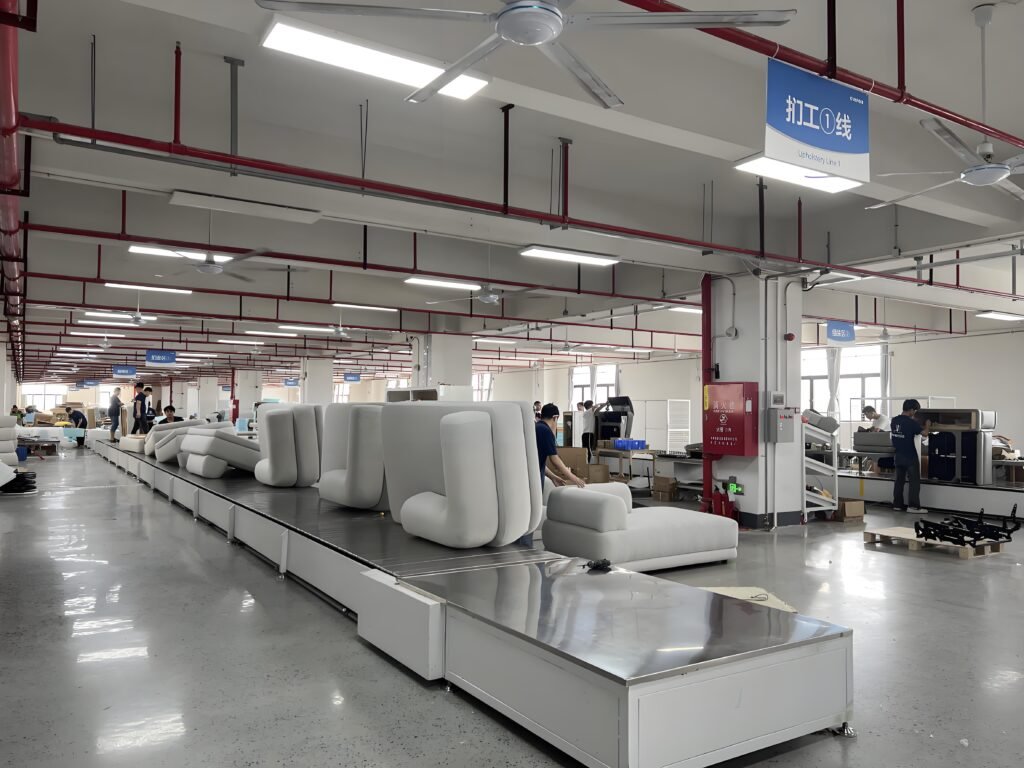
B2B Projects: When $50,000 Becomes $5 Million
For hospitality developers and design studios sourcing bespoke furniture manufacturing China at scale, the per-project workflow principles remain identical, but the risk profile transforms.
Intellectual property protection becomes the primary concern. When a European luxury brand commissions a custom collection, the technical packs, material specifications, and finishing recipes constitute valuable trade secrets. Reputable workshops maintain strict project segregation—dedicated production lines, separate material storage, non-compete clauses for senior technicians. However, enforcement depends heavily on the factory’s relationship with the client. First-time buyers without established contractual leverage should realistically assume that successful designs will inform the factory’s future capabilities, even if direct copying is contractually prohibited. The practical protection isn’t legal; it’s maintaining design evolution that outpaces replication.
Batch consistency across large orders requires a different QC architecture. Sample Three is no longer sufficient; a production control sample from the first batch is maintained and used to verify color, finish, and dimensions across all subsequent batches. Natural materials introduce inherent variation that no factory can eliminate. The control sample establishes the acceptable range. For a 200-room hotel project, this range must be explicitly defined and accepted by the design team before production begins. Otherwise, room 101 and room 201 may be individually perfect but visibly different when a guest walks the corridor.
Project management overhead increases disproportionately with order size. A single $50,000 piece requires minimal coordination. A 500-piece hotel program requires dedicated on-site project management, weekly production reporting, and milestone-based payment structures tied to verified completion, not calendar dates. The factory’s project management capability is as important as its manufacturing capability. Some workshops excel at production but lack the administrative infrastructure to manage complex programs. Others have invested heavily in bilingual coordination teams specifically to attract B2B hospitality clients. Knowing which type you’re dealing with before signing is critical.
For Personal Home Buyers: The Access Problem
Personal buyers entering the luxury custom furniture China market face a challenge that commercial clients rarely encounter: most true high-end workshops don’t actively want your business.
Their model is built on B2B relationships with designers, developers, and brands that provide repeat volume and predictable cash flow. A personal buyer must typically access these workshops through a design professional with an existing relationship, or by demonstrating a project value that meets the workshop’s threshold. The $50,000 figure matters because it represents the approximate point where a workshop will allocate senior staff to a personal commission rather than treating it as a distraction from their core B2B workflow.
Communication style significantly affects treatment. Personal buyers often make emotional decisions—falling in love with a particular wood grain, insisting on color matches to fabric swatches sourced from another continent, requesting design modifications mid-production. High-end workshops are production facilities, not retail stores. They operate on technical specifications, not sentiment. The most successful personal buyers we’ve observed adopt a quasi-professional communication style: precise technical briefs, clear acceptance criteria, disciplined change-order protocols with cost and timeline impacts documented upfront. This approach earns respect from factory management and produces better outcomes than a purely consumer relationship.
Payment structures for personal buyers typically carry more front-loaded risk than B2B arrangements. While a hotel developer might negotiate 30% deposit / 70% against bill of lading, a first-time personal buyer may face 50% deposit / 50% before shipment. This isn’t predatory; it’s risk management from a factory that has no established relationship to rely on. Mitigation options include working through an established sourcing agent who carries the factory relationship, or structuring payments against verified production milestones rather than arbitrary calendar dates.
Delivery logistics for personal buyers present additional complexity that hotels never face. A hotel has receiving staff, installation teams, and temporary storage. Your residence may have narrow staircases, restricted elevator dimensions, and no place to store a 3-meter sofa while you figure out how to get it through the front door. These constraints must be communicated during the design phase, not discovered at delivery. A sofa that cannot fit through the doorway is a $50,000 lesson in dimensional planning that no amount of craftsmanship can fix.
The Risks Nobody Lists on the Brochure
No honest assessment of high-end custom furniture cost dynamics can ignore the risks that experienced buyers learn to manage.
Timeline inflation is the most predictable. A quoted 16-week timeline assumes ideal material availability, no sample revisions, and zero production disruptions. In practice, 20 to 24 weeks is more realistic. Buyers who plan around the optimistic timeline face stress and rushed decisions. Buyers who plan around the realistic timeline face manageable delays. The difference is preparation, not factory competence.
The “same factory, different line” phenomenon catches buyers who trust brand names over verification. A workshop producing flawless goods for a European heritage brand may allocate your project to a secondary line staffed by less experienced workers. Same facility. Same company name. Different people, protocols, and outcomes. This is why factory visits and mid-production verification are non-negotiable for high-value projects. A showroom visit tells you almost nothing about the line that will actually build your furniture.
Material substitution under pressure is another silent risk. If your specified Italian marble slab becomes unavailable due to quarry maintenance, the factory may substitute a visually similar alternative without explicit approval, assuming you won’t notice. The defense is a material approval protocol: no substitutions without written consent, with photographic evidence of the proposed alternative and a signed acknowledgment of any aesthetic or performance differences.
Finally, the emotional risk: bespoke furniture is not perfect. Hand-rubbed oil finishes contain subtle variations that read as character to some buyers and as defects to others. Natural leather develops patina that some cherish and others regret. The bespoke process produces unique pieces with human marks, not identical factory products. Understanding this before commissioning prevents the disappointment that arises from mismatched expectations.

FAQ: What Buyers Actually Ask
How long does bespoke furniture take in China?
A properly managed $50,000-level project typically requires 14 to 20 weeks from design confirmation to delivery, plus 4 to 6 weeks for ocean freight. Rush timelines below 12 weeks almost always compromise material procurement or finishing quality. This is a general industry standard for high-end custom work; specific timelines vary by project complexity and factory capacity.
What is the real difference between a $20,000 and a $50,000 custom piece?
The gap is not primarily in materials, though material grades improve. The real difference is labor allocation: senior technician time, hand-finishing hours, and QC attention. A $50,000 project receives dedicated senior oversight; a $20,000 project enters the standard production queue. The visual difference may be subtle at delivery; the durability and refinement difference emerges over years of use.
Can I visit the factory during production?
Yes, and you should. Legitimate high-end workshops welcome buyer visits at the prototyping and mid-production stages. Evasive responses suggest either that you are not on the premium line, or that the workshop lacks the premium line it claims to have. Schedule visits by appointment; unannounced arrivals disrupt production and rarely produce useful insights.
How do I protect my custom design from being copied?
Complete protection is unrealistic. Design patents offer limited enforcement across borders. The practical approach is to work with workshops that have established reputations to protect, to avoid sending fully resolved production-ready files to unknown factories, and to maintain design evolution that keeps your offerings ahead of any replication. For commercial clients, contractual NNN agreements (non-disclosure, non-use, non-circumvention) provide baseline protection, but enforcement remains challenging.
Is the $50,000 price point better value than buying European-made?
For equivalent material and construction standards, a $50,000 Chinese bespoke piece typically delivers 60% to 70% of the equivalent European price. The value proposition is strongest in categories where Chinese workshops have deep expertise: mixed-material upholstery, complex veneer work, and solid timber construction. It is less pronounced in categories requiring proprietary European hardware systems or specific regulatory certifications unavailable in China.
What should I budget beyond the factory price?
Add 15% to 20% for shipping, insurance, customs duties, and destination handling. Add 5% to 10% for a third-party inspector. Add 3% to 8% for a sourcing agent if you are not working directly. A $50,000 factory price becomes a $65,000 to $75,000 landed cost. Planning for this total prevents budget stress at the delivery stage.
Final Word
China’s high-end custom furniture sector has earned its place in the global luxury supply chain not through marketing, but through decades of quiet execution for the world’s most demanding clients. A $50,000 bespoke furniture workflow in Dongguan, Suzhou, or Foshan can produce results that rival European ateliers at a significant cost advantage—but only when the buyer understands the process, respects the complexity, and engages with the rigor that high-end manufacturing demands.
The factories will not tell you about the three-sample rule, the material grading arbitrage, or the QC tier system. They will not explain that your project was quietly moved to a secondary line, or that the “full-grain” leather was a mid-tier selection within that category. That is precisely why Furniture Discover exists: to tell you what the industry won’t.
If you are considering a high-end custom project in China, treat it as a professional procurement exercise, not a retail purchase. The difference in outcome will justify every hour of preparation.
Recommended Resource
Interi Furniture specializes in custom furniture manufacturing for residential, hospitality, and commercial projects. Their experience in materials, craftsmanship, and project realization makes them a valuable resource for designers and buyers seeking tailored furniture solutions from China.